Wednesday, 26 June 2013

Monreale 1: mosaics


Dresden's baroque treasures are still glinting in my mind's eye, clamouring for the attention they'll eventually get, but Palermo and surroundings haven't been dislodged since our March visit. To whit, I've just finished reading  John Dickie's Cosa Nostra, which places the city unequivocally at the centre of 150 years' mafia hell recently brought to light. So much for the legend that what turns out to be a precisely rooted secret society, a kind of horrifying shadow state with murder as its main tenet, has been part of the Sicilian mentality for time immemorial.

Dickie - that rare bird*, a scholar capable of writing an impeccably researched book that reads like a series of high-level thrillers - mixes savage indignation with celebration of the heroic men and women who laid down their lives in the hope of a better future, among whom Borsellino and Falcone stand only as the most conspicuous because the most recent.


In every one of the western Sicilian territories there have always been these brave souls, including courageous priests to counter the corrupt ones. Don Gaetano Millunzi of Monreale is merely listed in one of Dickie's remember-this roll calls, but he helps redress the balance of mafioso skullduggery in that town so discrete from Palermo, and yet so inextricably linked with it.

Monreale's greatest glory was born of rivalry at the highest level. Building on the old establishment of a modest bishopric away from Arab-invaded Palermo before the Norman conquest of 1072, King William II created Monreale's supremacy in a power struggle with the English Bishop Walter of Palermo, his former teacher and would-be master.

Walter 'of the mill' (Offamilias) was still having Palermo's cathedral built when William quickly outstripped it with the duomo of a new monastery in his Monreale hunting grounds, finished by the time of the  young king's death in 1189. Without, it's far less remarkable than Palermo Cathedral. What make it one of the wonders of the world are both the mosaics - similar to those in the Cappella Palatina of WII's grandfather Roger II, but on a larger scale if less refined - and, above all, the no-two-the-same capitals on the 216 marble columns in the massive cloister. Since those truly are unique, they'll get an entry on their own in due course.

What stunned about the interior on our arrival at around 4pm was that the sun was blazing in through the west window, passing straight through the nave to ligh up the eastern apse with its colossal half-length figure of Christ.


Below the giant figure (13 metres across and seven metres high, if you want to know) are the Virgin and Child, flanked by saints and angels.


Just like the cycle in the Cappella Palatina, the Old Testament narrative in the nave runs first in one strip along the top of the south and north walls, from the seven days of creation to Noah receiving the command to build the ark, and then below in the same sequence, from the construction of the ark to Jacob wrestling with the angel. Thus close to the twin beginnings on the south wall,


a detail of Noah building the ark,


part of the north nave wall


and a segment with Adam, Eve, serpent, God and fig-leaf shame above, angel preventing Abraham's sacrifice of Isaac and Rebecca offering Isaac water below.


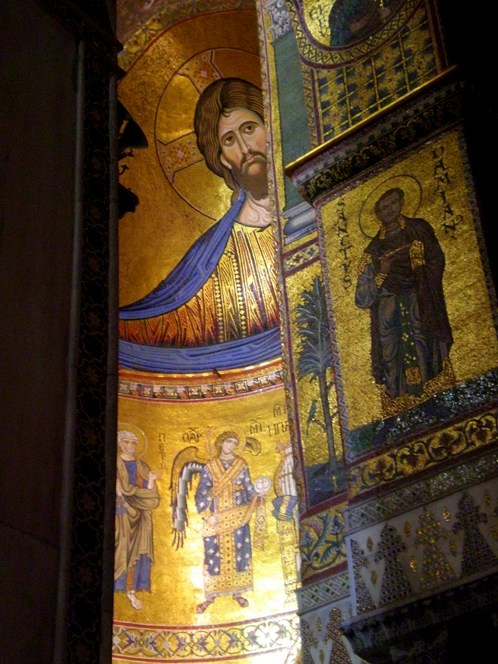
and that's only a fraction of the nave's riches; scenes from the New Testament up to Mary Magdalene's washing of Christ's feet similarly enrich the outer arcades. There's even the first known representation of St Thomas à Becket, murdered at the command of William II's father-in-law Henry II of England. The two side apses are mosaic-ed to the respective glories of Peter and Paul; here's one final glimpse of Christ from Peter's side.

But clearly I should have bought at the time a lavishly illustrated, reasonably scholarly volume on the mosaics I found in a bookshop in Palermo; I briefly tracked it down on the internet back home and lost it before I decided to splash out. Anyway, this marks the tenth of 12 'chapters' on the year's Sicilian experience and I am duty bound to see it all through eventually (unlike the Bach cantatas project which, some of you will have noticed, lapsed dismally as soon as we started spending Sundays away. Next year, I promise).

By the time we came to catch our bus back to Palermo, the whole of Monreale was out for a Saturday evening promenade, just like in any Italian town. It seemed so impossible to believe in a population cowed. Nor elsewhere - except, perhaps, for the smashed-up hotel in the Madonie mountains - did we catch a glimpse of mafia consequences. Only in a good way, perhaps, in the results springing from the numerous stickers applied by Addiopizzo, a Palermo organisation fierce in gathering together to refuse to pay the pizzo or mafia 'tax'/protection money. The text reads (if my translation is correct): 'an entire people which pays the pizzo is a people without dignity'.


Many shops now bravely sport the Addiopizzo insignia.


If you have anything to say, do leave a message of support on the website linked to above. And bear in mind the splendid couplet quoted in Dickie's superlative study, written about the lethal Don Calò of Villalba who 'rebirthed' the dormant Cosa Nostra at the end of the Second World War. It might just as well apply to Berlusconi, whose supposed connections with Italy's secret society may yet come to light: 'Cui avi dinari e amicizia, teni 'nculu la giustizia' - 'He who has friends and cash, can take justice up the ass'. Fortunately there's quite a movement in the new Italy, for all its seeming chaos and systematized corruption, which is trying to make sure that doesn't happen. Though it looks as if Berlusconi will never serve his prison sentences.


While I'm on my high-horse campaign to set the world to rights, finally, can I urge you to sign in solidarity with magnificent teenager Malala Yousafzai, about whom I hope I don't need to tell you, in her tireless fight for worldwide children's education? A woolly-liberal old friend of mine, when I sent the petition out to a select few, said 'but I don't know that we in the west should be interfering in other cultures'.

Goddamn it, does a girl have to be nearly killed for wanting the noblest thing in the world? Does one third of the world's married women have to suffer abuse within their relationships, as a recent survey pointed out? Such shame has nothing to do with a truly evolving Islam. Away with false scruples and parallel universes/centuries on the planet we share, please. And it's so easy to offer your name at the click of a button.


LATER: one big wrong in the world righted, 83 year old Edie Windsor and the late Thea Spyer vindicated. Susan Scheid broke it, to me at any rate, giving  the pith of the judge's summing-up before I could check the news. One extraordinary aspect I hadn't realiased was that Clinton introduced the iniquitous DOMA (Defence of Marriage Act - to which I would add, with no idea whether it's been written a thousand times already, there's dumb and then there's DOMA)  now quashed. But I'd rather celebrate with this picture history of a 'great American love story'. Now got to get the above DVD from Bless Bless Productions.

*no wordlink was consciously intended between 'Dickie' and 'bird' when I wrote that.

Sunday, 23 June 2013

The importance of composing comedy


Great comic opera, that is. Let's say it with carnation flinging and shout it through megaphones: the filleted-Wilde, stylised anarchy that is Gerald Barry's The Importance of Being Earnest has to be the best work of musical theatre since MacMillan's The Sacrifice. At times it's tear-jerkingly funny, always contradictory and unexpected (in the first of Stephen Cummiskey's production photos above, that's Miss Prism on the left as played by Hilary Summers, not Lady Bracknell, who's the pin striped gentleman in the ensemble).

Lucky those who were present at the already historic Barbican concert performance last year. As was my hard-to-please Arts Desk colleague Igor, who wrote a dazzling review of it but was less impressed by the first UK staging in the Royal Opera's Linbury Theatre. I couldn't fault it as a production. We got into the final performance yesterday evening only at the last minute, when nice Emily Benson in Kasper Holten's office found a couple of tickets to buy (the show was sold out the minute booking opened). And was it worth it.

As the best chamber opera, surely, since Britten's The Turn of the Screw, Barry's Earnest could not be better placed than it was in the Linbury, on Ben Clark's stage of shallow steps with the superlative Britten Sinfonia's ensemble of 22 players, flawless under Tim Murray, taking up half the space and the singing-actors, along with minimal props including a plate-rack and vases of white flowers, the rest.


Since the music goes against the grain of Wilde's crisp if subversive Victoriana, scattergunning a perceived subtext of rage, director Ramin Gray underlined the absurdity with an everyday contemporary look going increasingly awry - but not, dramatically speaking, out of control or overegged. Lady Bracknell was taken for granted as a megalomaniac businessman, the lovers ordinary young people - until they opened their mouths. Franz Peter David's quick-change lighting was a stripped-down version of the wonders Mimi Jordan Sherin is simultaneously achieving in the main house's Gloriana - what a parallel universe - and Christina Cunningham's costume colour scheme clashed deliciously.

Barry's style is now unmistakeable: the text is pattered out, sometimes robotically, on regular beats while the wind- and brass-dominated ensemble burps and shrieks between the words. The fury beneath what's said or sung is blatantly exposed. I first realised Barry's genius, having been totally baffled by his first opera The Intelligence Park at the Almeida, when English National Opera got Richard Jones to stage The Bitter Tears of Petra von Kant: now there was a Prelude to grab you by the scruff of the neck.

The abrasive style could quickly become wearing and/or enervating. But Barry is a master of scenic contrast. Lady Bracknell and Jack repeat some of their lines to a G&S jig-duet; there are two hilarious non-Beethovenesque settings of Schiller's Ode to Joy for bass and contralto in first and second acts respectively (if the Ninth Symphony has been re-ordered therein, I couldn't make it out); and many of the orchestral interludes grab the imagination. Horns buzz like monster-mutant flies or bees in between the Act Two pastoral and there's a refrain punctuating one-note declamation which for some odd reason reminded me of Strauss in Ariadne mode, very memorable. The four-note refrain in the introduction to Act Three is unforgettable, and the players' vocal participations a delight.


Hysterical highlight, though, is a Cecily v Gwendolen bitchfest as funny as in the Australian two-hander Wilde production I saw in the Barbican's Pit, where drag Gwendolen was a bunny-boiler from the start. Timed declamation through megaphones is punctuated by the ear-splitting smash-up of plates by percussionist Helen Edordu (above with Stephanie Marshall's Gwendolen), complemented by mallet, welly boots, buzzer, pistol shots and wind-machine: the wildest operatic percussion tour de force since the mould-breaking chase in Shostakovich's The Nose.


The vocal writing is of an insanely wide compass. The two singers who coped with it most flawlessly were the dazzling high/coloratura soprano Ida Falk Winland (above) and tenor Paul Curievici, more impactful lovers than the perfectly good Marshall and the OK Benedict Nelson (below,  Curievici with Marshall).


Alan Ewing's Bracknell and Hilary Summers's Prism, consummate actors both, had a bit more trouble with the upper reaches; but then Barry probably wants the sense of strain. Anyhow, the musically irreproachable ensemble work's the thing. Though, sadly, the Linbury performances are now over, this opera will run and run. Must get hold of the full score and can't wait for the NMC release of the Barbican concert recording, scheduled for release later this year. On a more pressing note, finally, don't forget the livescreening to cinemas around the world of the Royal Opera Gloriana tomorrow. There's a link which should eventually get you to venues at the foot of my Arts Desk review.

28/8  Trying to track down the plate-smashing duet for Sue Scheid, I found various short clips in amongst interesting talking heads, but perhaps the most intriguing snippet is here with Gerald Barry demonstrating alongside Thomas Adès. Stephen Fry seems fixated on the play in this five-minute precis of a 28 minute conversation and hasn't seen the opera, but he does come up with the treasurable image of Barry's applying a machete to a soufflé.

Friday, 21 June 2013

Birthplace of the rose-bearer


Strictly speaking, it should have been to salute Wagner's Dresden era in his anniversary year that I returned to the Semperoper (pictured above) after 23 years; I last saw Joachim Herz's so-so production of The Love for Three Oranges here, and still have one of the foam oranges chucked at the audience to prove it. That was a bonus to a recording-session visit for Gramophone; the occasion was Haitink's EMI recording of Der Rosenkavalier in the Lukaskirche, with Kiri te Kanawa and Anne Sofie von Otter (the highlight for me was getting to talk to the Staatskapelle Dresden's then first horn, Peter Damm, whose Kempe recording of the Strauss concertos I'd long adored). Subject for another entry must be the transformation of this once-beleaguered city that's taken place in the interim.

My Strauss Leibsoper - or is that Ariadne auf Naxos or Intermezzo or Daphne, I can't decide - had its first performance here in 1911, and this time we had a chance to catch it at home. Below, Robert Sterl's painting of Ernst von Schuch conducting at the opening run.


The prompt was our good friend Peter Rose, giving his latest showing of the role which has truly become his own, Baron Ochs; but he'd have to have paid my air fare and hotel to see him, say, with Simone Young conducting - as she so often seems to be, and I'm truly sorry not to think more highly of one of the few maestras on the scene - or a less than diamond cast. But the Marschallin was the glorious Anne Schwanewilms, her Octavian Elina Garanča (whom I also saw in Vienna years ago when Peter should also have been singing, but had to pull out). Thielemann was conducting, too, and he knows the score inside out.

So what could go wrong? Well, truth to tell, not enough to matter to the essentials, but all-round perfection, alas, it was not. By no means the biggest drawback was that the sets had got stuck in the floods and for some reason I didn't understand never made it even for the second performance. Elbe waters were still high after the heroic salvation of the city the previous week by sandbagging Dresdeners, but all else seemed back to normal and the locals were breathing huge sighs of relief by drinking and/or picnicking on the riverbanks during two perfect summer evenings.


I don't think we missed a great deal, having seen Uwe Eric Laufenberg's underanimated production WITH the sets on DVD; the 1950s costumes are the thing, and everyone wears them with style. Only occasionally was the perfunctory back wall, globe lamps above and shabby doors beneath, a liability. In the first act it helped throw the action forward, giving three fine singer-actors space to operate and impress. Photographer Klaus Gigga's images for the Semperoper often capture that superbly.


Garanča is such a hyper-feminine mezzo that she seemed more in her element as 'Mariandel' than Octavian, though always singing with that unique and connected upper-range fullness that makes her one of the world's top opera stars (and, for me, THE best Carmen). Peter has enlarged his repertoire of grins and tricks, making Ochs a more than usually lovable country cousin in his rustic get-up while singing the parlando with incredible elegance and beauty of tone when the opportunity arose. He told us he'd added some business with the naughty pugs in the levee scene mainly for our benefit, and sure enough I laughed so loud that the dowdy Dresden bourgeoisie around us cast disapproving looks. Below: cutting short the Italian tenor (Bryan Hymel, not visible here but excellent, though having to be followed by the orchestral players rather than following them) with 'Als Morgengabe!'


I complimented Peter first on the apparent rapport with Thielemann, but he told me they'd got by on just one rehearsal. Can you imagine? The conductor's one of the very best, but collegiality would not seem to be a forte; he barely acknowledges his singers offstage and sometimes trips them up with the marvellous but seemingly capricious flexibility for which he's famous (this information not from Peter, by the way, who got the thumbs up from the pit on more than one occasion). It's standard for continental repertory opera - not so the EXTRA rehearsal with the orchestra alone - but contrasts markedly with the Glyndebourne Ariadne, for which Jurowski was present from the first at the seven week of rehearsals.

Schwanewilms, anyway, was beyond sublime in the Marschallin's Monologue - phrases so delicately inflected that you strained to catch them - drawing an audience in is always a much greater art than reaching out - and such pointing of the German text that I never expect to hear it bettered. She certainly brought on the heartbreak and the tears in her changed-mood misalliance with her uncomprehending Quinquin.


Well, what can I say? Wanderer (see previous blog entry; and see now - 22/6 - his own take on the evening, capturing far more eloquently than mine the essence of heavenly Anne, which I should have highlighted more) and I couldn't stop blubbing in the interval. It's singing-acting on a level very few achieve. And throughout the interval we had the balmy Dresden evening to enhance the bittersweetness,  not to mention the astonishing view across the Theatrerplatz to Augustus the Fat's Hofkirche - an unpopular Catholic riposte to the citizens' Frauenkirche, about which more anon - the Residenzschloss and the Hausmann Tower, a great ensemble complemented by the Zwinger Palace out of sight to the right.


The location gave as much to gawp at as the crowds (though I have to say I've never encountered a more frigid audience, which seemed more local than international. They did, it's true, give a standing ovation at the end).


Oh, we were so anticipating the Presentation of the Rose, but from the minute the Sophie opened her mouth I knew we had a liability on our hands. Ungainly of phrase, lacking charm in sound and appearance, useful only for her top notes, Daniela Fally was not on the level of her colleagues. And frankly, you do need a bit of scenic glitz - even if it's nouveau-riche Faninal bling - for the famous Hofmannsthal-concocted ritual. At least the splendid Irmgard Vilsmaier, whose Hänsel Mother had made such an impact at Glyndebourne and who is also a Brünnhilde as you could tell, made some amends as a full-voiced Marianne Leitmetzerin (pictured on the right here).


Bit parts were a mixed blessing. Apparently Thielemann had sacked some of the house singers on a single hearing, putting the Dresden admin in a funk to find international replacements double-quick. For every plus there was a minus: vivacious Helene Schneiderman as a stylish Annina was let down by her unfunny, self-conducting Valzacchi (no name needed). The Faninal (also nnn) was a cipher; the Police Commissar in Act Three, house bass Peter Lobert, more than stood up to Peter vocally and demonstrated how threatening this usually saggy bit of the drama could be if it were moved back from Laufenberg's setting to the 1940s. Excellent pint-sized tavern owner from Dan Karlström; the footmen at the end of Act 1 the usual gabbled mess. The extras in the Lerchenau retinue wambled around grotesquely and without discipline.

But the main thing is that without a sympathetic Sophie, in effect the Marschallin's younger self who escapes the older woman's fate of a loveless arranged marriage, you do miss the senior soprano for an act and a half. Her comeback in Act Three was, naturally, highly emotional, and Peter made the most of Ochs's dashed hopes in that fascinating disentanglement before his waltz-exit: his 'mit dieser Stund' vorbei' gave the final threesome's entanglement a run for its money.


Trio? To be fair, Fally sang well enough and was even rather touching as a forlorn schoolgirl standing apart; Schwanewilms crowned it with hyper-pathos and Garanca provided lustre, though I inwardly groaned when she missed a big phrase - Thielemann-anxiety, perhaps? - and the magic took a while to return. Again, I just don't think this sort of thing would happen given Glyndebourne or even Covent Garden preparation time. You have to hand it to these international singers, exposing their reputations to an audience who knows nothing of the rollercoaster circumstances. Although Thielemann still gets results, and no-one does late-romantic rubato quite as easily as he does, the collegial way is surely better.

Anyway, we filed out with hearts tugged at, though not so much as in Act One, and wafted past the 19th century homages to Roman grottesco style in the foyers


down the stairs to the bust of Wagner (I wanted to find another to Strauss, but the attendants denied knowledge of one),


out into the fragrant Dresden summer night


and on to a meal with Peter and co. Our Dresden experience had only just begun - I have much more to write about the bewildering treasures we saw the next day - but our reason for being there was already fully vindicated.

In the meantime, my very long eulogy on Richard Jones's Royal Opera staging of Britten's Gloriana yesterday evening - a well-nigh perfect entertainment from first to last - is  up on The Arts Desk. Shame I didn't make it to Aldeburgh for an against-the-odds amazing Peter Grimes beach show on Monday, but a migraine peaked at just the wrong time, and it was a fair old trek to north London for the press bus - shudder - and back in the wee small hours.

Tuesday, 18 June 2013

Strindberg in Friedrichshagen


Since I went to see and write about Dances of Death, Howard Brenton's Strindberg adaptation at the Gate Theatre Notting Hill, the peculiar Swedish master - self-photographed above circa 1892* - has been popping up in various contexts. The first was musical, which I'll relate as a listenable footnote. The second was to find that he'd once, very briefly, stayed in a house virtually at the bottom of the garden owned and so beautifully tended by our Berlin-based friend and soprano extraordinaire Debbie along with husband Derek whom we've yet to meet (he was off working on the Ring in Milan).


Friedrichshagen, founded as its name suggests by Frederick the Great in 1753 to encourage cotton spinners from Silesia and Bohemia by giving them five-window houses with plots of land and planting lots of mulberry trees, was merged into Berlin in 1920, but still feels like a place apart, surrounded by woods and water. That's especially the case when you reach the end of Bölschestrasse (named after natural history writer Wilhelm Bölsche, central figure of the 'Friedrichshagener Dichterkreis'), take a left turn by what was once Berlin's biggest private brewery and the Müggelsee, Berlin's biggest lake in and out of which flows the River Spree, lies before you.


As I can think of few things more delicious than lake bathing, I was determined to take a dip in the Müggelsee on the evening of the most delightful birthday I can remember. The mosquitos had to be braved, but there was no problem about freezing water; the temperature, once in, turned out to be just right. The below shot's just about distant enough to pass muster for public consumption. You will note that I am not in the buff, as was the wont of Rudolf Steiner, another distinguished Friedrichshagen resident who arrived there in 1897 and walked around the lake starkers. The Germans still think nothing of it.


Strindberg came here in the autumn of 1892, taking the S-Bahn just as we did from Friedrichstrasse (in our case after a disappointing Berlin Philharmonic/Rattle performance of Britten's War Requiem, which was after all only an optional extra in the little holiday shared between Berlin and Dresden). The old, 'zerissene Berlin' map which hangs above the sofa in Debbie and Derek's biggest room shows you how far out Friedrichshagen was, and is, from the centre. It's defined here by its nearest neighbour, the similarly left-wing, free-spirited Köpenick where residents put up such a brave and, of course, fatal resistance to Hitler.


Strindberg lodged with fellow-writers Ola Hansson and his German-Baltic wife Laura Marholm at 2 Lindenallée. 'My boldest hopes exceeded here!' he wrote home, noting 'a little more air under my wings now I have a bigger fatherland than frightful Sweden'. Berlin lionized him and his plays, but personal relationships were as fragile as ever: after six weeks, surprise, surprise, he fell out with the Hanssons and moved on, holding court at an ordinary pub he called 'Zum schwarzen Ferkel' ('At the Black Porker'). The home at Lindenallée, however, handsomely restored after the fall of the wall, is the only Strindberg residence in Berlin to have survived the bombings of the Second World War, so this plaque is to be treasured.


I'm indebted for much of the above information, incidentally, to a book full of the most beautifully reproduced images - was there ever a more  photographed turn-of-the-century artist than Strindberg? - given to us by Swedish friend Carl Otto, The Worlds of August Strindberg. The pictures of productions at the Intimate Theatre in the early 1900s are especially startling, and the text is full of salacious new details.


At our household on Fürstenwalder Damm, all was exceptionally natural and harmonious. How could it not be, spending most of the birthday as we did in the garden surrounded by peonies


irises


and Johnson's Blue geraniums in full bee-adored midsummer glory.


Here's a shot towards the house, a massive project bought for a song - and as much for the garden as anything - which can be a little spooky when you're living on floors between ghosts. Very forbidding from the main road, but not at all from the haven at the back. And so much light, too.


Table decorations newly gathered for the day, my only duty, were a necessity


and then our guests arrived: the famous Wanderer (strictly speaking lower-case 'w'), Australian blog-ally and now very real friend along with partner Kim, who had ferried us to Dresden and back, and in whose company we spent three very happy days, and Debbie's UNESCO friend Annie. I have some lovely portrait shots, but they'd be out of place here, so let's make do with a distant shot from the stairwell of the big house:


Sustenance was simple** but of the essence and absolutely fresh: white asparagus, potatoes, salad from the garden, later strawberries, cherries and cakes from one of no less than three quality bakers on the main street. The Oz-men departed for their dose of War Requiem - their later verdict was much the same as mine the previous evening - and our dear Orfeuo, who has just started work in Berlin, arrived in time for our evening jaunt around the Müggelsee.


Bliss. Even the few mosquito bites I'm trying not to scratch are pleasant souvenirs. And now, back to Strindberg's married bloodsuckers and their favourite music, though it hardly suggests more than a little genteel barbarity. We have a vivid report from the director of the Intimate Theatre, August Falck, of Strindberg acting out the role of the Captain in The Dance of Death (to give its original title):

What he particularly liked to act  was the powerful scene when Alice [the wife in the nearly 30 year old central relationship], with a bored expression, plays the march 'The Dance of the Boyars' [sic] which incites and hypnotises the Captain [her husband] to dance - wildly and clumsily, terrifyingly. At such moments he was an excellent actor - a great dramatic talent. His vivid impersonation remains for ever in my mind's eye and echoes in my ear.

I found this in the Michael Meyer biography only a day after I'd been working on notes for an EMI 13-CD box of performances by the late, great Paavo Berglund. And I'd been especially struck by a work I'd never heard before, Norwegian composer Johan Halvorsen's Entry March of the Boyars. Inspired by a visit to Romania, Halvorsen's encore-worthy number was also arranged for piano by Grieg.

This is the piece to which Falck refers. Strindberg felt it was integral to any production, though the fact that there's no music at all in the Gate Dances of Death, only handclapping and footstomping, is perhaps even more effective. Berglund's performance isn't on YouTube, but the below one from Iceland will do. Entry March of the Boyars is halfway to being Wild Rumpus music for Where the Wild Things Are - though nothing will replace the favourite I play alongside readings to infants, the Dance of Chuzhbog and the Seven Monsters from Prokofiev's Scythian Suite.


*very proto-Expressionistic, isn't it? But then little about Berlin in the 1920s, the era seized on for the image of Weimar decadence, wasn't happening in the 1890s. Strindberg visited a gay dance bar and wrote about it with extreme distaste (probably because he was a bit of a closet case).

**somewhat indignantly, J reminds me that this was his first attempt at making a far from simple Hollandaise sauce for the asparagus, so under the cosh I add - albeit sincerely - that it was delicious.

Tuesday, 11 June 2013

Elizabeth and Britten


Seven Monday afternoons on Britten's Gloriana were much longer than I'd anticipated for our Opera in Focus chunk at the City Lit.  It's the only major Britten opera other than Owen Wingrave and the three church parables which I hadn't previously examined in detail - Paul Bunyan should go in to that list too, I reckon, since it's a great work we looked at a fair bit in passing - and it comes as no surprise to have found his coronation opera the unmistakeable work of a genius, professional throughout and sometimes inspired.

Richard Jones is coming to talk to us about his production at the Royal Opera, already seen in Hamburg; I love the logo above which promises us much about our own queen's coronation, as well as heaps of cod (and I hope real) Tudory. Strange but true: Jones was born one day before the world premiere on 8 June 1953. Boy, does he have his work cut out, though, given one of the most unforgettable productions of recent years. Not English National Opera's, which introduced so many of us to the opera.


Sarah Walker is magnificent, and has plenty of amplitude for the heroic-sopranoid nodal points, but she's marooned in a frigid Colin Graham production.


Phyllida Lloyd's selective cinematic adaptation of her Opera North production, on the other hand, turns out to be up there with Bergman's Magic Flute as one of the two best opera films I've seen. Chief reason being the camera's unrelenting focus on the kind of performance which, as Tom Randle says in interview, comes along ever 100 years: Dame Jo Barstow IS Elizabeth, just as Callas WAS Tosca, and Gheorghiu, at least close to the start of her career, WAS Violetta. I saw the production when it came to Covent Garden and was impressed, but nowhere near as much as now.


The voice is never beautiful, and more grating than it was on the superlative Mackerras recording* - what a Best of British, from late, much lamented Langridge down to Terfel's Cuffe and Janice Watson's Lady in Waiting - but that's not the point. Yes, this is the very definition of Great Singing Actress, up there with Anja Silja in Janacek.

OK, so you lose the Norwich masque with the mixed blessing of the choral dances, the love duet/conspiracy scene by the Thames and nearly all of the odd rebellion-in-London fiasco, but of those I can only truly regret the absence of the brilliantly concise interplay between Mountjoy, Penelope Rich and the Essexes.


I said yesterday that I was reluctant to use the overworked word 'iconic' with regard to Barstow's queen, but as student Jane pointed out, an icon was what Elizabeth and her advisers set out to create, and what a legacy of portraits we have as a result. My favourite is the dress with eyes and mouths at Hatfield House, which fits with the time of the Essex crisis (1600-1).


The point of the drama, of course, is that we see behind the projected image as the fault-line between duty and feelings swallows up the once-proud Elizabeth. I'd select as great cinema the mask-like image Barstow projects when the Queen, as really happened, encountered a muddy Essex, straight from Irish failure, in her bedchamber without her wig. And there are no ends to the depths Barstow and Lloyd plumb in the final scene; this is a face which can convey several emotions at once.

Lloyd's handling of the last rites is worthy of a scenario which at last joins hands with Billy Budd before it and The Turn of the Screw shortly after (Gloriana as Vere anguishing over the death-sentence, and later as the Governess bringing back the key tune - 'Malo' there, the Second Lute Song here). I wasn't convinced by the backstage layer of the film at first, but it pays off in the later scenes, and above all at the end. Get the DVD, watch it over and over again.


Of course, without the great Lytton Strachey's sometimes hilarious, often poetic Freudian study Elizabeth and Essex, Britten might not have gone so deep in Elizabeth's second encounter with Essex, a tense and dark counterpoint to the first; both are among his greatest operatic scenes. Strachey reasonably points out that much of Elizabeth's trouble may have stemmed from the fact that 'when she was two years and eight months old, her father cut off her mother's head.' Is it surprising if she developed a Turandot complex as a result?


At any rate the conflict of her 'ambiguous nature' with the impetuous, ambitious one of Essex (pictured above by the fabulous Hilliard), her habit when faced with his outbursts of 'relenting as unpleasantly [and as tantalisingly slowly] as possible', could only end in disaster, goading him, as one courtier put it, 'from sorrow and repentance to rage and rebellion'. Further enlightenment comes from Anna Whitelock's pithy new Elizabeth's Bedfellows, with its keen selection of flavoursome quotations. I've read the last five chapters; now I need to go back to the beginning.


Britten the musical dramatist captures the power-play as nakedly as his selective use of the orchestra could possibly allow, and to be fair William Plomer's libretto often goes straght to the nub of the matter. Every prelude to every scene is a masterpiece of orchestral colour, reprised to the action on curtain-up. I just wonder if he had to be quite so rigid with his alternation of public and private; after all, the former intrudes into the latter by steady degrees, and vice versa in the superb ball scene, so that maybe we could, as Lloyd in fact does in her film, do without the progress and rebellion scenes. But let's see how Jones handles them.

*I was there in Swansea's Brangwyn Hall in October 1992 to report on the sessions for Gramophone. I remember a wonderful time with Mackerras, though the casually homophobic jokes during playbacks were a bit off-colour, a reminder of why 'Charlie' became one of Ben and Peter's 'corpses'. Alas, I can only find the first page of the session report among my archives, and Gramophone's online resources are now hidden behind a paywall.

Friday, 7 June 2013

Postwar demons


Warnings of extreme sado-masochism inclined me to think I wouldn't be much interested in the film of  The Piano Teacher, nor in the Elfriede Jelinek novel on which it is based. I now know better about Michael Haneke through The White Ribbon and Amour, of course, and I've only just discovered the truth about the genius of Nobel prizewinner Jelinek.

I was browsing in the unusual little bookshop - I forget its name, but it shares office space with the local monthly magazine of quality - up a side-alley off Lewes High Street*. This shop, unlike the others, nearly always has a book I really want to read, and of course there was the volume of Poulenc's letters ten quid cheaper than I'd paid for it at Travis and Emery. But for some reason I was encouraged to take a sample of Jelinek's style in Wonderful, Wonderful Times, and realised that was the book for me. The gentleman- seller told me it was his daughter's copy; she'd been very low at the time of buying it, and of course soon came to realise that the title meant anything but feelgood.


Die Ausgesperrten (literally The Shut-Out Ones; wouldn't The Dispossessed do?), as its original title has it, soon sucks you into its topsy-turvy world. Advertised as a Clockwork Orange for 1950s Vienna - I can't say as I haven't read Burgess's book nor seen the film either, though it used to be shown regularly at a Kings Cross cinema - its ensemble of characters is a quartet of disaffected teenagers, each of them affected at one remove by their dysfunctional or abusive parents' experiences in the Second World War. There's something of the Dostoyevskyan Napoleon complex about their desire to commit naughty deeds in a bad, bad world. Which they do, sporadically, until the terrible denouement.


More important than any plot line is how you get to know and, for the most part, to sympathise with these wounded as much as wounding young people. And this is the key - Jelinek's unique style, which I'm guessing has been brilliantly rendered into English by translator Michael Hulse. I've never read anything approaching her often ironic authorial omniscience, which sometimes dissects but more often affects to understand her human puppets' motives. And then, just when you truly begin to feel for at least two of the characters, real tragedy strikes. But read it for yourself.

It ought, of course, to be a film, too, though I can't imagine how Haneke's Piano Teacher found an equivalent for the novelistic point of view; now I want to see it. Very close to the spirit of Wonderful, Wonderful Times is Lars von Trier's The Idiots: another sometimes alienating masterpiece which has a truly beating heart. Given that, anything terrible in a book or a film can be borne. Now I've got other Jelinek novels lined up to read. but given that I've also just discovered her equally brilliant fellow Austrian Thomas Bernhard - more on him when I've properly grasped the nettle - a fine balancing act between the two lies ahead.


I'm less convinced by leading Czech author Jáchym Topol's The Devil's Workshop (originally Chladnou zemí, Through a Cold Land). The idea is a very original one: how the need to memorialise sites which saw atrocities in the Second World War can be turned on its head to produce grotesque theme parks. The first half of the book, dealing with the protagonist's postwar upbringing in the fast-fading town of Terezín, is utterly compelling. The second, about which all I'll say is that it takes place in the horrible country of Belarus, is less convincing in its fantasy dystopia. But since it's a short book, I'd say it's well worth your time.


A real-life story of enfants terribles after the war is a strand in the last chapter of Michael Haas's Forbidden Music: The Jewish Composers Banned by the Nazis (nb the subliminal 'Hitler sells' black-and-red coloured jackets for both this and The Devil's Workshop). The devilish dead hand of Schoenbergian followers in sweep-away-the-bad-traditions Darmstadt - though, as Poulenc always pointed out, Boulez was a cut above - had a lot to answer for, especially in the world of musical academia, and I grew up feeling its effects.


Anyway, you can hear a trio of thumbs-up on this one when Tom Service quizzes Prof John Deathridge and myself on Radio 3 Music Matters a week this Saturday. I should add that it's in the can already, so I'd better keep stumm on the rest**. Again, a book everyone should read, and in this case certainly not just music-lovers. And what fun it was to be back again in the BBC's old-new Broadcasting House again, and swish past the odd media star, a day before Madge cut the red ribbon to declare the building officially reborn.

*It also doubles as a lending library, which makes it especially charming. 
**17/6 Listened to the broadcast on return from Deutschland - the discussion can be found somewhere towards the end of this 'chapter'. I take my hat off to the editing, and reason that perhaps the world doesn't need to know of my desire to hear Hans Gál's comic opera The Sacred Duck (Die heilige Ente).