Saturday, 23 December 2017

Seasonal sugar plums in Leipzig


A serendipitous double: on Wednesday evening I caught the legendary Leipzig Gewandhausorchester giving a nuanced performance of Tchaikovsky's heavenly Nutcracker score to lively choreography (ballet photos by Ida Zenna - featured below, Madoka Ishikawa as Clara, Francisco Baños Diaz as Drosselmeyer and David Iglesias Gonzalez as the Prince)


and then the following morning there was a full performance of Humperdinck's Hänsel und Gretel (premiered, incidentally, only a year later than The Nutcracker, 1893, just down the road in Weimar, conducted by Richard Strauss). While the ballet crowd was of all ages, including lots of young adults, this one consisted mainly of children (opera photos by Kirsten Nijhof).


The cast I caught included the perfect Gretel, Olena Tokar, regrettably not pictured, whom many may remember in the 2013 final of the Cardiff Singer of the World competition. I only just missed by a week her Rusalka in Leipzig. Here's why she would probably be incomparable in that role, too.


I was in Leipzig to see the Blüthner Piano Factory in operation, a unique opportunity to witness perfectionists in the art of pianomaking; I'll be writing about that on The Arts Desk. But of course I was equally excited to follow Bach from the font at Eisenach to the grave in Leipzig's Thomaskirche, for the choir of which, of course, he wrote all of his great choral masterpieces. More on that anon; in the meanwhile here's an Arts Desk feature on how to listen to Bach cantatas throughout the year, with a photo of Bach's statue outside the Thomaskirche at the top.


Anyway, it was clear from Tchaikovsky's Miniature Overture that this Nutcracker would be an interpretation, under Tobias Engeli, the like of which I've only once experienced in the theatre when Svetlanov conducting a run of the long-serving Peter Wright version at the Royal Opera House. The orchestral sound in the most recent theatre on the site, begun in 1956 and inaugurated in 1960, is so warm and immediate, with every timbre of the exquisite cor anglais and clarinet solos beautifully captured. For much of Act One Jean-Philippe Dury's choreography follows familiar lines. It's matched by elegant sets from Yoko Sayama that achieve all the necessary transformations with state-of-the-art effects as well as flats which fly up and down nimbly and costumes by Aleksandr Noshpal serving up a handsome contemporary bourgeois party (Drosselmeyer stands apart).


There's one interpolation - the opening and middle sequences of the delightful 'Marche Miniature' from Tchaikovsky's First Orchestral Suite as a variation for the quirky Fritz (Alessandro Repellini - I assumed the tap-dancer who makes a novelty addition to the Waltz of the Flowers was supposed to be Fritz too, but apparently not).


In both acts' narrative scenes the mice appear prematurely - pictured above, Kiyonobu Negishi's Mouse King and Flavia Krolla as Young Clara - but their battle with female as well as male soldiers is very well choreographed, and the first Pas de Deux for Clara-as-young-woman (Ishikawa) and her Prince (Iglesias Gonzalez) has plenty of novel spinnings to the second transformation scene. The snowflakes sequence has good visual effects, too.


On stage, it all goes a bit half-cock in Act Two. There's a lot in the programme from Dury about Clara's passage to womanhood, but whatever's intended, some of the character dances don't 'read' - least of all the three stomping, punkish folk doing a weird routine to the Mirlitons number (Mother Gigogne, as usual, is nowhere to be found - I love that musical number and always miss it). It's always difficult to thread some kind of narrative through the divertissement; Matthew Bourne's fun Adventures version is best for that - I see from the early days of the blog that I last saw it a decade ago - this one doesn't really try. Some of the costuming shows a penchant for bondage gear, too, though I liked the men's floral waistcoats in the ensemble waltz, even if the women had rather lopsided rose-tits.


The Leipzig corps de ballet is good and hard-working, though one of the six Arabian Dance men did threaten to sabotage the symmetry. The Pas de Deux becomes a Pas de Trois for Drosselmeyer, Clara and Prince, with the Sugar-Plum Fairy (Anna Jo) and her cavalier (Yan Leiva, hat on sideways, doing a Bob Fosse shuffle in the Tarantella) getting the variations. Still, the celesta player (Alden Gatt) was as fine an artist as many of the wind players.


The league of nations in any ballet company always intrigues me, and of course makes for photo-enlivenment of the foyer spaces. What a brilliant idea for Leipzig Opera and Ballet to promote its ensembles through pairs of contrasting photos by Andreas Pohlmann, updated every season. These were complemented on Thursday morning by first the rucksacks and then the interval snacking of the kids there for Hansel.


I have to say my expectation that the noise levels would abate during the actual performance, as they so impressively did at Glyndebourne-on-Tour's schools Falstaff, wasn't realised, but there were many younger kids here too. Quite a bit of the Overture was lost in the loud, long applause for curtain-up, even if it was only on a shooting star. And the restlessness crescendoed across Sandman, Evening Prayer and Angel Pantomime (why the whale? Because Gretel's main comforter is a toy one).


Still, it was a luxury to have Leipzig Opera Generalmusikdirektor Ulf Schirmer conducting. There were some frissony horns and lower-string activity; what a varied miracle Humperdinck's score is, always knowing when to slim down from the full Wagnerian works to the simple. Olena Tokar's little mushroom-Lied was so exquisite, likewise her morning wake-up call. She does some mean dance routines, too, which made me laugh aloud. The other standout among the voices was baritone Julius Orlishausen, and it was good to have a tenor in drag as the batt-y witch, Dan Karlström (though this morning I've been listening to Christa Ludwig on the peerless Staatskapelle Dresden/Colin Davis recording, perfect throughout).


The opera company as a whole seems in very good health. Among its regulars in the photo-parade, especially impressive in the parterre foyer on the first floor,


I recognised Faroese bass Runi Brattaberg, Hagen in the Budapest Ring and very good company at the aftershow gathering (on the right here),


and Wallis Giunta, at the top below and marked out as a star in the making in Opera North's Trouble in Tahiti.


She's Leipzig's resident Cenerentola.


On the way out, I found Tokar between handsome dancers (Yan Leiva and Francisco Baños Diaz, with fellow singer Gal James to the left)


and left the Opera House ahead of lines of departing kids.


And so, with an hour to catch my 14.15 train, I wandered back through town and snatched a quick bowl of excellent soup Zum Arabischen Coffe [sic] Baum, which I had to see


because Schumann's gang gathered here and even have their places marked - here, Schumann and Mendelssohn next to each other


while other musical giants line the walls.


Shame about the piped quartet music, but the place seemed to be inhabited by regulars. Bit difficult to tell, though, if the other diners might not have been German tourists here to visit the justly celebrated Christmas market, which fills the centre of town, radiating outwards from the Markt. More on that, too, in a future entry. Meanwhile,

Thursday, 14 December 2017

Bergman in fashion


Mighty Ingmar, that is, the centenary of whose birth we celebrate next year, not wonderful Ingrid, though I'll give her a repeat look-in at the end here. The above image of one of Bergman's greatest leading ladies, Eva Dahlbeck, in Smiles of a Summer Night, was used in a colour ad to make me slaver at the prospect of Bergman à la mode at the Hallwyl Museum (Hallwylska museet).To be honest, I wasn't so sure about the mode bit, but anything about the master while I was in Stockholm for the HK Gruber festival at the Konserthuset had to be embraced.

The actuality, curated by set and costume designer Anna Bergman and Nils Harning, teacher of Costume/Props at Stockholm University of the Arts, exceeded my wildest dreams, even if the setting, No. 4 Hamngatan close to Dramaten, the National Theatre, is a fascinating but oppressive monument to often dubious bourgeois taste. It was built for Walther and Wilhelmina von Hallwyl between 1893 and 1898 to designs by Isak Gustaf Clason. The exterior is a fanciful combination of Venetian Late Gothic and Early Spanish Renaissance.


Admission to the main rooms on the first floor - I suppose one should say piano nobile - has been free ever since the Museum, bequeathed by the Hallwyls to the nation on condition that the rooms stayed the same, opened to the public in 1938. Should you begrudge paying 80 SEK for the bulk of the exhibition in the smaller, mostly unfurnished rooms on the second floor - and you'll see further down how that would be a false economy - you may still coo at the very first room you see, shrine to the Ekdahl family Christmas, if you love Fanny and Alexander anything like as much as I do (it's still my No. 1 favourite film). By the way, these are all my photos, with permission; the catalogue doesn't have pictures of the exhibition displays, and it's all in Swedish, otherwise I'd have bought it.


There are the maids' costumes, the one worn by Pernilla August (then Östergren) as the vivacious Maj in the centre; there, too, are the gowns for the ladies of the family (the one for Gunn Wållgren's Helena Ekdahl on the right, and for Mona Malm's Alma Ekdahl in the centre).


There, too, next to an Oscar, are Alexander's sailor suit and his teddy.


J actually met the original, Bertil Guve, at a Bergman Centenary launch in London which, regrettably, I didn't make. Very friendly chap, apparently, now an engineer, there with his real-life sister.Testified to Bergman's infinite kindness and consideration on and off set.

The table is laid as for that sumptuous Christmas.


The taste of the Hallwyls, though, is rather more fustily eclectic; as a distinguished actor, presumably with connections in the artistic world, Bergman's Helena favoured something more along the clean, bright lines of the Thielska Galleriet out near the farthermost tip of the Djurgården island, still my favourite building in Stockholm alongside the art deco Konserthuset. The big showoffy room in the Hallwylska has opulent tapestries, an impressive marble relief of Abraham and Isaac above a for-show-only fireplace


and a Steinway model C delivered in 1896. Doughty Wilhelmina wanted more than just the plain pearwood look, so she commissioned Clason to make a 'Baroque' parquetry case. Restored in 1990, the piano is in fine working order, they tell me.


The exhibition has two costumes from that vulgar mess Now About These Women, one of the few Bergman films I can't stand (because, unlike Smiles, it's not funny. I don't like The Silence either, but I don't dispute its finer points).


As for the paintings in the Hallwyl collection, there are few that show much imagination other than the portrait tucked away in the corner of Walter's smoking room.


Collections of pipes, porcelain and other fripperies didn't do it for me, but at least there are a few more objects of Bergmania scattered around the other piano nobile rooms, like this costume (there's jewellery too) from the austerely masterful The Virgin Spring,


and a model of Bergman's maternal grandmother's home in Uppsala as recreated for the Bille August-directed The Best Intentions.


Costumes from that are in the first room of the exhibition's paying part upstairs


alongside some of Bergman's own working clothes (men do get a look-in from time to time). Of course I love the jacket matched to angel wings,


echoing the treasurable photo of Bergman wearing those from the nativity scene of Fanny and Alexander.


Outside in the hallway there's jewellery worn by Ewa Fröling as Emilie Ekdahl, the mother of Fanny and Alexander.


The generous placard tells us that it symbolises security for the children - the only time Emilie doesn't wear it is when she goes to live with the 'bad father' Bishop - and quotes Fröling: 'I remember when I first saw the "dog-collar"...A piece of jewellery joined together by older pieces. Extremely beautiful'. There's more jewellery, the engagement brooch worn by Bergman's mother (on whom Emilie was partly modelled), placed together with a letter below the striking photo of the parents, not quite easy - just, in fact, as played by Samuel Fröler and Pernilla August in The Best Intentions.


Now we head to the heart of the earlier masterpieces - and, in the case of the black and white films there's the fascination of seeing the actual colours we had to imagine. Thus the dress worn by Bibi Andersson as the old professor's youthful crush in Wild Strawberries


and here's striking colour to match the flamboyance of Desiree Armfeldt, the captivating heart of Smiles of a Summer Night as unforgettably played by Eva Dahlbeck.


The room also has two other costumes. As the helpfully translated panels have it, the dress designer Mago - born Max Goldstein, fleeing to Sweden from Berlin 1938 - found 'a creative outlet for his weakness for 1950s silhouettes, where slender waists, ample breasts and shapely hips dominated. As a type of "master of glamour," Mago turned the film's turn of the century into 1950s couture'. As a result Margot Carlqvist's Countess Charlotte 'is draped in duchess and chiffon with an asymmetrical cut'.


To balance, there's the provocative innocence of Ulla Jacobsson's Anne Egerman (cf Sondheim's 'You must meet my wife').


Dahlbeck's red dress is first glimpsed from a very different room.


This is a little masterpiece of exhibition design - a red room with a white dress, Ingrid Thulin's in Cries and Whispers. It mirrors, of course, the essential design concept of that harrowing work of genius.


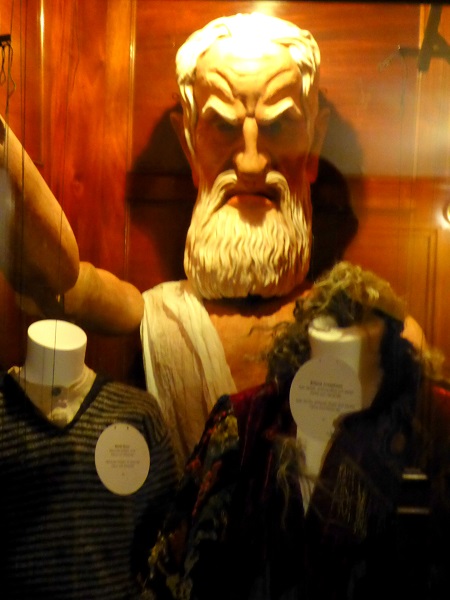
Creepiness rules in the corridor, as two alcoves give us the clown costume from Sawdust and Tinsel - telling us that Bergman was terrified of clowns, and that he thought white clowns 'mean' - and the God-puppet from Isak's shop of wonders, the 'fourth dimension' of Fanny and Alexander.


Pure enchantment, to the strains of the Christmas-tree decoration music in Tchaikovsky's The Nutcracker, opened up in the recreation of the children's room upstairs at grandmother Ekdahl's in the same film.


And there, at the very centre, is the toy theatre with which Alexander is seen playing at the start of the film.


One sumptuous male costume gets a look-in - the kaftan of the caddish actor-seducer played by Hasse Ekman in Sawdust and Tinsel.


Opposite are two more gowns for Gunn Wållgren's Helena - I love that touching photo. Wållgren knew she was dying from cancer when she made the film, which surely gives her superb, still sensuous performance an extra pathos.


Death stalks the next room.


The deepest resonance in the film for me was when Alexander's father is dying and the boy, taken into the room, hides under the bed. It wasn't quite like that, visiting my dad on the last night of his life in hospital - in fact it was a lot worse - but I did identify with him. So I wasn't unflattered when two Swedish ladies told me, unprompted, I was Alexander. Fortunately I didn't exercise any powers on my stepfather, whom I was old enough to tolerate. Anyway, here's another nice composition - the boy's funeral suit, and a photo of young Ingmar similarly attired.


In an excellent final flourish, the corridor back to the staircase has a fine selection of Bergman's boyhood drawings.


No surprise that he already saw himself as a filmmaker at an early age.


Even this little collection would have been worth the price of admission. As it turned out, the whole exhibition was a thing of amazement to me. Oh, and just to give Ingrid Bergman a look-in - we must watch The Visit again some time soon - I take the liberty of repeating one of my all-time favourite magazine covers as symmetry to the Dahlbeck picture at the top.


Sunday, 10 December 2017

Spitalfields' non-Christmas festival


A great idea, in principle: invite in a radical and respected curator, André de Ridder, whose conducting of Prokofiev's The Gambler at Grange Park impressed me so much on a first visit there, and whose adventures in contemporary music have been consistent ever since; combine the old and the new in most programmes; make each event an epic. And, of course, avoid the usual Christmas fare of previous years. Of the opening three-parter, I could only make the first third, in itself a generous hour-and-a-half, before dashing off to the Royal Opera's Cav and Pag. That put an Arts Desk review out of bounds, so I report belatedly on what I witnessed last Saturday here on the blog.

The launch of the Spitalfields Music Festival 2017 (all images here by Robin Savage for the Festival) was in every detail worthy of respect, but a little crepuscular (as a punter said in the Music Discount Centre when I worked there many moons ago, of music from Wagner's Ring arranged for the eight Bayreuth horns). Two of the three works receiving UK or world premieres were minimal to the point of dematerialising: perfect for a late-night concert in the summer, when the body is relaxed enough to go into meditative mood, less so for lugubrious Shoreditch Church 9as immortalised in the wonderful Rev.) on the gloomiest of December days. Much as I love Anna Thorvaldsdóttir's haunting orchestral pieces, Shades of Silence hardy feels like more than a tentative improvisation (it was composed for the Icelandic period-instrument contemporary group I heard in Tallinn Music Days 2016, and so it fitted David Bates and players of La Nuova Musica well).


Much more effective, as I'd have been able to judge more fully had I been sitting comfortably and not with a crick in my neck, was Jocelyn Campbell's THEFT, a very subtle meditation on fragments of Monteverdi madrigals. Beautifully maintained on the cusp of silence by violinist Maya Kaddish and viola da gamba player Gavin Kibble (pictured above), it was true to the composer's definition (Thorvaldsdóttir's title was advertisement enough, too): 'I want the pieces to feel somewhat vacant, still containing much of the beauty of Monteverdi's writing but with none of the sense of progression, and heard somewhat faintly as if from a distance and with elements of soft disruption'.


Dynamic at last, by way of much-needed contrast, was Josephine Stephenson's Between the war and you, a song cycle the words of which were not always audible, nor the tones consistently projected, from The Hermes Experiment's soprano Héloïse Werner. The quartet's admirable aim to commission work for the rare combination of voice, clarinet, double bass and harp (all four musicians pictured above) remains impressive, though, and harpist Anne Denholm wove consistent magic.


The framing madrigals both astounded me (through the course of the evening there were five scheduled, all from the radical Book Eight - I was sorry to miss Ben Johnson in Il Combattimento). I confess I've never heard 'Or che'Ciel e la terra e'l Vento tace' live before - wonderful text, spellbinding start, queasy harmonies. Radical indeed. This is up there with the weirdest of Gesualdo, and all in the cause of creating a mini piece of music theatre. Even more so 'Lamento della Ninfa', with Katherine Manley (pictured above with three musicians from La Nuova Musica) realising the full force of the girl's heart-tugging plaint. Excellent work, too, from The Erebus Ensemble, a group of singers for once as fair of face as voice. Men only, of course, alongside Manley in 'Or che'Ciel'.


Wish I could go on the Schumann ramble around Spitalfields' Huguenot houses tonight - Dichterliebe distributed and, it seems, in some cases reworked; the great Uri Caine is among the range of performers. But since Sakari Oramo's unsurpassable Independence Centenary Sibelius has left me on a high, and Salonen did a wonderful job on the colour in the Four Lemminkäinen Legends the next evening, I have to go tonight to hear what the first as conductor makes of the second as composer. And, I know it's the obvious choice, but I only just watched Oramo's Last Night of the Proms performance of Finlandia, with choir (though it's the revised standard, otherwise, rather than the original with its hair-raising apotheosis, which we heard on Wednesday). Gave me goosebumps and brought a tear to the eye. So good to see so many of my pals in the BBCSO in close-up, too.


UPDATE (13/12): Helen Wallace has done the honours for the Spitalfields Festival on The Arts Desk, catching the final special event, Schumann Street, and making me wish I could have gone. I don't regret what I did plump for - Oramo and the BBC Symphony Orchestra making a brilliant success of four works by Salonen at the end of the Barbican 'Total Immersion' day.

Wednesday, 6 December 2017

The greatest nature writing


I thought Robert MacFarlane was good - he is, if often a bit self-conscious in style - only to find Roger Deakin even better. Henry David Thoreau's Walden. Or, Life in the Woods is an in-the-beginning must for environmentalists and nature lovers, its very bumptiousness part of its charm (and it has the most poetic prose chapter on spring, to end the book, that I think I've ever read). But soaring highest of all, at least of what I've now read, is J(ohn) A(lec) Baker, page after page of whose 1967 classic The Peregrine offers lyrical writing of an order I've never encountered at the same visionary pitch. At the same time this is a study with its feet firmly planted on rough soil, with an acute awareness - shared by Steinbeck in Cannery Row's description of the tide-pool - about the destructiveness and ferocity of nature in Baker's stated intention to 'make plain the bloodiness of killing'.


Baker lived all of his too-short life (he died in  1987 at the age of 61) in Chelmsford, Essex. As anyone who has walked rural portions, and especially estuaries, of that much-maligned county, there is as much natural wonder to be found here as anywhere, though you need to search it out. Baker's stamping ground was, as Mark Cocker writes in his introduction to the Collins edition of The Peregrine and The Hill of Summer, 'a roughly rectangular Essex patch of just 550km, which includes the Chelmer Valley from the eastern edge of Chelmsford as far west as Maldon and the confluence of the Chelmer and Blackwater Rivers', and the author wrote that 'before it is too late, I have tried to...convey the wonder of...a land to me as profuse and glorious as Africa'.


As Thoreau more bullishly puts it, and more about the inner than the near-to-hand:

What does Africa, - what does the West stand for? Is not our own interior white on the chart? black though it may prove, like the coast, when discovered. Is it the source of the Nile, or the Niger, or the Mississippi, or a North-West Passage around this continent, that we would find? Are these the problems which most concern mankind? ...Be the Mungo Park, the Lewis and Clarke and Frobisher, of your own streams and oceans; explore your own higher latitudes...Nay, be a Columbus to whole new continents and worlds within you, opening new channels, not of trade, but of though. Every man is the lord of a realm beside which the earthly empire of the Czar is but a petty state, a hummock left by the ice. Yet some can be patriotic who have no self-respect, and sacrifice the greater to the less. They love the soil which makes their graves, but have no sympathy with the spirit which may still animate their clay.

But I'm letting Thoreau steer me, in his splendidly digressive way, off course. Baker's own introduction states how 'in my diary of a single winter, I have tried to preserve a unity, binding together the bird, the watcher, and the place that holds them both' - which he does by occasionally showing us how the watcher identifies with the bird.


But the first person is sparely used, never over-indulgent as it is in Thoreau, and the prose manages to be both rich and spare at the same time. Descriptions of the peregrine's soaring and then his stoops, those giddying plunges at speed, intoxicate the reader as they clearly did Baker. Daily descriptions of the scene have a physical force, partly through the Shakespearean use of vivid verb, some of them created or made intransitive, as here, all of which I recognise:

The sky peeled white in the north-west gale, leaving the eye no refuge from the sun's cold glare. Distance was blown away, and every tree and church and farm came closer, scoured of its skin of haze...New horizons stood up bleached and stark, plucked out by the cold talons of the gale...An iridescence of ducks' heads smouldered in foaming blue water...

In a freezing January, one of the coldest, and having killed a half-dead, bleeding woodpigeon, the writer records:

A day of blood; of sun, snow and blood. Blood-red! What a useless adjective that is. Nothing is as beautifully, richly red as flowing blood on snow. It is strange that the eye can love what mind and body hate.


The kill itself is brutal - here a soaring and a stoop, both thrillingly described in the previous paragraph, end in the final action:

And for the partridge there was the sun suddenly shut out, the foul flailing blackness spreading wings above, the roar ceasing, the blazing knives driving in, the terrible white face descending - hooked and masked and horned and staring-eyed. And then the back-breaking agony beginning, and snow scattering from scuffling feet, and snow filling the bill's wide silence scream, till the merciful needle of the hawk's beak notched in the straining neck and jerked the shuddering life away.

And for the watcher, sheltered for centuries from such hunger and such rage, such agony and such fear, there is the memory of that sabring fall from the sky, and the vicarious joy of the guiltless hunter who kills only through his familiar, and wills him to be fed.


Then there's this, of a close encounter with a tiercel perched on a post five yards away:

He looked round as I stopped, and we both went rigid with the shock of surprise. Light drained away, and the hawk was a dark shape against white sky. His sunken, owl-like head looked dazed and stupid as it turned and bobbed and jerked about. He was dazzled by this sudden confrontation with the devil. The dark moustachial lobes were livid and bristling on the pale Siberian face peering from thick furs. The large bill opened and closed in a silent hiss of alarm, puffing out breath into the cold air. Hesitant, incredulous, outraged, he just squatted on his post and gasped, Then the splintered fragments of his mind sprang together, and he flew very fast and softly away, rolling and twisting from side to side in steepling banks and curves as though avoiding gunshot. 

Three pages later there's a no less compelling passage about a meeting with a tawny owl in a wood just before sunset. Other birds appear and are noted, though unfortunately many of them are the peregrine's prey, seen either before the attack or as kill to tell Baker where his main object has been. Their vocalisings are vividly captured - 'the squelching call of snipe', the scolding of blackbirds' alarms, robins' song 'clear as spring water'.


But I realise that I could go on excerpting passages for a lot longer, glorying in the language as I take pleasure in typing it out and hoping something will rub off. Just read it. And re-read. I'll go even further than my title by declaring that it's a towering masterpiece by any literary standards and has gone on to my all-time-favourites list. I'm saving The Hill of Summer for a time closer to what it describes, though I realise it is probably even better to savour the opposite of what one's going through. Which, these past few days, has felt like the bleak heart of winter. In the meantime, here's the only reasonably close photo I've ever managed to take of a bird of prey - a mere buzzard, I fear, but it was splendid to see this summer in the well (but not over) maintained common near Jill's place in Lower Southrepps.


UPDATE: I realise I let the centenary day of Finnish independence pass unremarked, though I did go to the superlative celebratory concert from Sakari Oramo and the BBC Symphony Orchestra at the Barbican last night - all Sibelius, of course, part of the team's symphonies cycle - and reviewed it this morning on The Arts Desk. Was expecting an encore after the bleak, abrupt ending of the First Symphony, but there wasn't one. This bird-related beauty was Jukka-Pekka Saraste's choice of encore to mark the composer's own 150th anniversary in 2015. Here it is from Leif Segerstam and the Danish National Radio Orchestra: