If 2023's Norfolk Churches Walk was confined to Norwich a month after my big operation (all donations went to Maggie's Centre Charing Cross Hospital for a change) - some of us more or less completed the city's significant total in November, a route I haven't yet covered here - this year's was circumscribed by other ailments. Not the least was our cicerone Jill's incapacity which meant she nobly drove from church to church and waited for our arrival. But she'd planned superbly, as always, and we still had so many treasures among what we did see: Norman doorways, round towers, brasses, fonts, monuments. Plus dragonflies all the way along the route.
The main destinations are all (bar the last one we drove to) included on the map below, excerpted by fellow walker John, though ignore the yellow line. The group of seven, with one newcomer, was a perfect mix, and good humour prevailed.

We could have set out from Loddon in a different direction from the 2022 route, but decided that since we'd seen the church there, we might as well all meet up at our first stop, St Gregory Heckingham, only a couple of miles from a busy road but feeling very secluded up a cul-de-sac.

The parish here fell away due to flooding, though the church is, sensibly, on an eminence. You can see its thatched roof and the polygonal upper part of what was originally a Norman round tower. The Norman glory, as with two others on our walk, is the south doorway.

Pevsner itemises the details: 'Four orders of shafts, decorated capitals. Decoration even along the edges between the shafts. Arch with zigzag, bobbin, etc , motifs. Hood-mould with wheels'.


St Gregory is in the care of the Churches Conservation Trust, which means its interior is pleasingly uncluttered. The font, too, is Norman.

The chancel formed part of the original Norman church with a pleasant early 20th century window of the annunciation.

Medieval glass wasn't a highlight of this walk, but there are some fragments here.

The ledger stones include several pointed memento moris.

The nearby village of Hales is mostly modern; the church of St Margaret is some distance to the south, again in splendid isolation. Arrival in the churchyard pictured up top. More thatch and a pure Norman round tower this time.

It seems that the craftsman of the north door is the same one who worked on Heckingham.


The south doorway has also survived, and has its charms

including several carved sundials.

The medieval font, setting a pattern for others to come, has four lions against the stem, angels and flowers against the bowl.


St Margaret (also NCC) has the edge over St Gregory in its wall paintings, including St James the Great in the jamb of the south-east window

and decorative foliage trail in the chancel.


The chancel and apse are especially attractive from the outside. As a complete Norman church, this one has to come top of the day's list.


Our next destination, past a moated farmhouse, looked better with its lone tower seen across fields

than close to. St Andrew Raveningham stands in the grounds of its Hall, gardens closed to the public on Saturday, and cement-finished church relatively uncared for.

Nature was very much doing its thing, though. The warm day, first of an Indian summer week, had brought out dragonflies all along the route, and finally I snapped one at rest on a pretty headstone, a Brown Hawker.


Despite the general air of neglect - and there was no-one here to sign us in or offer squash and biscuits, nor indeed did that prove the case elsewhere - the grandeur of the family commemorations in the chancel is striking and probably dates from about 1820.


The marble monument to Major Edmund Hodge, died 1815, has plenty of text on the base beneath the urn.

Chief treasure is probably the brass to Margaret Castell, died 1483, depicted complete with splendid headgear.


The octagonal font has lions against the stem, four saints and the signs of the Evangelists above.

There's also a bit of heraldic glass from around the same time.

Next stop was lunch at the Raveningham Centre, a converted group of barns including an excellent cafe (the Ravenous), where the friendly folk were quite happy for us to consume Jill's chicken buns since we also bought coffees, drinks and even one of their home made sausage rolls (superb). A robin watched carefully very close by

and the pond was swarming with damsel- and dragonflies, including the ubiquitous but beautiful Emperor.

The hamlet of Toft Monks on the edge of the marshes was heralded by a water tower, apparently of Swedish design (couldn't find a date).

Just past Maypole Green, we were able to notch up the Primitive Methodist Chapel (converted, of course)
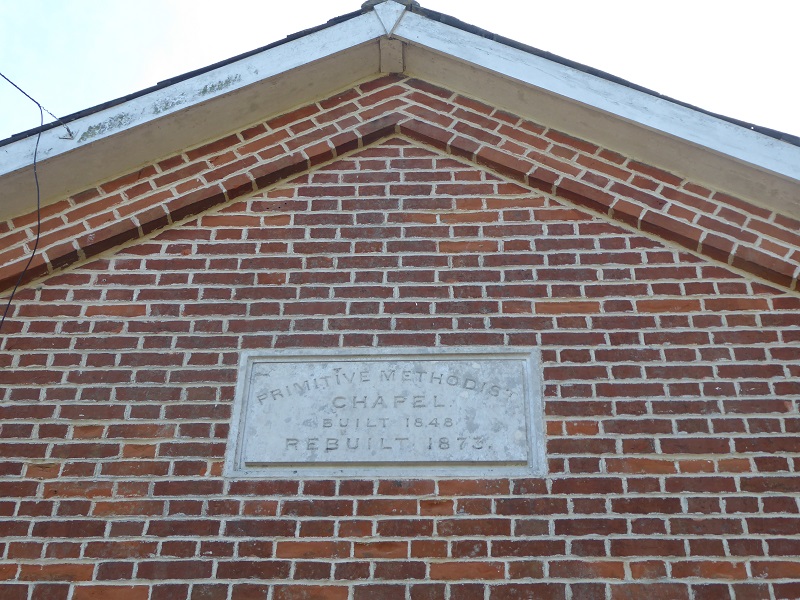
and noted from the message board opposite that most villages have the same preoccupations (coffee mornings, missing cat).

Then the view opened up to our right of the marshes and the shape of St Margaret in the not too far distance.

The church has a nice, open situation.

This was the second, and finer of our octagonal towers. Pevsner admires it, adding bluntly 'Lancet windows, also circular windows. The bell-openings also tall lancets, flanked by blank lancets. Later battlements with flushwork panelling'.

He makes no mention of the carved wooden corbel heads in the porch, quite unlike anything I've seen. Maybe they were covered up back then? Is their gargoyleish quality due to weathering?


Here's another font with lions against the stem, and this time both angels in striated clouds and Evangelist symbols.


The alabaster tablet monument to John Bayspoole, died 1673, features an open book on a base beneath.

The arch-braced wooden nave roof has attractive details including the sunny face below, though I don't know the date. Again, no information in the church itself and no-one there, though for the last two churches we were joined by two other people on a day generally lacking in signs of living human idiosyncrasy.


Our last stretch was of relative difficulty, for me, at least, since I'd swapped boots for sandals, and the path alongside watercourses was overgrown. Good,though, to get a bit of beech wood.

Suddenly we came out upon the hedge of a handsome house and a fine round tower beyond, that of St Mary Haddiscoe.

Approaching the church meant going round the hillock on which it sits, and reaching it by a gate on the other side, flanked by fine pines.

The flints on the outer south wall of the nave and the tower, with its flushwork chequering, gleamed in the late afternoon sun.


But the surprise was in the porch - I thought we'd left Norman doorways behind, but this was in a way a crowning glory given the seated figure in the niche above.


The door itself has splendid ironwork.


There's also a north doorway with a scallop motif in the arch.

By this stage we were beginning to take a certain type of medieval font for granted, but each one had different motifs around the bowl - these angels have musical instruments.


Of the fragments of wall painting, a head of St Christopher carrying the Christ Child is very clear

Martin Travers' 1931 stained glass window of the Virgin and Child meeting a young John the Baptist is a curious mix, commemorating Mia, wife of the artist John Armesby Brown.

Despite our small total of five churches and one Methodist chapel, it was already 5.30pm and we'd covered close to 10 miles. The option was to walk on to two more nearby churches, Thorpe-next-Haddiscoe with another round tower and Thurlton with another Norman doorway, probably finding them closed, or drive to a real curiosity some distance away. J, Cal and I sat happily in the sun while Jill drove Jane and John back to their car at Heckingham

and J noted another Brown Hawker presenting itself on a wooden post, a nice echo.

St Mary Burgh St Peter is in another world, the Broads by the river Waveney, a camp site close by but with a general feeling of seclusion. And its tower, illuminated as we approached, takes its inspiration from another continent.

Of the Boycott family, which furnished five rectors here, the one who gave his name to a now-common verb was Charles Cunningham Boycott, born 1832, second son of William. But it's William himself and his father Samuel, at that time bearing the name Boycatt, who concern us. The young man had travelled in Mesopotamia and sent a sketch of a ziggurat. The original tower of Burgh St Peter had fallen down , leaving only the flinty base, and Samuel had this red brick eccentricity constructed while his son was still away on his travels.

The tower remains just of a piece with the long thatched nave and chancel.

We were lucky still to find the church open, the interior simple and clearly much used/loved.

Most of it is 13th century, the font about 100 years later. This one is rich in heads, shields and flowers.


Decoration is minimal, and this is the only piece of stained glass, but all the more precious in its singularity

and again there was ironwork to admire on the door

before we strolled along the lane a little

and headed to Loddon for an excellent long 'sharing board' of local fare at the Angel Inn with our friends Katherine and Andy, who'd wanted to join us this time but had some house-sorting to do. I had been intending to add on our two days before the walk at glorious Wymondham where Andrew Hammond was being inducted, but that needs an entry to itself and the Abbey might slightly steal some thunder from these smaller-scale gems. Here's an angel on the roof, at any rate.

In the meantime, I'm sending this out to the lists including those who gave so generously, hoping they - and indeed anyone else who simply sent good wishes, quite enough - will get something out of it. The joint total raised by Cally, Jeremy and myself so far stands at a respectable £1122.20*. If you'd still like to donate, you can do so on the Norfolk Churches Trust's JustGiving page. A thousand thanks to those who already have.
Here are the links to all previous Norfolk church walks covered on the blog (we actually did our first in 2002, around the Burnhams):
Happisburgh to Winterton, 2017
Beechamwell to Gooderstone, 2013
Ingoldisthorpe to Thornham, 2012
East Rudham to Helhoughton, 2011
King's Lynn to Sandringham, 2008
*An extra £100 just came in after I sent the link to the post out.


 Posts
Posts