Saturday, 4 January 2014

Christmas in Cranford Lacock


We did very well without the fake snow and the weird filming at what was clearly the wrong time of year in the two slightly disappointing episodes following up the best of telly's classic series. Lacock in Wiltshire is the perfect fastness of our friends the Van der Beeks whose National Trust-owned home played host - most famously, in my life - to the diplo-mate's stupendous 50th birthday party. More people will know Lacock's ideal village as a suitable location for the Midlands setting of Elizabeth Gaskell's cosy women-rule-the-roost Cranford tales when they came to be adapted and interwoven by the Beeb (our hosts' residence, Cantax House, has also featured in the Harry Potter films, though don't ask me where as I've only ever half-watched one of them).

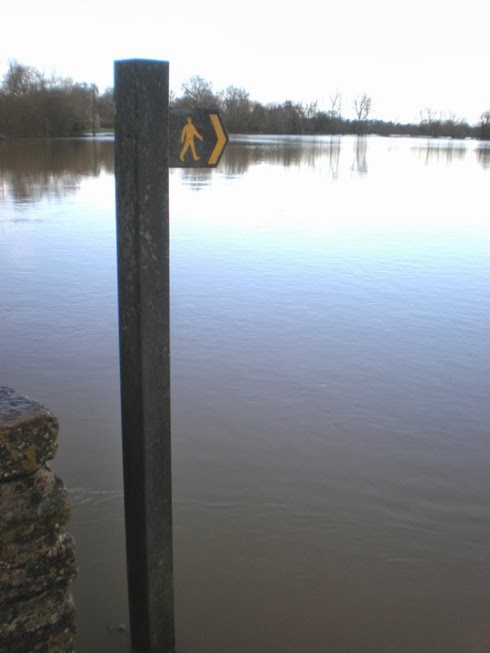
What we did have to negotiate on our Christmas Day walk was the fallout from the previous few days' floods. Fortunately there's been no building on the floodplain of the Avon and I understand the only badly affected house was an old mill. The water meadows did what they're supposed to do, looking quite a pretty sight both from Bowden Hill (up top) and as we approached Raybridge.


Down at the bridge pedestrians had the edge over cars, since the road was impassable. Not so the raised route for feet (and bicyles) only.


In the summer J and I went straight up the road, but Andrew led us on his preferred route along the banks of the local canal via a field that looks more northern France post-1914 than Wiltshire.


The Wilts and Berks Canal is a fascinating case of a disused waterway being brought back to life by active locals in recent decades.


It opened in 1810 to bring coal from south of Bath to the area, but with swift exhaustion of that resource fell into disuse and was abandoned in 1914, the final death-blow having been dealt by the collapse of an aqueduct 13 years earlier. Some of it still remains filled in, but our stretch was vigorously restored and includes the handsome Double Bridge (re)launched by Camilla, the canal trust's patron, in 2009.


Of course an ivy-covered ruin is more picturesque than this, but hopefully it will regain a weathered appearance within a few years. We were grateful for it, anyway, because a walker going in the opposite direction told us that the flooding meant we wouldn't be able to cross further up where Andrew had intended. We headed up a field with views of the rather ugly house in which Michael Tippett lived with Meirion Bowen for so many years. Half the field was in shade, and the night's frosts meant more pleasurable walking than the saturated ground we'd so far covered.


We crossed Nocketts Hill to Bowden Park, with views of Wyatt's 1796 house to our left and the floodplain below straight ahead. The high beeches on the top of the hill looked especially splendid in their skeletal outline.


Down to Bewley Court, and a wood full of birdsong (the mild winter so far means they're all out scrummaging), and then to the more famous of the two bridges near the Abbey, also closed to traffic. No walking across the meadows here for obvious reasons.



Sunset, and home to (eventually) a splendid goose


with sprouts and cavolo nero inter alia


to accompany.

Deborah's decorations were as original as you might expect from a true artist (scroll down this blog entry for shots of her exquisite bathroom muralling).


The hall collection of animal skulls was suitably feathered


or clementined, in which company our marzipan pig from the splendid new Swedish cafe Bagariet in Covent Garden seemed naturally at home.


The garden is still looking splendid in the dead of winter, especially as the mists began to burn away and steam rose from the bourne at 8.30 on Boxing Day morning.


The yew lady stands proud by the green castle.


Soon there was activity in the village which I hadn't bargained for - what else but the Boxing Day meet for the hunt.


My first experience of such a thing, and purely as pageantry it's handsome enough with the black and red ('pink'*) jackets, the horses' banded manes and tails and the occasional top-hatted, veiled, side-saddle dame. But investigate further and you unearth the social divide it represents.


They'll tell you that all sorts join the hunt, which of course under the ban means following a fake fox (or that's the idea). But the gulf became apparent when the Master of the Hunt exhorted us to give generously to the helpers' fund 'because we can't afford to pay them properly'. 'Rubbish', my now-lost-in-the-crowd companion tells me she shouted. And apparently there was a bit of aggression when one of the riders deliberately backed his horse into the group of erstwhile protesters.

Well, I don't like the idea of the fox torn to pieces, but I have to say there are far more important things to protest about. And the trouble with the more obsessive and violent objectors is that they care more about animals than human beings. On the other hand, the Countryside Alliance is made up mostly of self-interested conservatives. Never mind, it was fun to see, once at least.

Leaning against the wall of the great barn, it was warm in the sun. And the light was even more brilliant than on Christmas day, so J and I whiled away a pleasant hour around the (closed) Abbey.


We've visited several times, not least when my godson was six and gratifyingly identified a mortar and pestle as Baba-Yaga's flying machine in the Russian stories we'd been reading (still among his favourites). This time restricted to the walkways around the south and east facades, rounding the corner by the Renaissance tower of unscrupulous Sir William Sharington who bought the 13th century nunnery in 1540, a year after its dissolution.


The rather splendid oriel windows date from the time of the early 19th century Talbots, into whose family Sharington's niece had married (W H Fox Talbot famously pioneered the art of photography here). We sat on the bench beneath the biggest and basked in the sun.


After lunch, we were roused to join the family on a last walk close to dusk in a valley near Box.


Lichen on a beech stump contrasted with the fallen leaves of that fascinating-in-all-seasons tree.


An ascent brought us to a field of alpacas


and then on past a very fine group of farm buildings


to the park of a slightly sinister mock-Lacock Abbey (I didn't note the name), home to a charitable Lebanese foundation, with plenty of fine trees in its ground.


New Year we spent in the bosom of friends Jill, Susie and Michael back in North Norfolk. The weather was not, to put it mildly, amenable to any but the shortest walks this time, but apart from visits to more churches, including the extraordinary Binham Abbey which I need to cover here anon, we had one big compensation. As we were driving from Binham towards Hindringham on New Year's Eve, the pall lifted in the west for an unexpected sunset


and then to our left - a rainbow lit by the glow. Not just a strip, but a whole arch - and then a second: a full double rainbow.


I curse the fact that my camera battery needed recharging, but Jill and J rushed to get their iPads out of the boot, so these three treasurable pics courtesy of our valiant driver and Norfolk churches walks doyenne record the moment. Let it stand  as a symbol at least of a really wonderful 2013, whatever this year has in store.


*see comments below for the reason why.

Sunday, 29 December 2013

Villains of the year


I'm not talking Putin, Assad or lesser monsters of the daylight horror world, but three dreamhaunters of my reading and filmwatching year. Two gave me nightmares during an otherwise jolly Christmas in the bosom of our Lacock friends.

My compulsive pageturner was Fyodor Sologub's 1907 comic shocker The Little [perhaps better Petty] Demon, charting the descent into madness of a wretched provincial schoolmaster, Ardalyon Borisovich Peredonov, all envy, paranoia and hunger for the mortification of young flesh by the birch (top image, incidentally, is Boris Grigoriev's of Gogol's The Government Inspector as I couldn't find anything closer to this particular source). Peredonov's hopes for promotion through the agency of a distant, elderly princess - shades of The Queen of Spades - are exposed as ridiculous from the start, and their failure accelerates an already slippery slide.

Whereas Giulio Andreotti, seven times Italian prime minister and the all too real yet ungraspable subject of Il Divo, Paolo Sorrentino's previous masterpiece before La Grande Bellezza, went right at the top of the tree and stayed there, God knows how, for far too long.


The inscrutable devil died only this year. He was the spider at the heart of the mafia web investigated by Peter Robb in Midnight in Sicily, so we knew a little about the circumstances before seeing the film, which might well confuse you if your grasp of labyrinthine Italian politics is forgivably loose. Yes, I need to see Il Divo again, but I'm not sure the density is really a problem when the basic issue of compromised political ambition is so clear. In any case Sorrentino makes a virtue of necessity by giving a host of red print - sometimes speeding up with deliberate absurdity - around murder victims and courtiers (all of whom have nicknames, like mafia henchmen).

The two cardinal virtues here are the bewilderingly beautiful cinematography - every frame a gem of perfect lighting and composition - and the flummoxing impersonation of Andreotti, 'Il Divo' himself, by Tony Servillo. What a gulf separates Servillo's performance here from his melancholy-mocking ageing playboy in La Grande Bellezza; but what a payoff in the virtuoso monologue where his Andreotti rises from impassivity to hysterical fury in trying to argue the right reason - keeping Italy together - for the wrong deeds (mass murder). He's even allowed a measure of sympathy in the scenes with his wife Livia. But the inner decline is inevitable.


And that's what seems to connect Peredonov and Andreotti with the truly horrifying Cathy Ames, negative pole of  John Steinbeck's strange and wondrous family saga East of Eden. Steinbeck leaves us in no doubt of what we're in for before we even meet her in the eighth chapter. 'I believe there are monsters born into the world to human parents', it begins, and a little later on: 'it is my belief that Cathy Ames was born with the tendencies, or lack of them, which drove and forced her all of her life. Some balance wheel was misweighted, some gear out of ratio. She was not like other people, never was from birth'.


Which explanation doesn't stop us hating Cathy or fearing what she's going to do next. The implosion here is much longer, over years, but it comes all the same. Peredonov and Cathy can't really be called tragic, for they have no perception of the path to their own downfall. Like Andreotti, with whom there's more room for doubt, they lack understanding of any human needs other than their own dreadful imperatives; they know nothing of compassion or even - again, not clear with the enigma of Andreotti - guilt. And so, as both authors make us abundantly aware, there is no complexity in their characters, only in the nature of the responses they cause: horrified fascination in Cathy's case, except from a few supremely moral individuals, and mirth at Peredonov's antics, tragic because there's a complimentary failure to understand the mental illness which leads to murder..

Yet both Sologub and Steinbeck make the banality of evil very compelling -  and in Sologub's case very funny, as in the manifestations of Peredonov's paranoia in the maltreated white cat he's afraid will report him to the police and the antics of the nedotykomka, the dirty little laughing creature rendered by Ronald Wilks as 'little demon', making two in his not always felicitous translation.  I came across the wacky Russian artist Dobuzhinsky's rendering of the nedotykomka in the novel below on a fascinating Russian website devoted to Sologub.


There are, of course, 'good' characters in both novels, even if the society of The Little Demon is mostly very shallow; it has a peculiar parallel plot in which a girlish schoolboy becomes involved in a queasy erotic game with one of three capricious sisters (a transferred homosexual fantasy on the author's part, perhaps?). Steinbeck's chronicle, on the other hand, is one of the richest and most nuanced novels I've ever read - I might even compare it to War and Peace. I can't frankly see the point of the film (Jo Van Fleet pictured up top in the middle with James Dean, and below), which as I understand it launches in two thirds of the way through the family history.


The recurring cycle is what counts. There are characters who comprehend the good but still veer to the bad; there are lyrical descriptions of the beautiful and occasionally ferocious Californian landscapes in which they're placed. And the Biblical parallels move quickly way beyond the schematic. It's certainly the most powerful book I've read this year, Steinbeck himself my fondest rediscovery for a very long time (hell, I never did get to blog about the enchanting road book Travels with Charley). He seems so very modern in his ecological concerns. So it's The Log from The Sea of Cortez, his diary of a journey with the polymathic marine biologist who inspired the loveable hero of Cannery Row and Sweet Sunday, which I ought to read next, or soon.

Tuesday, 24 December 2013

An Ishmaelite welcome


It's the best part of the Christmas story, or rather the one according to Berlioz, Mary, Joseph and the infant Jesus, having escaped the most obscene horror, arrive in Sais, Egypt, close to starvation. In the third part of L'enfance du Christ, they are rejected by Egyptians and Romans in the town with the same cry: 'away with you, filthy Jews!' An Ishmaelite father, however, welcomes them into a lively household.

The gist of what he sings is 'come in, poor homeless people, relax, eat, drink, listen to this sweet music'. And heaven on earth it is indeed, the trio for two flutes and harp. This is enough to reduce anyone to tears at such a point in Berlioz's gentle drama, if they haven't been weeping already (I was, nearly all the way through the BBC Symphony Orchestra performance the other week). The best I could find on YouTube has the harp replaced by a guitar, but the three players - from left to right, Armin Egger, Chia-Ling Renner-Liao and Wolfgang Renner - aren't bad at all, even if the 'transcription' is a little eccentric and spare at times. Enjoy, and happy holidays.

Sunday, 22 December 2013

Orders of Russian angels


Definitely the cherubim and seraphim of Russian orthodox church music this year are a book and a CD. The book is the tender loving resurrection of our beloved late Noëlle Mann's work on an anthology for choirs to enjoy, as we did in the Kalina Choir under her guidance for all too few years. For that reason quite a few of the settings are familiar to me, though I'm racking my brains to remember the favourite - Chesnokov's Cherubic Hymn, I think.


It's also wonderful to have two settings of the birthday 'Mnogaya lyeta' ('Many years' or 'Long life') to hand. We used to sing Bortnyansky's version at the end, if memory serves, of every concert, but I'm also pleased to see Prokofiev's arrangements for either men's voices or seven-part chorus as taken from Ivan the Terrible, where the ceremonial scenes are a reminder that you could slip in orthodox music in Soviet times so long as it served the context of an historical film or play.


Heartfelt thanks to Noëlle's daughter Julia and her husband Kristian Hibberd for seeing everything through to publication as well as to Oxford University Press for making such a handsome job of it. There's also a very useful contextual introduction by Tatyana Soloviova.

I found out a great deal of interesting things about the luminaries of the style - Chesnokov, Kastalsky, Viktor (as opposed to the symphonist Vasily) Kalinnikov - when I was researching notes for that fabulous choir Tenebrae's new disc, Russian Treasures. The pathos of the Russian church music revival coming to a halt in 1917, and the fates of its strongest supporters, made for a moving background.


And the performances, which I had on an advance disc, formed a bedrock to my work. The famous low B flats of Russian basses are successfully emulated by the Tenebrae men on the first three tracks. There's special richness in the Cherubic Hymn of Moscow Synodal School disciple Nikolay Golovanov, later a conductor of incredible magnetism and eccentricity who was harried to death, like Prokofiev, in the last Stalin years. I think perhaps what haunts me most here is the way Chesnokov's 'Tebe poyem' works its way out of darkest B minor into light. It's a stunning collection, as good as any released by Russian choirs (though the Petersburg Cappella sound remains unlike any other worldwide).


This picture made me especially jolly when J showed it to me on Facebook. Standing are countertenor Iestyn Davies, tenor Ian Bostridge and baritone Peter Coleman-Wright in the Christmas-decorated Moscow home of the seated Rozhdestvenskys, great Gennady and his remarkable pianist wife Viktoria Postnikova. It made me especially glad to be reminded of the remarkable happening that occasioned the meeting - the Russian premiere of Britten's Death in Venice by one of his most stalwart Russian interpreters (Rozhdestvensky gave, inter alia, the first Soviet performances of A Midsummer Night's Dream in 1966 with Yelena Obraztsova as a mezzo Oberon). And now, 38 years after its birth, Britten's last opera arrived at the Great Hall of the Moscow Conservatory.


In amidst all the grotesque Putinshchina (is that right?), it was something of a miracle: an opera by a gay composer based on a novella by a gay author (Thomas Mann) about a gay man (Gustav von Aschenbach) longing for a beautiful youth, performed in a conservatory named after another gay composer (Tchaikovsky). I'm guessing that the performance, headed incidentally by four straight men, passed without censure only because it was done in concert - the elephant in the room would have been the exquisite dancing Tadzio.


Anyway, full marks to the British Council, whose photos these are, for facilitating it. I asked Iestyn on his return if he'd write about the experience for The Arts Desk - and he did, brilliantly. While we're on what would surprise Tchaikovsky, I've declared it repeatedly over the last 18 years: the very thought of the grand Pas de deux, Pas d'action, call it what you will, in Swan Lake's second act being danced so tenderly and lovingly by two men would have been unimaginable to him. But still it goes on its rapturously-received way, Matthew Bourne's Swan Lake with its virile, dangerous male swans, and at Sadler's Wells the other week the revival showed no signs of wear and tear.  I'm glad to have gone again and written about it for TAD.


The 'Odette/Odile' this time was the tall and sexy Jonathan Ollivier, pictured above with Sam Archer as the Prince by Hugo Glendinning and in many ways a fine replacement for Adam Cooper of sainted memory. We even got an orchestra back after several years of pre-recorded compromise. I praised it enthusiastically, much to the delight of conductor Brett Morris, who sent me a warm e-mail; time and again you find the music overlooked in ballet reviews, so I was happy to redress the balance. And I'm happy now - two days after putting up this post - to revisit the first Prince-Swan pairing as filmed in 1996, Scott Ambler as a superbly tortured prince and the dream swan king Adam Cooper. The picture isn't the best, but I wanted just that Pas de deux as it brings tears to my eyes whenever I watch it.


Serendipitously coinciding, Neeme Järvi's Bergen Philharmonic recording of the score on Chandos, absolutely complete, arrived a week before the return visit. As with their Sleeping Beauty, I've written the notes, indulging my long-term wish to do a number-by-number synopsis, so I can't praise it anywhere else. But I DO think this is as good as it gets, pending re-release of Rozhdestvensky's Moscow Radio Symphony version - and even that doesn't have the benefit of such extraordinary sound.


James Ehnes is once again the solo violinist, Johannes Wik has licence as before to work his individual magic on the harp cadenzas and Bergen cornettist Gary Peterson's playing in the Danse Napolitaine is out of this world. Järvi toys so beautifully with rhythms, melodies and reprises: sometimes brisk, sometimes leisurely, he's always unpredictable. Buy!