Showing posts with label Agnès Varda. Show all posts

Saturday, 8 January 2022

Heureuse après-épiphanie de Paris

We were in the city of day- and night-light for two days longer than planned; seek not to know further, other than that we're back home now. Let's just say that it was total joy to walk for miles, discover more, eat well, and see two stunning exhibitions (Anselm Kiefer's Pour Paul Celan at the Grand Palais Ephémère, a new structure at the foot of the Champs de Mars, and a big Georg Baselitz retrospective at the Pompidou Centre, a serendipitous stumbling-upon - since I hadn't seen it advertised - to balance the other monumental, post-war German genius).

There were other surprises. I've always wanted to stay in a hotel on the Île Saint-Louis, and we did, very happily, at the lovely Hotel du Jeu de Paume, strolling out along the back and side of the building-site that is currently Notre-Dame, very well informed by the board-exhibition as to what's going on. We had taken a dear friend who's confined on a virtual WhatsApp walk around the Duomo in Florence, and decided to do the same here. So we all gasped when we rounded to the west front and found it lit up in blue


as are all the major landmarks of Paris right now to celebrate France's taking up the Presidency of the EU. I'd wanted to see the stars on the Eiffel Tower, but had to be content with blue in the distance with the dome of Les Invalides in front

and the following night, after a day of brilliance and blue skies, a crescent moon hovered above the Panthéon


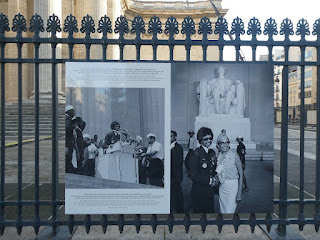
where we'd hoped to see the homage to its latest incumbent, Josephine Baker, but the building was closed for three days so we simply enjoyed another exhibition around the periphery, offering so many images like La Baker in her prime with pet leopard

and her role as the only woman to speak at the March on Washington (she's with Lena Horne on the right). What a life she led, and what a great human being.
For this it wasn't a wasted visit. I also got to show J my favourite church in Paris, Saint-Étienne-du-Mont opposite the Panthéon, with its stunning choir screen.

Hadn't previously appreciated its  abundance of 15th and 16th century stained glass, either.


More serendipity came in the Montparnasse cemetrery where, having duly admired the outlandish monuments of Niki de Saint Phalle to two dear friends and the Baudelaire cenotaph,


I was just remarking on how prosaic the place mostly seemed when we suddenly discovered, not knowing it was there, the grave of Jacques Demy and adored Agnès Varda - the headstone covered with lipstick kisses,

a cat homage
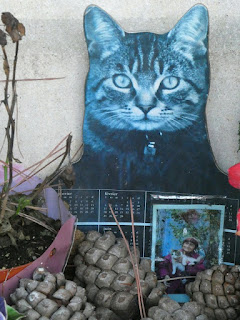

and several potatoes left among the offerings - mine was a 3D 'lucky' card of Buddha which I placed between the stones and the middle potato, all I could think of but it somehow felt right -


just as there are metro tickets on the joint grave of Jean-Paul Sartre and Simone de Beauvoir. 

Had to look this one up, and found that Saint Agnès was known as 'Dame Patate' and dressed up as one for her 2003 Venice Biennale installation Patatutopia, which used 700 pounds of tubers. This is a still from a documentary fim of hers I must see, The Gleaners and I. No wonder she's the film director who inspires the most love and affection of all.

After our Montparnasse wander, we finally visited the Catacombs, which was not quite what I'd expected but not uninteresting. Kiefer and Baselitz must wait on another blog instalment, but I must mention two last wonders which framed our visit - on the metro from the Gare de Lyon, a fellow singing melancholy French songs perfectly in pitch and sweet tone, not for money, and to balance it on the metro to the Gare du Nord yesterday afternoon, a chap with a murine companion, daintily ribboned. 

Paris can still surprise; this time it was not an anticlimax after Italy.

Sunday, 3 August 2014

From Cléo to Florence in 90 minutes


J came back from the Sheffield Documentary Festival clutching a DVD of a film he'd seen which he found absolutely entrancing. Agnès Varda's Cléo de 5 à 7 is a documentary-style work of highly artistic fiction, charting an hour and a half in the life of a pop singer who's waiting to learn the news of a biopsy (strictly, then, it's Cléo de 17.00 à 18.30). There are parallels here, among many others, with La Dame aux camélias, but mainly playful or enigmatic ones. I should have twigged earlier that 'Cléo' is merely a chic construct, for up to the point at which I started falling asleep on the sofa and switched it off half way through, I found it stylish in a very French, a very Parisian way, but slightly irritating and inconsequential. I suppose I should have been charmed by the trying-on of hats and the appearance of a young Michel Legrand as 'Bob le pianist' in the studio apartment Cléo shares with a playful kitten.


And how glad I am that I picked it up again, home alone, the following evening. For it was just after the extraordinary Legrand song that singer-actress Corinne Marchand as Cléo delivers with such feeling that the mask comes off - or, more precisely, the wig and the polka-dot dress. Black garb and dark glasses suggest Cléo, now her real self as Florence, is going into mourning for her life. Cue existential crisis, lightened by the arrival on the scene of vivacious artist's model friend Dorothée (Dorothée Blanck, more or less playing herself, as Varda later said)


and then by a soulful soldier on leave from the Algerian War (Antoine Boursellier) whom Florence meets - it's emphatically not a pick-up - in the Parc Montsouris.


So enchanting did the Parc look in the special camerawork, reminiscent of Bergman's Smiles of a Summer Night and backed up by the most haunting number in Legrand's score, that I wondered why I'd never been there - nor to the spacious garden yard of the Salpetrière Hospital where the action comes to a very poetic, unbearable-lightness-of-being open ending. By the way only the opening, with an intriguingly filmed tarot sequence, is in colour.


The film's meditation on mortality is deliciously complemented by a documentary Varda made reuniting the actors some years later - especially revealing on how she tried to reshoot the very last scene because the camera rail was visible in the original, but couldn't recapture the chemistry between her two leads - and her delightful commentary on the five-minute short woven effortlessly into the film at a point where she feared the viewers might begin to get bored with the leisurely pace, Les Fiancés du Pont Mac Donald. It turns out to be a witty bagatelle on the theme of trying to get Jean-Luc Godard to remove his dark glasses, and watching it after the insights makes it even more charming. Anna Karina plays "Anna", and I'm sure a cinéaste would know the other participants; I don't.


Years ago a friend got us to watch Varda's Jacquot de Nantes, and I can't say it left a great impression. But now I'm going to seek out as much of her other work as I can find. Another (10 minute) short among the extras, Les dites cariatides (The So-Called Caryatids [of Paris]), taught me, amongst other things, the origin of the word 'caryatid' and Baudelaire's miserable end. It's an absolute gem, pure magic in its weaving of music (Rameau on the piano and the song referred to below), poetry (Baudelaire beautifully read by Varda) and image. It seems wrong to show just this minute, all I could find on YouTube, but it does include the most remarkable cool chanson, one François Wertheimer singing (who'd have thought it) Offenbach.


Like Cléo, and no doubt other Varda films I have yet to see, Les dits cariatides celebrates Paris, and not the parts we'd necessarily know. Eat your heart out, Woody Allen, and go make a decent film after all these years of traveloguing rubbish (I know the Blanchett vehicle may be different, but friends I trust say not).

Went to the cinema for the first time in months last Saturday to see a film we might well call Mason from 6 to 18. Certainly I don't know why Richard Linklater's Boyhood isn't just called Childhood, since for at least the first 20 minutes the protagonist's sister, played by Linklater's own daughter Lorelei, is even more interesting. But as in Fanny and Alexander the male filmmaker is more interested in an alter ego growing up. Which, famously - though I managed not to read anything about it before going - Ellar Coltrane, playing Mason, did while the film was being made over 12 years.


There are many touching things about him - the refusal, for instance, to be bludgeoned by adults in his teens into conformity. But deepest sympathies really rest rest with his confused mother Olivia, a luminous performance from Patricia Arquette: thanks to her, the film could equally well be called Motherhood. Bring Ethan Hawke's complex dad into the picture, and you have Parenthood (as well as further touches of the feckless parents in What Maisie Knew). The site on which I found the above composite shot has a fine review by Mark Greene which explores the issues more deeply than I've time for now. Anyway, take your pick, enjoy which angles catch your fancy, it's that kind of a movie.