Showing posts with label BBC Proms 2018. Show all posts

Saturday, 18 August 2018

Ansermania


Ernest Ansermet's recording with his Orchestre de la Suisse Romande of Chabrier's Joyeuse Marche is a desert island track of mine: the precise brio instantly puts one in a jolly mood, the perfect curtainraiser to any concert of recorded music. His complete Delibes Coppélia was my top choice on BBC Radio 3's Building a Library. But I hadn't listened widely to the non-French repertoire in his 314 Decca recordings. Preparing for a Proms Plus homage on Thursday afternoon, I found myself constantly taken aback by the freshness, the combination of firm rhythmic definition and freedom, in  classical and romantic works. Not what one would expect from a Professor of Mathematics, but Ansermet was anything but rigid in his logic as an interpreter.


In the end a brief digression on that subject got edited out for the interval broadcast, which you can hear about 58 minutes into the Prom as available for a while on the BBC iPlayer (and I recommend it all). Listeners had just heard Debussy and Ravel, and were about to hear Stravinsky's Petrushka, so that remained the brief. But how I would love to have illustrated the perfect gait and spareness of the first movement in Ansermet's recording of Haydn's Symphony No. 22, 'The Philosopher'. In a fascinating documentary made during a rehearsal you can see here:


Ansermet says every Haydn symphony should be respected for its unique character, that there is so much more beyond the basic classical forms. The focused power of his Beethoven Fifth, Seventh and Ninth is also surprising. The studio performance of the Seventh's finale is one of the glories of the recording world; I haven't had time yet to watch the whole of the below film, but it's another of those unanticipated pleasures that YouTube constantly gives us.


Many sound files only reached me from Universal - which holds the Decca legacy but can't, it seems, get hold of it so easily - just as I was about to set out for Imperial College on Thursday afternoon, but the listening will go on. One of the tracks I did get to excerpt especially impressed our players - the second of the Valses Nobles et Sentimentales, silky but clear, with the necessary acidic jabs of pain. Here, also wonder of wonders, is a film of him conducting the OSR in La Valse.


The players weren't so fond of the Petrushka excerpt I chose - from the later, 1957 stereo version rather than the feted 1949 recording. A bit messy, yes, but so spirited.


I'd like to have included the white heat of Tchaikovsky's Pathétique Finale - like the Beethoven, one of the best interpretations I've ever heard of a very familiar work - and more of Ansermet's perfect sympathy with dance music.

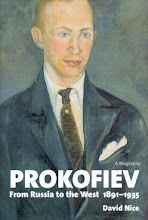
The relationship with Stravinsky (Ansermet pictured below with him and Prokofiev) is fascinating. It ran smoothly from the early days of the Ballets Russes - Ansermet took over from Monteux, called up for active service in 1915 - until 1938, when they fell out over a cut Ansermet insisted upon in the ballet Jeu de cartes. Much of the correspondence in Craft's Volume One selection is businesslike, but there's a touching commendation from Stravinky in 1919, after an OSR rehearsal of the new Firebird Suite, of how well Ansermet understands contemporary music, in that he doesn't approach it differently from 'music of the past'.


Schoenberg and his system Ansermet did not, would not, understand, and it's shocking to read in his huge study of musical aesthetics how he links the aridity with the 'Jewish question'. And that was in 1961! I won't sully the entry with quotations (and there's a still worse one in an earlier article on how Schnabel played like a Jewish banker). Still, I found that the Hannah Arendt Institute was promoting a conference on the holistic approach to music we find in Ansermet's magnum opus. A nicer way to end is to quote his fundamental tenet:

It is easy for a conductor to fill a musical phrase with feeling, because one can do more or less what one wants with a musical phrase. In any case, it is easier to do than to find the correct feeling, the one that puts the phrase in its context and takes account of its contribution to the piece as a whole...It is the interpreter's job to assimilate as much as possible the feeling which the composer turned into music, and to express it in such a way that the listener can hear it in terms of melody, harmony, rhythm and tempo. I have made my choice. First I imagine the musically sensitive listener. Thus I have faith in the listener, just as I have faith in the music, and the two things hang together. My idea is that the listener is able to understand and so all I need to do, in so far as I am able, is to let the music speak, without recourse to the sort of effects that one can always produce, but at the expense of the truth.

Saturday, 21 April 2018

BBC Young Musicians at the Proms Launch


Here, in the pink thanks partly to the lighting, are two pianists from among past winners: Lara Melda (2010's victor, then known as Lara Ömeroğlu) and Martin James Bartlett, 17 when he took first prize along with saxophonist Alexander Bone in 2014. Perhaps the one significant step forward for the BBC Proms this summer is to bring together 21 Young Musicians of the Year (as they were formerly called) in a single concert, marking the event's 40th anniversary. Lara and Martin will be repeating their tour de force, featured first time round with the Aurora Orchestra, as specimens in the 'grand zoological fantasy' of Saint-Saëns' Carnival of the Animals, always a delight. Who'll play the Swan? Sheku Kanneh-Mason or one of the other three cellists represented, including Sheku's mentor Guy Johnston?


The reception had a special setting this year, after many sweltering gatherings in the Amaryllis Fleming Concert Hall of the Royal College of Music - the Imperial War Museum, looking less grim and Bedlamish than usual on a day of summer-in-spring. My photos of the gathering were taken before and after the great throng, from which you'll gather I lasted the duration.


The reason for the location was the Proms' commemorating the centenary of the last year of the First World War. The theme reminded me that my paternal grandfather's reconnaissance mission at the Front took place on 7 April 1918 in Fampoux Field to the east of Athies, 100 years ago this month. As related in the History of the 5th Dragoon Guards published by Blackwood in 1924 in my first entry on Captain George Nice - and it seems apt to repeat it here -

Second Lieutenant Nice of A Squadron was afterwards awarded the Croix de Guerre for his gallantry in reconnoitring under heavy rifle and machine gun fire to try and find a route for the regiment to make a further advance in the direction of Greenland Hill.

1918 was also the year in which Parry completed his richest choral music, the Songs of Farewell. At the launch the BBC Singers gave a very nuanced performance, stilling the party crowd, of 'My soul, there is a country,' the only one of the set I know, from All Saints Banstead days*; I came to marvel at the rest when working on a talk for Tim Reader and his Epiphoni Consort, who sang a selection. Sakari Oramo will conduct the entire set - and I think they do need to be heard in one concert, if not necessarily all together at once - in a Cadogan Hall Prom on 20 August.


Looking through the Proms prospectus - our usual pleasure in revelation at the pre-event gathering with David Pickard and Alan Davey was pre-empted by the untimely morning announcement of the whole lot - the Cadogan events strike me as much the most enticing in terms of repertoire. There aren't many great surprises in the rest, though DP made the very good point that what looks ordinary on paper can be transfigured by the unpredictable magic of the Albert Hall (conversely, it can let some pieces down). And there will be thousands who've never heard Shostakovich 4 before - it has to be worth it from Nelsons and the Boston Symphony.

To my surprise Bernstein's MASS isn't on the cards, a Proms piece if ever there was one - though I've had my vision to last the next five years. West Side Story (complete in concert for the first time) and On the Town are, under the peerless-in-that-rep baton of John Wilson.

Cue my chat with Martin and Lara (I knew the former a bit from his Southrepps recital and trio performance). MJB's quirky imagination revealed itself when we were chatting about Bernstein, I told him how, courtesy of my then editor at The Guardian Ted Greenfield, I shook the great man's hand at a recording session for Candide before he (MJB) was born, and he said that Lenny was the person he'd most like to have met. But then he thought about it and commented that probably you'd have the man's entire attention for five minutes and he would be charming, and then switch it off. Like Ripley.


I did a double-take. Yes, Patricia Highsmith's Talented Mr Ripley as immortalised cinematically in Plein Soleil, which MJB hadn't seen, and Minghella's beautifully filmed, scary and poignant masterpiece, which he had (Matt Damon's Ripley pictured above), and we talked about it, and told Lara she had to see it.

Well, it was a grand evening, and though I sometimes dread the thought of chit-chat, there were so many welcome faces, some of whom I asked along to the Europe Day Concert. Several key folk will be involved in that whom I met at the fabulous Pärnu Music Festival, which is a roundabout way for me to close in saying that the orchestra I'm most looking forward to seeing at the Proms, following the usual heavenly (we hope) week, will be the Estonian Festival Orchestra under Paavo Järvi (a chat with David Pickard at the Multi-Story Orchestra Prom last year encouraged that set-up, I'm told). Here the 2016 vintage is on the beach at Pärnu, a typically wonderful shot by the great Kaupo Kikkas.


 Only connect: they'll be opening with Arvo Pärt's Third Symphony, the UK premiere of which father Neeme conducted with the Gothenburg Symphony Orchestra at the Proms in 1989 - an event which led to my first ever visit to Estonia a few weeks later. Terviseks (Estonian for Cheers!) to all those Järvis!

*RIP Choirmaster DAH/David Harding. I can't say much more except that he was the most inspirational figure in my musical education.