.jpg)
The phrase is not mine but my bright young colleague Alexandra Coghlan's on The Arts Desk, penned about Berio's Sinfonia, which preceded a shattering but nuanced interpretation of Shostakovich's Fourth Symphony at Tuesday night's Prom. I choose to apply it to the superlative team which gave one of the best Proms I've ever heard, our already-beloved European Union Youth Orchestra, and further, to the even younger members of nine British youth orchestras they mentored in an inspiring workshop featuring 180 young musicians on the platform of the Royal Albert Hall the morning after the EUYO triumph.
.jpg)
All photos here by the wonderful Chris Christodoulou, with whom I managed to have a good chat as the players lined up on the steps in front of the hall's south side. Above, below and in the last photo are some of them on Wednesday morning conducted by likeable young motivator Duncan Ward and playing to a small audience of friends, family and a handful of scribblers like me.
.jpg)
A big question which I intend to peck away at: why did the BBC not ask Chris to snap one of their most photo-friendly evenings? He tends to come to everything he can, but the press folk only ask him for so many Proms. More bizarrely, why did BBC Television choose not to film the EUYO concert for broadcast (Radio 3's transmission is on the iPlayer for the next month)? The fact that they'll be transmitting the National Youth Orchestra Prom is no excuse: it shouldn't be a case of either/or, but both. And what better to spell out the message that there IS a future for great orchestral music than the enthusiasm and commitment of these photogenic young players with their handsome young conductor, the already great Vasily Petrenko (replacing an indisposed Semyon Bychkov, who would also no doubt have trained them up to the hilt)? Was it politics or is there a less sinister explanation? Shame on you, Beeb - you should be helping to tell the world that this is what we're fighting for in Europe. True internationalist Sir Henry Wood would have thought so too. I asked Chris especially to snap this one for us.
.jpg)
Anyway, I was there on Tuesday evening with the diplo-mate - having to break his rule of avoiding all Proms, and he couldn't have admired it more - in the EU invitees' zone close to the stage, leaving Alexandra to write up the event for TAD. I didn't sway her beyond a very late message saying that if she didn't give it five stars, she would be exiled to an island of exclusively baroque music. There was no need: she'd already written the piece by then, and she touches on just about everything I would have done, very much in her own eloquent style, so I don't have to reduplicate here.
.jpg)
Just a few points of my own, then: first, that I've never heard a more detailed, coherent or intelligent performance of the baggy-monster Fourth. Petrenko, at times sexy-sinuous, at others rhythmically taut, amazingly so in the Berio, drove a line through Shostakovich's most outlandish orchestral work without ever being over-emphatic.
.jpg)
There was much more more lyricism than we've come to expect, more sheer fun in the concerto-for-orchestra parade of solos and groups, while never losing sight of the terrifying overall rhetoric. And what an extra layer of emotion there was in hearing a first-half work which seemed to think that 'classical' music had shattered into fragments, never to be pieced together again, and an even greater masterpiece ending in total annihilation, and finding them in the hands of a future which is as bright performer-wise as it is in the new wave of post-Darmstadt, post-modern composers who are no longer afraid of the kind of cornucopia Shostakovich loved so much.
.jpg)
I've written about the Inspire Workshop event over on TAD, but the BBC were slow in getting Chris's pictures over to me, which is how I can indulge in a few more here. That was fun, but the EUYO concert has burned itself on my heart as what will have to be the most extraordinary Prom this year, however much of excellence is no doubt still to come.
Young and old alike must rejoice that today is the 100th anniversary of Tove Jansson's birth, a special day she shares with her Moominpapa (anyone's guess), the diplo-mate (thirtysomething, of course) and his mother Wyn (86, doing pretty well by the sea yesterday). Shot of the last two at St Leonard's from behind only due to privacy wishes.

I raise my special Hemulen mug to the great author, and like to think of her like this below in 1956 on her special island with her partner Tuulikki Pietilä and her beloved mother Signe Hammarsten-Jansson, the 'Grandmother' of the volume I most often gift, The Summer Book (remember this to young Sophia, countering the child's insistence of 'a big, enormous Hell': 'You can see for yourself that life is hard enough without being punished for it afterwards. We get comfort when we die, that's the whole idea').

Tove would approve last Saturday's outing to Holland Park and Will Todd's splendid opera for children Alice's Adventures in Wonderland (or should that perhaps be 'New Adventures') with goddaughter Mirabel. I managed to sneak in a picture of her with the lovely Fflur Wyn, Alice personified, to the Arts Desk review, but felt it might be overload there to include Keel Watson's very friendly Caterpillar
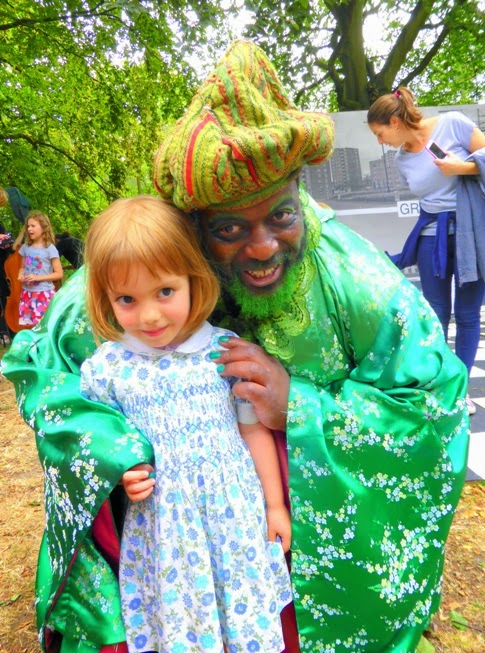
and the family bear of long wear and tear, Special/Spesh, occupying the White Rabbit's cage in the opera's Grimthorpe Pet Shop.

Fortunately they all lived happily shortly after: Spesh was released to join Mirabel, ma Edsy and auntie June for tea and scones chez nous.


 Posts
Posts



