Since a mostly golden October declined into a sombre November and December, with a few hours here and there of light and the most spectacular sunsets, I've managed to keep the afternoon walks up on days when I don't have Zoom classes (it's already dark by the time those end at 4.30-5pm). There's a certain beauty to the skeletal frames and shapes of leafless trees. But this sort of autumnal peak seems like a very long time ago. October was also the month when I finally discovered the London Wetlands Centre on my doorstep, a gift that will keep on giving with the winter migrations.
Yet that will largely be the subject of the November diary. Meanwhile, until the last week of October also comes into the picture, we have the usual suspects. I dealt with the wet but inspiring Mile End weekend here. Two days later, it was back to the Walled Garden of Fulham Palace, which keeps showering us with surprises. On our September picnic, a swarm of giant dragonflies; on 6 October, a flock of goldfinches. I wondered if I one would settle long enough for me to catch it, but this is one of several obliging poses.
Robin, yes, much commoner, but always singing (several still are - territorial even in November).
And just one rewarding clump of bracket fungus on a noble ash.
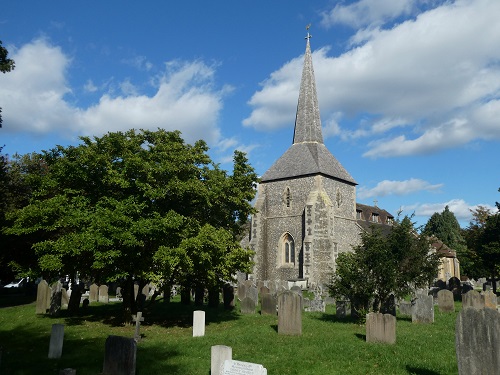
Another of those jolly autumn times with ma in Banstead, excurting to the Chai cafe and sitting outside in warm sun, gave me more chance to commune with my favourite churc, because so known over years as a chorister, All Saints Banstead, with its square tower once presumed a kind of defence and lookout (Banstead is one of the three highest places in Surrey, apparently - I know Leith Hill is No. 1).
The light was almost too bright for the faces in the Victorian stained glass, but since it's relevant now, here's an Annunciation
and the Adoration of the Kings.
Next time I must check out the west window, usually difficult to see because you can't get at the belfry, which includes saints designed by Rossetti and Morris. But I've long been fond of the above.
Kensington Gardens was a frequent haunt for social-distance walks with Sophie in the spring - I hope to see her there tomorrow now that our Xmas Day together can't go ahead - and in earlyish autumn it was still lush.
No sign of the solitary, ever-diving Great Crested Grebe, but here's a Shoveller - I've become very fond of this duck with its spade-like beak from observing a constant pair in the Wetlands -
and the cormorants like to hang it with the seagulls on the row of posts across the northern end of the Serpentine, drying their wings.
The sculptures in the Victorian Water Garden also repaid closer examination, a fine ensemble with the water beyond.
Much was still flourishing in the Chelsea Physic Garden on 14 October (I grudgingly renewed my membership despite their depriving us of the Tangerine Dream cafe). Dahlias still thrive well into November; this. I think I'm right in saying, is the 'Honka Pink' in the richest-flowering zone of the Dicotyledon Order Beds.
Artichoke flowers nearby are all but over, yet still striking (more of this sort in Battersea Park still to come).
Last leaves on a potted fig
and plentiful shiny, inviting fruit on Punica granatum (bark excellent for dealing with tapeworm) - the pomegranates last well into late winter, even when the leaves have gone.
Basella alba 'Rubra', with the loveliest of leaves at this time
and tinted varieties of the long-running sunflower, their heads turned away from the statue of the resident deity, Sir Hans Sloane (*slavery alert*, but we're Fotherington-Thomasing right now).
Lemons in October - Citrus trifolliata from China/Korea
in the formal beds, close to Impatiens tinctoria.
Magnolia grandiflora has lost its flowers and thus its heavenly if sometimes overpowering scent, but the seedhead remains compelling.
Not a fungus in sight here - though a return to Kew on the 16th helped me locate the trees under which I've always found the wax-cap (or related) mushrooms in plenty.
Nearby, a lone magnolia bud was going against all seasonal instincts and hoping to flower.
Into the wooded zone, and the colours were at their peak on beeches, maples and oaks.
More myceliums at the roots.
The river scene, unchanging except in terms of leafing,
and colour alongside the Temple of Bellona by the Victoria Gate.
More of the same on the main thoroughfare through Kensington Gardens alongside the Palace the next day.
Holland Park was deep into autumn, and visitors packing out the Japanese garden. With difficulty, I excised the crowds and tried to keep my distance.
Carp, meanwhile, swam lazily in the leaf-reflecting pond
and acers provided a red backdrop to the ever-growing bracket fungi on a tree in the woods.
Back at Fulham Palace's Walled Garden, or - here - just outside it, the gingko leaves still hadn't turned
and the bees were still finding sustenance in dahlia flowers
while produce was still being gleaned from the vegetable beds (on a last visit, only a netted group of Brussels sprout plants remained).
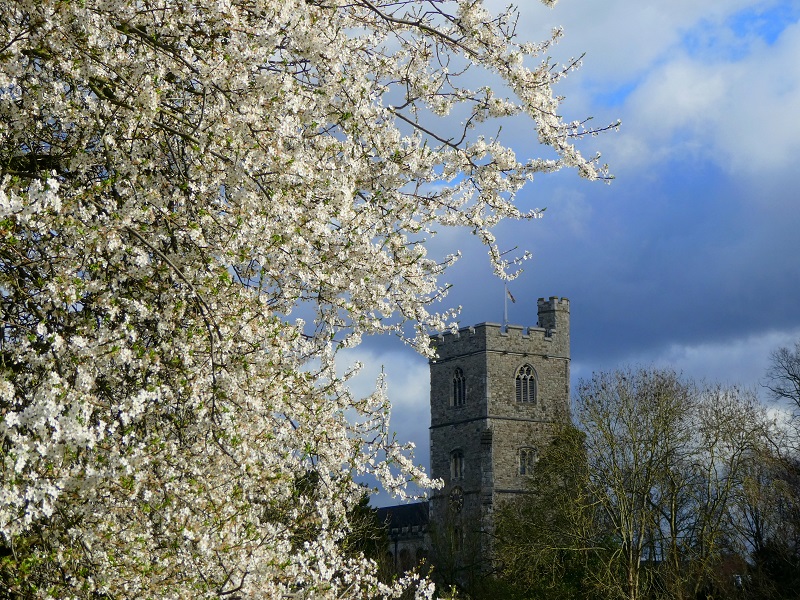
More towers, the one known as the Shard barely seen through the low rain clouds to the right of the church by Lambeth Palace on my way from coffee with Richard Jones at Tate Britain (good to walk with a handful of others through the collections here).
The Shard's illuminated night-time self is more clearly seen to the right of Southwark Cathedral on 22 October.
I came here with Sophie and J for the first of two inspiring concerts presented under relaxed circumstances by the City of London Sinfonia. Perumbulations were possible - here I'm passing the monument featuring Alderman John Humble, his wife and daughter, made by Flemish craftsmen settling in the area (Southwark is proud to note its long-term welcoming of refugees).
Another excursion westwards, can't remember what for exactly now, to Hammersmith's King Street led me on to cycle around an area I'd never explored, but heard about from our friend Cally who lives on the other side of the Great West Road, blight of late 1950s planning, which now bifurcates a treasurable part of Hammersmith/Chiswick. St Peter's Square has very grand houses with eagles above somewhat pretentious columned porticos.
Eagles, I'm guessing, because of St Peter, the church to whom was consecrated in 1829 when there was nothing around it but meadows, market gardens and smallholdings.
Architect Edward Lapidge followed the neoclassical style, and the stone Ionic columns and portico aren't bad.
Thence to the undisturbed Mall by the river on the other side, where you can't hear the rumble of traffic on the main road. This big house which, like all the others, has a 'front garden' on the other side of the road, right by the edge of the Thames. You can just see its prize dahlias over the wall, where purple-flowering sage (not illustrated here) is still going at the time of writing (23 December).
And so, finally, to the first revelation of the London Wetlands Centre on the afternoon of Hallowe'en. The first distinctive bird we saw from one of the hides was a solitary visitor listed in their daily round-up,
Herons of course are ubiquitous, but characterful both in flight and in repose
This one foregrounds the main mere rather well, and we are told to pay more attention to the wintering range of seagulls.
Over at the hide by the Wader Scrape, we could hardly believe our eyes - a crane! But surely they're not to be seen in the wild here. On the route to the west, there are zones with wildfowl of the world, each in a separate zone. And here, later, I saw one of the two Demoiselle cranes - this must be the other, and it must have been able to fly out to the wider spaces. Anyway, there's a hope soon that cranes may breed here, just as they have spontaneously in the Norfolk broads, where I heard but didn't properly see them.
The first of many spectacular autumn/winter sunsets over the Wetlands followed - I have some greater beauties in store for November and December - and by the time I cycled into the home square, the full moon was up
and bids this post an elusive farewell between the branches and leaves of the London planes.




 Posts
Posts