Showing posts with label Concertgebouw. Show all posts

Saturday, 6 May 2017

Orkestival 2017: back to the Concertgebouw


I was delighted to be asked back to serve on the jury of this annual Dutch school orchestras festival - only nominally a competition - and as chairman, no less. Slightly overparted, I feel, as my colleagues this year were not only, once again, the brilliant violinist Jeroen de Groot - how brilliant has become clearer in the interim from hearing his Bach CDs - but also two other high-level instrumentalists: international cellist Larissa Groeneveld, whose disc of Zemlinsky, von Brucken Fock (no, me neither) and Dohnányi with pianist Frank van de Laar I look forward to hearing, and Royal Concertgebouw trombonist Nico Schippers, who also rewarded me with two splendid discs featuring the orchestra's brass ensemble.

We were very happy to be joined in our backstage discussions by the genial and obviously very hard-working Gerda Hoekstra, director of the Stichting het Zelfstandig Gymnasium. The title should explain that though the Netherlands is without what we'd call public or private schools, in national terms at any rate, the participants drawn from the 40 top schools tend to be among the high achievers. The mix consequently isn't that representative of multi-kulti Holland. Well, that's the way it is, being under such auspices at any rate. The musical standard, even so, varies, as do the types of ensembles featured. I set most of this up in last year's account, so, with a preliminary shot of myself with (left to right) Gerda, Larissa, Nico and Jeroen,


let's follow the same format I used in 2016 and give what I hope will be helpful notes about each of the orchestras. We actually did this between the three of us in the summing-up speeches up, but as that was divided, these are my personal opinions - though we were mostly in agreement. Not least about the clear winner, which has to come first -

Aulos, Praedinius Gymnasium, Groningen And what a difference a year makes. In 2016 they were, to be honest, the least inspired of the bunch - though the most charming afterwards, when they asked me about their Handel 'if we had let off real fireworks, would we have got more points?' To which I answered with that assumed sagacity of someone appointed judge, 'the point is to put more fireworks in your playing'. Last year's messages about communication - with the proviso I made this year, that I know it's difficult to show you're enjoying yourselves if you have to concentrate on playing the notes - seem to have paid off. Aulos's programme was perfect. It started with an ideal novelty act, Leroy Anderson's The Typewriter (why aren't more of this witty tunesmith's pieces played by youth orchestras?) A boy who was clearly a born actor operated an invention which neither he nor any of his contemporaries are likely to have used before (I stopped using my electric typewriter in 1986). Another rang the bell. The cross rhythms and hiccoughs aren't easy, but they all did it perfectly. Then there was a really lovely piece composed by the horn-player, Daniël Apol, who I snapped in the finale (that's him on the left below).


Not only was Apol's Romance a gem, but we also suddenly heard real phrasing - not common in Orkestival. Full marks to the music teacher/conductor, Jorien Elout. She also had the inspired idea of bringing in players from the other orchestra in that segment of the day, Mercator et Musica from the splendid town of 's-Hertogenbosch - more on them below - in a wittily compiled fantasia on Bizet's Carmen by Eijk Suzuki: unexpected, concise and taking a leaf out of Shchedrin's Carmen ballet in its use of tuned percussion. So all told, a winning formula: wit, lyricism, originality, panache and collegiality.

Taking the rest chronologically, let's go back to the beginning with Group 1, kicking off with Coornhert Gymnasium, Gouda. The teacher needed to conduct with a bit more spirit, and it was a shame the lively percussion used in an Abba medley weren't engaged for the Radetzky March. The revelation here was 17-year-old soprano Annecke de Hoop singing Pamina's 'Ach,ich fühl's' from Die Zauberflöte. A polished technique already, though the pace should have been set faster for her and while I know the conductor had to keep his eye on his players, once he realised his singer was likely to come in early or late, he needed to cue here. But no doubt about it, she was the individual standout of the day. Unfortunately Coornhert outstayed their time and welcome - should have dropped the Grease selection; 'Dancing Queen' had already left us happy enough.

Murmellius Gymnasium, Alkmaar made a mistake by starting with Fauré's Pavane, and those loud string passages in the middle are really tricky. Again it was the teacher's job to set it flowing, and to hell with the wrong notes. Can't say I remember much about the other two pieces. They seem to have lost the inspirational music master who helped them to win the 'promising' category last year with a clapping piece.

Vossius Gymnasium, Amsterdam always has the biggest advantage in terms of size and training; they gave the strongest purely classical programme last year and had won several times before that. Coen Stuit got a terrific performance from them, overall the most polished, of songs and dances (not the symphonic ones) from Bernstein's West Side Story. Quite an impressive string sound here, I think you'll agree, since Vossius has been quick off the mark to put up a film on YouTube (not in the same league as the professional one excerpted for the Ode to Joy below, which I think covered everything, but this will do).


Less good was Haydn's Overture to Lo Speziale: much too heavy for an curtainraiser to an opera buffa. But still, an ambitious choice. And wonderful to watch the enthusiasm not just in performing but also in reacting when he wasn't playing of timpanist Omar Beganovic - I think I've got the right name there, but in summing up I simple called him 'cool dude'. That's him on the drumkit for the Bernstein.

Group 2 Aulos followed Mercator et Musica, Stedelijk Gymnasium, 's-Hertogenbosch. They could have done with more contrast, and the repetitive theme of Jacob de Haan's Concerto d'amore was really rather boring. There were some fine solos in Alexis Ciesla's Balkan Groove, though, even if not enough was made of the groove itself.  M&M can also share part of the prize, too, for fielding soloists in Aulos's Carmen selection.

A quick lunch in the Concertgebouw canteen, staffed by extremely pleasant people - as is the entire hall.


Group 3 Euterpe, Stedelijk Gymnasium, Arnhem fielded a star treble last year, and a good one this year, giving us the novelty of a boy as Mozart's Cherubino with 'Voi che sapete' from Le nozze di Figaro. Sang it accurately but - big ask - needed to express something of what it was about. Otherwise, a very impressive programme began superbly with Corelli's Concerto Grosso Op. 6 No. 8. The first violinist had professional poise, and there was a real surprise when we heard the solo tone of the young lad sitting next to her: beautiful (if I'm not mistaken this is the same who sang so amazingly as last year's star soloist, Casper Jeukendrup). Quite enjoyed Tijuana Taxi but the awkwardly filleted Capriccio Espagnol didn't have a hint of elan. In the only slight lack of agreement between us jury members, the decision was taken to give the runner-up prize to Euterpe, but as I understood it was really supposed to be for the group who showed the biggest promise, I would have unhesitatingly have given it to

Panta Musica, Johan de Wit Gymnasium, Dordrecht Last year they began virtually from scratch with a charming, oddball ensemble. How it had grown this time, enough for them to begin with a clever guide to the orchestral departments in carefully chosen snippets. And what I loved best about their engaging Dudamelesque mentor-conductor Saul de Caluwé was that he went not for a David Stone-style 'classics for schools' arrangement but the WHOLE of Saint-Saëns's Danse Macabre which, even if it was almost beyond their abilities, the group got through intact.Always happy to hear any version of Piazzolla's Libertango too.

Gymnasium Haganum, The Hague had another would-be charmer in charge, but I never quite worked out what Piet Raphael was playing at, gurning occasionally when he would have done better to keep his eye on the ball. The teacher should never become the centre of attention. And they deserved better. But we all enjoyed a 'Hey Jude' singalong at the end.


The poster, by the way, is also the result of a competition - the winning entry is by Eva Versteeg from Gymnasium Haganum. The theme - maybe it was made clear by presenters Adda van Zanden and Rikkert van Huisstede, but my Dutch isn't up to it - was 'Met een Twist', 'With a Twist', that apparently also having the connotation in the language of strife or conflict. Which some orchestras carried through, others seemingly didn't.

Group 4 Gymnasium Celeanum, Zwolle introduced a novelty in the form of bagpiper Cees Scholten, but as he wasn't one of the kids, the effect was slightly marred (and the orchestra only got to join in briefly). Good to see that the dayglo pitched thwackies known as 'boomwhackers' made a special appearance for a more aptly novel treatment of the James Bond theme. Personally I rather liked the Muppet Show tune to end, though my colleagues were a bit sniffier about it.

Big Band Stedelijk Gymnasium, Nijmegen still needed a bit more swing, as we noted last year. There was a rather interesting kid who made impressive sound effects, but the amplification went awry again for the talented vocalists. The mikes need testing, if it's possible, so that they don't scupper good intentions.

Last but certainly not least, last year's winners Christelijk Gymnasium Beyers Naudé, Leeuwarden. Even if Aulos hadn't come up with such a brilliant trio of entertainments our champions wouldn't have cut it this year simply because their programme was lacking in variety. But now that the red-headed violinist who made such an impression last year has moved on, all eyes were on Jorn Stavenga, the trumpeter who was the true leader, capping a brass sound that's absolutely gorgeous to hear (trombones shone at one point). For that we have the brass band tradition in Friesland - where nearly everyone, it seems, is blond - to thank. She spoke to me afterwards to thank me for last year, I returned the compliment for this one. Very focused, is going on to study conducting, and I'm sure she'll do well.


Final break, quick summing-up backstage and then on for the grand finale. First came the results of inspirational Mirjam van Dam's group voice coaching. They'd only allocated half an hour for the whole thing, but I still insisted that we all got to speak to give encouragement to each group. Got applause for starting with a bit of Dutch, but it all went a bit quiet when I said how good it was to be back just after the Dutch people had made the right choice in the election. Maybe you don't raise politics, but there was an important link to be made between Coen's choice of the Ode to Joy aka the European Anthem - we will be standing for it at the Europe Day concert on 9 May - and the pride we feel in being united in Europe against populist bigots like Wilders.


From then on it all went swimmingly, until I was so flustered by being pinched - I kid you not - to get on with it (I wasn't rambling, but I was determined to make the points I'd intended) that at first I announced the wrong winner. Pure Oscars moment; I think it was taken in the right spirit. Confusion absolved, there were more speeches, and then Coen conducted the Beethoven. Kudos to the superior film work here.


He's planning a Brexit concert with ironic takes on various pieces - The Lark Ascending is the UK flying away, though as a passionate fellow-European he certainly doesn't think that's a good thing.


We retired to the very characterful bar behind the Concertgebouw. Nico told me it's the favourite haunt of the brass and many of the older players - the younger ones tend to go round the corner. Anyway, the sun shone in the midst of a cold snap, we sat out, my hosts Machteld and Nick (centre back; sorry the sun has all but obliterated Coen's face) turned up along with Adda (second from the left), we moved into the shelter,


Rikkert and Adda's co-organiser Jitske joined us,  and a select party went off for supper since this time there wasn't a concert in the evening. A happy day, fired up by youthful enthusiasm and dedication. I took away a lovely bunch of tulips, but assuming they wouldn't get through airport security the following day, left them with my hosts after our lunch at Keukenhof Manor.

Tuesday, 29 March 2016

14 hours in the Concertgebouw


And I'll treasure every minute, from checking in for Orkestival 2016 to watching Daniel Harding walk down the great red-carpeted steps for the last time following an amazingly good concert of Bach and Brahms. That, by the way, was my first experience of THE orchestra in its own hall - I'd previously heard the Netherlands Philharmonic here under Hartmut Haenchen in the original version of Mahler's Das klagende Lied. But the main reason I was here turned out to be only my second adjudication (the first, for ENO, was only a couple of months earlier). Through the vivacious Machteld (Max to us) Hopperus Buma, wife of J's old Glyndebourne chorus pal Nick Hills and the mother of his (J's) godson Frankie and brother Charlie, I was invited to be one of a three-strong panel judging the 14 Dutch school orchestras and ensembles of Orkestival. Love the poster, by the way, designed by a classmate of Frankie.


It's thanks to the Royal Concertgebouw Orchestra's dedicated education programme that Orkestival gets to inhabit the hall for the whole day. My very distinguished colleagues for the day were Kees Olthuis - bassoonist of that great ensemble from 1970 to 2005, composer and good friend of Haitink  - and Jeroen de Groot, 11 years violinist in the Concertgebouw and now a soloist who's just recorded the solo sonatas of Bach on a Dutch Record Company Super Audio CD (waiting to hear it). Here they are, Jeroen on the left and Kees on the right, with Max holding the cup just before presentation.


Kees, as you might expect, has a knack of going straight to the point, while Jeroen was humorous - we got on instantly and, I think, agreed on all points. The presenter was Karel Baracs, 'the story-teller of Amsterdam' by virtue of his narrative of the fates of Jewish relatives during the Nazi occupation.

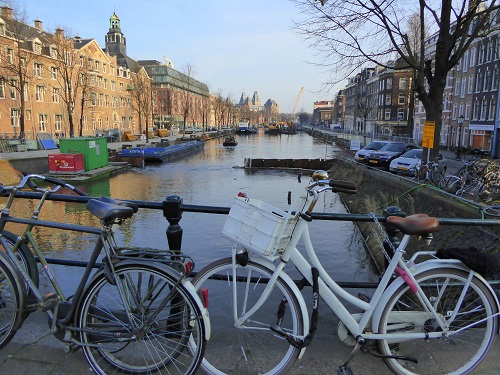
Let me start with the day itself, in which everything had a sense of wonder about it. Not least stepping out of the Buma-Hills residence overlooking the Sarphatipark in south Amsterdam and seeing everyone going to work or school on bicycles, children often in buggies attached. Only a distant bike in this photo, but I like the mum in the hat and coat.


One stretch of water to be negotiated en route, the Boerenwetering, looking towards the Rijksmuseum; on the way back, the waterfront houses were lit up by red framed windows, prostitutes posing like gaudy mannequins within.


And so alongside the tram route to the Concertgebouw itself


and Max on the front desk.


I think it might be helpful for all participants if I sketch from memory, without looking back on copious notes, what I remember of each. The criticisms are supposed to be positive, of course. This is in order of performance. They were heard in groups of three or four, impressive in itself as you would see the various orchestras sharing the platform - nothing, of course, as compared to the 300-strong performance of Musorgsky's 'Great Gate of Kiev' from Pictures at an Exhibition at the end, but I jump ahead.

Group 1 Barlaeus Gymnasium, Amsterdam  Very tentative at the start of each piece; impressive how the spirit was finally there in the recaps of the Grieg Peer Gynt numbers and Shostakovich's Second (Jazz Suite) Waltz (don't know why this piece is so popular - it's repetitive. There are better waltzes out there).

Murmellius Gymnasium, Alkmaar  We wanted to award the prize for the enthusiastic mastery of complex rhythms in Geert Rubingh's Clap Trap. The orchestral pieces, though, left less of an impression. No doubt the prize for most resourceful teacher/conductor should go to Jos Meijer. He was one of the five to give us the music, too.

Vossius Gymnasium, Amsterdam  One of the Netherlands' best schools - this is only one ensemble of three (all main schools are free and state-run, incidentally - though there's a division between top-layer, sending students to university, from which I believe all the participants were drawn; second-division, like the first but not university-oriented; and technically-minded, training kids for apprenticeships in practical work. This, of course, is equally valuable, and I wish we had something like it here). The most polished orchestra under expert clarinettist-conductor Coen Stuit, pictured below with Max at tea later; the Beethoven First opening movement undoubtedly the most accomplished single performance. Admirable, too, to choose Soifer's Amstel Suite, with a chance for the wind to shine; but it was all a little sober. We were looking for spirit above all.


Group 2 Trinitas Band, Almere  First of the 'schoolbands' - I'm allergic to the Lion King music but that was well enough done. Things looked up with an inventive symphonic take on 'I Want You Back' by the Jackson Five. They had the bad luck, though, to be followed by

Christelijk Gymnasium Beyers Naudé, Leeuwarden  One of two groups who had set off early for Amsterdam from Friesland in the north. Our firm favourite first because the brass ensemble made such a beautiful, mellow sound and second because there was so much personality from the players. We loved the way the leader sat (pictured below with Karel and the cup). A wonderful trumpet solo in Hans Zimmer's Roll Tide arranged by Jay Bocock - the best of the film music played throughout - as well as rhythmic ingenuity (7/8) in a Greek folk dance. Last two numbers too similar but both done with great, ever-accumulating spirit.


Aulos, Praedinius Gymnasium, Groningen When the delightful kids from this group flocked round me on the way out afterwards and asked me what they could have done better, I had to say that I hated the arrangements their teacher chose - claptrap Carmen Habanera and Barber of Seville Overture tune a la RPO Hooked on Classics. Why not play something authentic and original? 'If we'd let off real fireworks, would we have got more points?,' one boy asked. No - the real fireworks should have been in the playing. Look as if you're enjoying it, then the audience will too.

Coornhert Gymnasium, Gouda  Some weird cut and paste stuff going on here too - even the versions of Sibelius's Finlandia and the third movement of Brahms's Fourth Symphony were way too ambitious. And they needed to do their shouting in 'Minnie the Moocher' with much more spirit, so that we'd want to join in (which we did anyway).

First of the longer breaks here. We withdrew to the brass department's ?dressing? room (photo by Max)


having gathered our lunch from an orchestral canteen which must be envied by any musicians over here. Extremely friendly staff here as everywhere I went in Amsterdam.


Group 3  Gymnasium Haganum, The Hague Over-ambitious choices here, too. Brahms's Fifth Hungarian Dance began well, but the first movement of Beethoven's Fourth Symphony went badly. Not least because flu had been spreading in the Hague and apparently they were missing some key musicians. Not least a bassoon who never appeared to cue in the bucolic second subject - to do the exposition repeat, therefore, was a big mistake. I understand the personable Piet Raphael is not a conductor. More modest choices next time, please.

Panta Musica, Johan de Wit Gymnasium, Dordrecht A newly formed group, small and eclectic - I had a real soft spot for these players. Excellent trumpet and wind playing in an unusual arrangement of Musorgsky's Pictures Promenade, and a Dance of the Sugar Plum Fairy like you never heard it before - side-drum included. The young pianist did really well here.

Group 4 Gymnasium Celeanum, Zwolle Very eclectic programme here, including a chance for the cellists to shine in James Hook's Duetto V. The stand-out was a young marimba player who provided his own introduction to 'Hava Nagila'. That's him pictured on the right below with one of the other solo stars, Casper Jeukendorp (see below)


Big Band Stedelijk Gymnasium, Nijmegen  Not enough swing here, despite spirited contributions from electric guitar and piano. They drafted in a cool oldster to sing Joe Cocker's 'Leave Your Hat On'. Faulty mikes did for the two girl singers, though it was clear Ajuna Soerjadi has real talent (the mike went off for Rebecca-Elise de Jeer with the nice lilac hair).

Mercator et Musica, Stedelijk Gymnasium, 's-Hertogenbosch Again a rep problem. Jacob de Haan's Dakota Suite was short and horrid, Marj van Gils' arrangement of highlights from Ruud Bos's Efteling interminable and horrid. Some good players, clearly, but they needed to do the circus whirligig music with much more spirit.

Euterpe, Stedelijk Gymnasium, Arnhem Loved the shirts and the programming contrasts/symmetries were excellent. Abba medley fine by me, Game of Thrones rubbish definitely not, but I wouldn't have marked them down for that. A highlight of the day was the showcasing of treble Casper Jeukendorp. Not only did he sing Mozart's 'Laudate Dominum' superbly - a bit hampered by mike which made too much of his 'oo' vowels - but presented his own composition, about a refugee child, I understand, first aired in a Dutch ensemble's annual New Year's Eve auditions of new music by teenagers. It was excellent musically, though of course I couldn't understand most of the words. Loved the way Henry VIII's 'Pastime with Good Company' evolved into another popsong.

So much for the competitors. We didn't need much time to choose the winner (Beyers Naudé) and the 'most promising' (Murmellius). Though as I said in my speech, this is a festival and not really a competition. I also compared their enviable education system to ours, where the bulk of musicmaking for young people rests with public and private schools  (sobering statistic: did you know that when our National Youth Orchestra started out, five per cent of its members came from paying schools, and now it's 85 per cent?)The three of us divided our speechifying between the different 'sets', with Kees topping, tailing and presenting the cup, here held by our vivacious leader with Karel acclaiming her.


For me the great thrill was to walk down the red stairs to applause, an act which Artur Rubinstein wrote made him tremble with emotion. Like those great artists, you get to peek through the porthole


before making an entrance.


After all, Mahler


and Mengelberg


did the same, while Haitink and Jansons continue to do so. Here they are on the wall of fame in the upstairs main bar. Gatti will be joining them soon - not such a great appointment IMO but let's see. Chailly certainly matured over the years.


Why can't the Festival Hall and the Barbican honour their musicians past and present in this way? Below, a row of greats in bust form - Rubinstein, Ameling, Walter and Horowitz.


But I digress from the grand finale. Once seated, we were first treated to one of the events rehearsed during the day by groups of contenders while others took the stage, a mass rendition in canon style of 'Rhythm of Live' from Sweet Charity led by the vibrant Mirjam van Dam.


After the speeches and awards came the 'Great Gate' of 300 conducted by Coen, in the middle of which we were grabbed by Karel to carry boxes of free bicycle bells for all contenders with the Netherlands Philharmonic insignia on them.


Flowers all round, and then tea in the cafe with Max's elder sister Eline, friends and relatives, another gathering with Max and a bit of time to kill before the evening concert. And now I do fully understand how you haven't heard the Royal Concertgebouw Orchestra until you've heard it in the Concertgebouw Hall - much improved in decor and extension since the last time we were in here.

From a distance, Harding's string group of 4.4.3.2.1 sprang and danced along with leader Vesko Eschkenazy in Bach's A major Violin Concerto. while three oboes and three trumpets lent silvery colours to the Fourth Orchestral Suite. Harding's interpretation of Brahms Three after the interval was extremely subtle, with easy rubato and superb dynamic adjustments; and oh, the four horns, the inner string lines. I've only heard this work sound so good once before, and that was from Abbado conducting the Berlin Phil at the Proms. One solitary shot from the auditorium in the evening, just to see Harding coming down the red stairs from the famous door with 'Bach' inscribed above it.


So, good fortune all round, a happy walk back to Sarphatipark and a fun late supper with Max. Followed by a lazy morning before setting off to the airport, plans to see the new work on the Rijksmuseum abandoned, and a final glimpse of the Buma-Hills' li'l Johnny looking out on the dogs barking in the park with the poster still proudly displayed above him.

Wednesday, 30 November 2011

My afternoon with Valery


I've known longer waits than Sunday afternoon's predictably leisurely build up to the Gergiev interview I'd been asked to conduct and write up for the Concertgebouw (which he visits early next year for the first time since 1995). There was the 1991 hanging around in the antechamber to his Mariinsky - then Kirov - office, fascinating to watch the various petitioners come and go; the all-day will-it-won't-it-happen anticipation of a second interview which eventually ended up at 1am in a bedroom of Petersburg's Astoria Hotel; the third wait culminating in a speed along the Neva to the Gergiev family home; and the interviews snatched during the two intervals of an extraordinary Mariinsky concert (viola concertos by Kancheli and Gubaidulina framing a Mahler Six conducted straight through with barely a pause between movements).

You might think me a bit of a masochist if I say it's always worth it. But so responsive, rather than on-transmit, is our Valery that something unexpected usually transpires. Besides, the journey, as it were, can be as interesting as the arrival, and never more so than on this occasion. Columbia Artists Management had suggested I show up at 1pm after the Barbican morning rehearsal and said they'd confirm it. They didn't, weren't to be tracked down, so I blagged my way backstage and then had to furnish a business card for the suspicious trio who greeted me. This seemed to conjure up Columbia's vice president (and Gergiev's manager) Doug Sheldon, who took me in to the conductor's room. And there a lively discussion on various players and halls was to-ing and fro-ing between a very engaged Gergiev and four other musicians including - the one I thought I recognised, and he helped me to place him - heldentenor Simon O'Neill.

Simon needed a short session to sing a bit of Siegfried through with Gergiev, and outside I met a colleague I haven't chinwagged with for some time, vivacious Tommy Pearson, who's made films with VG and wanted to nab him to discuss 3D projection among other things. So it transpired that Valery, Tommy, Doug, the LSO's digital marketing manager Jo Johnson and I all piled into a waiting car at 2.20. The driver had a rather treasurable rendition of the maestro's name stuck up on the window; I needed to edit this shot so as not to put egg on the face of the car-hire firm.


And so we all had a splendid risotto in Charterhouse Square, a lively batting to and fro between us all and Valery curious as ever to know what we thought of this and that. We discussed the Hochhauser tours and visa problems - no prizes for guessing how VG sorts out his - Abbado in Rome (Gergiev was conducting the Santa Cecilia orchestra on the day Claudio arrived for rehearsals), film music, ballet v opera at the Mariinsky and what I thought of Deborah Warner's ENO Onegin which Gergiev will be conducting when it arrives at the Met (I could only be diplomatic and say it might be very different, which no doubt it will be, with Netrebko and Kwiecien).

Also had a good chat with the others while Valery went off to discuss future LSO seasons with its managing director Kathryn McDowell. Then back he came - clutching Muti's recording of the Scriabin symphonies, which may or may not be a clue as to what's in the pipeline - off my other lunch companions went and we finally had our interview at 5pm. Whereupon Gergiev, who had been so delightfully freewheeling and curious though seeming to crumple physically somewhat after his spruce demeanour four hours earlier, spoke with perfect focus and diplomatic charm about the Concertgebouw, Dutilleux and Leonidas Kavakos (who'll be playing the Sibelius concerto). I left exhilarated, as always, and the evening's concert, with the gorgeous Anne-Sophie Mutter on riveting form in a Gubaidulina masterpiece, was much more than just the icing on the cake.


Love this photo of all three artists at an earlier recording session for the work (Gubaidulina centre) by Harald Hoffmann for DG - included it in the Arts Desk review but can't resist repeating it here.