I had until 5.30pm in my favourite city the day after Robin Ticciati's predictably wonderful Usher Hall concert with the Scottish Chamber Orchestra. I needed a main objective, so in the absence of any exhibitions that cried out for attention, I decided to head for the Meadows Pottery to buy a bowl or two from Paul Tebble and Junko Shibe, parents of genius guitarist Sean Shibe. I'd seen their website, so I know there would be something I'd want to take home.

And on the way back to pick up my bags from Parliament House Hotel and head down the hill to Waverley Station, I stopped off at one of my favourite Edinburgh places of recent years, the Dovecot Studios housed in the former Infirmary Street Baths. The exhibition here was of a perfect small size: Daughters of Penelope, celebrating women weavers and artists connected to the Dovecot's glorious history.

Staying in Parliament House Hotel always puts me in a good mood (I'm not on any sort of commission to say so, by the way). I love it not only because it's close to Waverley Station, comfortable and quiet, but also because it's connected me with the Calton Hill side of Edinburgh, which never figured much when I was a student here. I made this point the last time I wrote about a short time in Edinburgh, which I see was a year ago and also close to a trip to Leeds (this time I travelled on from there, having seen an excellent performance of Bernstein's Trouble in Tahiti and a disappointing one of Janáček's Osud, which I love, from Opera North).

Each room I've stayed in - and the latest was part of a refurbishment at the surprisingly extensive back of the house - has had fabulous views: the first over Calton Burial Ground, others looking north to Fife across the Firth of Forth and Leith like this one, view from one window of which pictured above.

Last time the cemetery had been closed, but here it was again chiming with the autumn mood,
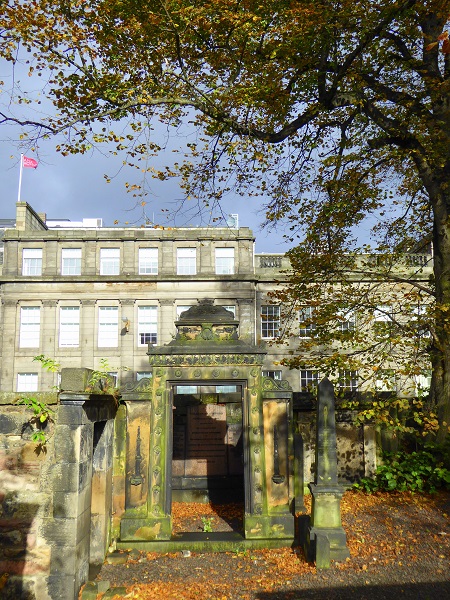
offering its own view over Old College and the Castle one way

and its sister hill the other.

Autumn colours beneath the Nelson Monument

and a view across to Salisbury Crags and Arthur's Seat from one of the several flights of steps downwards past the Old Parliament Building (you see, I became a tourist yet again).

Headed up again past picturesquely ruined buildings which a council worker was, alas, denuding of the luxuriant growth on them, and came out on the lower end of the Royal Mile - again a part of town I only ever visited as a student when guests wanted to head to Holyrood Palace - and it still looked grand in the clear skies, swept by a warm wind after the freezing cold one the previous evening.

Up again past the Pleasance to the South Side, where I had a blissful half-hour at a friendly cafe serving Greek cakes and good coffee (started out in the sunshine outside, but went indoors as intermittent clouds dropped unpredictable rain). This is a view of said street from a pub with a sign that nicely conjures how it was - not so very different from now.

Another happy half-hour in my kind of bookshop which has sprung up near to where Seeds, our favourite vegetarian restaurant, used to be in West Nicholson Street - Lighthouse, 'home of radical books'. That disposed me to want to spend some money here. Serendipity led me to three volumes of nature-writing: Findings by Kathleen Jamie, whom I've admired ever since The Golden Peak, which reflected our own travels in Pakistan's North-West Frontier Province and whose style is elegant here, but there's a bit of a 'why' about it for me so far; Thoreau's Walden in a Thrift edition (cheapskate that am, but it's pleasant to handle); and Nan Shepherd's The Living Mountain, a revelation to set alongside the thrill of J. A. Baker's The Peregrine. I'll be waxing lyrical about both anon. Anyway, I liked the spirit of Lighthouse, and I have to agree with the comment above the book below, not least because I disliked Clegg's use of paradox to sell a book and the way he went about marketing it.

How had George Square and environs changed since the 1980s? Well, there's now the mosque nearby, which has a sensible notice outside making it clear that Allah is the God we all share, if you believe.

And I liked the shadow of the old chimneypots on a completely new facade.

The major damage was done in the 1960s, when nearly half of the square's Georgian houses were pulled down to be replaced by monstrosities like the David Hume Tower. I have very fond memories of hours in the classics library, though, and the views out were fine. The fifth and sixth floors are no longer home to the classics department, though, so having seen how the basement cafe has been transformed beyond belief and taken the lift up, I wandered down and snapped a view with which I became very familiar over four years.

On a sunny autumn day from the other side of the Meadows, even 'the DHT' doesn't look too bad.

Then it was into Marchmont, an area I for some reason envied other students for making their home, though I couldn't have been happier in Dundas Street. I could still live here. This is a nicely maintained front garden, not doing badly in the northern October.

And then I more or less sniffed my way to the Meadows Pottery. Junko, it turned out, was just in front of me as I crossed the road, though she disappeared to work while I spent what must have been nearly an hour chatting with Paul, not least about how Edinburgh had changed for the better since the 1980s. Here are Paul and Junko at the end of my visit, purchase completed.

Paul made the interesting observation that the big increase in Oriental students made street life much livelier: Auld Reekians tended to be closed in public, whereas these folk felt comfortable making public spaces their living room. And I'm glad I flourished my books, because that encouraged Paul to talk about his and Junko's close association with a poet and friend who, sadly, died just after their joint show. I can call her 'the wonderful Elizabeth Burns' because I bought on the spot the volume of poetry from which Paul read, Held, not least for its cover image of a Chosan Dynasty moon jar which I have to seek out in the British Museum.

Much here is about transience and mortality; the central sequence, 'The Shortest Days', was originally published as a pamphlet coming to terms with two then-recent losses. Paul hooked me simply by reading 'The enfolding', which I hope will resonate with you too.
As the potter enfolds air with porcelain,
making, in this new vessel,
a presence round an absence,
containing what's invisible,
and at the same time smoothing into being
something that the hands can cup,
so, walking through October woods
I find myself reaching out
in some ancient gesture
of holding and encircling
as if I clasped my hands
around your body in its sickness -
as if by this I could give you,
for a moment, strength,
fastening more tightly
your spirit to its fragile skin.
Already that makes me perceive the objects Paul and Junko craft very differently. Perhaps it was why I was especially attracted - and rightly judged that J would be less so - to the tea bowls or chawans, some of which are displayed here (I chose one for myself, and a different bowl for J). I love the sensual feel of holding them, the spiral within inside a symbol of the energy between the hands.

There's also a poem in Held, 'In the butterfly house', which applies the difficulty of the creative life to a feeling for it within to Sean and his sister when they were younger. I don't want to spoil it by quoting the relevant lines out of context, but it seems Burns was prophetic, for I've never encountered a performing artist more conscious of the responsibility to go deep and take time than Sean.
By the time I left, it was pouring with rain, so I stopped off at Richard DeMarco's transfigured Summerhall next door for a very late bowl of soup (excellent), and then popped in next door to that, a very odd second-hand shop where I had an odd conversation with an old Edinburgh eccentric about the LPs and blush to say I bought one of The Black Mikado, which for obvious reasons (not least its original cover artwork) isn't available on CD, and I'd never heard the treatment of G&S, which is extraordinary.
Jamie's essay on Surgeons' Hall reminded me that I've never visited, but time was too short as I passed to explore something new, so I reverted instead to Dovecot, and I'm glad I did. Daughters of Penelope was just the right size, and everything in the big space worthy of attention. The first thing I looked at screamed 'Delaunay', and it was - Sonia as realised in fabric.

More local were other eye-catchers in various mediums. Caroline Dear's Soundings iv – hearing the reed’s voice (2016) stitches together reed leaves and casts shadows which compliment the physical work (deliberate, I assume).

Joanne Soroka's For Irene Sendler (2015) rewarded on every level. Simply in the composition of its mixed mediums - cotton warp and wool, linen, metallic tweed and ash keys - it's harmonious.

But there is a deeper significance here. Sendler was a nurse who smuggled 2500 children and babies out of the Warsaw Ghetto - their number represented by the ash keys, which Soroka gathered from an Edinburgh cemetery and painted gold to signify their importance.

Soroka was Artistic Director of Dovecot from 1982-7, Fiona Mathison Director of Weaving from 1976 to 1984. Mathison kept her Sink (1972-3) of cotton warp and wool in her Edinburgh tenement flat, where visitors took it for the real thing. It's been recreated specially for the exhibition and seen for the first time outside her private dwelling.

I love it that the exhibition is haunted by the sound of Hanna Tuulikki's spinning-in-stereo (2013-14), the voices of herself and Mischa McPherson, a singer from the Isle of Lewis, on LP taking a traditional Gaelic spinning-song and treating it to a series of upward transpositions.

For once in an show like this, audio really does complement visual.
After the making, the demolition. I'd already seen and heard the work on razing to the ground the always unattractive St James [Shopping] Centre where Princes Street joins Leith Walk.

It has some resonances - after I'd graduated, I sold cameras in the Boots branch here until I got my summons to my first job in London, as Assistant Editor on Music and Musicians. There is always pause for thought in seeing something once regarded as terra firma so subject to the wrecking-ball of change.

I still had a bit longer than I'd thought I would before returning to the hotel, so I bought some honey and a slice of orange polenta cake in Valvona and Crolla, still somewhere to homage despite its transformation into a mighty empire shortly after I left university, and walked up the side of Calton Hill to catch the late afternoon light over Fife.

I always have fresh experiences each time I return to the Alma Mater, and this splendid day was no exception.


 Posts
Posts