Showing posts with label Liljefors. Show all posts

Tuesday, 23 October 2018

Privileged preview: Stockholm's Nationalmuseum


A more pompous term for it would be 'VIP visit', but what's for sure is that the large group of international journalists present in Stockholm for the Birgit Nilsson Prize ceremony had huge privilege in being given a tour of the Nationalmuseum prior to its public reopening after five years of renovation and reconstruction. Here's the west facade seen from over the bridge, complete with a weekday morning exercise group.


I'm assuming the original idea was to have the sparkling, colour-filled redesign launched 150 years after the original opening on 15 June 1866, when the first exhibition drew more than 90,000 visitors in a city of 115,000 inhabitants, but presumably the work took longer than expected. Anyway, here it all is for the world to admire - a curious collection famous above all for its Rembrandts, including a personal favourite, The Song of Praise of Simeon in the Temple painted in the last year of Rembrandt's life, seen here to the left of the vast and peculiar canvas The Conspiracy of Claudius Civilis which reminds me more of contemporary artist Ken Kiff.


We were lucky to be led, for half of the tour, by Helena Kåberg, project manager of the art collections, seen here beneath Balder the beautiful.


The priority, as she puts it in an interview for the 'Reopen' brochure, was "the lighting and the colours. One of the main principles underlying the new approach to displaying art collections is to use daylight in the galleries. It has been a challenge to handle the daylight flux and complement it with artificial light to create varying experiences'. Our morning, though it quickly gloomed, had started out bright, so the filtering screens were down, but still allowed for views across Strömmen to the Royal Palace.


The colours had been part of German architect Friedrich August Stüler's plans, but the Swede Fredrik Wilhelm Scholander who took over was more conservative. Many of the present schemes revert to Stüler's ideas. They work especially well, I think, in the 18th century French room (two Watteaus on the right here)


and the lilac matches the rather ugly vase in this assemblage.


Once 1950s whitewash had been removed, many of the domes in the ceiling looked like the one furthest away here, which was left as revealed while the rest were repainted and modern essentials like air conditioning and a sprinkler system were installed in the roses.


The Nationalmuseum's miniature version of the Great Court at the British Museum is the Sculpture Courtyard, which is probably the first room visitors enter once up the steps from the entrance. A new dome has been inserted


while the idea in what could well - but hopefully won't - be marketed as 'an ace cafe with a good museum attached' aims to attract families with affordable fishy tapas by a leading Swedish chef Fredrik Eriksson, who laid on a selective but insanely delicious spread for us.


But I leap ahead, mouth watering. After the gathering in the sculpture court, we were divided into two groups. My lot headed to the top floor (see lead pic), to be immediately dazzled by the lighting, especially of the sculpture casts in the niches - Laocoon has never looked so good -
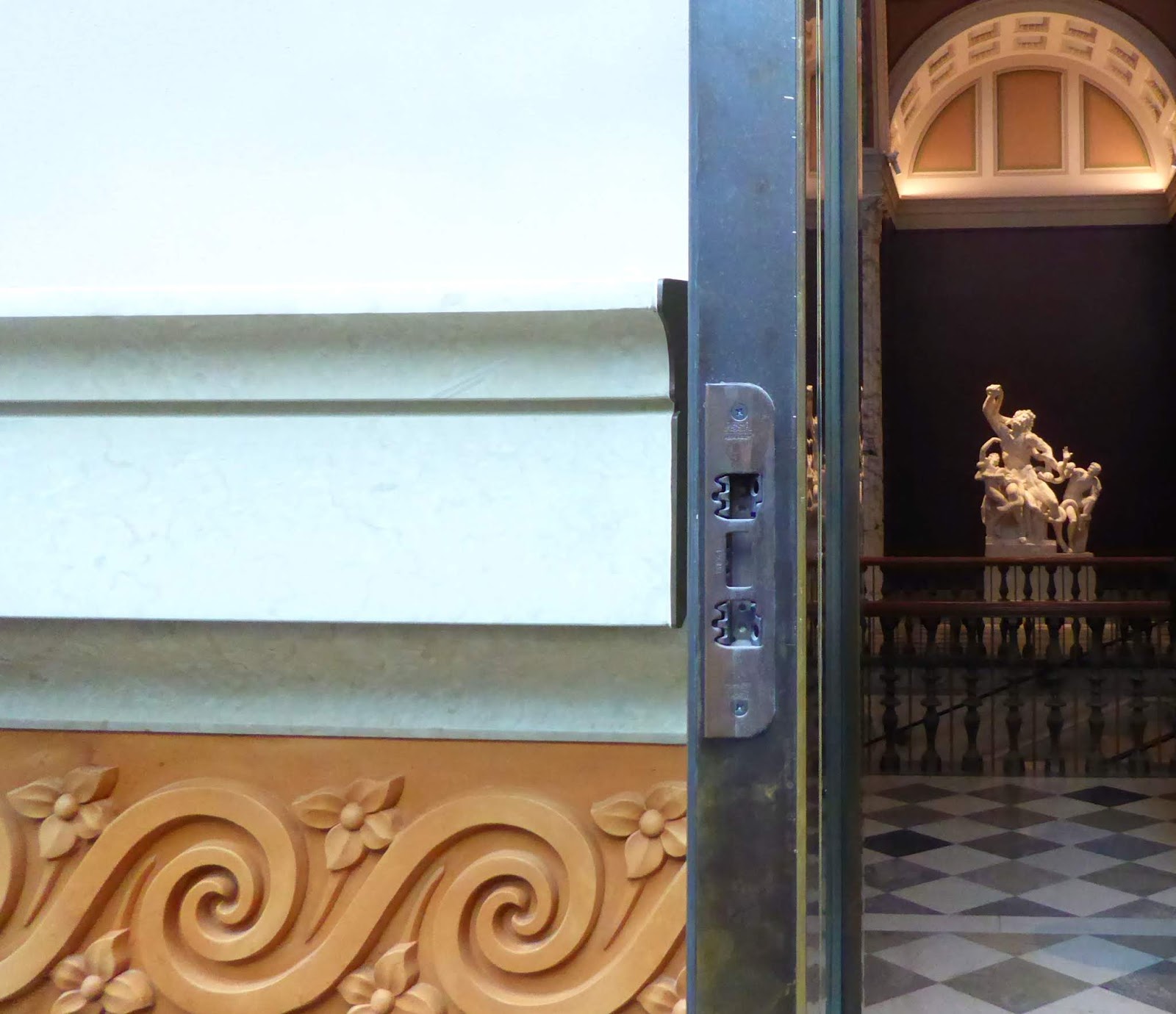

before heading into the picture collection. Its core was assembled by Count Carl Gustaf Tessin (1696–1770), who doesn't seem to have gone that far back into the past; the earliest top notch paintings in the first room are by the Cranachs, including one of the many portraits of Luther


but then, via an exquisite gathering of Rembrandt drawings, we hit the big guns, including these portraits as well as the Biblical canvases depicted above.


After time in the French collection, we rejoined Helena downstairs in the 19th and early 20th centuries, as it were, and moved through the mixed showings of native and international art. It was good to see beloved Liljefors, the best of nature painters, in two works reunited with their original Japanese-style frames.


In a nice parallel to our own V&A, there's a big room of 20th century Swedish interiors with a fabulous and colourful array of designs.


The first big exhibition of the newly-opened building is devoted to John Singer Sargent, with some well-known loans including the National Portrait Gallery's Henry James, second along in the row here,


and comparisons with Sweden's own JSS, Anders Zorn, as here (the Zorn on the left).


I'd be prompted to think more of that great turn-of-the-century collector and gay icon Prince Eugen when I revisited Waldemarsudde, a superb bequest to the nation, in brilliant sunshine the following day. Hungry for more inside, though, on our grey day, I walked over the bridge to the museum island of Skeppsholmen and spent several happy hours in the Museum of Modern Art - a fine collection, but that had better wait for another time.

Wednesday, 16 April 2014

To the Thielska Galleriet


It was a dazzling sunny March morning in Stockholm, so what better than to walk to the most outlying of the city's many galleries and museums, the collection of Swedish banker Ernest Thiel (1859-1947) in the grandiose villa he had built by Ferdinand Boberg in 1904?

By a not unhappy chance, the Gallery wasn't where the Rough Guide put it on the map: that turned out to be the Maritime Museum, where a nice lady gave us a bigger and better map which showed we had another couple of miles to walk across to the former royal hunting grounds on the island of Djurgården and its westernmost tip on the Baltic. Better still, we'd be able to walk back to the city centre via a different rustic route. From the map on the noticeboard at the entrance to the Djurgården, which of course we only saw on the way out of the park, here's the furthermost part of the island with the Thielska Galleriet illustrated.


So let's embrace the grand sweep. We packed up and paid for our night in a clean, comfortable and quiet hotel with a lovely breakfast room, the unpromisingly titled 2Kronor in Norrmalm, and strode out past the church opposite


down to the 18th century Adolf Fredriks kyrkan, unprepossessing enough from the outside but surrounded by a pleasant cemetery with crocuses in abundance.


The inside is minimalist but boasts some fine monuments, not least this one to Descartes, who was buried here for 11 years until his body was removed to France in 1661,


and one of the few which can boast a camel on top, in memory of the explorer Sven Hedin.


Even the modern fixtures sit naturally within the white space, not least this crystal font


and outside there's a simple memorial to Olaf Palme, shot dead outside the cinema opposite in 1986 - a crime that shocked Sweden out of its liberal sense of security.


Then up the hill on the other side past the Johannes kyrka, one of several grand cousins to Victorian St Augustine's Kilburn but with a pleasing wooden church in its grounds


and past the Royal Library with workers and students basking in the sun through the posh district of Ostermalm, with its deco designs writ large (as is so much, rather inappropriately, in central Stockholm).


Linnegatan finally ends at the waters of Djurgårdsbrunnsviken, where a statue of Diana and a stag (Actaeon transformed) reminds you of the hunting grounds across the inlet.


Stockholm's suburbs now give way entirely to nature,


with plenty of joggers and strollers out in the spring sunshine. Here's bracket fungus on a waterside tree


and now we're out on to the Baltic via a narrow canal which is all that separates Djurgården from the mainland.


Around the shoreline, and then the over-imposing dome of Thiel's villa on an eminence comes in view.

We were, of course, ready for lunch after our exertions and the Thielska Galleriet's light, airy cafe serving superlative soup and cakes did us proud (the house has been under state control since Thiel, virtually bankrupted after the First World War, bequeathed it in 1926). We'd just missed an exhibition on naked Swedish manhood, worse luck, which meant that the downstairs rooms were empty, but the gallery spaces on the first floor are the thing, approached by a staircase immediately displaying the idiosyncratic nature painting of the wonderful Bruno Liljefors, a good friend of the not entirely conventional Thiel (who described himself in the third person as 'a banker with a mind of his own').


All the interior shots, incidentally, were taken without flash, and there was no-one in attendance in the empty rooms to ask if I could or couldn't: what a delicious far cry from National Trust properties where you'll be mugged by anything up to five old volunteers in attendance wanting well-meaningly to intrude on your absorption.

Undoubtedly, despite many more obvious masterpieces, the picture I'd most like to take away with me from the Gallery is Liljefors' Winter Hare. This one, reproduced on Wikimedia Images, isn't quite the same, with the hare more in motion and less snow clumps on the vegetation, but it gives you some idea.


Liljefors also painted a very fine scene with a curlew which would be my second choice. The next great painting hangs above the piano in the central first floor room. In Five Portraits Vilhelm Hammershøi, now hugely popular in the UK thanks to a stunning Royal Academy exhibition and the championship of Michael Palin, depicts his younger brother and four friends in sombre mood around a table with candles and glasses (in one of the Thielska's few marketing ploys, you can buy replicas of those glasses). I'd use the Wikimedia image but it's much too dark.


A room to the right is all contrasting light, hung with the mostly sentimental pictures of Carl Larsson. I do like the two male portraits either side of the clock here, though.


And then comes another surprise, of which the leaflet with its very strange choice of illustrations gives no hint: another large gallery room full of Munchs, including his portrait of Nietzsche above a hideous piece of furniture which would surely give the philosopher a nasty turn in his grave.


I'd like to know more about Thiel's connections with Nietzsche. I think the acquaintance might have stemmed back even to before he took up with the circle of cultured Signe Hansen, the woman for whom he so scandalously left his wife. At any rate Thiel funded a luxury edition of Also sprach Zarathustra and a proposed Weimar archive. It's not surprising, then, that the death mask of the great man greets one in an attic room


surrounded by Munch prints, all of which remind me that this is the aspect of the artist's work I like the best.


The Scream looks best in that form, too: Thiel's lithograph has a hand-written insciption which reads 'Ich fühlet das grosse Geschrei durch die Natur' (' I felt the great scream [resounding] through nature'). Back in the downstairs room there's also a treasurable version of the girls on the bridge


and Munch's portrait of Thiel himself (left)


while up the stairs three of Strindberg's nature scenes, perhaps not his best, hang together


next to a vivid Toulouse-Lautrec and an exquisite tiny Vuillard interior.


Now it was time for the exterior - mostly under scaffolding, but haunting at a distance under the beeches beyond the wall.


A haze had gathered over the view of the distant Stockholm skyline (third picture up top) and we rounded the peninsula past the old customs house where boats enter the city harbour were obliged to stop.


Snowdrops appeared on a nearby rise


and then we arrived at the bird-loud lake we'd only seen (and heard) from the other side of the canal.


Its chief attraction is the heronry high in the trees.


I'd never seen one before, and so it was all the more surprising - and just a little deflating - to find a smaller one on the lake island of Regent's Park a couple of weeks later. This one, though, was rather spectacular


especially as I'd always thought of herons as solitary birds, perched at distances along the Thames. We even saw a couple on one of the nests


and further east a duck or two I'd be pleased if someone could identify for me.


Palace buildings and monuments became more frequent as we came closer to the park entrance, including this statue of Jenny Lind.


And then, with one look back across the Djurdgårdsbrunnviken to the radio tower on the Ladugårdsgärdet,


we were at the gates


and crossed the most picturesque of Stockholm's bridges


back to Ostermalm, passing Dramaten where years before we'd seen an interesting production of Three Sisters with each act set in a different 20th century decade, and Bergman actress Stina Ekblad (the androgynous Ishmael in Fanny and Alexander) as one of the sisters.


Bergman has the most miserable street imaginable named after him behind the theatre


but there are grander allees up towards the Konserthuset, namely the cinema street of Kungsgatan, with the familiar Svenska Film motif everywhere


and the gigantic towers of, what, the 1930s, giving a green light to the outsized developments of later years. With which, as our day's walking was over and we had only to return to the hotel before heading out for our friends in deeper nature further south, I take my leave in a shot to complement our starting point.