We packed quite a lot into 1 and 2 January up in North Norfolk - a familiar route from Lower Southrepps to Cromer for the fireworks on New Year's Day, starting with the usual perspective of St Michael's tower up across the fields,

and on a duller sequel, weatherwise only, indulgence of my heart's desire to see the famous medieval screen at Ranworth, the most elaborate in the county.

Norwich on New Year's Eve was a disconcerting mix of bleak-midwinter lanes and lights with way too many homeless people, all of the ones I met touchingly friendly (though as I well know Norwich has a big drugs problem). We were there to spend the greater part of the evening at the house of friends Kate and Fairless in Norwich, where I got to meet a poet I much admired, and whose The Photographer at Sixteen I'd just chosen as one of my books of the year, George Szirtes, and his equally friendly and interesting wife, the artist Clarissa Upchurch. Back in Jill's garden, we got simple pleasures from waving sparklers around at midnight - I was thankful not to be in hospital, as I was at the same time a year ago - and then set out not too early the next morning, heading for lunch at the Vernon Arms up the hill in Southrepps village. The sun popped in and out through mists and cloud, eclipse-like.

We spent far too long over lunch, and sunset seemed not too far off when we left. The light was pleasingly on the west tower of St Michael,

and a lingering sunset gave us various lights over the fields.


Walking along a favourite lane parallel with the lovely woods at Frogshall, the moon was apparent

and gnarled trees foregrounded the view back down the hill.

Dawdling a bit, thanks to the camera, behind the others, I took what intuitively seemed a left turn at a road when I should have taken a right. At least I had a good perspective on Northrepps.

After the village, I fell in with a very jolly couple, Sue and David, who had come out for a brief spin with their lively rescue dog, Tyler. They decided to accompany me all the way to Cromer before they turned back along the beach. It was a joy to see Tyler cavorting around the golf course on the way up to the cliffs. We enjoyed the high beam of the lighthouse before descending towards a seaside town that seems to be really on the up again.

They'd loaned me their mobile phone - I'd left mine in the cottage - to contact the others, so we knew we'd meet up at the church where on a previous occasion we'd so enjoyed the party spirit within.

Now I was too late for tea and cakes, but not for the fireworks, which did their usual stuff from the pier,

after which we took a packed train, full of human interest, back to Gunton.
The next morning Jill drove the same route she'd taken to the start of the Churches Walk in September. This time she proceeded beyond Wroxham to a Broadside road towards Ranworth; we were heading for edifices that wouldn't join up so easily on a future walk, due to the disposition of the Broads and channels blocking direct routes. We stopped along the way at the fascinatingly-named Woodbastwick. Bast is a substance found under the bark of lime trees; Danish and Saxon invaders used it for binding in leggings, seen being tied on the village sign.

A green with thatched houses around it is attractive. The church, which goes by a unique dedication to SS Fabian and Sebastian, has a loved, used feel about it, but as it was heavily restored by George Gilbert Scott in 1878-9, there's not a lot to see here, though the Victorian and Edwardian glass is attractive enough. The setting's the thing, the south porch approached via an avenue flanked by some splendid old yews.

The exterior of St Helen's Ranworth barely hints at the treasures within (though why would it? It's handsome enough, not especially grand).

The screen's one of several extraordinary treasures here. You (that is, I) may prefer the angelic ensemble of nearby Barton Turf, with its radiant seraphim and cherubim, which we saw - but not really for long enough - back in September. Undeniably, though, the complete arrangement here is grander, running the full width of the nave. On the main panels in the centre are the twelve Apostles. Left side, with St Stephen to the left, Simon, Thomas, Bartholomew, James the major, Andrew and Peter,

Right side: Paul, John, Philip, James the minor, Jude and Matthew.

Either side, assorted saints and martyrs both in niched spaces backing altars, seasonably adorned on 2 January. I've clearly missed out on the left altar but here on the right are Mary Salome, the Virgin Mary, Mary Cleophas and Margaret of Antioch.

The angels above come close to the loveliness of Barton Turf.


Indented, and perhaps finest of all, in the centre entrance to the choir are two saints facing each other: George with the dragon

and Michael

with his feet on the seven-headed beast of the Apocalypse.

This saint is especially appropriate in his anniversary year: Thomas Becket, Archbishop of Canterbury.

though the details on Saints Jude, Matthew and Laurence are perhaps more interesting from a painterly point of view.

We have the iconoclasts' habit here of covering the faces in brown paint rather than scratching them out to thank for the saintly ones' survival. Above, on the ribbed coving is a design of local flowers so fresh I assumed it was of a more recent provenance; apparently not, in essence.


The return stalls have a few good misericords

while on the back of the screen behind, a floral design was revealed relatively recently

and the cantor's desk, which I assumed was a later relic, is from the same time, with an eagle and the opening words of St John's Gospel on one side

and on the other a versicle in plainsong.

Looking at the postcards, I was wondering where the obviously wondrous illuminated antiphonary, c. 1400, was lodged. It turned out to be in an unassuming glass case to the left of the south door. You'd have thought this was too precious to remain in an out-of-the-way church and might be more likely to be found in Cambridge's Fitzwilliam Museum, but no, here it is. and open at the most appropriate of the 19 miniature paintings (another featured Jonah and the whale). It's photographed rather well through glass without flash.


We had lunch at a more or less deserted place by Ranworth Broad which clearly caters for mass diners at spring and summer weekends, but at least it had kept a good sign with a design that could almost be by Ravilious.

Then, as gloom and mizzle seemed to be setting in, we abandoned plans for a walk and drove to see two/three more churches on our way to Norwich to catch the train back to London. South Walsham is a long way from North, a small village and not a town, but with two adjacent churches.

St Lawrence (closest in the picture), which was burnt out in 1832 and its chancel rebuilt by 1832; it's now a craft centre where local ladies hardly welcomed us as we walked in with a cheerful 'hello', so we didn't linger. St Mary has a Perpendicular south porch with a Coronation of the Virgin in the niche above the entrance.
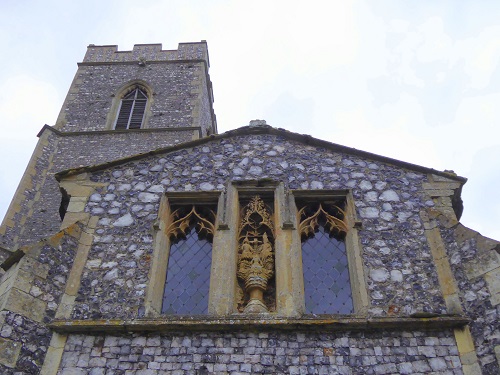
There's also some nicely coloured Edwardian glass, including an unusual personification of Astronomy by R. O. Pearson.

Acle, further south, sounds rustic but no longer is, sprawling along several main roads and its church tower not prominent enough to help you find the building easily. But it lives in its own rather lovely little world, trees lining the pathway to the north porch, and the whole seemingly remote in the gloaming. The round tower has an octagonal 13th century (says Pevsner; 15th century according to Harrod and Linnell) top storey surmounted by statues.

We couldn't find a light switch other than for the porch, so the inspection of St Edmund's gems was also atmospheric, by the light of mobile phones. The font, donated in 1410, is surely one of the best in Norfolk, with four lions and four wild men (wodewoses), identical to the ones in Happisburgh's St Mary, but with remnants of paint still on them.


Around the bowl are (thus Pevsner) 'four angels and the Pietà, the Trinity and further angels with the Emblems of the Trinity and the Instruments of the Passion'.

The rood screen boasts a dado wih pretty ornamentation including multiple IHSes.


This double-headed bench-end looks good by mobile light.

Below the north chancel window are a brass to John Swinne (died 1533)

and above it, not really to be made out in the photo, an early 15th century Latin inscription from a time of plague.

The translation - for which I'm indebted to Simon Knott's Norfolk Churches site goes thus:
Oh lamentable death, how many dost thou cast into the pit!
Anon the infants fade away, and of the aged Death makes an end.
Now these, now those, thou ravagest, O Death, on every side;
Those that wear horns or veils, Fate spareth not.
Therefore, while in the world the brute beast Plague rages hourly,
With prayer and with remembrance deplore Death's deadliness.
May it not become an incantation in time of Coronavirus.


 Posts
Posts



