
It was my one full day free from Wagner in Budapest - magnificent, unforgettable, now chronicled on The Arts Desk - and I decided to visit somewhere upstream. The choices were plentiful: Szentendre, Esztergom, Vác, Visegrád. So I set off through the Budapest streets on the hottest day of the year, shaded by its art nouveau-d or neoclassicized tall buildings - no time to pause and namecheck with guidebook -


to the Nyugati Station to see what was going where. Vác cropped up the most as a destination, only an hour away, so I bought a ticket and hopped on a train there (Budapest to Vác, incidentally, was Hungary's first rail line, from the time of this now very quiet town's livelier past). While settled and guide-studying, I realised that another train and a ferry would take me to Visegrád on the Danube bend.

In the meantime, I had a couple of hours in this very pretty place with a grim more recent history.

Claudio Magris, who like Simon Winder in Danubia and Péter Esterházy in his much more selective and typically funny/quirky/profound The Glance of Countess Hahn-Hahn (down the Danube) ignores Visegrád in his own Danube, sums up Vác perfectly:
This little town, also rich in memories of bloodshed, is really beautiful, with its Renaissance and baroque buildings...on the way from Vienna to the Tartar Crimea, the noble gentleman Nicolaus Ernst Kleeman complained about Hungarian innkeepers in general, and those of Vác in particular, saying that among them one found 'the quintessence of inkeeperish incivility': the food and drink were bad, served in filthy kitchenware at exorbitant prices. But Vac has seen worse. In the Theresianum, the old academy for the sons of nobles built by order of Maria Theresa and later converted into a prison, the Horthy regime imprisoned and eliminated the militants of the workers' movement.
I certainly didn't avoid this edifice on purpose. But my free ramble didn't take me close to it. The walk from the station is one long, mostly pedestrianised, provincial shopping street, very pleasant. It ends in the Marcius 15 tér. The town is clearly proud of its showcased 12th century remains, central to the square, which is dominated on one side by the Town Hall

and on another by the Dominican Church.

Outside it a holy dedication was neatly formed with rose-petals, lime-blossom and other vegetation.

Not the approximation to the colours of the Hungarian flag on either side.
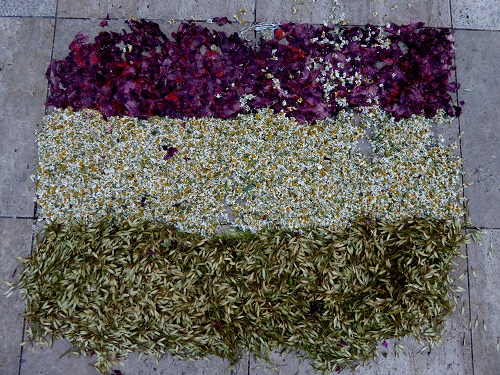
A blackbird was presumably enjoying the pickings.


It's hard to believe that under Turkish occupation there were seven mosques here. The Catholic takeover lost no opportunity to replace them with churches. The bishops of Vác have left quite a legacy; several of the religious schools are still in use as centres of indoctrination. Heading south-east down Köztársaság Utca, you first hit the Piarist Church and handsome row of buildings alongside it

with a holy trinity statue group dating from the 1750s opposite.

Then there's a big square dominated by the Cathedral.

Its French classical ('revolutionary', though pre-1781) look the result of Bishop Kristof Migazzi's instructions to the architect Isidore Carnevale. The huge Corinthian columns are its most striking feature.

The interior has now been restored to its original pomp; Migazzi didn't like the fresco behind the altar and had it bricked over. It was only rediscovered during restoration work in the 1940s (*shrugs*).

Walking past the lively pupils of the Piarist grammar school, I found my way down to the river with an abundance of trees and the inevitable lime blossom smell which had overpowered us on Budapest's Margit Island a couple of days earlier.

You're looking across not to the main opposite bank of the Danube but to the enormously long Szentendre Island which effectively runs from Visegrád to the northern tip of Budapest. Which is why Danube boat trippers would tend to see either Szentendre or Vác, not both, unless they made a detour.
After a quick lunch in the central cafe, I took another train up what is now the spectacularly beautiful Danube bend to Nagymaros, graced with the best view of Visegrád and a beach which was clearly much enjoyed by people, dogs and swans.

I headed straight for the hourly ferry, which left within minutes and likewise took only minutes to cross to the other side.

'Visegrád' is the name for 'high castle (or city/citadel)', given by the Slav tribes who settled here. The strategic castle on top of the hill replaced a Roman fort; it's both ruinous, though parts have been restored, and not as spectacular as I was anticipating from the description of János Thuróczy in 1788: 'upper walls stretching to the clouds floating in the sky, and the lower bastions reaching down as far as the river'. Not Valhalla, as it turns out, but still quite impressive.

The real ruined gem is hidden from initial sight, and you have to take the road into the village proper to see it: the royal palace of King Mátyás Corvinus and Beatrice of Aragon/Naples, who may have plied her influence to make this a place of Renaissance splendour, described as a 'paradisum terrestrium' by the Papal legate Cardinal Castelli.

I only got thus far into the palace site, intending to plough on in my remaining hours up the hill, but I should quite like to have seen the reconstructions of courtyards, Hercules and Lion Fountains (pieces of the originals are lodged either here or in Solomon's Tower, which unlike the palace is, like the citadel, a landmark from a distance.

Maybe best to imagine the palace as Antonio Bonfini defined it, describing 'a large number of magnificent and spacious halls, porticos with snow-white facings and beautiful windows, as well as a terraced garden and splashing fountains with ornate red marble and bronze basins'.
The real hard sell here now is of medieval knights and jousting. There was hardly anyone around on the Tuesday I visited, but you could tell from the craft-y shops and 'armoury' that it could be hell on a weekend. Perfectly good visitors' centre, though, and the lavender planted outside the information office looks good if selectively photographed with the citadel behind it

as well as being a haven for bees and butterflies.

I walked on into the village, poked around a rather interesting antiques shop with plenty of rooms, pondered buying a Napoleon campaign plate, decided against it, found the start of the route to the citadel behind the post office - and quickly realised as my head began to spin that despite all the water I'd consumed and was consuming, heatstroke might seize me if I ploughed on up. So here, above the church, I halted in the shade
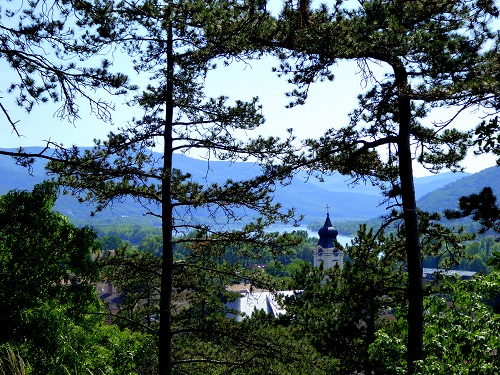
and walked onwards for another 10 minutes or so, with fine views of the Danube and the hills when open spaces appeared between the trees

and plenty of bird and butterfly life, as well as these sempervivums on a rock,

before the path started to ascend steeply, whereupon I turned back and down to the pizzeria in the row of buildings leading up to the church

for one of those very special Hungarian lemonades. The heat was going out of the sun and the sky turning bluer as I headed back down the high street - shouldn't omit another bird here, a thrush, pert to my left -

for the 5.30pm, two-and-a-half-hour boat back (the only one - it heads up from Budapest in the morning and I think goes as far as Esztergom on the border between Hungary and Slovakia).

Soon after rounding the promontory past Solomon's Tower,

the scene opened up and for much of the way there were nothing but trees and water. It seemed a shame to be saying farewell to the Danube bend having only just begun to discover it,

but the views back continued to open up in the deepening light

and the vegetation on the banks of the island to our left could be mistaken as Amazonian.

The occasional groups of birds came into sight either on the beaches or up certain creeks. I could hardly see exactly what I was snapping here, but closing in reveals not only two herons but also - widespread through the world, but not that common - a black stork.

A very jolly white-kimonoed Japanese gentleman, two French cyclists and myself seemed to be the only non-Magyars on a lively boat full of Hungarian scouts and elders.

Many disembarked at Szentendre with its Serbian past, the first major sign of human habitation since we'd left Visegrád. I want to come back here on my next visit to Budapest and stroll around at leisure.

Magris calls the town 'the Montmartre of the Danube'; I'd prefer to think of St Ives, but the point in both cases remains the light that draws artistic colonies to such places. It was quiet even here at about 7pm. Then we moved outwards

and onwards

to Budapest, signalled first by the southern end of Szentendre Island just past a road bridge which connects the island to both banks.

Then there were lots more holiday chalets, then joggers running round the track that surrounds Margit Island in Budapest proper
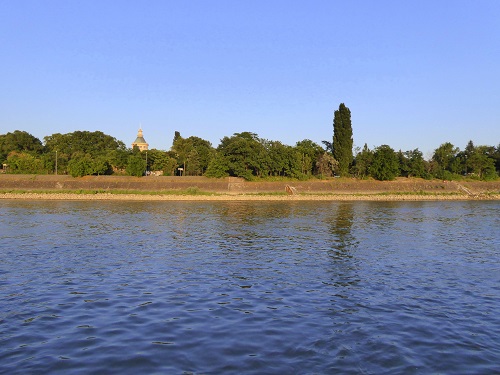
and the Margit Bridge came into view, with the Gellért Hill behind it

and then the ever-impressive Parliament Building appearing on the other side.

As the boat made its first Budapest stop at Batthyány tér close to where we'd stayed for the first four nights as guests of J's friend Marie-France André at the Belgian Embassy, a bigger pleasure cruiser and a more humble tourist boat negotiated in front of the Parliament

and then we reached our final destination at the Vigaro tér pier just as the sun was setting over Buda.

Alone but not lonely after many days of lively socialising, I headed back to the excellent Gerlóczy Cafe and Brasserie which our friend Ildiko had chosen for our pre-Götterdämmerung Sunday lunch - it was no hardship sitting outside in front of the trees and the statue watching the world - and back to the hotel for an early night before the final assault on Parsifal at 4pm the next afternoon.


 Posts
Posts



