Showing posts with label Pevsner. Show all posts

Thursday, 9 September 2021

Norfolk Churches Walk preludial

Having reached our 233rd Norfolk church (mostly pre-Reformation, though we've always thrown in a few Methodist chapels) a year ago, we're off on another walk for the Norfolk Churches Trust this weekend. Plans in brief are to rove the Wensum Valley and collect specimens in Elsing, Lyng, Great Witchingham, Little Witchingham (the semi-ruined one with the medieval wall paintings), Swannington, Alderford, Attlebridge, Morton-on-the-Hill and Weston Longville. 

While I have your attention, you can donate via the Norfolk Churches Trust Just Giving website (please say that it is for David & friends). Otherwise, cheques made payable to the Norfolk Churches Trust can be posted to me at home (if you don't have the address, message me privately with an email and I'll send the address). Alternatively, a kind word never goes amiss.


This time we won't be taking in the wonderful Norfolk coastline, as we did on perhaps the most varied walk of all in 2017. We revisited Happisburgh two weekends ago, as these photos attest, more by happenstance since the crab and lobster shack at Overstrand had sold out, and so had the van at Mundesley; the girl blamed Brexit for the lack of foreigners in the trade. Our host Jill drove us southwards, and at Happisburgh to our surprise we found a shop selling what we wanted. So it was down on to the beach, just as the grey skies cleared. for a picnic under the cliffs (but not too close). Rough seas forbade swimming, but walking along the shore brought the usual frissons this quite dramatic part of the coast produces.


Thought we'd also return to the beautifully restored long barn at Waxham, hoping that this time we could get in as back in 2017 there had been a wedding reception. Same in 2021, but of course we stopped for tea. Waxham is a lonely little place behind the dunes which must be very atmospheric in the bleak midwinter. It has a somewhat schizoid existence because of the rather dilapidated farm and church on the one side and the popular tea-place which helps keep the barn in good nick


while the west end looks almost church-like with its lancet windows.

The melancholy pleasure of semi-ruins begins as you walk around what remains of Waxham Hall, a rather dilipidated farm from which the church tower can be seen from the west.


The walls of the old hall are splendid, with what Pevsner calls 'polygonal angle buttress shafts crowned by finials'

and a 15th century gatehouse, seen here from one of the church windows.

St John's feels very lonely on the seaward side

though its treasures are disproportionate to the care (not) lavished on it, starting with the traceried spandrels above the south porch entrance,

the now-mossy/mildewy Perpendicular font with quatrefoils

and the early Elizabethan, effigyless monument to Thomas Wodehouse

which contrasts pleasingly with the restraint and plainness of the church as a whole - I like these unvarnished buildings.

A splendid ruin ('one of the best...in the country,' writes Pevsner) contrasts with a rather lugubrious Victorian church in the grounds of St John the Evangelist Stanmore, which we reached at the end of last Sunday's walk in intense sunshine, led by our friend Jimmy. The old building was consecrated by Bishop Laud in 1632, and its first feature of interest is the red brick.


The interior has been closed since Lockdown, but you can see enough through various gratings. It's dominated by the 1866 Gothic Mausoleum to the Hollond Family of Stanmore Hall - clearly the Victorians were still using the old church as an extra cemetery.


The most striking monument in the graveyard proper foregrounds a perspective on the old church

and turns out to be the grave of W. S. Gilbert and his wife Lucy. Famously, Gilbert died of a heart attack while trying to rescue a young woman whom he was giving a swimming lesson in the lake at his country estate of Grim's Dyke. Handel, incidentally, has associations with Canons and St Lawrence Church a few miles away, owing to the connection with Lord Chandos. We must make another visit to see that splendidly decorated church.

Inside the Victorian edifice, there are several old monuments, best known being that of John Burnell (died 1605) and family, twice restored.

Then, rather unexpectedly in a side chapel, is the marble figure of Sir John Wolstoneholme (died 1639) by Nicholas Stone.

The much more recent glass provides some comedy specials in two saints - the first a Marvel comic hero, the second a simperer who doesn't look capable of slaying dragons.
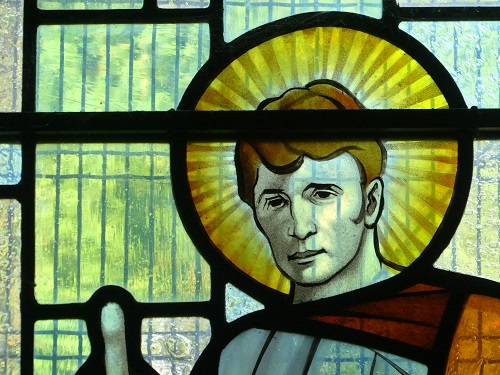
There are, however, two sets of glass which prove noteworthy, though neither is mentioned in Pevsner. First, Burne-Jones angels in an appropriate frame


then, on the other (north) side, peacock wings on angel and lion.


We'll be seeing older glass than this in Norfolk, but the design and execution are surely both first-rate.

Thursday, 14 March 2013

The only way is Essex - 2


It's thanks to people power, civic pride, call it what you will, that anything substantial remains of Waltham Abbey. Founded by Harold Godwinson in 1060 before he was king and a mere Earl of Essex and East Anglia, it became an Augustinian abbey - and another building was erected - during Henry II's penance for the killing of Thomas à Becket. Henry VIII loved coming here, not least to discuss his divorce issues, which sealed the abbey's doom but also explains why this was the last of the monasteries to be dissolved. The churchwardens saved the nave from destruction on the grounds that it had always been the parish church.


This exterior shot shows a jumble of styles: the spacious 14th century south (now Lady) chapel makes a very prominent addition to the Norman nave, the west tower is even later - a post-Dissolution afterthought - and the east wall with its wheel window dates from the Victorian era. 

The 16th century rescue explains why the building is only one third of its original length, 100 feet - I still can't think in metres - of nave with chisel-patterned Romanesque columns uncannily close in design to those of Durham Cathedral (there was probably a connection).

There are also a Victorian replica of the zodiac ceiling at Peterborough (I like it) and a rather remarkable remodelling of the east wall in 1859-60 by William Burges. Pevsner dismisses its 'robust ugliness' and finds it 'astonishingly loud after the silent severity of the nave'; Norman Scarfe in the Shell Guide, much fonder of Victoriana, thinks it was 'brilliantly remodelled', and again I tend more to his opinion.


No disagreement seems to flare about the glass in the wheel window and the three single lights, among Burne-Jones's finest. Sadly my handful of details won't stand up to close inspection.

The abbey church has its fair share of individual treasures. Chief is the Denny memorial. It can only be seen as a whole from the seats one side of the sanctuary (I got told off by a charmless warden for putting aside the rope very briefly to do so).


Sir Edward (d.1599), privateer turned rebellion-suppressor alongside Raleigh, clasps the sword he swished about so infamously in Ireland and is recumbent above his wife Joane in the central niche. The repainting of 1965, by a Miss Northolt, may be a little crude.


Below them are six sons to the left, looking like little Camerons (could Miss Northolt be sure that four had reddish-brown hair?)


and on the right three girls and a boy apart, apparently the twin of the sister whose arm he clasps.


Above are the appropriately balanced figures of Fame


and Time.


Beyond the monument is the markedly different 14th century south chapel. I'd hardly agree that the Doom/Last Judgment painting from the same period is 'very faded', as Pevsner insists; you can see exactly what's going on with the blessed souls on the left


and the monster into whose maw the damned are heading.


Another monument is well worth examining, this time in the north aisle. Scarfe does the words for this: 'Captain Robert Smith's white marble-altar tomb, 1697, carved with cherubs in tears, displays his ship, Industria, sailing through a sea full of dolphins'.


Heading west, you pass the bust of a Romanized Henry Wollaston, JP (1670) on one side


and a pretty Stuart pulpit on the other, restored to its rightful place since Pevsner wrote of its removal.


On the way out, I admired the beasts inside the west tower, though I suspect they may be Victorian: very splendid in what little light there was by late afternoon.


There's plenty to see in the abbey grounds, chiefly intriguingly embedded walls and the proposed site of Harold's remains. I suspect it must all be rather beautiful in fine spring and summer weather. A solitary budding gave promise of things to come:


On that bleak February day, though, it was too freezing to linger. I walked to the 14th century gatehouse


but we abandoned our plan to do a circuit round this part of the Lee Valley. Instead we had a very late comfort lunch in a pleasingly old-fashioned cafe looking out on the abbey grounds, gaping through a window with a bullet hole in it (!) at various folk exercising their whippets and pitt bull terriers. A quick spin up a high street with a surprising number of occult and witchy shops, and then we made our way back along the desolating busy road to Waltham Cross station, the view on the return journey even less promising than the outward journey since at least there had been Waltham Abbey's tower to lead us onward.


I must at least insist that we've seen a bit of sun and warmth since then. One day of it, in fact, last Tuesday, when spring was in the air before blizzards and ice struck again. I shifted my work around, having been told it wasn't to last, and cycled down the river to that wonderful free amenity for all, Chiswick Park. I've written about this perfect - and more recently beautifully restored - 18th century landscape garden here as well as here (comparing it with William Kent's work at lovely Wotton) and here, but the spring light and attendant blessings have to be recorded. Above all the circular patch of crocuses to the south of Burlington's villa,


the beauty of bare branches against blue sky and the white house exterior,


steam rising from the pool in front of the Ionic Temple,


and more promise of blossom to come, this time against an almost azure rather than a grey background.


Everyone was in a benign, friendly mood given our one day of grace. The only thing that irked was the huge admission fee being charged to catch camellia blooming time in the Victorian greenhouse (once free). Anyway, it can't be too long before the robins nest again now, can it?