Showing posts with label President Zelensky. Show all posts

Wednesday, 31 December 2025

Slivers of light for 2026

This is Siena's Fontebranda, mentioned in Dante and other Italian classics, built in the 13th century by the Guild of Woolmakers. We revisited it in brilliant sunshine on St Stephen's Day after a splendid Christmas feast which began with a Swedish breakfast, 

and still the light broke through in patches. If I use it as a metaphor for where we are now, it's a loose comparison: we try to swim in the strips of light, aware that millions around the world are confined to the darker patches (where carp and goldfish glide, nevertheless). 

I know that my own life, for all its setbacks in recent years, is a lucky one, not least in the freedom and the resources we have to wander Italy and discover new places in the weeks leading up to Christmas each year. But the darker patches have become muddier for Americans, Ukrainians, Sudanese, trying or failing to lead their own private lives as public disaster engulfs them. There's some hope that the light may expand in the mid-terms, that this horror that the USA is going through, to which so many of its citizens don't seem to be fully awake, may be at least partly reversed and its perpetrators may face some kind of justice. 

Not sure whether Zelenskyy's New Year message is posted on Xitter or not - what the hell at this particular point - but it has special eloquence in stating 'what keeps us going: experience and memory, the world of home, hope and faith'. We all understand that, except perhaps the tyrants of the USA and Russia, wishing each other a happy new year full of further destruction and loss of life. And hopefully more people will realise the possibility of collective action.

America may turn things round, but I fear the UK is heading towards the worst, currently reeling under a Labour government persecuting protesters, refusing to call the Israeli murder of Palestinians what it is - genocide - and banging on about growth. Who will take over from all this - Deform, or the hope offered by the Greens? Anyway, Ireland beckons, where marching for Palestine still doesn't leave anyone in danger of arrest, where despite problems things are relatively good right now. We see how that can all change. On the personal front, the fire-destroyed disaster that was my London study, photographed here by Bill Knight,

is finally being cleared, and there's some order in the new flat insurance have provided on the other side of St Andrew's Church. 

In the meantime, here's a last glimpse of early morning light in Torino on our last morning, in the square where we stayed, with the Alps seeming so close at the end of the street,

and the 30th looking over to Dublin's Vesuvius, the Sugarloaf mountain, from Sorrento Park in Dalkey - Killiney Bay = the Bay of Naples... 


Athbhliain faoi mhaise daoibh! And yes, I had to look that up, but I fully intend to take Irish lessons in 2026. What comes more easily to me is the quotation from the end of Dante's Purgatorio, which Sophie painted on to her brilliant hallway floorcloth with a reference to the contrada to which she has been admitted, Onda. 

In English, straightforwardly (there are some very fussy translations out there):

I came back from that holiest of waves
   remade, refreshed as any new tree is,
   renewed, refreshed with foliage anew,
pure and prepared to rise towards the stars.

May we all find access to that 'holiest of waves' in the midst of our dark wood. One last quotation, the most potent of all if not necessarily the most poetic, from Aeschylus's Agamemnon: αἴλινον αἴλινον εἰπέ, τὸ δ' εὖ νικάτω - 'Cry sorrow, sorrow, but may the good prevail'.

Wednesday, 2 March 2022

The bombing of Babyn/Babi Yar

The name has horrific connotations for all of us. Yesterday Russian forces hit not only Kyiv's TV tower but also the memorial which hadn't been constructed at the time Yevtushenko wrote his famous poem, marking the Nazi massacre at the ravine outside the Ukrainian capital. Four people visiting it were killed. I found on YouTube film of a performance of Shostakovich's Thirteenth Symphony, setting this and other Yevtushenko poems I didn't know had taken place - conducted by Thomas Sanderling, Russian-born son of Kurt, on the very site last October, to mark the 80th anniversary of the atrocity. As there are no subtitles, here's a translation of the poem by Benjamin Okopnik. Here's a link to the website where I found his translation. Certain horrible ironies resonate there now.

No monument stands over Babi Yar.
A steep cliff only, like the rudest headstone.
I am afraid.
Today, I am as old
As the entire Jewish race itself.

I see myself an ancient Israelite.
I wander o’er the roads of ancient Egypt
And here, upon the cross, I perish, tortured
And even now, I bear the marks of nails.

It seems to me that Dreyfus is myself.
The Philistines betrayed me – and now judge.
I’m in a cage. Surrounded and trapped,
I’m persecuted, spat on, slandered, and
The dainty dollies in their Brussels frills
Squeal, as they stab umbrellas at my face.

I see myself a boy in Belostok
Blood spills, and runs upon the floors,
The chiefs of bar and pub rage unimpeded
And reek of vodka and of onion, half and half.

I’m thrown back by a boot, I have no strength left,
In vain I beg the rabble of pogrom,
To jeers of “Kill the Jews, and save our Russia!”
My mother’s being beaten by a clerk.

O, Russia of my heart, I know that you
Are international, by inner nature.
But often those whose hands are steeped in filth
Abused your purest name, in name of hatred.

I know the kindness of my native land.
How vile, that without the slightest quiver
The antisemites have proclaimed themselves
The “Union of the Russian People!”

It seems to me that I am Anna Frank,
Transparent, as the thinnest branch in April,
And I’m in love, and have no need of phrases,
But only that we gaze into each other’s eyes.
How little one can see, or even sense!
Leaves are forbidden, so is sky,
But much is still allowed – very gently
In darkened rooms each other to embrace.

-“They come!”

-“No, fear not – those are sounds
Of spring itself. She’s coming soon.
Quickly, your lips!”

-“They break the door!”

-“No, river ice is breaking…”

Wild grasses rustle over Babi Yar,
The trees look sternly, as if passing judgement.
Here, silently, all screams, and, hat in hand,
I feel my hair changing shade to gray.

And I myself, like one long soundless scream
Above the thousands of thousands interred,
I’m every old man executed here,
As I am every child murdered here.

No fiber of my body will forget this.
May “Internationale” thunder and ring
When, for all time, is buried and forgotten
The last of antisemites on this earth.

There is no Jewish blood that’s blood of mine,
But, hated with a passion that’s corrosive
Am I by antisemites like a Jew.
And that is why I call myself a Russian!

And here's heroic President Zelenskyy's reaction yesterday:

Tuesday, 1 March 2022

Hungarian music course: songs of lamentation


Last Thursday I'd spent all morning in a mood of heartsick distractedness, following the latest developments in Ukraine. The plan in our seventh class was to move on to Kodály's Háry János. But I was in no mood for light-heartedness, and at the risk of depriving students of their 'safe space', I turned explicitly to music that somehow reflected the grief and fury we all feel about Putler's senseless invasion.

The biggest work to fit the bill was Kodály's Psalmus Hungaricus, a work I've never heard in the concert hall. And why on earth not? It's a masterpiece, setting a gloss on King David's Psalm 55, "Hear my prayer" (that same text which inspired Purcell's radically chromatic anthem and Mendelssohn's famous anthem for treble and choir, in which I was lucky enough to sing the solo part before my voice broke). The image above is of King David painted on an egg by my dear but long since unheard-from St Petersburg friend Natasha Romashova, who moved to Sacramento some years ago as the wife of a Russian dentist; her wonderful mother Sima joined her later.

The Hungarian version is by the 16th century poet, preacher, and translator Mihály Vég, written at a time when Hungary was under Turkish occupation. The 1923 Budapest concert in which Kodály's work had its premiere was supposed to be a 50th anniversary celebration of the unification of Buda, Pest and Óbuda, so this Biblically derived, plaintive offering must have seemed odd, even though it moves finally to thanksgiving. The wails, the powerful climaxes and above all the transcendent moment when Kodály anticipates Martinů in an extraordinarily levitational passage are all perfectly placed. 

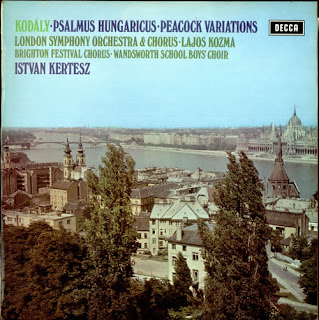
I listened first of all to István Kertész's splendid Decca recording with an excellent soloist, Lajos Kozma, and a not quite incisive enough Brighton Festival Chorus. On YouTube there's a film of Péter Eötvös conducting the International Chorakademie Lübeck and the Frankfurt Radio Symphony Orchestra with tenor István Kovácsházi (not as expressive as Kozma, but the choir is better). but that performance also features in one of those labours of love in which the poster has added the score. Especially useful since you can also read the text in English translation.

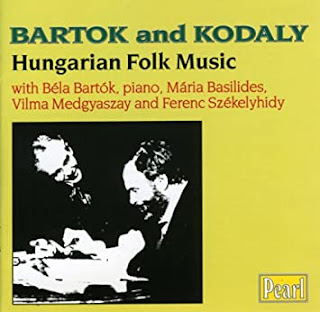
Leading up to this, what I'd already planned made sense last Thursday. First. the three soldiers' songs Bartók added in 1918 to an earlier set. Finding these evocative 1928 performances on YouTube was a revelation. I'm delighted to have got hold of a copy of the long-deleted Pearl CD. That's Bartók and his only close friend Kodály' in 1912 on the cover.

The Hungarian-Greek contralto Mária Basilides is so fine-tuned to Bartók's piano-playing in the first four (one of the original eight is omitted); then at 5m05s comes the tenor Ferenc Székelyhidy - a great voice, a fine artist, one of so many Hungarian musicians of whom I knew nothing until I started this course (and there's not a lot out there). I'll preface it with the texts of the soldiers' songs: 


Recruiting Song 

They are filling the great forest road

Taking away the Transylvanian soldiers,

Taking the unfortunate ones,

Poor Székler young men.

They take them away to that place

Where the road is red with blood,

From the men whom the bullet, the lance,

The sharp sword have cut.


Soldier's Farewell

My work has always been the spring plowing,

Cutting grasses in fields and gardens;

Now my ox is in his place, my horse is saddled,

My whip ready, the halter in my hands.

The day has come when I must leave,

To depart from my home, my country, with a heavy heart,

To take leave of my parents in tears,

To leave my dear wife alone.


Soldier's Spring Song

Snow is melting, oh my pretty little angel, spring is coming.

How I wish to be a rosebud in your garden!

But I can’t be a rose; Franz Josef wilts me.

In the big three-storey Viennese barracks. 


A reminder again that the Soldiers' Songs begin at 5m05s, though it's worthing hearing the full seven. 

From the same recording sessions I took Székelyhidy and Bartók in Kodály's powerful arrangement of 'Rákóczi's Lament', a memorialisation of that early 18th century Hungarian warrior's unsuccessful cause. No translation here, I'm afraid; and translations generally have been a problem. So has English-language study of Hungarian music - I guess few musicologists ever get to grips with the language.

Who'd have thought we would actually comprehend the heroism of taking a stand against an overpowering enemy? But in President Zelenskyy we have it as I've never experienced in my own lifetime. Tomorrow I'm putting up a piece on The Arts Desk celebrating Russian musicians around the world in solidarity with Ukraine, and I'm doing what I can with constant posting on LinkedIn, much as I detest the site's inaction on disinformation. But I'll leave you with this speech for the ages. Zelenskyy has just made another one today to the European Parliament which was even more emotional. Slava Ukraini!