Showing posts with label Stefan Zweig. Show all posts
Wednesday, 17 August 2016
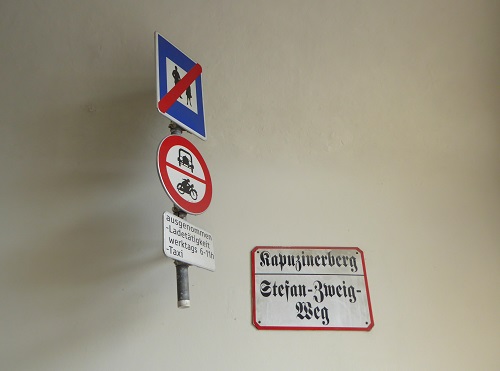
Stefan-Zweig-Weg
Unlike my walk along the 'Julie-Andrews-Allee', this Salzburg jaunt wasn't serendipitous, but I did it the wrong way round, widdershins, as it were, unintentionally avoiding at first the Stations of the Cross. The great writer, and very much my current god in the reading stakes - from a biography by George Prochnik alongside Zweig's own studies of Marie Antoinette and Erasmus to his takes on Montaigne and now Mary Queen of Scots - bought an eyrie on the romantically-titled Kapuzinerberg in what, shortly after the First World War, was quiet, unfestivalled Salzburg. He chose the city for both for its calm and its position as 'the right springboard to [the rest of] Europe'. I'll let the author of The World of Yesterday paint the picture:
The little wooded hill on which I lived was the dying wave, so to speak, of the mighty mountain chain; inaccessible to automobiles [that only pertains up to a point now, though I saw no vehicles and only two other people on my way down]
and attainable only by a hundred or more stairs up a way of the Cross that was over three centuries old; the effort was rewarded by an enchanting view over the roofs and gables of the many-steepled city. Indulge me here: the light was good, so I give you three.
Zweig has to point out that the view in the other direction was towards the Alpine chain and - horrid irony - the Salzberg at Berchtesgaden where his oppressor, unknown at the time of purchase, would make his home. The fact that the 17th century Archbishop's lodge was in a ruinous state and well-nigh uninhabitable didn't put him off; nor did the cold in a time of post-war famine and need. It seems typical of Zweig's aristocratic remoteness that he only really got in touch with that on his few excursions a week into town.
The house is now screened on all sides by trees
and, sad to say, some dramatic barbed wire, but you can take the 'Weg' up behind the house into the woods. Had I had longer before returning to the hotel after a fine lunch in the Stiftskeller Skt Peter ('Europe's oldest restaurant'), I should have walked further to see the Alpine range end of things, but I went only so far,
having made the ascent via an obscure alley so that I hit the big view first and the church after.
There, at any rate, was a bust and wall plaque opposite the hidden house
after which I went down past the garden gate
and saw in reverse the Stations of the Cross.
A speedy walk towards the tram stop took me via the magical Steingasse which snakes between the Kapuzinerberg and the river, a mixture of the plush and established
with touches of Bohemianism.
At least Salzburg has a university, which saves it from ossification. Meanwhile, over at the Haus für Mozart where I saw the intriguing second performance of Adès's The Exterminating Angel, Zweig's bust
and Max Reinhardt's flank the entrance to one of the most opulent theatre bars in the world.
I was going on to write about Zweig's Montaigne, but work is pressing and the great French man of letters will have to join proud Mary Stuart when I've finished reading about her ill-starred path to the scaffold.
Labels:
Haus fur Mozart,
Kapuzinerberg,
Salzburg,
Stefan Zweig,
Steingasse
Tuesday, 12 April 2016
Zweig on Erasmus v Luther, Shortt on God
He always gets to the dramatic heart of things in his 'popular' biographies, does Stefan Zweig. The polarities clearly chime with his own divided soul in one way or another. His Erasmus study, not easy to get hold of these days, is both more brief and more reserved than the Marie Antoinette quasi-novel I read a couple of months ago. It even takes rather a long time to get over the faint whiff of the platitudinous in setting up Erasmus's virtues and flaws, his 'ambiguities and contradictions,' but once Martin Luther appears on the scene we know we're into material which would make an exciting screenplay.
'I must insist,' writes Zweig, 'on the facts that Erasmus of Rotterdam was, of all the writers and creators in the West, the first conscious European, the first to fight on behalf of peace, the ablest champion of the humanities and of a spiritual ideal'. But the 'universal language' he expressed himself in was Latin, and he remained an elitist, neither understanding of the ordinary people nor aware that the path of Enlightenment which he took could be upturned by the barbarism that lurks in human nature.
You feel Zweig is talking a bit about himself and his times here; and his knowledge of Freud convinced him that there was no steady progress in humanity. For both himself and Erasmus, 'an aristocracy of the spirit' could be swept aside, and not just by the unlettered:
An educated man, a civilized man - and herein we see the tragical failure in their [the humanists'] reasoning - was no longer capable of resorting to gory violence, and when once the educated, the cultivated, and civilized got the upper hand, chaos and brute force would inevitably disappear, and war and persecution of opinions would become anachronisms. In their overevaluation of the effects of civilization, the humanists failed to take account of the basic impulses and their untamable strength; in their facile optimism they overlooked the terrible and well-nigh insoluble problem of mass hatred and the vast and passionate psychoses of mankind.
The representative of that, for Zweig, was Luther (Cranach's portrait of him in 1529 pictured above), 'an emanation of the dark, daimonic forces of the Germanic peoples'. Erasmus and he were opposite poles: 'the conciliatory temperament as opposed to the fanatical, cosmopolitanism against nationalism, evolution versus revolution'.
At the midway point of the biography, Luther in all his crude vigour and energy - his study in the Wartburg above Eisenach, snapped on last year's unforgettable Bach pilgrimage, pictured above - takes centre-stage: a potential force for the good, flawed by intemperance and irrationalism, sure that 'my confidence is God', 'a cheerful and friendly father and house-master' who 'as soon as battle was joined...was transformed, becoming a werewolf raging with uncouth and unjustifiable scorn and fury', a 'hot and mighty hater' who never 'put in a word to save an enemy condemned to death'.
There are dramatic points of no return and moments where if Erasmus had become more involved and Luther less intransigent, Europe would have been spared the tide of blood.
Even when the battle was joined, Erasmus, the peacemaker, went a long way to meet his opponent. He took occasion to warn his contemporaries not to place too great importance on such discussions, but, rather, 'to ask themselves if it is right to set the whole world in a conflagration for the sake of a few paradoxical conceptions' [the chief issue over which Erasmus and Luther had locked horns was the one of predestination].If only Luther would yield but the fraction of an inch, would take but one step to meet him, this intellectual squabble would end in peace and harmony. But could Erasmus hope for compromise from the most iron-minded man of that century, from a man who in matters of belief and conviction would not, even if tied to the stake, sacrifice a jot or tittle of his principles, who, born fanatic that he was, would prefer death or the destruction of the world to giving up the tiniest and most indifferent paragraph of his doctrines?
For Erasmus, even the refuge of Basel where he had found true acceptance and tolerance and where he would be buried
was not immune from Reformation fever. That beautiful city is once again a centre of enlightenment and harmony, more outward looking than other Swiss centres of excellence; our trip there first put me properly on the Erasmus trail.
Yet Zweig's epilogue carries the grain of hope at the bottom of Pandora's box, in his argument that 'no thought that is the outcome of the fusion of clear thinking with high moral energy can wholly disappear':
An idea which does not take on material shape is not necessarily a conquered idea or a false idea; it may represent a need which, though its gratification be postponed, is and remains a need...Those ideals only which have failed to put on concrete form are capable of everlasting resurrection.
Resurrection: is it a metaphor or a parable in Christianity? On that, and on the issue of miracles, I can't quite grapple with what my new friend the excellent Rupert Shortt has to to say in God is No Thing. In every other respect, I agree with him wholeheartedly on the essence of good Christian teaching, tolerant and respectful of other opinions, and on most of its tenets - but despite the overlap, it's still not enough to persuade me in to the fold. I like this:
An American historian and agnostic...summed up her diagnosis [of today's malaise of disrespect towards Christianity] like this: 'I've always seen Christianity as involving an encounter with the depths of experience,' she told me. 'Yet so many educated people on this continent [Europe] seem to associate it with nothing beyond the shallows.'
I believe, like Shortt and so many scientists (and Darwin, one of the best formulators of thoughts about the existence of God in his autobiography), that 'science...explains how this or that process has taken place, but cannot say why'. Neither first causes nor what people call God are nothing. Shortt quotes Denys Turner:
'Nothing' has no process, no antecedent conditions, no random fluctuations in a vacuum, no explanatory law of emergence, and, there being nothing for 'something' to be 'out of', there can be no physics, not yet, for there is nothing yet for physics to get an explanatory grip on.
Hence the book's title, and the title of the chapter in question, 'God is no thing, but not nothing'. I believe - this is turning in to a credo - in the likelihood of a numinous world beyond the phenomenal; how could I not, being in a constant state of bewilderment at the examples of creative and performing genius in my sphere? Let me share the epitaph Kurt Vonnegut wanted for himself - can't work out from this picture whether his wish was realised:
Vonnegut and Shortt both cite the Sermon on the Mount as one of the great texts, if not the only text you need for life. They're both immensely likable beings. So even if you're a confirmed atheist, I recommend you read God is No Thing - and don't let the recommendation from hack writer A N Wilson on the cover put you off. Pleased to see it's among the best sellers already.
Labels:
Christianity,
Erasmus,
God is No Thing,
Kurt Vonnegut,
Luther,
Rupert Shortt,
Stefan Zweig
Thursday, 3 March 2016
Dust of Empire
Before I moved on to two of his psycho-biographies, reading about Stefan Zweig led me sideways to two short novels set in dusty eastern corners of the Austro-Hungarian Empire (that's the blessing of Daunt Books which arranges its fiction in sections on countries). I now trust just about anything published by New York Review of Books' Classics series, not least because they're such a pleasure to hold in the hand. Yet the blurb on the back of Dezső Kosztolányi's Skylark as translated from the Hungarian by Richard Aczel led me to expect only the wit, and not the wisdom, of this quietly marvellous tale.
Ma and Pa Vajkay, inhabitants of Sárszeg circa 1900 - which, as Kosztolányi's native Szabadka (Subotica) Péter Esterházy in his stylish introduction describes as 'that (to use his words) poor, grey, boring, dusty, bored, comical, provincial town' - have depended on their unintentionally controlling daughter Skylark for their increasingly limited outlook on life. From the moment they see Skylark off at the town station (Szabadka's depicted up top) on her reluctant summer visit to nearby country relatives, their life begins to change. Small pleasures and misdemeanours are recorded by the author not with scathing irony but with a real sympathy for these townsfolk. I expected something wicked, along the lines of Sologub's The Petty Demon, but the results are quite different.
Perhaps it's all best summed up by the local newspaper editor Miklós Ijas, the nearest thing to an authorial self-portrait (I imagine). In an unusually candid and lofty couple of paragraphs, Kosztolányi captures his own achievement in making the outwardly comical richly human. Ilja is standing in the street outside the Vajkays' humble home:
He stood for some minutes before the gate with all the patience of a lover waiting for the appearance of his beloved. But he was waiting for no-one. He was no lover in a worldly sense; the only love he knew was that of divine understanding, of taking a whole life into his arms, stripping it of flesh and bone, and feeling into its depths as if they were his own. From this, the greatest pain, the greatest happiness is born: the hope that we too will one day be understood, strangers will accept our words, our lives, as if they were their own.
All he had heard about his father had made him receptive to the suffering of others. Until then he had wanted nothing to do with those who lived and moved around him...For yes, at first sight they had seemed worthless, twisted and distorted, their souls curling hideously inwards. They had no tragedy, for how could tragedy begin to grow in such a wasteland? Yet how profound, how human they all were. How much like him. So he did have something in common with them, after all.
That excerpt is untypical of the rest of the book, which is not often given to inner reflection, but paints the souls of the characters in all their contradictory richness all the same. As Esterházy points out of the style, 'Kosztolányi simplified the Hungarian sentence, made it shorter, purer'. Towards the end of his preface Esterhazy decides that the writer is closer to Chekhov than to Musil: 'He shares that same helpless fascination for the banal or trivial, for a drama-of-being which can be unravelled from a remote gesture, a twitch of the mouth, a dismissive wave of the hand, from lamplight and ugliness. A spider's web over a mine.' And he ends: 'Kosztolányi''s prose is quiet and sharp. Today our books are noisier and perhaps more blurred'.
There is little of the 'quiet and sharp' abut Robert Musil's astonishing account of sado-masochism and psychological torment in a military boarding school clearly modelled on the one he was forced to attend in Hranice (now in Moravia; there's another, Bohemian Hranice in the Czech republic; the real-life academy pictured below), The Confusions of Young Master Törless. That the impressions remaining from having read A Man Without Qualities decades ago are blurred is perhaps right - Musil is the stream-of-consciousness writer whose very fascination lies in the way that meaning and definition slips away at every turn. His sentences go on for ever, a bit like Proust's; hard to say whether Christopher Moncrieff has done a good job of the translation.
At first I was impatient, following on from Kosztolányi, to find this all self-indulgent, a bit evasive about its homoerotic element (but then that must have been the case, outwardly, with the kind of schoolboys pictured within). Even when Törless finally decides to speak unambiguously to the masters about the strange events that have gone on, Musil pauses for yet another digression which comes closest to defining his special style, and brings it close to Hofmannsthal's perception of transience:
For thought is a strange phenomenon. Often it is nothing more than an accident that vanishes without a trace, because for thought there is a time to be born and a time to die. We can make an amazing discovery, and yet it slowly withers away in the palm of our hand like a flower. The form remains, but its colour and fragrance have gone. Or, put another way, we might remember it word for word, the logical value of its phrases might remain intact, and yet it drifts by aimlessly on the surface of our being and we don't feel enriched by it. Until the moment - perhaps many years later - when it suddenly reappears, and we realize that in the interim we have been hardly aware of its existence, although logically speaking we knew it all the time.
Yes, there are dead and living thoughts. The thought that moves around on the surface, in the light, and which can be regained by the threads of causality at any time, isn't necessarily the most vivid. A thought we encounter in this way remains as insignificant to us as a random solider in a column of marching troops. A thought that might have passed through our mind a long time ago only really comes alive when something which isn't thought, which isn't logic is added to it, with the result that we feel its truth, independent of any proof, like an anchor that has been dropped into living, bleeding flesh...Only half of any great discovery is made in the light-filled region of the mind, the other is found in the dark soil of our inner depths, and this is above all a state of mind which grows at the farthest extremity of our thoughts like a flower.
Of course it was the age of Freud, though the founding father of psychoanalysis was the first to admit that much of what he had to discuss had already been articulated in masters like Shakespeare, Ibsen and Dostoyevsky. Certainly knowledge of Freud allows Zweig to shed a special, if speculative light on some fascinating historical subjects. I wasn't sure I wanted to read a 500-plus-page biography of Marie Antoinette; nor does Zweig's subtitle, 'the portrait of a mediocre character', exactly encourage it. Actually 'mittleren' really translates 'ordinary', and even that isn't quite right; Zweig's preface in Eden and Cedar Paul's translation qualifies that by explaining that his book will be about an average, unreflective queen forced by tragic destiny to transform:
At the very time when she was stripped of the last insignia of power, she grew aware that in her there had dawned something novel and stupendous, and that but for her sufferings this dawn would never have begun. 'Tribulation first makes one realise what one is'. With mingled pride, agitation and astonishment, she uttered these remarkable words, seized with a foreboding that through suffering her life, otherwise commonplace, would grow significant for posterity. The consciousness of a supreme duty lifted her to a higher level than she had ever known. Just before the mortal, the transient frame perished, the immortal work of art was perfected. Marie Antoinette, the mediocrity, achieved a greatness commensurate with her destiny.
A tragic tale indeed - and it needs no rose-perfumed invention on Zweig's part to show the transformation. Marie Antoinette's deeds and words are sufficient in the final stages of the tragedy. Even as a pleasure-loving queen, thoughtless of the people and heedless of expense, she can be paradoxical in Zweig's eyes: her very refusal of stiff courtly etiquette showed spirit, albeit the determination of the Valley Girl as portrayed by Kirstin Dunst in Sofia Coppola's rather amazing film (though it doesn't go far enough, of course).
Marie Antoinette's essential fidelity to the very foolish and hapless Louis XVI speaks well for her; the true love she felt for the noble Swede Count Fersen was discreet and constant to death, and there's not the slightest hint of dalliances with anyone else. And she always put her son, at least, before herself (first portrait above, one of Elisabeth Vigée Le Brun's several portraits, this one of Marie Antoinette with her children; below, the craven David's sketch of the queen on the way to the scaffold).
Yet it's in the final stages that her sense of tragic dignity constantly amazes. Up to that point she's still capable of intrigue, as Zweig's account of the flight to Vincennes and especially the journey back to Paris makes clear (this episode would make a superb film in itself). But the outrage we feel at the whole sickening episode of the Dauphin's 'confession' of incest with his mother - very Turn of the Screw, this, especially in the conflict between the two women who want him to be too good and the revolutionaries who want him to be too bad - makes us all the more impressed by her unshakable dignity in court. I like Zweig's dramatic sense, too, which hides the King's execution from our sight until the last minute, just as it was hidden from his consort. This is a book to be read alongside Hilary Mantel's A Place of Greater Safety, and it succeeds on the same high level. Mary Queen of Scots next.
Just a quick final note on a masterpiece which has nothing to do with the above, but since we're on the subject of books, I urge you to read it since, being advertised as 'a novel for young adults', it might slip through the net.
Janne Teller's Nothing, translated from the original Danish by Martin Aitken, has been turned into a bold and beautiful opera at Glyndebourne, the latest unforgettable achievement of that company's long-running, award-winning education department. I describe the mythic essence of the subject, both simple and complicated, over on The Arts Desk, and can only reiterate that the book is even stronger and more uncompromising. It's written from the perspective of a teenager but it's not exclusively for that age group; it should have a powerful and unsettling effect on everyone who reads it.
Tuesday, 12 January 2016
Exile
There's no escaping the issue; nor should there be, when every personal story of Syrian refugees helps us to understand that it could be us, that we could be these human beings. In terms of reading, I wasn't trying to avoid the subject, but nor was I actively seeking it out in two of the three books I read in close succession, both of which turned out to locate the present in the near or distant past, adding to an understanding that being an exile, a refugee, an emigrant/immigrant is such a constant part of the human condition (the third book, incidentally, was Diana Darke's My House in Damascus, which gives an equally distressing picture of how everything falls apart over time for those who decide to stay. I hope I'll find time to write about that soon).
Most Europeans of my generation are so lucky never to have experienced it, but surely we all know someone who has, and most of us come, way back, from somewhere else (on my mother's side of the family, my first known ancestor was Jean de Paris, a Huguenot fleeing to London after the St Bartholomew's Day Massacre of 1572).
Mark Mazower's Salonica: City of Ghosts is, for much of its duration, a portrait of a city that no longer exists - a special case in Europe where Jews, Muslims and Orthodox Christians co-existed peacefully - always with a few isolated exceptions - from 1430 to the early 20th century. So this is a book first heartening, then deeply distressing. The stance of the early Ottomans - described by Mazower as akin to the central Asian attitude of the Grand Khan Mongha, for whom the religions of the Empire were 'like the five fingers of the same hand' - had already come as a pleasant surprise to the Archbishop of Salonica, Gregory Palamas, when he had been held captive in 1355. According to Mazower, Palamas found that
Prominent Turks were eager to discuss the relationship of the two faiths with him and the emir organised a debate between him and Christian converts to Islam. 'We believe in your prophet, why don't you believe in ours?' Muslims asked him more than once.
Which takes us back to the fundamentals of Mohammed's original teachings (I've long been meaning to try and sum up here, for myself as much as anyone else, what Karen Armstrong's Islam: A Short History reveals on that front - 'all is one', in short). Pictured below: an Ottoman family in the house known as 'Las encantadas', with its row of caryatids long since vanished
But the point here is to move on to the arrival of the Sefardim looking for a new home after their expulsion from Spain by Ferdinand and Isabella in 1492. They were more welcome here than in Christian Europe. And despite the official separation of Muslims and non-Muslims, placed in a position of inferiority by what they had to wear, the boundaries in professions quickly became fluid: 'young Muslim boys served as apprentices to Christian shoe-makers; Jewish and Muslim hamals and casual labourers scoured the docks together for work'. And in places of worship, too: Muslim guardians would watch over Christian shrines even where the building had been converted.
So, essentially, Salonica remained until the early 1900s, when the Ottoman Empire crumbled and nationalism rather than religion became the basis for Greeks and Young Turks alike. The First World War pulled things further apart; what endless fires had brought about, temporary tented settlements for those who had lost their homes (one such pictured above outside the walls of the fire-ravaged city), became real in a much larger sense with the almost unbelievable, rigid exchange of Muslims and Orthodox Greeks between Turkey and Greece in 1923-4. !8,000 Muslims were uprooted and removed from the fabric of the city. The picture below is of a mother and child waiting in Salonica to make the onward journey to Thrace.
What finished off Salonica as 'open city' was, of course, the German genocide of the Jews. Christian citizens tried to stop the deportations, or at the very least sympathised as the victims were led to the trains; in a few weeks of 1943, one-fifth of the population was 'disappeared'. Less admirable was the ready appropriation of the deserted shops and houses, and the difficulty of restitution to the few who returned.
Mazower's tale is of a city, not of individuals - despite countless examples of human nature's extraordinary adaptability and survival - while to read George Prochnik's The Impossible Exile is to learn about one ambiguous and mostly very unhappy refugee. Was Stefan Zweig doomed to kill himself (and, much more troublingly, to persuade his younger second wife to join him in death) from the moment he was dispossessed of the Viennese milieu which seems to have been the only one in which he could thrive.
Zweig was a determined, eloquent internationalist - a true humanist European, or rather citoyen du monde - who thought he could settle anywhere but ended up desperately unable to adapt outside Austria. The book's strengths are also its weaknesses - a determination not to give a chronological biography, to leap back and forth in time, which can make for confusion but also gradually pieces together the mystery posed by the beginning: how could Stefan and Lotte end up in Petrapolis, old German-feeling town in the hills above Rio de Janeiro?
There are moments of suspense along the way. The last couple of years read like the final quarter of Tolstoy's Anna Karenina, where our heroine seems to be happy, not necessarily heading towards disaster, but keeps taking wrong turns (and right ones, too). Zweig was prone, ever so eloquently, to romanticise new places as paradise - he certainly did so in the case of Brazil - only to be defeated by inner despair, even emptiness. Perhaps the real tragedy was that, for all his vision of what nations should share in common, he had no real grounding in what was only a dream. And his sense of self was being eroded all the time. Prochnik, himself the son of Viennese refugees, writes:
If only a third of European Jewry survived Hitler, only a tiny fraction of those who did escape made it out with their former identities and sense of humanity intact. Zweig's life on the run draws me in in part for the way it presents, as in a tableau vivant, archetypal stages of refugee experience shared by others fleeing a state turned murderous. His story is particularly revealing for what it says about the predicaments of exile that aren't resolved when freedom is regained.
Archetypal, and yet different from other exiles. Zweig came from a fabulously wealthy family, moved among the high literary movers and shakers of the world. What, he asked, did he have in common all the other Jews 'thrown together for persecution'? Prochnik continues:
At least, he writes, their ancestors in medieval times knew what they were suffering for: their shared 'faith and their laws'. But the Jews of the 20th century were no longer a community and had not been one for a long time. They had no law. They did not want to speak Hebrew together. Only exile swept them all together, like dirt in the street: 'bankers from their grand homes in Berlin, synagogue servers from the Orthodox communities, Parisian professors of philosophy, Romanian cabbies, layers out of the dead and Nobel prize winners, operatic divas, women hired as mourners at funerals, writers and distillers, men of property and men of none, the great and small, observant Jews and followers of the Enlightenment.' In a heartfelt cry, Zweig apostrophized: 'Why I? Why you? How do you and I who do not know each other, who speak different languages, whose thinking takes different forms and who have nothing in common happen to be here together?' If Shylock's famous question - 'If you prick us, do we not bleed?' - was intended to show that Jews share a common humanity with all mankind, Zweig approached the injustice of anti-Semitism by revealing the total absence of common ground between the Jews themselves.
Yet others found it, adapted and thrived. Was Zweig too aloof, too fond of talking about universal values but too weak to put them into practice by really getting to know his fellow men from all walks of life? Not for us to judge, who never went through this upheaval - one compounded by shame that the language in which he wrote was appropriated by a destructive regime. Below: Zweig and his mother, who died in Vienna just before the Anschuss, at the home of friends in Vence.
Whateve the answer, it is a complex tragedy. Prochnik is good on paradoxes, on the dismantled vision of the Viennese coffee-house, in his troubled concern for poor Lotte (he is bad, by the way, in the only sphere I know, the musical one, where he tells us that Zweig's adaptation for Strauss was of Jonson's Volpone, with a new title of Die scheigsame Frau, The Silent Woman; of course the original play is Epicoene, or The Silent Woman). The main thing is that I want to go on and read more from Zweig's restless pen, not least his biographies reflecting back on himself of Marie Antoinette, Erasmus and Montaigne.
Finally, a story not of exile but of the pros and cons of emigration told with a complex flow of similarities and differences between home and abroad, John Crowley's film Brooklyn. I've given up on Colm Toibin; I hated The Master as a novel a million miles away from the style of its subject, Henry James - David Lodge's Author, Author is much better in my opinion - and the dialogue taken from the book as rendered by Nick Hornby doesn't strike me as anything special. It's a beautifully crafted but over-clean tale of the 1950s - Todd Haynes's Carol evokes what feels like a much more real world, albeit with less moving portrayals of the central figures - yet the lead performance of Saoirse Ronan is one of the most remarkable star turns I've ever seen on screen.
She lights up within, right from the start; it's the sort of face that makes you want to burst into tears, and I did weep quite a lot. While her character in the book has been described as passive, and Ronan's Christian name rhymes, she tells us, with 'inertia', Eilis, the role she plays, has incredible vitality and strength as well as vulnerabiity. In fact I saw immediately in Ronan the ideal incarnation of Natasha Rostova in War and Peace - a very different character, but one who needs that same incandescence. Someone make another version with her in it before she gets too old (she's 21, but would be convincing as the 13-year-old Natasha, which Morag Hood in the old BBC version wasn't). Interesting that both my friend Simon and I thought of Audrey Hepburn, Natasha in the American film I haven't dared to see - I've braved the BBC serialisation and, though rushed, it's not as bad as I feared - because although our Saoirse looks nothing like her, and isn't obviously beautiful in the conventional sense, she's equally mesmerising on the screen.
The men are very watchable and sympathetic, too, compounding the symmetries; there's the puppylicious Emory Cohen as her American-Italian true love
and Domnhall Gleeson as the Irish 'quiet man', who achieves the difficult job of partly wrenching us, as well as the heroine, temporarily away from Brooklyn affiliations.
Mother and sister are sympathetically portrayed, too; there's not a false note in any performance, so that you buy the more sentimental moments. But the point is, as Prince Andrey says of the young Natasha, that 'there's something special about that girl'. Everyone should go - it's a film which I could take my mother to see - and be spellbound by Ronan's ever-changing face on the big screen.
Subscribe to:
Posts (Atom)