
Have you ever seen the like? Following advice to 'head for the 14th century Jaani [St John's] church and its abundance of statues,' I guess I was expecting something like the interior of Bamberg's magnificent Dom.

There are in fact three 'big' statues, the largest according to their medium, of the Virgin Mary, Christ on the Cross and St John, but that's only relative to the material - terracotta.

I'd long wanted to visit Tartu, Estonia's major university town, but I expected something different, more along the lines of the other Hanseatic cities. It was indeed a member of that league, though very far inland, situated on the river Emajõgi. But it feels so remote: the drive from Tallinn is half an hour longer than the trip due south to the 'summer capital' Pärnu; halfway, you head east towards the Russian border, and similarly you see little but storks, fields, woods and the occasional lake, with only the occasional settlement. Most of the buildings on the hill, including the cathedral, were destroyed by Peter the Great's troops.

I only had time in the centre to walk around the old town, not much bigger than Pärnu's, though it has an attractive square (triangle) at one end rising towards the Town Hall

and includes the neoclassical university building.

The visit of composers and writers from the World Music Days Festival took us first to the National Museum, a vast and impressive new edifice built on a disused airfield 20 minutes' walk from the centre.

After our international group was welcomed by a village band playing some of the songs heard in Estonia's first Choral Festival, a tradition which started here,

we had a lunch, a tour of the 'Finno Ugric migration' exhibition (one of two permanent fixtures, well done but hardly revelatory, though it clarified for me that Estonians belong to this group and aren't Balts like Latvians and Lithuanians) and a rather dreary concert. Much better, in fact a festival highlight, was the programme given by the superlative Latvian Radio Choir in the Jaani Church. For the two of us who walked there, half an hour beforehand permitted a whizz around the university's botanic gardens and a quick perambulation of the streets.


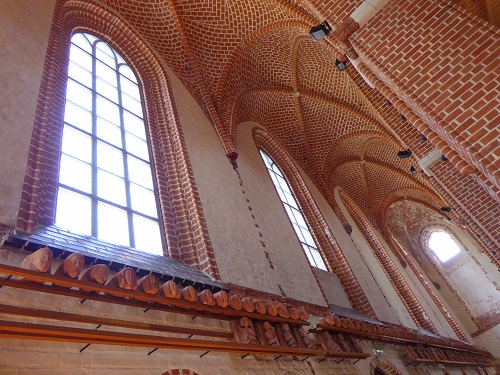
The Jaani Church, its present version essentially of the 14th century, was originally decorated with around 2000 sculptures, uniquely modelled out of wet clay, not put into moulds, and then burnt. In August 1944 the church itself burnt down during the Soviet invasion. It was reconstructed in 1989 to serve as a concert hall.

Further work continued after Estonia's regained independence in 1991, with reconsecration in 2005. The people of Tartu gave a great deal of money for their city's greatest treasure, but there was also funding from the Republic, the Church of North-Elbe and the City of Lüneburg (also full of red-brick buildings; it's a place I'd love to visit). German organisations initiated the restoration of the sculptures, many of which sit on racks along the north wall.



For our evening event, we headed to the riverside

and the perfect small offspring of the National Vanamuine Theatre for Märt-Matis Lill's impressive full-length opera about the First World War, Into the Fire, catching a glimpse of Tartu's most unusual modern tower, the residential Tigutorn, on the way.

Tallinn's walls and towers looked as good as ever through fringes of leaves as Estonia's spring began, on cue in early May. My daily walk took me past the Pikk (Tall) Hermann tower Toompea Castle

before the tower of the Niguliste Museum (former St Nicholas Church) came into view.

Favourite eating discovery: the Väike cafe-restaurant opposite St Nicholas, with the friendliest waiting staff and every detail just perfect (superb bread, excellent soup, exquisite cakes). Two years ago on the way back from the Pärnu Festival, I sat outside here with fellow write Nahoko Gotoh and I remember how they wrote little notes on the napkins, a bit twee, but friendly. This time I got 'may the rest of your day be as nice as you seem to be'.

Another route to the coach stop took me through beautiful gardens, the Dome Church spire just visible here.

Church interiors were for concerts - including the first I've heard in said Dome Church on Toompea. The only rooms I hadn't seen were in the House of the Brotherhood of Blackheads - bachelor merchants who took black St Maurice as their saint when the Hanseatic League was established.

The White Hall, walls fanning out from the performance space, had perfect acoustics for the two-piano recital I heard (and loved) there,

but clearly the treasure is St Olaf's Guild Hall upstairs with its splendid vaulting. All was remodelled in the 1920s, but extremely well.


Unpleasant to think that after I'd left the horrible Helmes of EKRE, the far right party, hosted Marine Le Pen here, an act which did not go unprotested. Estonia's horrifying embrace of extremists, gaining seats in Parliament thanks to an opportunistic power-sharing deal, is a blot on the new democratic dream of a young nation. Let's hope it survives the shake up.


 Posts
Posts



