It's second quarter time in the ongoing Palermo saga. Day two in the great city, now that I think about it, was one of total cultural overload. We began in the vicinity of our lovely lodgings in Via Butera with the church of San Francesco and the oratory of San Lorenzo just along the street: cue first discovery of the great baroque stucco master Serpotta. But his wonders belong to the eventually forthcoming entry on the Vucciria district. Later, in the mid afternoon, we caught a bus to Monreale. The chronicle here deals with what we saw in between.
We needed to hit the streets of the Capo in good time, as recommended by our masterchef hostess Nicoletta as the best of the three old-town markets. So we had the strongest of coffees - Palermitan espresso seems to me uniquely strong and deliciously bitter - in a fine bar on the Corso Vittorio Emanuele and arrived at the great junction of the Quattro Canti, a colossal homage to the rather more lovable
four fountains by Borromini's San Carlo in Rome and built under Spanish occupation at the beginning of the early 17th century. Each 'corner' of the octagon has a Spanish king, a patroness and a seasonal fountain: hence, on this west Capo/Seralcadio side Philip II, Santa Ninfa and summer.
Winding our way without reference to the map through the narrow steets of the Capo felt different to the Kalsa because here it's a matter of climbing and descending various hills. As you hit the Via Sant'Agostino the market zone begins - not food as yet but tat and furnishings. Sant'Agostino turned out to be Serpotta'd too, and again I ought to keep his (or his studio's) contributions to the relevant entry. No harm, though, in taking a look at the depiction of Abraham stalled by the angel as he prepares to sacrifice Isaac.
The 13th century west door and latticed rose window above - not dissimilar to the one for San Francesco which we'd just seen, but less richly ornamented - are the main remainders of the Chiaramonte and Sclafani family's foundation.
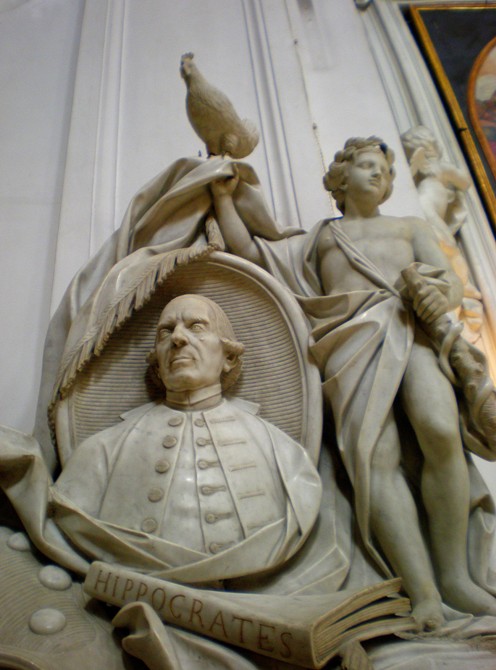
Within are various chapels in white and one especially splendid monument of Francesco de Medici sculpted by Ignazio Marabitti in 1771. I think - I should have noted it down - there was reference to a medical connection, hence what I take to be Asclepius's cockerel on top and the volume of Hippocrates.
The cloisters are very lovely and, yes, that inescapable word inscribed in a million church visitors' books, peaceful, though nothing to what we were to see later in the day at Monreale. The arcades are 16th century, attributed to Domenico Gagini, a name we'd come across a fair bit.
The portico to the cloisters from an atmospheric, candlelit chapel, though, seems to be from the time of the church's foundation.
Sant'Agostino was in frequent use by its congregation in Holy Week - much coming and going, and a well-tended shrine to the bound Christ.
All this, of course, was in contrast to the main drag of the market, teeming with fruit and vegetables. Artichokes were very much in season,
and everywhere we saw marketeers stripping them down to the usables, as up top. In the thick of all the marine profusion shaded pinky-red by the awnings,
a fishmonger was chopping up chunks of swordfish.
Later, I was reminded how this is one scene that hasn't changed over millennia. In the Mandralisca Museum in Cefalù, there's a fourth century BC crater or drinking bowl showing a seller carving tuna for a customer - not great art, but an invaluable document of everyday life. I believe I'm entitled to reproduce it from
ancientartpodcast.org's photostream on Flickr.
Bang in the middle of the main market street there's an ideal refuge from the hurly-burly - the Church of the Immaculate Conception. This is another of those Palermitan institutions gone baroque-crazy in its polychrome marble unity. The altarpieces of each chapel, all unified as variations on a theme, seem inspired by the orient in their candied depiction of various fantasy edifices. These, if I understand a rare entry on the web, are 'the Triumph of Religious Orders' executed by Olivio Sozzi around 1740.
We strolled up and down the street several times and bought - as Sebastian had told us to look out from them - a punnet of remarkably early
fragole di bosco, wild strawberries.
As the market fizzled out, the cathedral in all its confused splendour appeared from a less than picturesque car park. I was reminded of a rather overelaborately inscribed postcard from a friend of ours on her first trip to Moscow: 'the Kremlin domes are visible from a Dickensian slum of mindblowing squalor'. I'll just stick to the picture, thanks.
The dome is a very unfortunate 18th century addition to the Norman splendour of the whole, which in any case wasn't finished for centuries. Extravagant towers are multiplied by more on the Bishop's Palace,
connected to the cathedral proper by impressive arches.
Some are sniffy about the jarring note of the Gothic-Catalan portico, erected in 1465 by the Gaginis, but it's a marvel in its own right.
Its first column on the left - the one in the shade - belonged to an original mosque on the site - another of those Arabic inscriptions to be found everywhere in Palermo's old town - and to the Byzantine basilica which was erased in 1172 by the English archbishop, Gualtier Offamiglio (Walter of the Mill). We'll see what happened at Monreale when the jealous Norman King William II tried - and within, at least, managed - to surpass his insolent priest's glory. The most intact part of the archbishop's original design is the east end with its semicircular apses, a little bit in shadow early in the afternoon. You can just about see the very beautiful design on one of them.
As there's a school just opposite, you would expect more trenchant graffiti of the kind I illustrated in
Piazza Magione, and sure enough this commentary on regional attitudes to culture does not disappoint. We were to find a striking embodiment of its objection when we learned that the aforementioned Mandralisca Museum has been starved of funds, with the still-devoted staff not having been paid for ten months and closure looming.
Inside, the cathedral is horribly disappointing, victim of a dingy 18th century makeover. It's not without its treasures, and a key curiosity is the bronze meridian line running north-south with signs of the zodiac. We two visitors were happy to find our astrological twins and lion duly paired.
The official entry explains all this better than I can:
The Cathedral has a heliometer
(solar "observatory") of 1690, one of a number built in Italy in the
17th and 18th centuries. The device itself is quite simple: a tiny hole
in one of the minor domes acts as a pinhole character, projecting an image of the sun onto the floor at solar noon (12:00 in winter, 13:00 in summer). The...Meridiana[line's]...ends mark the
positions as at the summer and winter solstices; signs of the zodiac
show the various other dates throughout the year.
The purpose of the instrument was to standardise the measurement of time and the calendar.
The convention in Sicily had been that the (24 hour) day was measured
from the moment of sun-rise, which of course meant that no two locations
had the same time and, more importantly, did not have the same time as
in St Peter's Basilica in Rome. It was also important to know when the vernal equinox occurred, to provide the correct date for Easter.
Palermo has quite a link with the astronomical sciences: as we'll see, the princely great-grandfather of Giuseppe Tomasi di Lampedusa who's the model for his Leopard was quite a stargazer, and had an observatory in his palace.
Well, we can't go out on a disappointing interior. We didn't make the Cappella Palatina of the Norman Palace further up the hill until our final day in Palermo on returning from the mountains, but despite having already experienced something of the same wonders in the
Martorana Church and out at Monreale, I wouldn't have missed it for the world.
Within the walls of this not especially grim edifice, which now houses the parliament, various parts of the palace can be seen according to what's going on in Palermitan politics. I was rather regretful that we weren't going to be admitted to the Sala di Ruggero with its frescoes of animals and mythological creatures. But the small, perfectly formed Palatine chapel of Roger II constructed between 1132 and 1143 is the thing. The loggia overlooking the Fountain Courtyard may only be lined with 19th century mosaics, but it offers a handsome entrance.
Within, which we had almost to ourselves - clearly not often the case to judge from the ropelines - other than a group of Italian officials clearly being deferred to, is Sicily's most remarkable balance of Arab and Norman motifs. Somehow a unity is woven between the painted wooden ceiling of the nave with its exquisite
muqarnas of multifaceted niches and the mosaics beneath.
It's difficult without binoculars to see the painted secular scenes of the ceiling, executed it's now thought by Egyptian artists. The artwork of the aisle ceilings comes a little closer to the visitor. Not all the artwork is original - the latest, loving restoration with German funding was completed five years ago - but at least it's consistent with the Egyptian style.
The dome above the presbytery is where you'd expect to find the mosaics, and it's not disappointing, even if the angel wings aren't as wonderful as those of the Martorana
but the real glories are all over the nave and side chapels, as at Monreale. Indeed, many of the same Biblical scenes are common to both, including the Creation in the top level and further Genesis tales including Noah's nakedness and the Tower of Babel below.
The two aisle walls are decorated with the lives of Saints Peter and Paul. The latter takes his name at his baptism after the Damascene conversion in the South Aisle
while on the opposite side Peter and Paul (unseen in this shot) dispute with Nero and Simon Magus before the latter's fall.
I've only touched the tip of the narrative iceberg, happy to have a splendid Miribilia Italiae guide to peruse back home. And as Catriona reminds me below, there is so much more to be said about the Norman court with its seemingly easy co-existence of religions, its co-opting of Arab workmanship (the script appears not just in the roof but also on the garbs and scrolls of the Biblical participants).. Just one more detail, of the Moorish style below the mosaics. Any other chapel which boasted only this and the gorgeous pavement would still be on a list of grand Arab-Norman designs.
Not only that, but the chapel was being prepared for Easter services, with the heady scent of floral arrangements and the sacristan preparing a singular cross. I wish we'd still been in Palermo to witness the finished results.




 Posts
Posts