Wednesday, 29 August 2012
Chamonix trails 3: Col to Col
You could with not much effort approach the Col des Posettes (1997m) and the Col de Balme (2191m) via the télécabines from either Le Tour - a pretty village spoiled by a massive car park, which we'd walked to on a previous excursion - or our beloved Vallorcine, where torrential rains the day before had driven us to a leisurely lunch in the wonderful L'Arret Bourgnette. Since, however, it was likely that these high pastures above the north-east end of the Chamonix valley would be dotted with more than a few fellow-hikers, I reckoned it might be nice to have a wooded path up from the valley floor at Le Buet more or less to ourselves. We were delighted to be joined on our last full day by Laurence, Bertrand and Ambroise, who'd prised themselves away from their much quieter mountain hideaway near Beaufort (where the most delicious of the Savoie cheeses we tasted comes from).
The way up, after ten days' worth of acclimatisation, was 'pleasant', just as the trail-book described other such forest climbs; in the beginning they'd just been a slog. The reward is always when the vistas open out and the bigger mountains suddenly reveal themselves in greater splendour than from below - or in this case in splendid strangeness, on the track from Vallorcine which our narrow path eventually met. I think this is the Aiguille Verte, at 4122m junior only to the two peaks leading up to Mont-Blanc and, of course, the Alpine king himself. It reminds me of the planet, asteroid, call it what you will, that looms in Lars von Trier's Melancholia.
Passing a lunchtime-dormant télécabine from Vallorcine, we were soon out on the alpages, with residents grazing and clanking
and to my surprise only a sprinkling of other humans in evidence, which made me wonder where all the télécabinistes from Le Tour had gone. So we made ourselves comfortable in the soft turf
and picnicked, as usual, on the excellent rolls from the Boulangerie Saint Hubert in Chamonix's Place Eglise - our local, along with the nearby cafe. Growing lad Ambroise would, he said, be in need of more calories in an hour or so's time, which gave us the pretext to walk on to the refuge at the Col de Balme. Along the exhilarating high way, Bertrand's eagle eye spotted a handful of gentians - the only ones we came across on this trip. As we know from our Italian Apennine jaunts, they should be seen in clusters, but here's at least the ocular proof of a single Gentiana verna.
The refuge seemed to be run by a sour crone, and plastered with prohibitions; I imagine in the mists it could be a rather sinister place. Ambroise had his extra sandwich - sans beurre - and we just about downed some evil coffee, looking across at the bar and a stand stocked, as our absent Chamonix hostess Merrie had told us, with ancient but alas not at all interesting postcards of the slopes in winter.
Anyway, it was an atmospheric, almost deserted change from the swish restaurant descended upon by hordes which I'd for some reason imagined. Then it was back along the Col de Balme, which gave us views towards Switzerland
as well as the Chamonix valley in the opposite direction, and down, at a cracking pace, to Le Buet - a fitting final holiday jaunt.
Labels:
Chamonix,
Col de Balme,
Col des Posettes,
gentian,
Le Buet,
Le Tour,
Mont-Blanc
Thursday, 23 August 2012
Chamonix trails 2: Vallon de Bérard
A slightly busier route, this, than the Loriaz way I happily recalled yesterday, as it's part of the mouthfully-named 'Grande Randonnée de Pays du Tour du Pays de Mont-Blanc'. Yet the lovely Bérard valley is quite unlike anything we encountered in the vicinity, not least in its variety of Alpine flowers once you reach the first of several plateaus on the way from Le Buet up to the Refuge de la Pierre à Bérard at 1924m. Before those, there's a shady gorge to climb after the first easy meander.
Then you're out among discreet handfuls of picnickers and a fair few myrtille-gatherers, en plein air with Alpine flowers in abundance.
Very well, so this didn't quite match the botanical wealth of the Lago del Predil in Italy's Julian Alps, but that we saw at an earlier time of year; August may not be the best month for flower-spotting even this high up. But I was delighted to see, in lonely ones or twos, the famed Martagon lily
the brilliance of Potentilla aurea
the Alpine Rosa pendulina - my Predil photo is much better than the slightly out of focus one I took here - and several varieties of orchid.
I misattributed this exquisitely-wrought specimen; if anyone knows better, do let me know.
Wild strawberries are everywhere, of course, refreshing the way
and once you reach the slopes towards the Refuge, nestling attractively directly under the rock which gives it its name and protects it against avalanches, the purple-and-white foreground enhances a view down much of the valley.
We made the mistake of not bringing sandwiches on this excursion; the set lunch was wretched. But it didn't matter so much, sitting at a table outside and commanding the view. And it was no hardship to walk back, with a slight detour along a looser path by the waters.
For those intent on further refreshments - we weren't - there's also a pretty-looking chalet-cafe by the Cascade de Bérard. But by then, of course, the enchanted uplands have long been left behind.
Wednesday, 22 August 2012
In the footsteps of Pococke and Windham
Those not especially famous Messrs sidled into history in
1741 as the first tourists to Chamonix, engaging local guides to lead them up
to the snaking glacier that is the (now much-reduced) Mer de glace, seen above
in the distance from the Grand Balcon Sud in the Aiguilles Rouges national park
on the other side of the Chamonix valley. Like Pococke and Windham, we used
footpower* rather than the 1908 railway to ascend 867 metres to Montenvers and
the Mer de glace, hitting the crowds only at the summit and quickly leaving
them behind for the descent. Especially glad we took the Chemin de Montenvers, as there are plenty of view-friendly clearings along the forest climb and a lovely refreshment hut stands at the halfway mark, the Buvette Caillet, run by a charming hostess who evidently takes pride in her food (though we only had crepes with pine-tree syrup, having trusted to a picnic-pack for the rest, the fare looked better than most we encountered).
We also shared P&W’s mid-level ambitions at
around the 2000m mark rather than any bolder climbs like the one their
successors (Balmat, Paccard, Saussure, Whymper) all essayed to the summit of
Mont-Blanc at a daunting 4810m. The subsequently hallowed name of the Alpine
mountain king was not so much as uttered by P&W, though like us they could
not in clement weather have missed the sight of it and the Glacier de Bosson
from any south-westerly facing Chamonix balcony. Our view, thanks to the loan of
pals Edwina’s and Merrie’s apartment, was a specially fine one.
Apart from Montenvers and the surprisingly lovable holiday
resort of Chamonix itself, the only other real evidence of August holiday
logjams was on the infamously popular hike up from the La Flegère cablecar
station to the Lac Blanc, packed with French families (though you had to hand
it to the scrambling kids). No wonder we took a longer way back via the much
quieter Lacs des Chéserys - this is the highest, approached from the Lac Blanc via a couple of steel footholds and a ladder, the Glacier d'Argentière behind -
and along the Grand Balcon.
These, and a long hike back from the Glacier d’Argentière, which I can't resist depicting up close
though the labour to reach it was not extreme, to Chamonix, all offered impressive mid-level viewpoints over the Mont-Blanc massif and/or the Aiguilles Rouges on the other side, if a bit short on the Alpine flowers I’d been expecting. I shan't bore you with chapter and verse of all the walks and hikes we managed on each of our thirteen full days in Chamonix – only a couple of which were disrupted by rain or storms - but I crave your indulgence in chronicling the three most memorable. Even that would be to ramble too far in one blog entry, especially after so long a silence, but I'll leave you with the first today. It took us from the cowbell-loud pastures of Le Crot in Vallorcine
to the Chalet de Loriaz refuge at 2020m, an ascent of 725m. Because much of the forest looked like it had been felled in an avalanche, the way up was mostly airy and bright - viz these larches and the view towards Switzerland -
after which the Alpage de Loriaz certainly felt like pastures new and high
though none of the far horizons reveals its magnificence on camera. Instead accept this Tarte aux myrtilles in which we indulged at the Chalet before sneaking off to have our picnic on a nearby rock. It's high season for the gathering of these delicious berries.
The way down to Le Buet was forest walking as usual, with a bit of Alpine suburbia at the end - I'd have preferred in retrospect to have returned the way we came. But it was a great day out, one of many thanks to the replacement bus service for a mostly out of action train which hourly trundles up and down the valleys (free, along with the scheduled buses up to Le Tour, for those booked into hotels, a mere 2 euros a week for the rest of us). Chamonix may be bustling in peak season - the northern reaches much less so - but it knows its walkers, and bends over backwards to make their hikes work. More on a second gem tomorrow.
*Perhaps they went up on mules, as (I'm sure) did Napoleon's Josephine and Marie Louise.
Labels:
Argentiere,
Chalet de Loriaz,
Chamonix,
glaciers,
Mont-Blanc,
Montenvers,
Vallorcine
Friday, 11 May 2012
Three Wiltshire churches
Flanked here by the pinnacled fantasia of St Mary the Virgin Steeple Ashton - a 'silvery battleship' as Betjeman described it - and the massy grandeur of the collegiate church at Edington on the edge of Salisbury plain is the spired bellcote of a small gem in an equally prosperous context, All Saints Great Chalfield. We started our Bank Holiday Sunday excursion there, skimming a lively plant fair our Lacock hosts were keen to catch and heading straight for the garden of the amiably proportioned manor at opening time. The church, which feels more like a cosy private chapel appended by Thomas Trop(e)nell to the late 15th century house - he added the bellcote to the 13th century building at the same time - is echoed by two topiaried pavilions or tree 'houses' of hollowed-out yews, part of Alfred Parsons' splendid garden design in 1910.
Tropnell further enhanced the little church with a family chapel, approached through an elegant screen with his coat of arms - gryphons, not cockatoos - in the centre.
Mutilated but still striking wall-paintings of the life of St Catherine within are surprisingly well complemented by Andrew Taylor's 1999 windows taking St Luke's Parable of the Sower as pretext for a detailed representation of British nature. I've chosen just a couple of details.
The good folk of Steeple Ashton lavished the profits of their cloth-weaving on what for me is one of the most magical flourishes of Perpendicular Gothic.
The steeple which gives the place its name was several times toppled in the 17th century and is no more, but the height of the tower which once supported it remains impressive. Beneath the pinnacles is a gallimaufry of gargoyles.
The porch gives promise of stonework within: its vaulting, which contains at its centre the Assumption of the Virgin,
continues in aisles and chapels, though the original intention to have stone vaults throughout apparently halted when it came to the nave. This roof of oak and plaster with pendants and bosses gives the well-lit interior further airy grace.
Fragments of medieval glass help to date the greater part of the church: the white rose and the sun-on-shield of Richard III mean the structure must have been completed before his death in 1485.
Just as Steeple Ashton is a great flowering of late medieval art, so the church of the Blessed Virgin Mary, St Katherine and All Saints at Edington, just below the north slope of Salisbury Plain, ranks as a handsome specimen of the previous century's transition from Decorated to Perpendicular. Its richness is due to its foundation, between 1352 and 1361, by William of Edington, Bishop of Winchester, who set up the neighbouring priory for the Augustinian Order of Bonhommes. Among whose number this monk may or may not be counted (the inappropriate blue of his vestment is due to a later recolouring, though some of the original has survived).
Again, he may or may not be a Baynton, as suggested by the visual representation of a bay in a barrel (tun) of wine.
Even more splendid is the monument dedicated to Sir Edward Lewys by his wife Anne Beauchamp, who followed her husband to eternal rest in 1664. It quite seduced me away from the other glories of the 14th century chancel. The angel or putto poised with crown above the couple is of wood rather than marble, which accounts for his elegant suspension.
The children pray for their parents below
and are imitated - with a presumably unintended sense of humour - by the early 19th century monument to the Tayler family in the north aisle. These equally pious offspring are children no longer.
Very nearly contemporary with the Lewys monument are the plaster vaults of nave, transepts and tower.
And so, our church homages done, we journeyed south for a circular walk around woods and downs. In a couple of weeks the bluebells may be over
but the beeches will be in full leaf and parts of the woodland will be covered in the orchids of several species we found emerging on the slopes.
Friday, 4 May 2012
Cymbeline of South Sudan
Of all the Globe to Globe ventures, the visit of the South Sudan Theatre Company seemed the most likely to be overwhelmed by its background story: theatre folk and poets coming together in a country less than a year old, still torn by strife when it should be building its new peace, to tackle an unfamiliar text. Not that Cymbeline is among the Bard’s most studied plays anywhere – I discovered a special fondness for it at university - but the circumstances here seem especially fraught. For two decades no English books were permitted by the Sudanese government in the north, so having the text translated into Juba Arabic, a language subject to an oral rather than a written tradition and one formerly suppressed under British colonial rule, was a double victory. This excellent little film draws you in to the newly-formed company's preparations.
How was it, in practice? Very rough and ready: some
tentative entrances, plenty of stand and deliver, actors talking over each
other rather more often than was in the interests of lively drama. But there
was no mistaking these Africans’ enthusiasm and instinct for storytelling, the
way they slipped so easily between punctuating drumbeats into the Globe’s best
house style of engaging the audience and resonantly addressing invisible gods
(I hear the six Italians’ crazy version of Julius Caesar later on Wednesday
needed miking: che disgrazia!) The tradition of strolling players was alive and
well here; you could well imagine this team putting across the essence of the
play vividly to assembled village people al fresco. We don’t find the
raising of a sleeping maiden’s nightdress cause for a good laugh, but cultures
can’t always be expected to agree.
How much does the story reflect South Sudan’s struggle for liberation, as has been claimed? Not a great deal: though peace and reconciliation must resonate in spite of very recent Sudanese evidence to the contrary, the conflict between Cymbeline of the woaded Britons and ancient Rome is, at least until the very late stages of the play, mere background for the wanderings and trials of the king’s daughter.
‘Heavenly Imogen’ I’ve always thought of as a kind of Alice cast adrift in a grotesque wonderland when separated from her beloved Posthumus. She fends off the advances of his scurvy friend Iachimo, who wrests love-tokens from her unknown by sneaking into her bedchamber concealed in a trunk (here he snakes out of a trap door). She wakes from the effects of a death-simulating potion alongside the headless body of her wicked stepmother’s silly son Cloten, killed by a young man under provocation who will turn out to be her brother, and takes the torso to be Posthumus. The lengthy reconciliation scene is full of what a friend of mine calls ‘I was that toothbrush’ moments.
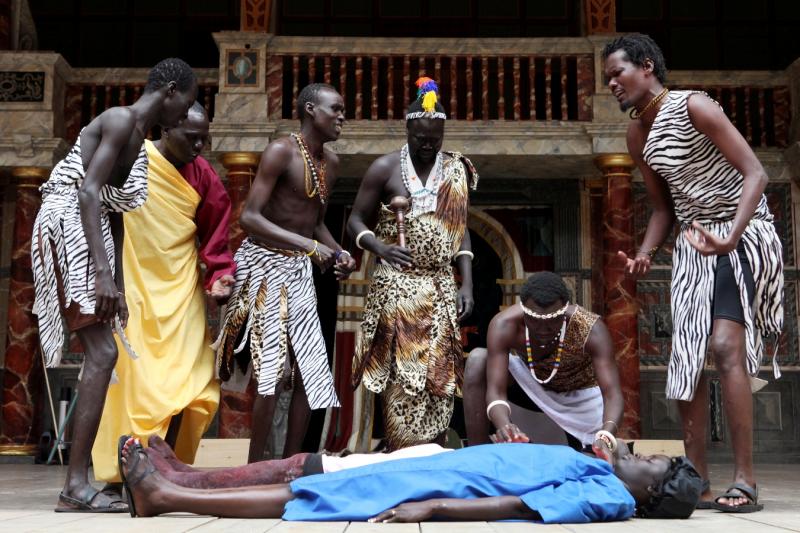
All this was strongly evoked by the South Sudanese actors, with (I fancy) very few cuts and minimal help from the scene summaries in the LED paratitles. It was impossible not to warm to the indignation and passion of Margaret Kowarto’s Imogen (prone in the above photo) or the dignity of Francis Paulino Lugali’s Posthumus. But the festival’s ongoing problem, which can occasionally be a virtue, of not having the text translated back into the Shakespeare original to help the punters made me realize more than ever that the contrived situations of Cymbeline seem merely daft in themselves; it's the poetry they conjure up in the unlikeliest circumstances which gives them sense and wonder.
Here it’s not quite enough to claim that one vaguely feels the force of that poetry in another language without understanding it. The audiences for these shows are incredibly resilient and patient, but they have to be grateful for resourceful mime, jolly dances to clap along to and choice morsels dropped in (non-Shakespearean) English, in which the South Sudanese were as well versed as the Indian actors in the much slicker Twelfth Night. Which of course is far from the whole story, however well that story's told. Shakespeare the poet is largely absent unless you happen to speak the language; Shakespeare the dramatist usually emerges triumphant. Which is enough to keep me going, I hope, to more offerings in this extraordinary world festival.
Production images by Ellie Kurttz for Shakespeare's Globe
Labels:
Cymbeline,
Globe to Globe,
Juba,
Shakespeare's Globe,
South Sudan
Subscribe to:
Posts (Atom)