Sunday, 2 November 2014
Norfolk churches: Mileham to Bittering
Our beginning, middle and end on this September's annual walk in aid of the Norfolk Churches Trust, pictured above, offer different aspects of what we're walking for. St John the Baptist Mileham, up top, where we parked the car that we'd retrieve ten hours later, has extraordinary treasures - chiefly some of Norfolk's best medieval glass - but feels a bit tatty and unloved (the village straggles along the main road, though it does have a shop). It will need extra funds sooner or later. Godwick, a vanished settlement with the church 'wholly ruynated and decaid long since' in 1602, is a warning for the future, however picturesque its solitary tower might seem in the midst of the sheep; St Peter and St Paul Bittering Parva nearly suffered a similar fate, 'left to grazing animals in the 1950s', but the vision of one Canon Dodson saw it restored and reopened as a parish church - ostensibly for five remaining houses - in 1961.
We need more like him, but in the meantime the various conservation trusts are doing grand work. Regulars will be familiar with our motives: we walk, as we did when she was alive and we stayed with her, for our friend Jill's mother Mary Dunkerton, warden of All Saints Burnham Thorpe, the 'Nelson church'. This year was characteristic of the average - about 18 miles and 13 buildings, including ruins and Methodist chapels, which takes our overall total of Norfolk churches specific to the walks up to 149.
The walk was the most pleasant of the lot so far - if that doesn't make our fourth regular, Cally, envious, for this year she couldn't join us - since the temperature was clement, the sun not too insistent and trainers made walking easier than the rather cumbersome hiking boots. The landscape threatened rather too much prairie farming, but that made all the more impressive the stretches between Horningtoft and Stanfield, then above all between Brisley and East Bilney (a valley! Large woods!) And only, it seems, on 'Ride and Stride' day could you guarantee these churches open; Simon Knott in his excellent guide to the churches of East Anglia - of which he has seen many more than I - describes this area as the 'black hole of Norfolk', and found many of the churches firmly locked with no key obtainable.
Mileham plunged us into glass on a more spectacular scale than that of a nearby favourite, West Rudham. The west window, saved from destruction by whitewashing, is the chief glory.
Its double reticulated tracery still houses much of the original glass donated by Lord Fitzalan on his marriage into the royal Lancasters in 1340. Inheriting a fortune after the battle of Crecy, he added the tower, set to the north so as not to block the great window. The colouring stresses intermediate yellow, green (especially striking at first glance) and brown. The three main-light figures are St Catherine, dedicatee John the Baptist and St Margaret.
The paler glass below is reset and from the 15th century - figures identified here being St Margaret again on the right, and St Barbara on the left. Earlier roundels have been inserted below.
There are also fine representations, similarly reset, in the east window of the south aisle, with St Agatha in the centre, a bishop to her left and St John the Evangelist to the right.
At the bottom of the outer lights, worth inspecting at eye level, are one and a bit pack horses
and a kneeling couple.
The church interior as an ensemble didn't look great in the light we had, but it includes box pews, a 15th century pulpit and font, niches in the east wall and plenty of fine memorials - many of the names, as in the churchyard, are very piquant on floor
and wall
while there's a touching little poem about the children on this memorial.
Not sure if you can see it properly so I'll quote:
These pretty babes may passe for wonders who
Ran through the world ere they could stand or goe
The shortes and the cleanest way is best
These took that to thire everlasting rest.
Treading across fine heraldic slabs to the Barnwell family, who lived at now-demolished Mileham Hall, is a ledger to two Pepys(es). Fermor was the diarist's cousin.
I lingered too long here, and was rebuked. Caught up with the others passing a converted Methodist chapel and a be-gnomed residence along a side turning
and a dull walk across fields took us to enchanting, isolated Tittleshall, with St Mary's churchyard an oasis after the bare open agricultural land.
The 14th century tower has canopied niches with - the guide says - decorative animals carved on the footstalls, though this looks like a chap showing his bottom.
You wouldn't expect grand monuments here, but there are five in the chancel owing to the fact that the Cokes, including Thomas First Earl of Leicester who had Holkham Hall built for his art collection, came from here.
Bridget Coke, nee Paston, died 1598, has a splendid alabaster memorial
with children kneeling at the base beautifully detailed.
Equally fine is the commemoration of her husband Sir Edward Coke, Lord Chief Justice and champion of parliamentary rights, died 1634, by Nicholas Stone in black and white marble.
Sir Edward lies in realistic sleep, again finely detailed.
Robert Coke, died 1679, has no effigy; the Holkham folk have busts by Roubiliac, Corinthian grandeur and the splendid family arms with the ostrich(es) you see around the estate.
And last but not least, there's Nollekens at, I'm told, his best, depicting Jane, first wife of Thomas Coke 'of Norfolk', showing her at her death in 1805 being received by an angel on the clouds and pointing heavenwards with a cherub beneath holding a bleeding heart.
This was the second church unmanned, but this time a signer-in-ner was to be found down the fair main street at the (this time active) Methodist chapel by the bowling green.
We've often had the warmest welcome from the Methodists. Not this time, but anyhow we got our signatures and took off across more big fields to the 'lost' village of Godstone, a rare case of redoubling church walk footsteps since we'd covered it back in 2006 - though not in such good light -
and that meant we already dreaded running the gamut of the thousands of turkeys of Godwick Hall Farm. Could the Cokes, whose seat this was at the end of the 16th century, ever have imagined their place would be dominated by the insane screeching of these famously stupid birds?
Yes, the path goes right through there. So we strode purposefully with these creatures gobbling and wailing at our heels - not entirely intimidating until we saw hundreds more heading down a funnel from the farm.
Leaving the din behind, we soon hit the church we'd also reached at the end of our 2006 walk. It was open then, but knowing what we do now it wouldn't have struck as too much of a disappointment if it hadn't been. Knott was perplexed in searching for St Mary Whissonsett; the church is approached down a long drive and green set way back from the road, with two ancient yews (just to the right below) grown together livening up the scene.
.
The best that can be said about what Pevsner calls its 'over-restored' Perpendicular is that it's used and cared for. The Anglo-Saxon cross seems curiously out of place
and most of the glass is Victorian or Edwardian - this annunciation is rather good, though -
but you're rewarded with medieval fragments including Christ in Glory in the west window if you head under the bell tower.
We tucked into our annual chicken and chutney rolls on the green and pressed on to other churches of the Upper Wensum Valley, all chronicled in a neat little book from the curious, sometimes whimsical perspective of the parish's rector, poetry-inclined Rev Robin Stapleford.His entry on St Edmund's Horningtoft shows us what a second tower looked like in a sketch of 1823. But that, like the first at the west, fell down, and now the west end is prettily surmounted by a Victorian bellcote, its continental feel enhanced by the pinetrees flanking the entrance.
Harvest festival was about to be celebrated, very pertinent in this agricultural belt as witnessed by the wreath on the west door
and: the giant beets in front of the rood screen, painted in 19th century folk-style like most of the woodwork in the church (another reason for the feeling that this was a central European rather than an English church)
Apart from the attractive ensemble, the lightness of the interior, the main treasure is the finest font in the area. Pevsner: 'of Suffolk type, ie octagonal and with four lions against the stem and four angels with shields and four lions against the bowl'.
Our next stretch of walking was the most pleasant we'd yet encountered, with the variety of green lanes, woods and an especially lovely lime avenue
as well as what I think are the ubiquitous and tree-destroying honey mushrooms doing no harm now on a couple of stumps.
Just past a free-range pig farm we came to the handsome ensemble of St Margaret's Church and neatly rowed graveyard, Stanfield, with no sign of a settlement around it.
The approach to the south porch was the greenest and most striking of all, adding further to the sense of seclusion
with further lichened and mossy headstones lined up against the wall.
The interior feels loved and all of an Early English piece (in fact the east window dates from 1864, but Pevsner grants that it's 'convincing'. The font cover is Jacobean.
There are animal carvings on the elbow-rests of most of the thick-timbered benches. The leaflet says they're all dogs, but this looks like a hare
and this, the most characterful, a lion.
A wall-painting was recently uncovered by the Jacobean pulpit
and the triple-lancet windows were made attractively taller in the Perpendicular period.
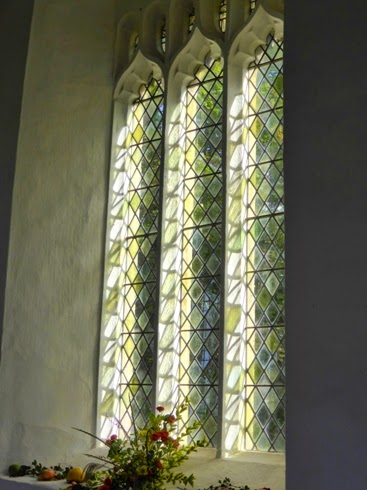
There are fragments of old glass at the tops of several to enhance the already attractive effect
and outside are unusually placed stone heads at either end
several of which appear to be swimming, or it may just be the contorted effect of the way they seem to support - well, what I'm not sure, but the decorations are each individual and striking.
The remoteness was only from our approach; a main road runs just beyond a clump of trees, though that meant a decent coffee stop before the great Perpendicular tower of St Bartholomew's Brisley, shining in the late afternoon sun, beckoned us onwards.
Though the road curves through the village, it's attractive, even if - again - the church, unattended, didn't seem especially well cared for. But then the walls are pleasantly rough and medieval St Christophers carrying Christ Childs have been revealed on north and south walls. The south one is fine for its silhouette
and the north for the painted detail of St Christopher's head.
The tall, wide chancel has a rather striking Victorian window of the crucifixion, garish but interestingly coloured.
Leaving the church on the north side gave another perspective
and then we were in a position where we not only looked back on the distant, tree-fringed tower
but forward (a picture wouldn't do it justice) to two more ahead of us, East Bilney in the foreground and Old Beetley further on - a Norfolk perspective we've had on several other walks. Approaching St Mary's East Bilney hinted at a change of landscape
and it sits, remote and beautifully sited, above - wonder of wonders in Norfolk, a sheer drop to the Blackwater Valley. The wall in front of which we sat for afternoon refreshment only hints at it.
St Mary's framework is essentially Early English, but it was mostly rebuilt in the late 19th and early 20th centuries.
Another Victorian window of colourings similar to those in Bilney, this one by Shrigley and Hunt, commemorates the local celebrity. Thomas Bilney was born here in 1495. A pioneer of the Reformation, he was tried for heresy before Cardinal Wolsey in 1527, eventually released from prison, rearrested and burned at the stake in Norwich (hence the cathedral in the background).
Evening was advancing and we didn't find Bilney's cottage in the village, heading instead down the valley, a truly beautiful and untypical stretch, and up again to St Mary Magdalene Beetley.
Past 5pm, the church was shut, so we missed another fine font but not, it seemed, too much else, wandered round the shady churchyard and pressed on for a final stretch via a green lane
with views back on church tower and a tractor in a field pursued by hundreds of gulls (not visible here)
and a pheasant in surprisingly elegant death
until a couple in a car stopped and asked us if we were heading for Bittering Parva's church. They'd just locked up - first surprise, Jill had thought it was a ruin - and could follow us down the road just to let us see it. So we approached what did indeed look like a crumbling building in a wilderness from a distance (the village, of course, has gone) but turned out to be another of those resources treasured by the local community. And how good it was to talk to human beings at last who had a stake in their church's future.
I've told the story of Canon Dodson's late 1950s rescue mission up top, and the locals still continue his work with a Friends of Bittering Parva Church membership (£10 a year) going towards the upkeep. The tiny interior - this is the smallest church in Norfolk - shows their dedication.
While the bell tower is 17th century, the rest is Early English and, despite a fine piscina,
feels so more on the outside, with further carved heads around the windows.
And so, with the setting sun, back towards Raynham, sculptural harvest bales looking good in the evening light.
and a meal back in King's Lynn starting with fresh Cromer crab. This is the last time we started out from that wonderful town: next September, a different part of Norfolk beckons from Jill's new home. Any last contributions welcome - I can but ask - in a cheque made payable to the Norfolk Churches Trust and sent to me (details available on request). I'll be back with the figures of a very good year's chchugging (church charity mugging) soon.
Previous chronicles:
Beechamwell to Gooderstone, 2013
Ingoldisthorpe to Thornham, 2012
East Rudham to Helhoughton, 2011
Wormegay to Castle Acre, 2010
Walpoles to Wiggenhalls, 2009
King's Lynn to Sandringham, 2008
Earlier walks back to 2002 BB (Before Blog)
Saturday, 25 October 2014
Masters’ farewells: Strauss and Parry
Until I worked on the programme notes for a very curious
concert a month ago at St John’s
Smith Square which I’d been asked to talk before
and during, I wondered what Tim Reader, conductor of the newly-formed Epiphoni Consort (pictured below on the day of the concert), and
his colleagues were thinking of: could great-blaze masters Richard Strauss and
Charles Hubert Hastings Parry have much in common?
It soon became clear: Parry’s six Songs of Farewell, of which I
only really knew the first from All Saint’s Banstead days, ‘My soul, there is a
country’, are total valedictory masterpieces in their sphere, equal in their
own more extended, specific way to Strauss’s Four Last Songs (by the way, the
top picture should have been a sunset, but I settled on the rainbow we caught
on a drive back from the high Maiella range in Italy’s Abruzzo region to our
lodgings in 2009 simply because we were playing what I still think may be the
best 4LS I know on disc – Harteros’s with Luisi and the Staatskapelle Dresden –
and had to stop the car to listen to ‘Im Abendrot’).
Parry’s medium is a cappella choral writing, from four to
eight parts. His instrumentation has never struck me as anything special,
though well-padded orchestration supports those earlier panoplies ‘I was glad’
and ‘Blest pair of sirens’ well enough. But leave him alone with a choir, and
wonders result. Listening and score-gazing, I marvelled at the modulations and
the word-sensitivities, most moved by what would be a perfect funeral anthem, ‘There
is an old belief‘, a nuance-perfect setting of a poem by John Gibson Lockhart.
The one to hear on CD is the incomparable Tenebrae's (the Epiphonis are very much of that ilk) but I'll settle for YouTube's Vasari Singers, a notch below both - you may need to look up the words, which are essential*.
Tim asked which of the six I’d recommend for performance; after some discussion, I’m flattered that we settled on this and its successor, the very rich realization of Donne’s ‘At the round earth’s imagined corners’.
I knew the Epiphoni Consort would be first-rate, and the choir's
interpretation of Strauss’s Deutsche Motette, the toughest work on the
programme, was infinitely finer than the BBC Singers’ Proms performance (no
wobbles, richer body of sound, better soloists – I already knew that Catherine Backhouse is a star, and I loved the tenor sound of William Morgan). But I was
pleasantly surprised by the instrumentalists’ contribution. The Bloomsbury Chamber Orchestra is an amateur ensemble, of course, and with the usual
attendant problems of intonation, but what a difference it makes when a
conductor is firm of purpose, as James Lowe was in Tod und Verklärung. Sounded to
me, too, as if they had imported a professional first trombonist, and the horns
were very fine, too.
Biggest surprise of all was how well soprano Charlotte Newstead coped with the insanely long phrases of
the Four Last Songs: the top isn’t the freshest, but the middle range was
golden, the overall assurance again streets ahead of the Proms singer, Inger
Dam-Jensen.As a result, this one actually moved me.
Enjoyed, too, working on the note for Brahms’s first choral gem,
the Geistliches Lied he composed at the age of 23, even if it was a tad thrown away right at the start
of the programme. I haven’t tuned in to any of Radio 3’s Brahmsfest, but I’m
more in love with this genius than ever thanks to three programme notes for the
Scottish Chamber Orchestra. Exploration of the profound Horn Trio led me back
to the fabulous recording by Isabelle Faust, Teunis van der Zwart and Alexander
Melnikov. I hadn’t listened properly before to Melnikov’s performance of the
Op. 116 Fantasien. It totally won me round to the 1875 Bösendorfer on which he
plays here: the Allegro passionato has a tumultuousness which just doesn’t
sound the same even on the most resonant of contemporary Steinways. Anyway,
Melnikov is one of the relatively unsung greats, and this confirms it. None of his Op. 116 is up on YouTube, so I've settled for his performance, on said Bösendorfer, of the Op. 4 Scherzo.
As for the piano concertos, now that I’ve done proper
homework on them I’m even more eager to
hear my idol Elisabeth Leonskaja in a never-to-be-repeated evening of both with
Okko Kamu conducting the SCO – worth travelling to Glasgow or Edinburgh to
hear, I’d have thought. One special fascination was cued by a typically
brilliant observation from the late, lamented Calum MacDonald. He points out
that Brahms’s manuscript words ‘Benedictus qui venit in nomine Domini’ below
the violin melody of the First Concerto’s Adagio may refer to more than just
the Latin Mass. They’re also the inscription above the entrance to the abbey
where Hofkapellmeister Kreisler seeks refuge from disappointment in E T A Hoffmann’s The Life and Opinions of the Tomcat Murr, my second-favourite comic novel (Don Quixote will always remain No. 1). As this was also one of the young Brahms’s
favourite books, and he was himself known as Kreisler by his circle, the
connection seems plausible. At any rate, it furnished further quotations from
Hoffmann for the note which link back to the concerto’s turbulent opening.
I’d forgotten that Hoffmann lived in Bamberg for a formative
four years, shortly after which he brought out his first collection of tales, Fantasy Pieces in Callot’s Manner (annotators
also overlook this when writing about Mahler’s forest funeral march in the
First Symphony, also in Callots manier).
So apart from the unreal, extensive and other-worldly beauty of Bamberg which so overwhelmed me when I was there recently, the Hoffmann connection was a bonus.
The House-Museum was closed on the days I was there, but we walked around the
square which embraces not only the great man’s poky dwellings but also the
theatre where he was engaged, first unsuccessfully as the director and then as
machinist, scene-painter and composer.
Its interior is, I’m told, preserved as
it was, but the shell is modern. At least it includes his own caricature on the
glass
and there's a recent statue of writer and cat in the space before
the theatre.
In a street winding up one of the town’s seven hills, the curiously-named Eisgrube leading to St Stephen's Church, there’s also the door-knocker which in Hoffmann's most
fantastical story The Golden Pot turns into the face of the ugly old Apple Woman of the
Schwarzthor. The tale is nominally set in Dresden,
but it seems imbued with the more medieval atmosphere of Bamberg.
My cicerone, Matthias Hain of the Bamberg Symphony
Orchestra, told me the famous knocker now turns up everywhere – as candy,
mementoes etc. I had no idea, and saw none. Anyway, it was good enough to turn
me back to re-reading the tale. And I feel in a mood for Murr again; but there’s
Mann’s Joseph and his Brothers to
surmount first. And I owe a few reflections on the second reading of Doctor
Faustus here. Eventually. Long-overdue Norfolk Churches Walk chronicle next,
with apologies for work deadlines getting in the way.
*so here they are:
There is an old belief,
That on some solemn shore,
Beyond the sphere of grief
Dear friends shall meet once more.
Beyond the sphere of Time
And Sin, and Fate's control,
Serene in changeless prime
Of body and of soul.
That creed I fain would keep
That hope I'll ne'er forgo.
Eternal be the sleep,
If not to waken so.
*so here they are:
There is an old belief,
That on some solemn shore,
Beyond the sphere of grief
Dear friends shall meet once more.
Beyond the sphere of Time
And Sin, and Fate's control,
Serene in changeless prime
Of body and of soul.
That creed I fain would keep
That hope I'll ne'er forgo.
Eternal be the sleep,
If not to waken so.
Tuesday, 14 October 2014
Malala v malignity, Malaparte the dualist
Of course there are always going to be troll-toads lurking to aim their spit at the dove of progress*, but it came as a shock on the day that Malala Yousafzai had been awarded the Nobel Peace Prize along with Indian anti-child slavery campaigner Kailash Satyarthi to find an attack from an official quarter. I won't dignify the Editor of the Pakistan Observer with a name, but it was astonishing to find a supposedly educated man, interviewed on the BBC World Service's Newshour, describing the whole incident of Malala's shooting as a western set-up, asserting that she wasn't even shot and that her father is a sinister manipulator. And Malala herself? 'Just a normal, useless girl'. Well, that says it all. And why give such a creature airtime? Because his views are shared by - or should one say stoked in - thousands around Pakistan.
It's the same old story worldwide: one laughs at the absurdity of such goons, but when they are in positions of power, it's a different matter. Putin, after all, has idiots in place around Russia, as we know from Stephen Fry's interview with the ludicrous St Petersburg homophobe. When ideologies you could knock down with a feather of logical argument become enshrined, lives are at risk. And yes, we have it lurking close to home in the deceptive personage of Nigel Farage.
Frankly I share the view of my old ma who, until our brush with a local Ukip councillor doubling as the taxi driver who ferried us to Priscilla, Queen of the Desert for her birthday treat, might have voted for Farage. She keeps telling me how every time Nige appears on the telly she has the urge to 'smash his awful smug face in' (this is figurative, you understand, not a threat of real physical violence). And yet people will still vote for him, even after every week some new fool in the grassroots of his party says something absurd, and even now that he's come out, as it were, with the proposal of banning HIV positive foreigners from entering our sceptred isle (this, it seems, might even have been a jealous hit at the not very prepossessing-looking but presumably slightly brighter Tory MP Douglas Carswell who defected to Ukip and won their first seat in Clacton-on-Sea; Carswell's father was a pioneer in HIV research, and he condemned Farage's cheap trick unreservedly. One can only hope he's a plant to implode Ukip policies).
No coincidence, then, that Clacton Council removed from a town wall the above Aesopian or La Fontaine fable by the great Banksy (as it comes from banksy.org, I assume the reproduction is freely available), one of his best commentaries yet. It's said that people didn't get the real point, but I imagine they got it all too well.
Enough ranting. But it did sadden me, too, to read of the humble Satyarthi's injuries in 34 years of attempting, sometimes successfully, to rescue enslaved children: a broken shoulder, a broken leg and a broken back. Plus the losses of two of his colleagues - 'one was shot dead and one was beaten to death. Most of my junior colleagues have been beaten up many times. So it is not an easy game'.
Two inspiring comments from Satyarthi to wrap up this part of the argument: 'This is a moral examination that one has to pass...to stand up against social evils' and 'India has hundreds of problems and millions of solutions'. The spirit of Gandhi is alive and healthy. By the way, if you haven't done so already, please sign the #upforschool petition.
The connection with a masterpiece of a novel by Italo-German writer Curzio Malaparte, born Kurt Eric Suckert in Prato, may be tenuous. But I get a queasy sense of good and evil, beauty and horror, mixed up in The Skin (La pelle), published in 1949 as an extraordinary literary transfiguration of his experiences as a liaison officer in Naples following the Allied liberation in 1943. I've just read it in a New York Review Books edition which reinstates passages omitted from previous English-language editions (in Italy La pelle was banned by the church for some time). My cover has Luciano Fontana's Concetto Spaziale of 1966, but I like the one above, where the transcendent coincides with the all too mortal just as it does in the book.
At first it seems as if Malaparte is being perverse, almost playing with the paradox of a liberation which is worse for the Neapolitans than the war itself. What does he really think of the rosy, fresh-faced Americans? How disingenuous is he being and what is he making up? Clarification soon comes in the second chapter:
I do not like to see how low man can stoop in order to live. I preferred the war to the 'plague' which, after the liberation, had defiled, corrupted and humiliated us all - men, women and children. Before the liberation we had fought and suffered in order not to die. Now we were fighting and suffering in order to live...It is a humiliating, horrible thing, a shameful necessity, a fight for life. Only for life. Only to save one's skin. It is no longer a fight against oppression, a fight for freedom, for human dignity, for honour. It is a fight for a crust of bread, for a little fuel, for a rag with which to cover the nakedness of one's own children, for a handful of straw on which to lie.
Malaparte cranks up the superb rhetoric and concludes:
The plague had been able to achieve more in a few days than tyranny had done in twenty years of universal humiliation, or war in three years of hunger, grief and atrocious suffering. Those people who bartered themselves, their honour, their bodies and the flesh of their own children in the streets - could they possibly be the same people who a few days before, in those same streets, had given such conspicuous and horrible proof of their courage and fire in face of German opposition?
Malaparte's philosophical games on the edge of politics are perhaps embodied in his biography: an early supporter of Mussolini who soon turned against the dictator in powerful prose, was exiled to the island of Lipari - an era which coincides with a tragic narrative in The Skin about his dog Febo, pictured there with him below
and woven in with the main gist about a dying soldier - and ended up after the war a committed communist. But he is, first and foremost, a deadly serious artist, and his chameleonic tone is what puts The Skin as a work of literature above the mere, if excellent, sometimes selective reportage of Norman Lewis in Naples '44. There is, besides, a metaphysical dimension, a use of Homeric similes and a conscious, often parodistic parallel between the post-war situation and Greek or Roman mythology which, like music, Malaparte knows and describes so well.
There are too many vivid embodiments of his savage irony to cite here, but I'll just touch on the linking of two dazzlingly described gatherings.. The first, in my favourite chapter 'General Cork's Banquet', makes absurd contrasts between the fine, Capodimonte-laden table beneath a fresco by Luca Giordano in the Duke of Toledo's palace and the food served up, including fried Spam and boiled corn which sends Malaparte off on one of his grotesquely enjoyable riffs. 'The ancient and glorious house of Toledo had never witnessed so tragic a humiliation, ' he summarises. He makes fun of the guest of honour, Mrs Flat - a seeming 'monster of purity and virginity' in command of the WACs, and the piece de resistance is the fish course.'The famous Siren from the Aquarium' has been sacrificed, like other prize specimens, 'to General Cork's mental cruelty'. Unfortunately it resembles a dead girl; Malaparte tortures both us and Mrs Flat with the possibility of cannibalism. I can't see it myself in images of the eel-like siren fish, but this superstitious concoction brings us closer to the semi-fantasy:
If that's priceless and relentlessly horrible, almost more so is the way Malaparte takes his revenge on his fellow diners at a camp outside Rome, discussing what's fact and what fiction in his previous novel, Kaputt (about his time on the eastern front, partly resurrected in The Skin. Thankfully Kaputt is also in the NYRB series, and I've ordered it up from Daunt Books). A General Guillaume opines that 'in Kaputt [Malaparte] is pulling his readers' legs'. Malaparte, previously silent, goes into a long and eloquent disquisition about how in his couscous he had discovered the hand of a Moroccan soldier which had just been blown off by a landmine. And ate it. We almost begin to believe him. Then in an aside to his best mate Jack he asks him if he saw 'how skillfully I arranged those little ram's bones on my plate? They looked just like the bones of a hand'.
But it's not all so gruesomely joky. I came to respect and marvel at Malaparte's role as a truth-telling jester of paradox, of the gulf between seeming and being. In the last chapter he transcends his own descent into hell by telling a less brilliant American than Jack: 'it isn't true that Christ saved the world once and for all'.
'Christ died to teach us that every one of us can become Christ, that every man can save the world by his own sacrifice. Christ too would have died in vain if it were not possible for every man to become Christ and to save the world.'
'A man is only a man,' said Jimmy.
'Oh, Jimmy, won't you understand that it isn't necessary for a man to be the Son of God, to rise again from the dead on the third day, and to sit on the right hand of the Father, in order to be Christ? It is those thousands and thousands of dead men who have saved the world, Jimmy.'
Kurt Vonnegut, my recent obsession, who loved the simple message of the Sermon on the Mount, would like that, I think, even if Malaparte has stopped playing the Vonneguttian holy fool. So, I hope, would Malala.
*French proverb which I like, 'La bave du crapaud n'atteint pas la blanche colombe'. The nearest English equivalent, 'sticks and stones may break my bones, but words can never harm me', isn't quite so poetic.
Labels:
1943,
Banksy,
Curzio Malaparte,
Kailash Satyarthi,
Kaputt,
Malala Yousafzai,
Naples,
The Skin,
Ukip
Monday, 6 October 2014
Go, Girl
Puccini's La fanciulla del West certainly went for gold on the first night of Richard Jones's new production for English National Opera. There's not much I can add to my Arts Desk review, or the BBC Radio 3 Music Matters chat with Tom Service and Alexandra Wilson, about Minnie's return to the original Americanization of David Belasco's The Girl of the Golden West. One thing I ought to admit in a marginally more private sphere is that, once past the thrill of being hurtled into Puccini's sheer showmanship in as brilliant a grab-you-by-the-throat start as any he composed, I wept to the point of sobbing at the miners' yearnings for the folk back home, and at the sheer candid insecurity of Susan Bullock's Minnie (pictured above by Robert Workman for ENO at the end of Act Two with Peter Auty's half-dead Ramerrez and Craig Colclough as the defeated Ramerrez glowering through the window) in the beautifully paced, clinch-postponed scene with the man she loves at the end of the First Act. I love it that Richard, in his typically pithy responses for the Music Matters slot, described the plot as being about 'three people with very low self-esteem'.
The key word about Jones's careful stagecraft is truthfulness, not easy in a piece which can slide into hammy melodrama. It's overwhelmed me to the point of obsessiveness since I saw the show on Thursday, reminding me that any imperfections in the purely vocal qualities of the principals can be far outshone by the lasting impression of a terrific piece of staging. For vocal thrills untroubled by questions of dramatic fidelity onstage, you still have to go back to peerless Birgit Nilsson* on the 1958 studio recording with Teatro alla Scala forces. Her tenor, the now more or less unremembered João Gibin, ain't bad either. But what surely makes this one of the great opera recordings is the perfect theatricality of Lovro von Matačić's conducting. It's all here on YouTube.
What some top-notch singing can be without staging of Jones's peerless know-how and thoughtfulness struck me all too forcibly when I went to see ENO's other new production of the season so far, of Verdi's Otello, two evenings later. I don't doubt that Stuart Skelton will make a great Otello sooner or later. But David Alden's was not the production to help him. Maybe it was an especially lethargic, energy-dimmed Saturday night, but I didn't even get the sense of any outsider status in this tormented warrior to make up for an avoidance of the elephant in the room, the racial issue (which matters less in the opera, certainly, than in Shakespeare, who makes Othello's apartness the crux of Iago's manipulation).
Sadly, there was little dramatic spark until Skelton's protagonist fell to his knees and launched into a suddenly thrilling 'Si, pel ciel marmoreo giuro' (or whatever that is in the rather dreary, antiquated-sounding English translation). Veteran Jonathan Summers backed him up and suddenly we were experiencing again the true theatrical spark (the two below pictured by Alastair Muir for ENO).
For me, that was it. No doubt it wasn't Summers' fault but the production's that Boito's text for Iago's Credo just struck me as downright silly. I didn't see or hear the feistiness many had detected in Leah Crocetto's Desdemona, either. She can do the works, the top and the pianissimi, but I didn't hear much pathos or lower tones in the bright, well-schooled soprano voice; not was there the bearing which can make Desdemona effective even when the voice is lacking (as it certainly wasn't with Crocetto). Alden's mise en scene conveyed very little to me, but the real death blow was the fatal unpaciness of Edward Gardner's conducting. Yes, the orchestra delivered all the detail on top form, but why did we come away at the interval - despite that duet-finale - feeling so torpid? The score should fly like an arrow until the bedchamber scene, which was neither set where it needs to be nor affecting in any way. Here was a case where fine singing and playing didn't constitute the musical supremacy which might have made up for the sheer incoherent movement and apparent indiscipline of the dramatic picture.
Back to school tomorrow - or rather today, since it's now past midnight - but no longer to the City Lit; slight regrets about having sacrificed Fanciulla, which was on the menu there before it all went pear-shaped, in favour of Prokofiev's War and Peace, so as not to be accused of replication. My Opera in Depth course at the Frontline Club kicks off at 2.30pm, and I'm confident about the fabulous resources of the place; this was the right choice. Loyal students, and some new faces, have helped to make it happen. And I'd particularly like to acknowledge the generous support of David Pickard, Laura Jukes and James Hancox at Glyndebourne in giving the course a big push in the house's October e-newsletter which went out on Saturday. On Thursday we'll see how the Nielsen/Sibelius course works at St Andrew's Fulham Fields; for the first week we'll be in the church proper while there's a winetasting in 'our' lecture room.
One disappointment was that the BBC Symphony Orchestra management came back to me, after three weeks of persistent e-mailing on my part (some staff were away, others weren't) to check whether we could have the usual student discount, to tell me that wasn't possible for 'privately-run courses'. So with the agitated action that I've been prone to since having to start afresh, I approached the London Philharmonic Orchestra and they'll give us 50 per cent discount on selected concerts next year. I've opted for two classes on 12 and 19 March to cover three Ballets Russes scores being conducted by Jurowski - Ravel's Daphnis and Chloe on the 14th, excerpts from Prokofiev's Chout and Stravinsky's complete 1911 Petrushka on the 21st. One of Bakst's paintings associated with his designs for the original production of Daphnis pictured below.
Then on 23 April we anticipate the last concert in Jurowski's Rachmaninoff: Inside Out series on 29 April. So that's a new start, and I may well add other one-off classes depending on how things go. But it's a fun adventure so far, not least to discover that I can administer my way out of a paper-bag; I have the internet, and xls, to thank for that. Again, my e-mail, if you'd like further details: david.nice@usa.net.
*This is serendipity, since I'm off to Stockholm for the Birgit Nilsson Prize, recipients the Vienna Philharmonic who'll be playing under Muti. I look forward to hearing the reasoning.
Thursday, 2 October 2014
Extraordinary women
That's three on a stage in the spooky-spectacular Union Chapel the other week, and about three times that many, all in prison. But let's start with the divas. Courtesy of the Royal Society of Literature and the unfortunately-titled but really rather good magazine Intelligent Life, we were promised The Lives of Others from great dames Harriet Walter and Hilary Mantel, moderated by a less visible genius of the theatre, playwright Timberlake Wertenbaker, productions of whose classic Our Country's Good and of her translation of Gabriela Preissova's Jenufa remain among my theatrical highlights. All shots of the evening courtesy of Mike Massarow via the RSL.
It was perhaps only because I've seen Harriet in action before, rivetingly at the Garrick and - if I'm the right person to judge - achieving miracles of transformation as 'my' Marschallin, Prima Donna, Brünnhilde and Moses in the German Opera Discovery Day up in Birmingham, that the lion's share of my wonder this time goes to Hilary Mantel. In putting the spotlight on her I know I sidestep the theme of inhabiting male characters from the fictional or real past, about which Harriet was so eloquent. But our greatest and most versatile living novelist is also a consummate performer; I hesitate to use the word 'actor' because a lot of what she said seemed spontaneous, a direct response to questions or comments, whereas with Robert Macfarlane in conversation at the East Neuk Festival I found that a lot of his phrases came straight out of his books.
In any case I'm usually sniffy about attending literary events - I have the feeling, possibly unfair, that the writer's life's his/her work, to paraphrase Henry James. But here there was almost a sense of possession, as Mantel made clear in paralleling her work with that of her medium in Beyond Black (the first of her books I read). She began by saying how as she was about to begin Wolf Hall and wasn't sure how to, she heard a voice directly above her saying 'now get up', found herself 'in Thomas Cromwell's body - and then all the decisions about the novel had been made'. And she ended in response to an audience question about how much was imagination and how much 'what you know' in much the same seer's vein:
You may know more than you think, and there's a turning point where you recognise that, you gain authority...People suppose that imagination is an airy quality and that employing it is a genteel act that might be done on a chaise longue. But to imagine properly, you have to imagine strenuously, it involves your whole body, from feet to head.
That was richly embodied in what she said about the novel I found the most shattering of all, A Change of Climate, her Heart of Darkness which transports us back from Norfolk to Africa, in the writing of which she told us how the 'secret' had to be torn out of her.
My gratitude here to good friend and impressive novelist Anthony Gardner, who pointed me in the direction of his write-up in Intelligent Life as I hadn't written down the quotations I found most interesting. It came as no surprise to find he'd selected most of them. Read his article for more from Harriet.
Much later - I'm indebted to the charming folk at the RSL for notifying me when the interview went up on YouTube. It seems unembeddable, so click here for the whole thing.
And then we had to spoil it all by going off to a truly dismal late night Prom with Rufus Wainwright.
There's a parallel here between being so utterly swept off our feet by two whole series of the Netflix prison drama from Jenji Kohan Orange is the New Black that dipping diligently into several supposedly 'arthouse' gay-themed movies has been disappointing. If I could have done, I'd have walked out of Rufus - I couldn't because I had to write about it - and we've given up on the three films since the last Orange episode.
You think, perhaps, it's going to be a campy American equivalent of Prisoner of Cell Block H, but being based on a writer's prison memoir, a mostly less grim version of Dostoyevsky's autobiographical From the House of the Dead, it already has a claim to truthfulness. But then there's the extraordinary script, plotting and acting (every character a winner in one way or another). Our guide, Piper Chapman (Taylor Schilling), is slammed up for just over a year for having carried drug money 10 years earlier at the request of her charismatic lover Alex (low-voiced Laura Prepon, a woman I can well imagine falling for). So this is the chronicle of Piper's 'time'.
Well, if prison is as full of characters like this, give me a sentence ('you wouldn't last a week', says J scornfully, telling me unrepeatable things about why not). While it teaches you a lot about the American prison system - not least that a cancer sufferer will probably die in prison (Barbara Rosenblat turns in a terrific performance as 'Miss Rosa')
and an old lady with Alzheimer's will be dumped out on the streets if she becomes too much bother inside - the biggest message is about the waste of talent and creativity. We all love the wit and wisdom of Sophia (Laverne Cox, a transgender actress playing a transgender prisoner). The black group hanging out together - presumably this isn't racism but just how it is - includes characters with a fabulous sense of fantasy and language (gongs, please, for Uzo Aduba, Danielle Brooks and Samira Wiley). So we (I, at least) get really upset when they nearly all come under the sway of one hard-nosed businesswoman, the evil Vee (superb actress Lorraine Toussaint).
I won't provide any spoilers by describing what Vee gets up to, but suffice it to say POSSIBLE SEMI-SPOILER ALERT that by the penultimate episode of Series Two I was wanting to leave the show alone because it was so upsetting. But whereas Series One ended on a bout of terrifying violence, this one wound up in more of a feelgood way.
Praising the good actors would just turn in to one long list: they include the men, not least the prison counsellor (Michael J Harney) of warped good intentions and the large guard who had us in tears of laughter rapping about his humiliation in a Catholic school to a group of nuns protesting outside the prison. The one I find most consummate of all is Taryn Manning as the appalling hick Pennsatucky; how the hell does that actress keep the gravel in her voice?
She, as much as anyone else, you're allowed to feel for over the course of time. So no-one is there for cheap laughs, at least not in the long term during which we get flashbacks to their former lives. Absolutely a case of Dostoyevsky's epigraph 'In every human, a spark of God'.
Subscribe to:
Comments (Atom)


%2BRobert%2BWorkman.jpg)


