Our beginning, middle and end on this September's annual walk in aid of the Norfolk Churches Trust, pictured above, offer different aspects of what we're walking for. St John the Baptist Mileham, up top, where we parked the car that we'd retrieve ten hours later, has extraordinary treasures - chiefly some of Norfolk's best medieval glass - but feels a bit tatty and unloved (the village straggles along the main road, though it does have a shop). It will need extra funds sooner or later. Godwick, a vanished settlement with the church 'wholly ruynated and decaid long since' in 1602, is a warning for the future, however picturesque its solitary tower might seem in the midst of the sheep; St Peter and St Paul Bittering Parva nearly suffered a similar fate, 'left to grazing animals in the 1950s', but the vision of one Canon Dodson saw it restored and reopened as a parish church - ostensibly for five remaining houses - in 1961.
We need more like him, but in the meantime the various conservation trusts are doing grand work. Regulars will be familiar with our motives: we walk, as we did when she was alive and we stayed with her, for our friend Jill's mother Mary Dunkerton, warden of All Saints Burnham Thorpe, the 'Nelson church'. This year was characteristic of the average - about 18 miles and 13 buildings, including ruins and Methodist chapels, which takes our overall total of Norfolk churches specific to the walks up to 149.
The walk was the most pleasant of the lot so far - if that doesn't make our fourth regular, Cally, envious, for this year she couldn't join us - since the temperature was clement, the sun not too insistent and trainers made walking easier than the rather cumbersome hiking boots. The landscape threatened rather too much prairie farming, but that made all the more impressive the stretches between Horningtoft and Stanfield, then above all between Brisley and East Bilney (a valley! Large woods!) And only, it seems, on 'Ride and Stride' day could you guarantee these churches open; Simon Knott in his excellent
guide to the churches of East Anglia - of which he has seen many more than I - describes this area as the 'black hole of Norfolk', and found many of the churches firmly locked with no key obtainable.
Mileham plunged us into glass on a more spectacular scale than that of a nearby favourite,
West Rudham. The west window, saved from destruction by whitewashing, is the chief glory.
Its double reticulated tracery still houses much of the original glass donated by Lord Fitzalan on his marriage into the royal Lancasters in 1340. Inheriting a fortune after the battle of Crecy, he added the tower, set to the north so as not to block the great window. The colouring stresses intermediate yellow, green (especially striking at first glance) and brown. The three main-light figures are St Catherine, dedicatee John the Baptist and St Margaret.
The paler glass below is reset and from the 15th century - figures identified here being St Margaret again on the right, and St Barbara on the left. Earlier roundels have been inserted below.
There are also fine representations, similarly reset, in the east window of the south aisle, with St Agatha in the centre, a bishop to her left and St John the Evangelist to the right.
At the bottom of the outer lights, worth inspecting at eye level, are one and a bit pack horses
and a kneeling couple.
The church interior as an ensemble didn't look great in the light we had, but it includes box pews, a 15th century pulpit and font, niches in the east wall and plenty of fine memorials - many of the names, as in the churchyard, are very piquant on floor
and wall
while there's a touching little poem about the children on this memorial.
Not sure if you can see it properly so I'll quote:
These pretty babes may passe for wonders who
Ran through the world ere they could stand or goe
The shortes and the cleanest way is best
These took that to thire everlasting rest.
Treading across fine heraldic slabs to the Barnwell family, who lived at now-demolished Mileham Hall, is a ledger to two Pepys(es). Fermor was the diarist's cousin.
I lingered too long here, and was rebuked. Caught up with the others passing a converted Methodist chapel and a be-gnomed residence along a side turning
and a dull walk across fields took us to enchanting, isolated Tittleshall, with St Mary's churchyard an oasis after the bare open agricultural land.
The 14th century tower has canopied niches with - the guide says - decorative animals carved on the footstalls, though this looks like a chap showing his bottom.
You wouldn't expect grand monuments here, but there are five in the chancel owing to the fact that the Cokes, including Thomas First Earl of Leicester who had Holkham Hall built for his art collection, came from here.
Bridget Coke, nee Paston, died 1598, has a splendid alabaster memorial
with children kneeling at the base beautifully detailed.
Equally fine is the commemoration of her husband Sir Edward Coke, Lord Chief Justice and champion of parliamentary rights, died 1634, by Nicholas Stone in black and white marble.
Sir Edward lies in realistic sleep, again finely detailed.
Robert Coke, died 1679, has no effigy; the Holkham folk have busts by Roubiliac, Corinthian grandeur and the splendid family arms with the ostrich(es) you see around the estate.
And last but not least, there's Nollekens at, I'm told, his best, depicting Jane, first wife of Thomas Coke 'of Norfolk', showing her at her death in 1805 being received by an angel on the clouds and pointing heavenwards with a cherub beneath holding a bleeding heart.
This was the second church unmanned, but this time a signer-in-ner was to be found down the fair main street at the (this time active) Methodist chapel by the bowling green.
We've often had the warmest welcome from the Methodists. Not this time, but anyhow we got our signatures and took off across more big fields to the 'lost' village of Godstone, a rare case of redoubling church walk footsteps since we'd covered it back in 2006 - though not in such good light -
and that meant we already dreaded running the gamut of the thousands of turkeys of Godwick Hall Farm. Could the Cokes, whose seat this was at the end of the 16th century, ever have imagined their place would be dominated by the insane screeching of these famously stupid birds?
Yes, the path goes right through there. So we strode purposefully with these creatures gobbling and wailing at our heels - not entirely intimidating until we saw hundreds more heading down a funnel from the farm.
Leaving the din behind, we soon hit the church we'd also reached at the end of our 2006 walk. It was open then, but knowing what we do now it wouldn't have struck as too much of a disappointment if it hadn't been. Knott was perplexed in searching for St Mary Whissonsett; the church is approached down a long drive and green set way back from the road, with two ancient yews (just to the right below) grown together livening up the scene.
.
The best that can be said about what Pevsner calls its 'over-restored' Perpendicular is that it's used and cared for. The Anglo-Saxon cross seems curiously out of place
and most of the glass is Victorian or Edwardian - this annunciation is rather good, though -
but you're rewarded with medieval fragments including Christ in Glory in the west window if you head under the bell tower.
We tucked into our annual chicken and chutney rolls on the green and pressed on to other churches of the Upper Wensum Valley, all chronicled in a neat little book from the curious, sometimes whimsical perspective of the parish's rector, poetry-inclined Rev Robin Stapleford.His entry on St Edmund's Horningtoft shows us what a second tower looked like in a sketch of 1823. But that, like the first at the west, fell down, and now the west end is prettily surmounted by a Victorian bellcote, its continental feel enhanced by the pinetrees flanking the entrance.
Harvest festival was about to be celebrated, very pertinent in this agricultural belt as witnessed by the wreath on the west door
and: the giant beets in front of the rood screen, painted in 19th century folk-style like most of the woodwork in the church (another reason for the feeling that this was a central European rather than an English church)
Apart from the attractive ensemble, the lightness of the interior, the main treasure is the finest font in the area. Pevsner: 'of Suffolk type, ie octagonal and with four lions against the stem and four angels with shields and four lions against the bowl'.
Our next stretch of walking was the most pleasant we'd yet encountered, with the variety of green lanes, woods and an especially lovely lime avenue
as well as what I think are the ubiquitous and tree-destroying honey mushrooms doing no harm now on a couple of stumps.
Just past a free-range pig farm we came to the handsome ensemble of St Margaret's Church and neatly rowed graveyard, Stanfield, with no sign of a settlement around it.
The approach to the south porch was the greenest and most striking of all, adding further to the sense of seclusion
with further lichened and mossy headstones lined up against the wall.
The interior feels loved and all of an Early English piece (in fact the east window dates from 1864, but Pevsner grants that it's 'convincing'. The font cover is Jacobean.
There are animal carvings on the elbow-rests of most of the thick-timbered benches. The leaflet says they're all dogs, but this looks like a hare
and this, the most characterful, a lion.
A wall-painting was recently uncovered by the Jacobean pulpit
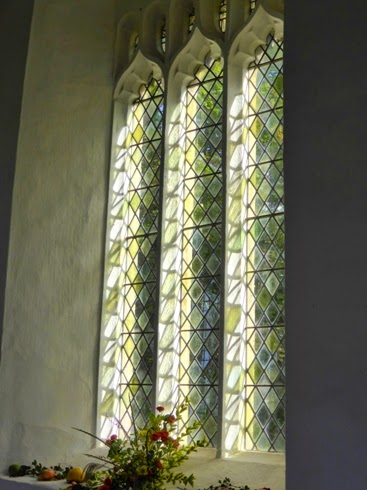
and the triple-lancet windows were made attractively taller in the Perpendicular period.
There are fragments of old glass at the tops of several to enhance the already attractive effect
and outside are unusually placed stone heads at either end
several of which appear to be swimming, or it may just be the contorted effect of the way they seem to support - well, what I'm not sure, but the decorations are each individual and striking.
The remoteness was only from our approach; a main road runs just beyond a clump of trees, though that meant a decent coffee stop before the great Perpendicular tower of St Bartholomew's Brisley, shining in the late afternoon sun, beckoned us onwards.
Though the road curves through the village, it's attractive, even if - again - the church, unattended, didn't seem especially well cared for. But then the walls are pleasantly rough and medieval St Christophers carrying Christ Childs have been revealed on north and south walls. The south one is fine for its silhouette
and the north for the painted detail of St Christopher's head.
The tall, wide chancel has a rather striking Victorian window of the crucifixion, garish but interestingly coloured.
Leaving the church on the north side gave another perspective
and then we were in a position where we not only looked back on the distant, tree-fringed tower
but forward (a picture wouldn't do it justice) to two more ahead of us, East Bilney in the foreground and Old Beetley further on - a Norfolk perspective we've had on several other walks. Approaching St Mary's East Bilney hinted at a change of landscape
and it sits, remote and beautifully sited, above - wonder of wonders in Norfolk, a sheer drop to the Blackwater Valley. The wall in front of which we sat for afternoon refreshment only hints at it.
St Mary's framework is essentially Early English, but it was mostly rebuilt in the late 19th and early 20th centuries.
Another Victorian window of colourings similar to those in Bilney, this one by Shrigley and Hunt, commemorates the local celebrity. Thomas Bilney was born here in 1495. A pioneer of the Reformation, he was tried for heresy before Cardinal Wolsey in 1527, eventually released from prison, rearrested and burned at the stake in Norwich (hence the cathedral in the background).
Evening was advancing and we didn't find Bilney's cottage in the village, heading instead down the valley, a truly beautiful and untypical stretch, and up again to St Mary Magdalene Beetley.
Past 5pm, the church was shut, so we missed another fine font but not, it seemed, too much else, wandered round the shady churchyard and pressed on for a final stretch via a green lane
with views back on church tower and a tractor in a field pursued by hundreds of gulls (not visible here)
and a pheasant in surprisingly elegant death
until a couple in a car stopped and asked us if we were heading for Bittering Parva's church. They'd just locked up - first surprise, Jill had thought it was a ruin - and could follow us down the road just to let us see it. So we approached what did indeed look like a crumbling building in a wilderness from a distance (the village, of course, has gone) but turned out to be another of those resources treasured by the local community. And how good it was to talk to human beings at last who had a stake in their church's future.
I've told the story of Canon Dodson's late 1950s rescue mission up top, and the locals still continue his work with a Friends of Bittering Parva Church membership (£10 a year) going towards the upkeep. The tiny interior - this is the smallest church in Norfolk - shows their dedication.
While the bell tower is 17th century, the rest is Early English and, despite a fine piscina,
feels so more on the outside, with further carved heads around the windows.
And so, with the setting sun, back towards Raynham, sculptural harvest bales looking good in the evening light.
and a meal back in King's Lynn starting with fresh Cromer crab. This is the last time we started out from that wonderful town: next September, a different part of Norfolk beckons from Jill's new home. Any last contributions welcome - I can but ask - in a cheque made payable to the Norfolk Churches Trust and sent to me (details available on request). I'll be back with the figures of a very good year's chchugging (church charity mugging) soon.
Previous chronicles:
Beechamwell to Gooderstone, 2013
Ingoldisthorpe to Thornham, 2012
East Rudham to Helhoughton, 2011
Wormegay to Castle Acre, 2010
Walpoles to Wiggenhalls, 2009
King's Lynn to Sandringham, 2008
Earlier walks back to 2002 BB (Before Blog)




 Posts
Posts