Showing posts with label Tower of London. Show all posts

Tuesday, 21 March 2017

Under and over the Thames


It started as a very special 'exclusive': an invitation to see the Guildhall School of Music and Drama's sound and video work in the enormous Bascule Chamber of Tower Bridge, 100 steps down beneath the Thames (main installation photos by Paul Cochrane, courtesy of GSMD). The bonus was just as good: a chance to join the tourists and look down from the walkways originally constructed as a Victorian wonder for pedestrians until too many people started throwing themselves off (it's all now very much enclosed, but you still get the views). Rounded off, moreover, by the sexiest machinery I've ever seen: the Industrial Age as a thing of beauty.

Of which Tower Bridge as a whole, constructed between 1886 and 1894 at a cost of £1,500,000, is the best representative I can imagine - and now that I know what it can reveal, I'd make sure any visitor put the paying part of it on a top five list of London sights (the Tower of London, with which I've been mildly obsessed since childhood, has to be number one).The one part the public doesn't usually get to see, other than on one day of the year (I assume during Architecture Open Weekend) or on specially-ordered private tours (which I'd recommend), is the Bascule Chamber, the operational area that houses the massive counterweights lowered when the two bascules are raised to allow big shipping through (which still happens regularly). The two towers clad in stone of Gothic design have a steel frame to support the heavy bascules, each weighing about a thousand tons.


The counterweights, if I remember what we were told correctly, amount to a couple of hundred tons, so it was quite a frisson to think of them, as well as the river water, hovering above our heads once we'd made the descent 'Down the Rabbit Hole', as the first part of the Guildhall School's live and installed work was called. Photos were allowed on the way up, so here are a couple I took, one of the dramatically lit staircases


and another of the big boiler? engine? towards the bottom. Very cold and dank down there. You could feel the temperature dropping as you descended.


The work was carried out by students from the GS's BA in Video Design for Live Performance and BA in Performance and Creative Enterprise degree courses. And a remarkable job they made of the 'happening'. We lucky few sat and donned headphones with a lively collage of music and quotations from films - most of them identifiable - while the images played with the sense of space. Back to Paul Cochrane for the next three pics.


Inevitably they were of variable quality, coming from so many different sources, but made up an imaginative journey which evoked cinematic travels to the centre of the earth with tumbling rocks, rainbows, spinning London landmarks and a projection of the underground map,


underwater sequences and giant faces.


Did the results achieve their stated objective as 'an imaginative and visual transformation of the space'? Absolutely, though it was also good to be allowed to linger and see the brickwork at closer quarters after the adventure.


As I exited, I saw tourists coming out of the lift that runs up one of the towers. and asked if I could go upwards, having been down. The staff couldn't have been more charming: a jovial Welshman escorted me up, and a nice girl I met at the top in the steel-encased upper part of the tower


told me how much she loved working there and watching people's reactions. My own was, why on earth have I never done this before? First I strolled along the east walkway, from which David Piper, in my first and still favourite big guide to London writes how 'the quintessential Thames opens up, the widening waters claim the sky and reject any further construction by bridges'.


The warehouse ghosts he writes of, though, have now been replaced by mostly undistinguished luxury housing all the way to Greenwich - and then, of course, there's Canary Wharf, undreamed of when the book was published in 1964.

Kids loved lying and taking selfies on the glass which gives way to views of the bridge and Thames below (it was half-term week and the hot, stuffy enclosure was rank with schoolroom smells).


And the information is good throughout, though there are rather too many photobooths and naff refreshments machines; whatever it takes to get extra money out of the visitors, I guess.

On the west walkway there's so much to see, familiar and yet not from this height or angle: the City Hall 'Armadillo' and the Shard,


the skyline along to St Paul's and beyond


with zoom shots of Wren's dome


and the Monument, which is higher but still surpassed by this for interest.


And of course, at the end of the walkway, there's the splendid Tower below


with a view of Traitor's Gate that's very unfamiliar


and Billingsgate Fish Market a bit further along.


I descended by the steps until I had to take a lift.


Having had my curiosity piqued by the electric machinery for the bascules which replaced the original in 1976,


I wanted to see the original hydraulic works by Armstrong-Mitchell Ltd, and was very kindly 'connected' to the last stop by another incredibly friendly attendant. I asked him if the employees had been offered a special showing of the Bascular spectacular. They hadn't; I wrote to the management to ask if that could be arranged, but never got a reply. Anyway, the glistening, repainted machinery is all worth seeing just from the aesthetic point of view. As I have no knowledge of what was pumping and turning for what (or would have been, were it still in use), I'll leave it at a parade of images.


It was one of those February days which give promise of spring, and of course the sunset was spectacular as I cycled homewards over Westminster Bridge*


with a Chinese wedding on the other side of the road.


The tourist closest to the bride has the staggered look of the bedraggled lady at the New York socialites arriving at the Met in one of Weegee's most famous images.


I decided to leave the cycle path in Hyde Park and walk with my bike along the Serpentine


where swan activity was strong, but peaceable


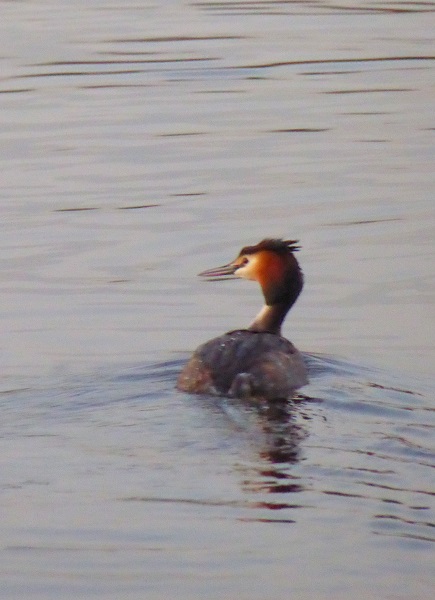
and a solitary Crested Grebe's head caught the last of the sun.

At times like this I enjoy both being a tourist and taking a proprietary pride in my inexhaustible city.

*23/03 Coincidental that I posted this a day before the attack. The last words above hold true more than ever. 

Wednesday, 9 September 2015

Chchug* and stride


It's that time of year again when I begin the *church charity mug and we prepare to join what they call the annual Ride and Stride for the Norfolk Churches Trust (as walkers, needless to say). May the shell of St James, alternating with shields on the lower frieze of the church of that name in our base of Southrepps, be metaphorically pinned to our hats as we attempt our 18-or-so-mile pilgrimage of sorts. Only connect: a couple of weeks ago I was stunned by the cathedral at Le Puy, one of the starting points for the camino to Santiago de Compostela.


I appreciate that asking for donations of any sort isn't going to seem so very pertinent when more money should be sent to help the appalling refugee crisis, so wretchedly handled here in the UK, but I suppose I could rather opportunistically invoke IS's destruction of two temples in Palmyra, which we remember with such sadness, as a symbol of 'what's gone is gone forever' - and many of these churches must be repaired or crumble and 'die'. If you want to send a cheque, contact me (since I'm now very liberal, it seems, with shelling out my email) at david.nice@usa.net. You can sponsor by the church - I think we aim to see at least 14 this time - or in a lump sum.


Last Thursday we enjoyed a little ceremony at the Tower of London, courtesy of J's raising the most money of all riders and striders last September and as a result being presented with a certificate signed by Charles (I've been slightly tongue in cheek calling it his 'Prince of Wales Award'). For its sake I was happy to postpone my visit to the Lahti Sibelius Festival, catching a plane out that night for the last couple of days. The hermit-like diplomate, though his photo will be in some East Anglian paper, won't allow the appearance here of a splendid one of him on Tower Green with two Beefeaters and General Lord Richard Dannatt (Sir, Baron, you name it, he's been decorated with it), Constable of the Tower and President of the Norfolk Churches Trust, so instead we have the latter and NCT Chair Sara Foster with the certificate. Though obscured by figures and flash, that's an 18th century painting of the Tower behind them.


It was worth the excursion. General Lord Dannatt received us in the Queen's House, which of course no tourists usually get to see, lodgings for, inter alia, the young Elizabeth and Sir Thomas More, into whose wretched prison zone we were allowed to take our glasses of champagne (the television serialisation of Hilary Mantel's Wolf Hall wasn't filmed here, but they got the light and the space right, like so much else).


Plenty of hurly-burly surrounded us. We didn't return to the Chapel of St Peter ad Vincula because every quarter of an hour or so a great group of guided tourists filed in, and there wasn't time to jump into a gap. Some unfortunate visitor had fallen and broken his/her wrist by the site of the block - jinxed? - hence the ambulance.


Then Jill and Cally went off to see the Crown Jewels and I returned home to pack for the flight.

This year we'll be walking in a different part of Norfolk from our usual Burnhams/Fens/western zones, since the chief organiser of our foursome has moved from King's Lynn to Lower Southrepps. Jill was hard at work singing in our enterprising friend the mezzo, composer and conductor Susie Self's Gershwin show at the Granary Theatre in charmingly old-fashioned Wells next the Sea. So we managed to combine a visit to a matinee before Jill nobly ferried us back to Southrepps for an evening concert.


Susie had marshalled three excellent singers, including a Frenchman with an uncanny resemblance to George (though you had to pardon his English. When I find the programme I'll credit all three). The pianist was composer Michael Finnissy no less, consummate in this music and weaving in a couple of rarities as well as accompanying Susie in a deft cross-cutting between Berg's 'Nacht' and snatches of Gershwin hits ('Summertime' provided a remarkable correspondence). There was also an opportunistic star turn from Susie and Michael's totally adorable border terrier Tristan (I want one, always have). Here he is afterwards trying to lick Jill's ear before howling along to his owners' tormenting songs.


I fell in love with the Southrepps area when we went up for part of its serendipitous and superlative music festival last month, commandeered by top tenor Ben Johnson (read all about it on The Arts Desk). For TAD I was lucky to get screenshots of the concerts from the nice man filming them, but here's just one of some stands for the out-of-this-world Schubert Quintet we heard on Sunday morning.


I'll save snaps of the church's few treasures for the blog entry on this year's walk - we start at Cromer and end up at Southrepps for an evening meal in the excellent pub, by which time St James's may well be closed - but as a taster of the area here are a few shots of a much shorter route we took that Sunday afternoon: only a couple of miles to the sea, viewed from above because here are cliffs (not had those on any of the previous walks).


We came out on the coast road at a very pretty coastal village called Trimingham, its church a pilgrim site because of the head of John the Baptist (hence 'San Giovanni Decollato'); more will be revealed when we go inside on Saturday.


The walks to and fro are across very secretive-feeling farmland with an abundance of oaks - I loved it all - and back at Lower Southrepps there's a well-done boardwalk around a locally-maintained common which is a perfect sanctuary for birds.


Much more to come some time after the big day. Chronicle of last year's walk is here, with links back to 2008.

Wednesday, 12 December 2012

Bach plus seven in the Tower


Here’s an absolute gem I would have missed, had it not been for the diplo-mate and European Commission/EUNIC support for a fabulous cause. Organist William Whitehead is masterminding a project to ‘complete’ the Orgelbüchlein, Bach’s miniature collection of chorale preludes for organ. The exquisite little book has titles of 164 chorales, but Bach only completed 46 of them. Whitehead had the brilliant idea of commissioning composers to fill in the gaps, providing as he puts it ‘a “Gesamtorgelbüchlein”, a complete hymnal...a sort of 21st century tribute to Bach posing the question “what would Bach have done if he’d been alive today?" '.


Looking forward to getting inside my beloved Tower of London and sitting in the airy Chapel Royal of St Peter ad Vincula, I nevertheless approached what I imagined would be an all-organ programme with some trepidation. I only partly josh that too much organ music makes me sick, simply because during one Aldeburgh Festival when I was on duty as a Hesse Student, I had to leave Gillian Weir’s recital in Norwich Cathedral to throw up just outside the porch. In truth, it was probably something I’d eaten, though Liszt’s Prelude and Fugue on BACH is chromatic enough in itself to turn the stomach.

As it turned out, Whitehead had devised a sequence of dazzling intricacy and variety. The real depths were plunged in the wonderful Catherine Martin’s exploration of three Biber ‘Rosary’ Sonatas, accompanied by Whitehead: I’ve heard Andrew Manze’s performances on CD, but I was hardly aware of all the musical symbology, such as the sign of the cross, in these searing representations of the Annunciation, the Agony in the Garden and the Crucifixion. And only rarely have I taken on board how vibrato-free playing as expressive as this can pierce the soul. It was helpful to have an introduction from Catherine explaining the use of scordatura; each of the sonatas requires retuning of the strings to create its special quality. I came across the scheme while I was seeking further web enlightenment:


Two of the Biber sonatas were placed strategically as part of the Orgelbüchlein sandwich, respectively prefaced and concluded by two of Bach’s big Preludes and Fugues as played with magnificent control and the occasional freedom by Colm Carey; the one in G major (BWV 541) sent us out treading air. Carey also played the Bach originals and the new works in the Orgelbüchlein’s sequence, broken only by the central Biber meditation on Gethsemane. In another inspired touch, Susan Gilmour Bailey gave expressive rein to the original chorale melodies, so we could hear what the six new composers as well as Bach had done with them.


Or not. In two cases, undoubtedly the most original, Spanish composer Benet Casablancas and Lithuanian Justé Janulyté had sent the melodies underground, Casablancas’s wild fantasia – much the longest at just under the commission limit of five minutes – asking the organist to pull out a multitude of stops. Most interesting, perhaps, was the range of approaches: in addition to these mysteries and complexities, Thomas Daniel Schlee gave us a 21st century version of Bachian polyphony, Ēriks Ešenvalds contented himself with chaste homage to Bach and Jonas Jurkūnas’s reflection on the surprisingly cheerful Am Wasserflüssen Babylon burbled along cheerfully, if a little aimlessly, in minimalist style.


I was delighted to see Benet there (pictured above right with Whitehead), since we’d enjoyed a lively correspondence following our pre-performance conversation when the BBC Symphony Orchestra under the brilliant Josep Pons played his Seven Scenes from Hamlet. And I hadn’t realized that my connecting Jurowski with Casablancas, as a composer in whose music he might take no small interest, resulted in a performance of the composer’s Darkness Visible when the LPO and their principal conductor visited Barcelona this February.

I’ve said little of the circumstances surrounding this Spitalfields Winter Festival event. It began unpromisingly with our queueing at the Tower entrance in the freezing cold, being roughly herded by an uncharming Beefeater while penguin-suited Esso employees swanned past us to their reception. But it’s always wonderful to enter the inner sanctuary at night, the White Tower looking more imposing than ever


As you can see from the top photo, the lights of St Peter ad Vincula glowed invitingly. Inside it was warm and bright. We admired the monuments, and the sanctuary inscriptions to the three ladies who lost their heads on Tower Green and were buried here – Anne Boleyn, Catherine Howard and Lady Jane Grey – alongside sanctified Thomas More and Bishop John Fisher. The organ case sat in the Banqueting House Whitehall from its construction by Bernhard Schmidt in 1699 to its removal to this royal chapel in 1899, by which time additions had made it three times larger; more recently it has been restored to its original dimensions. The pipework is recent and the instrument sounds in good health, for all I can tell. One thing’s for sure: sitting in the first row of the left aisle and watching foot and fingerwork, as well as having superlative Martin playing right in front of us only added to the pleasure of an unforgettable evening.


One footnote while we’re in chapel: should I have been surprised when the government’s Maria Miller announced that the Church of England would be legally exempt from the current move to allow gay marriages in church* (ie limiting such marriages to a very restricted number of venues)? After all, isn’t the CofE the Tory party at prayer? For myself, I don’t care: civil partnership is good enough for me, and I was reminded that in early January we celebrate seven years of our ritual and the ‘Just Not Married’ party which followed, jumping in as we did to tie the registry office knot three weeks after it all became legal in the UK. But why should those who do want a church event be treated like second-class citizens? Erstwhile blogger pal Jon Dryden Taylor, who doesn’t post enough these days, gives a brilliant exposition of why our rights should be extended here.

*It now turns out this was done 'on the hoof', without consulting the CofE