I first saw the goldfinch flock outside the window last summer, when the swifts were also soaring and diving. They've been back in the past couple of months, perching in the tree opposite. More exclusively winter visitors, the redwing groups of 40 plus have been evident in our local (Margravine) cemetery, at least until very recently (they're due to fly back to Scandinavia soon, if they haven't already gone). The above goldfinch was snapped there on a Sunday morning of briefly settling snow, a solitary, along with various redwings.

Most exciting for me, because I've never seen them before, were the abundant lapwings at the London Wetlands Centre, briefly settling on one of the little islets.

And that was a one-day wonder, because soon the LWC became a casualty of new government lockdown ruling on animal collections and enclosed reserves. I've missed it, but there are always compensations, most recently a weekly Friday cycle to Kew Gardens and back with friend Cally. That needs another post, but let me whizz now from late November to the end of January elsewhere.
Impressive winter sunrises and sunsets have been very much a part of the last few months, especially when the days were shortest and rising meant catching the early morning light. Also from the front window, Venus still visible


and a few days later, true red sky in the morning.


Somewhat later in the morning and the month, tending towards mackerel sky.

Glad I made the most of the Wetlands while I could. On 13 November I was able to take in both Fulham Palace's Walled Garden, where the sprouts were coming on, and the other side of the river from Putney Bridge. Interesting fungus growing on felled tree trunks along the tow path

and rich ground-colouring from deciduous larches shedding within the LWC grounds

while on the 'wild side', the main channel always reflects different colours - after the previous visits this felt decidedly more winty.

In Old Brompton Cemetery the last of the leaves were in evidence.


Sunnier Sunday (22 November) in Kensington Gardens, a more robust autumnal splendour behind the statue of Queen Vic.


Late afternoon back at the Wetlands: long-tailed tits flitting back and forth

and plentiful action on the inland mere.

I've developed a special affection for the shovelers, most uxorious of birds, it seems: those who forage together stay together.

An ever-deepening (c. 4pm) sunset, punctuated by flights of geese and ducks overhead.


Kew Gardens on the 27th, mycological hunt not yielding a great deal other than a splendid clump of these big 'uns
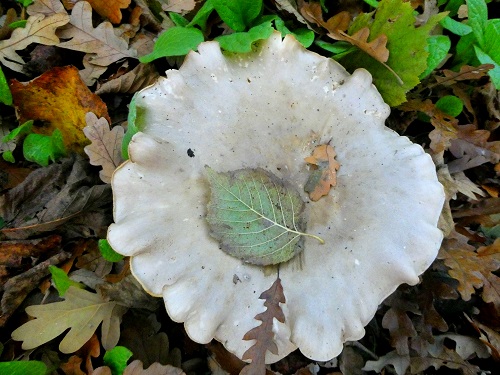
and yet still a pleasure to wander the woods, admiring the beeches and birches,


out to the open opposite Syon House, the trees flanking always look handsome with or without leaves

and round the lake,


until we came in sight of all the mechanisms for the gimmickry of the annual 'Winter Wonderland'. Beats me why people need this when nature itself puts on the best show, but the lighting of the 'dancing fountains' in front of the Palm House did awaken a bit of the kid in me.

No electrickery, though, was going to outdo the sunset at the Wetlands the following Tuesday.

I'm getting a bit ahead of myself here. On 1 December, even the hides were open, so it was splendid opportunity to visit with my polymathic young friend Freddie Wilkinson, who can identify every bird simply by the song. What we couldn't see, we could hear. In the willow, aspen and alders by the gate leading to the Wild Side, he noted long-tailed, great and coal tits, goldcrests, treecreeper and chiffchaff, and became very excited to hear what he'd told me he hoped he would - a Cetti's warbler. You might not think that the river cycle to get there came up with anything remarkable, but I've developed a soft spot for Canada gees when they glide

and fly (here past the new works on Fulham Palace football ground, which will extend the Thames Path to go around it on the river side).

Meanwhile I got a closer look at some of the special-collection residents - the Puna teal (you think it would be called blue-beaked, since that seems more remarkable)

and the plumed whistling duck, which likes to hang out with its relations (so does the Pune teal, for that matter).

First time I've got to see the resident otters, too - that route had been closed along with the hides - and while it was a preface to what we were there to see, a lady who comes to see them all the time assured us that this is the best place to see a pair in full sight which happens around feeding time.


The highlight for me, though, was the sight of all those lapwings - first in the air, where they do the peculiar thing of flying about in different directions,

and on the little islet where they settled with cormorants and gulls.

I'm always happy to see a great crested grebe, and especially so when Freddie had so much to tell me about its existence (he's a fan, too)

and your common-or-garden mute swan is always a beauty, especially at sunset on the main waters

with the lapwings still flying about

and the sunset just getting deeper.

8 December yielded a double whammy of another amazing sunset and nature in Fulham Palace grounds. Flowers still to be found on one of the echiums in the herbaceous border

while across the lawn in front of the Palace ambled a fox.


Out on the river, mackerel clouds were playing their part in the most amazing skies yet

which only deepened as I walked my bike along the Thames Path homewards before fading.


A rainy afternoon at the Wetlands on the19th did at least yield a lit-up head of cumulus
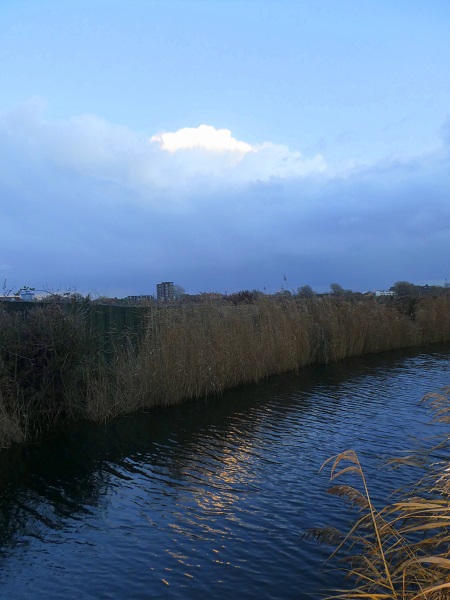
and dark drama over the main waters

worth getting drenched for on the cycle home. It was more placid heading the other way on the other side to Chiswick

and heading back, there was a moon above the eyot.


but the fading of the light was more dramatic closer to Hammersmith.


and the bridge, closed for who knows how long, duly glittered.

Christmas Eve was the time to exchange presents with Sophie in Kensington Gardens - restrictions meant we decided not to join her group on the day. Brilliant light over the Round Pond

and plenty of bird activity there, albeit mostly swans, Canade geese and gulls.


Close-to-solstitial sun gleaming through the Albert Memorial


where we met our German friends Katharina and Uli for coffee at a distance, admiring the imperial groups of statuary around Albert (the Americas here)

before walking around the Serpentine, paying the usual homage to Peter Pan

and finding a brilliantly-lit swan meet the other side of the bridge.


Loud song from a coal tit on the way to Margravine Cemetery

and redwings showing off again on the usual trees.


I've covered the darkling thrush at Fulham Palace on New Year's Eve previously, and the January Fridays at Kew will get another blog spot, but here seems the right place to insert a gull shot.

The cold was closing in, and on a cycle to Battersea Park on 9 January, paying homage to the bandstand in memory of those glorious late-summer chamber concerts there (the peace temple is beyond),

I caught signs of the first freeze.

Flora in OId Chelsea Churchyard seemed unaffected


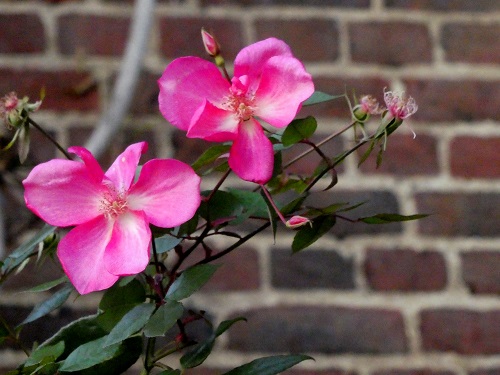
and the sunset close to home, at the Brompton Bridge, glowed on an urban scene.

Magnolia tantalising with the promise of furry buds by the Tudor gateway at Fulham Palace on the 15th

and camellias flowering on the outside of the Walled Garden.


Heron by the Serpentine, looking across to the Henry Moore sculpture, 17 January


and a cormorant holding out its wings to dry near the bridge.

In the Margravine Cemetery on the 23rd, I met two ladies from the Fulham and Barnes Peregrines Association. They were there with their cameras - much more sophisticated than mine - and told me that the male peregrine who lives on the roof of Charing Cross Hospital, and who lost his mate last year just as their young 'un was taking his first steps, has a new one they've called Azema, who turned up a couple of months ago. This is a rather feeble shot, but there she is perching on an aerial on one of the residency blocks of CCH after much swooping and soaring against dramatic clouds.

A redwing again, looking good against a clear sky,

plus - later - the clouds and the moon at sunset.


Red-letter morning the next day - heavy snowfall outside the front window.

My geranium sidoides and rose-scented pelargonium in the back window boxes are still flowering, and all the better for a dusting of snow.


There was no time to waste - the snow wasn't going to settle for long, so I wrapped up and went out along the gardens

straight to Margravine, knowing that snow-capped angels and statuary would look good.


But there were also redwings again

here, at last, revealing why they're so called, and what distinguishes them especially from other members of the thrush family,

the solitary goldfinch illustrated up top, crocuses in the snow,

ice on licheny branches and catkins


and eight snowmen. The most impressive was wrought by a group of jolly French people


while I admire this little fella for his catkin eyes.


By the 27th, it had nearly all gone

and crocuses were forcing their way through further among the snowdrops,


though we had a dreary freeze of four days in which wet snow dribbled endlessly against grey skies. Now, with milder weather and sustained sunshine at last, spring is on its way.


 Posts
Posts