Saturday, 11 May 2019

CDs of 2018: public gongs, private pleasures


Last month's BBC Music Magazine Awards helped me to get to grips with what the panel - on which I served for the 2017 selection, not this year's - thought essential listening from the glut of five-star CD reviews. Out of the two I'd reviewed, the one sure winner - Adams's Doctor Atomic - didn't get the Opera award and the other which I wouldn't, when it came down to three choices - Ádám Fischer's Mahler One in his Düsseldorf cycle - took the palm  in the Orchestral category. And Sean Shibe was superseded for the second year running, this time when an even more inventive and ground-breaking mix of ancient and modern, the softLOUD programme, was the option.


Predictions were that in this public vote, social-media-savvy Vikingur Ólafsson would triumph among the three instrumentalists on the final list. Not only that, but he took the Disc of the Year award for his fascinating Bach sequence (up top, he's third from left with Sara Mohr-Pietsch, his shorter double Gareth Malone and BBCMM Editor Olly Condy).


I like and respect Ólafsson. He speaks persuasively and with dignity, and writes well too. I enjoyed meeting him in Reykjavik at his impressive summer festival in 2016. On 1 May he played a 45 minute sequence of works from the 77-minute CD without interruption to an audience of mostly young people in the Royal Albert Hall. Yes, the sound was amplified - much better, as the Proms constantly prove, to hear a solo piano without sonic assistance in that vast space, drawing the listener in - and what followed after the interval seemed to me pretty dire, movements from Bach's Cello Suites muzaked by cellist Peter Gregson, appearing with a group of fellow cellists and a double-bass player, perfectly good in themselves.


Ólafsson, though, has integrity. His palette is varied, his fast runs astoundingly even. But even while I admired both the sequence and especially his own arrangement from Cantata BWV 54, 'Widerstehe doch der Sunde'. It's on YouTube but doesn't seem embeddable here, so here's a link. But to find the missing spiritual inscape you only had to turn to İdil Biret's selection of Bach transcriptions by her great mentor Wilhelm Kempff. Here are the elusive space and the fuller sonority  that I, at any rate, want from this music. Just one example will have to do here, though you can find others.

I heard that interiority again at the start of young Martin James Bartlett's debut disc 'Love and Death', with Busoni's transcription of 'Ich ruf zu dir, Herr Jesu Christ', BWV 177. But I jump ahead of myself into 2019; that CD deserves proper consideration in its entirety. As far as the awards ceremony was concerned, I wanted to hear viola-player Antoine Tamestit, one of my favourite live performers of 2018 for his walkabout interpretation of Berlioz's Harold en Italie at the Proms with John Eliot Gardiner and the Orchestre Révolutionnaire et Romantique, in Jörg Widmann's Viola Concerto and again in late Debussy chamber works shared with other very impressive musicians. Tamestit is among the other award winners, trophy on piano, in the below photo taken from above in Kings Place's Hall One.


Cellist Laura van der Heijden, winner of the Newcomer Award (and pictured on the right behind Tamsin Little), has produced a thoughtful disc of works by Russian composers from 1948 with Petr Limonosov; introducing this former BBC Young Musician of the Year winner, Julian Lloyd Webber reminded us tartly of the gulf between the first competition, shown on BBC One, and now, when it's ghettoised (though thankfully other events have come along to give the phenomenal Sheku Kanneh-Mason the wider acclaim he deserves),

Last year I heard some imaginative programming on CD which either didn't make it to the above shortlist or, in one case, was released a few years back (but I make no apologies, since the experience dates from the time of discovery).


Another musician who thinks very carefully about his concert and CD programmes is Israeli pianist and composer Matan Porat. Lux engages 12 pieces to take us from dawn to night. Gregorian chant is followed by Schumann, or framed between Bartók and Beethoven; Adès' Darkness Visible makes a startling sequel to Liszt's Harmonies du soir, superbly done.


I was so pleased last year to make the acquaintance of Estonian pianist Kärt Ruubel, twin sister of violinist Triin; their joint lunchtime recital in Berlin's Konzerthaus was an unanticipated highlight of my time at a Baltic festival there. Triin is especially keen that the works of Johann Jakob Froberger, subject of a musicological paper she wrote to complete her piano studies at HMT Rostock, should be heard alongside Handel and Bach, and so they are in her debut disc. The Lamentation in F minor has become a firm favourite; there's an extraordinarily modern progression or two, the play of major and minor is beguiling, and the freedom of Ruubel's playing adds to the freshness.
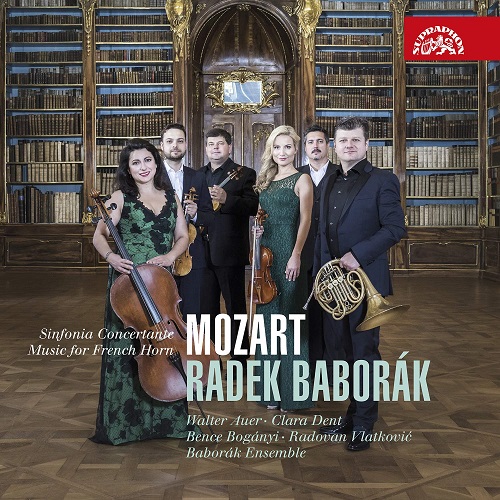

There are several candidates for 'world's greatest horn player', and Radek Baborák is certainly up there. Creative in so many spheres. he has followed up the expected Mozart Horn Concertos with a perfectly programmed two-CD set of other Mozart horn music. Movements make up other possible 'concertos', the second disc ends with the Sinfonia Concertante for wind and orchestra which I've long had a soft spot for, and the 12 Duos for two French horns are split across the discs and shared with no less a master than Radovan Vlatković. The set also includes some of the most exquisite high-register playing I've heard, and some wacky cadenzas.


The set of longer standing was a gift from our dear Latvian friend Kristaps Ozoliņš, understandably a fan of the astounding native youth choir Kamēr. Latvia's abundance of folk songs about the sun led to the commissioning of 17 'World Sun Songs' from international composers, among them Leonard Desyatnikov, Dobrinka Tabakova, Giya Kancheli, Peteris Vasks and John Luther Adams (the stunning Sky with Four Suns that launches the second CD). 

There is no stronger choral tradition than Latvia's in the world; I experienced it writ very large indeed last summer and I've just heard the superlative Latvian Radio Choir give one of the best programmes of contemporary works in the stunning surroundings of Tartu's St John's Church as part of the Estonian (this year World) Music Days festival. But that's another story. 

Tuesday, 30 April 2019

From Tellaro to Montemarcello and back


Having only briefly savoured the delights of Tellaro, a Ligurian fishing village that isn't on the Cinque Terre route so has a relatively unspoilt atmosphere, on the final day of my time last year at Gianluca Marciano's Suoni dal Golfo Festival, I decided I had to come back at the first opportunity, show J the beauty of the place, hopefully swim and certainly walk on the paths I'd only begun to discover. A good map bought at trusty Stanford's showed the further possibilities of the Parco Nazionale di Montemarcello Magra: we would at the least find our way further on from Fiascherino beyond Tellaro


to Montemarcello, another picture-postcard-perfect village, this time overlooking the sea but protected from it (a bit like those Corsican places where the inhabitants had turned their back on marine dangers and invaders).


Opportunity had to be planned for. We arrived from Pisa on the second day of April to spend a wonderful afternoon in Sarzana (more anon) on what turned out to be the last afternoon of Sirocco warmth. Italy hadn't seen rain for at least three months - reports varied - and river levels were worryingly low; the Po was at least three metres below its average. On cue, the Tramontane changed all that and we braced ourselves for two days of stormy weather.


It wasn't so much of a hardship; the Hotel Rosa dei Venti, despite having taken my booking, chose to tell us that it would be closed for two days' renovation work, and would we mind moving along the road to the unpromisingly named Albergo Blueline? As it turned out, that was officially an upgrade; though the room wasn't as spacious, the balcony had a better view over Fiascherino Bay, and it was cosy to be in, walled up with good books, when the storm finally broke, leaving us to muse on how poor Shelley drowned in just such weather on his way back in the Ariel from Livorno to Lerici.


Besides, the staff made a delightful double act. The wife of the owner was incredulous that I swam between storms off the public beach which had been such a delight in September. Now it was deserted, but at 7 in the evening the water wasn't too cold and I took the prize for first bather of 2019 in Fiascherino.


Earlier, I'd managed a preliminary reconnaissance of a couple of hours on the path up from Tellaro,


turning left at the top to take an old mule track back through olive groves to Fiascherino rather than right towards Montemarcello


and catching the glint of white irises through the trees.


The next day was going to be a washout until early evening, so once the morning storm had abated we took the bus down to Lerici, had a long lunch in a restaurant overlooking the harbour and, once the rain had all but ceased, took the lift up to the castle where several of the concerts had taken place last year. So much mud and water had come down from the hills that the sea below was very much two-tone.


Later we walked into Tellaro and down to the much smaller harbour there


after which the clouds were lifting


and a fine sunset formed across the bay at Portovenere.


As predicted, the Friday started sunny and was set to become even fairer: we could do our walk at last. Swallows had just arrived and were swooping over the hotel garden with its olive trees


and the bay.


Perhaps I should have read the sign at the start of the cliff route to Montemarcello: 'trail with steep sections for experienced hikers' - the same legend we found on a later board.


Experienced, yes, in terms of rock clambering, but the only time I've ever had serious vertigo was at the top of the cliff path down to the gorgeous Spiaggia delle due sorelle (two sisters beach) in the Marche's Monte Conero, and I got it again, especially in an open stretch like this - though steadying myself to take a couple of photos -


as well as on a part of the path that seemed to go ever downward virtually to sea level before climbing all the way up again (that bit has never been a problem). Still, though I didn't entirely relish them at the time, the vistas were dramatic


and finally we joined the (more or less traffic-free, minor) road for the last ten minutes into Montemarcello. Arborial traces of what had once been a 'giardino botanico' on Monte Murlo made a change to the landscape


while Montemarcello's fields and orchards sloped invitingly down towards the sea.

 
We entered the all-but-deserted village through a fine gate


and got our first glimpse of the view across to the Apuan Alps, still in dark cloud,


before winding around the streets


towards the church, which had some old prints of the Stations of the Cross against pleasingly coloured walls.


Wonder of wonders, the one place to eat was absolute perfection - the Caffè delle ragazze, where two very friendly ladies were serving just what we needed in the shape of chickpea and chicory flan. Which we were able to consume in a perfect piazza. Note man on roof to the left.


After this J decided to take a shorter route back to Fiascherino, while I was curious to see the botanical remains on Monte Murlo, which would mean ascending to a fairly modest 362 metres. I'd wanted to go as far as Bocca di Magra, the mouth of the river which separates the national park from the plains around Sarzana, but I did at least get perspectives of the river


and later of the coast towards Viareggio.


This is wild boar territory - hunting only between October and January on Wednesdays and Sundays


I heard a porker or two snuffling and trampling through the woods as I rounded the mountain towards the Zanego valley


with views down to attractive Ameglia


and across towards one of the Apuan hill towns (possibly Falcinello?)


Eventually this lovely path curved round to meet the minor road J had taken at Le Figarole and from that point on I was following in his footsteps, joining the other end of the same mule track I'd taken two afternoons earlier. Again, the fields sloping down towards the sea were so attractive in the late afternoon sun


and I just missed snapping this goat in the act of standing on its hind legs to pull down the branch of a tree, on the blossoms of which it is now munching.


Though an easier route than the lower coast path, the mule track's cobbles were punishing on the feet


but it wasn't a long way at all back to Tellaro, seen from above here,


and by about 6pm I was back at the hotel. If only I could have staved off the desire to rest and changed for a final swim. But idleness beckoned, followed by a wonderful evening meal. And so our little Italian seaside holiday ended in glory and deliciousness before the next day's four-change train journey (no hardship) up to Treviso and a splendid working weekend.
