As in, a chance to touch upon all those events and images I didn't get a chance to engage in my Arts Desk piece on a remarkable festival of new music. The first thing to emphasise here is the incredible level of music education in Estonia, which heading towards the country's centenary celebrations next year has launched a scheme called 'A Musical Instrument for Every Child'. Children and teenagers playing music are everywhere in Tallinn; the above image, which I caught one morning as I found myself walking through the old town in the opposite direction to young students of stringed instruments heading in the opposite direction. Random shot of gull here because I like the balance.

EMD has a 'junior' branch whose activities we tend to see little of since their 'Mini-EMD' is usually over by the time we reporters arrive for the main events. I'm rather glad I insisted, in the face of my colleagues' indifference, on a little tour of the town which promised music in various locations. I didn't know then that it was programmed by Mini-EMD students. Our guide was a charming teenager - alas, I don't remember the name - who made a good start by telling us a heck of a lot about the Estonian National Opera and Concert Hall which we didn't know (how, for instance, it was destroyed in the Second World War bombings and rebuilt very quickly). Led within the foyer, we found a young violinist, Rita Iris Loonde, who played for us Heino Eller's Luurilne Laul.
A second violinist, Triinu Piirsalu, was prepared to play in her gloves outside the Musical Instrument Museum I'd visited that morning. She's going to have a fine career; watch below and you'll see what I mean. She played Kadents ja teema by Ester Mägi, 'First Lady of Estonian Music' and 95 this year.
Our last musician, Liisu Siimer, surprised us with the bagpipes (the Estonian mini-variety, so much more pleasant than the Scottish bruisers) by the statue of major Estonian composer Heino Eller.
That was some day. We'd just reeled off the bus from a blindfold magical mystery tour which I've described on The Arts Desk - read more about it there - as a bit of a life-changer. Namely having the confidence to be guided by invisible hands, to let go after a while of the tension which was sending my back into spasm and trust that I wouldn't fall or bash into things. And then to have an hour and a half to get used to this state while electronic sounds and then a beguiling new piece by Helena Tulve sounded all around us. Photographer Rene Jakobson caught us in the blind act and has allowed these pics to be used.


After the mini-tour there was a reception in the Maiden's Tower cafe. Superb food and excellent company, with a chance to talk to Erkki-Sven Tuur, whom I first met decades ago when he was going out with Katherine Howard and now the second in line of succession to Arvo Pärt as The Greatest on the Estonian music scene (photo - I think - by Peeter Langovits),

and to his fellow composer Helena Tulve, the genius behind the festival along with Timo Steiner, here seen in one of my own pics with her husband Jaan-Eick Tulve, conductor of the magnificent Vox Clamantis choir.

One of Helena's more numinous additions this year was a meditative sequence before the choral programme in the Niguliste Church/Museum with the sounds of crystal bowls wielded by herself and others (photo by Peeter Langovits).

It seemed rather providential that I'd never managed to see inside the Niguliste (St Nicholas) before. One of the few old buildings seriously damaged by bombs in the Second World War, it has long served as a 'museum of ecclesiastical art' from Soviet times onwards, and seems to have had a splendid overhaul in recent years. While its most celebrated treasure is the Dance of Death by the Lübeck master Bernt Notke, or rather a fragment of thirteen figures from it - I take the liberty of breaking the long picture-strip into two out of four panels -


the main altarpiece, depicting scenes from the lives of Saints Nicholas and Victor by the workshop of another Lübeck master, Hermen Rode, is perhaps even more impressive in that it stands where it was originally intended. And this was how we saw it at the first concert with Vox Clamantis in front of it.

A later visit by the Estonian Chamber Choir saw the seats turned from east- to west-facing, placing these singers in front of the seven-armed candelabra, also Lübeck work, presented to the church in 1519 (photo by Peeter Langovits).

Before that concert I had time to wander round, though sadly the silver chamber housing a splendid ruby-eyed popinjay was closed. Still, there was an interesting display within the nave of silver guild medallions, very like ex votos, and you could walk around the altarpieces. These panels are from the high altar retable: Saints Catherine of Alexandria and Barbara flanking Virgin and Child

and the male saints Victor, Nicholas and George the Dragon-slayer.

Folded back here are the annunciation wings in grisaille of the Virgin Mary Altarpiece (1493) commissioned by the Brotherhood of Black Heads, whose guild hall with its splendid portal is nearby. To save the altarpiece from iconoclasm they took it to their base in 1524 and it remained there until 1943.

The Passion Altarpiece is from the workshop of Bruges master Adriaen Isenbrandt.

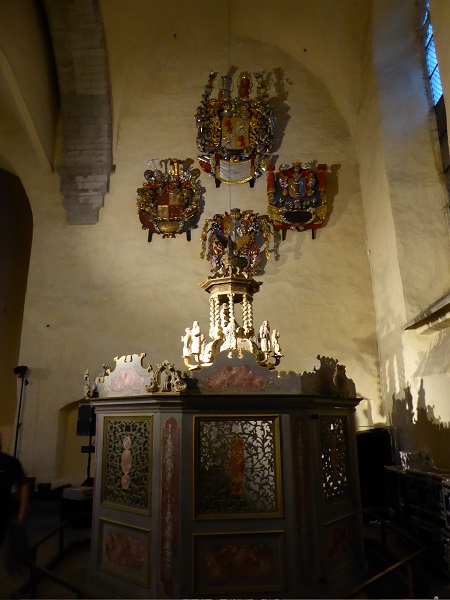
It's at the other end of the aisle from the octagonal Lutheran baptistery of the 1680s, the only one of its kind in Estonia and taken from the Swedish church of St Michael.
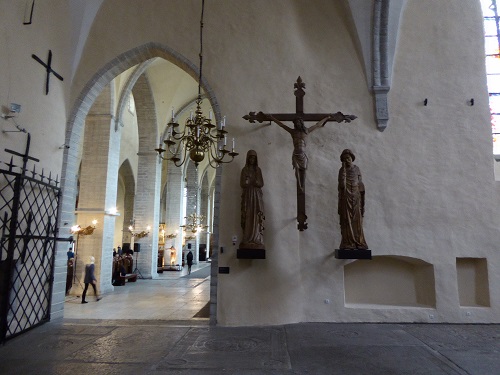
On the opposite wall is a life-sized sculpture of St Christopher (workshop of Tobias Heintze, 1624), originally a support for the pulpit otherwise destroyed in the March bombing of 1944.

Away from the main body of the church, this Cavalry Group is on the wall opposite to the Dance of Death in St Anthony's Chapel. The figures come from the small Harvu-Risti Church which served as a chapel of the Cistercian Monastery in Padise, and were actually created at different times in the late 14th (Christ) and early 15th (Virgin and St John) centuries.
On the official way out, you pass a splendid decorative screen designed for the Memorial Chapel of Bogislaus von Rosen in 1665.

As my guide deals only with the interior of the museum, it tells me nothing about this ?Romanesque? doorway in the south-west of the church.

The light that morning was especially lovely, lighting up the tower as you approach it down the historically rich

and this wall behind the Musical Museum,

which I finally got to see after three visits. Its fine displays deserve an entry to themselves, and there was a remarkable exhibition in the tower featuring musicians just sitting and looking at the camera in a series of portrait videos - unnervingly brilliant.


But other more-than-sweepings need commemoration. Some extra shots of our magical time at Arvo Pärt's summer retreat on the Lohusalu peninsula west of Tallinn, named after his first work following the long silence which gave birth to the so-called 'tintinnabulist' rebirth.

The notebooks from the interim period, when he set psalms almost obsessively without any intention of publication, may be facsimiles, but it was good to see them in the room where many of the jottings were made.

Below is our wonderful guide, Riin Eensalu, former EMD administrator and now the Arvo Pärt Centre's Head of Communications, holding one of the pots which Pärt painted as therapy during his creative block, and which his neighbours returned to him when he and his wife finally returned from Berlin.

And here's Riin again showing the long table on which Pärt composed many of his major works, brought from Berlin.
Around the visit, I've already written about our seaside stop in the entry 'Estonia's first spring flower', but this is an excuse to post another picture, of a typically welcoming sign
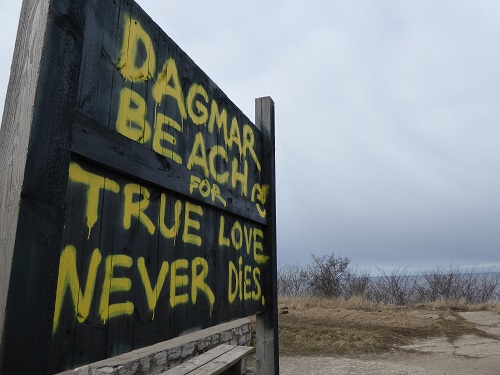
nicely mirrored by this lively note in the toilet of the charming cafe we visited at the end of the road to Aliina. The humour is typically Estonian.

Superb food here - the best pea soup I've ever tasted, and delicious cakes.

Even the local bus shelter is worth noting, part of a design competition for senior students at Estonian schools.

Finally, from my last day, a concert I ran out of space to include in the Arts Desk piece - a tribute 85-year-old composer Jan Rääts from pianist Nicolas Horvath and nine composers. Not much to write home about among the homagers, though Tuur's Salute managed to be quirky in a very short space of time. Rääts's whimsy, elliptical brevity and unpredictability are startling at best, though perhaps he recycled tricks rather readily. At any rate, Horvath certainly shot us bolt upright with the opener, Radio 4,and it was easy to see why the 1968 Toccata became such a cult piece after its inclusion to be played by all 86 competitors in the Fourth International Tchaikovsky Competition of 1970. Here are three professional shots by Peeter Langovits of pianist and composer.


The venue was last on a list of interesting places - I notched up many more this year, and this was no exception, the just-refurbished Studio One of Estonian National Broadcasting. Good, as usual, to see all the Estonian discs on sale as we entered

and here's a shot of the delightful and talented Liisa Hirsch discovering one of her works on a disc for sale at the Niguliste Church.
 #
#Which allows me to return to the first concert on that sunny evening in early Spring at the same church, and a nice shot by Peeter Langovits of senior Estonian-based national treasure Galina Grigorjeva with Jaan-Eick Tulve and members of Vox Clamantis.

I bumped into the vivacious Else Torp and her husband Paul Hillier at the Glyndebourne premiere of Brett Dean's Hamlet on Sunday, and was able to tell them how much pleasure I'd got out of the Theatre of Voices' Grigorjeva CD, also recorded in the Niguliste Museum. Paul now has the score of the Vespers I heard premiered in April - he's not only more deserving but luckier than me, because the friendly Galina was very apologetic that she couldn't issue one when we met, having noticed some mistakes - and very much wants to perform it. In the meanwhile, terviseks (cheers) to my favourite conductor and friend Neeme Järvi on his 80th birthday, two days of celebrations of which took place in Tallinn last week. Time and costs didn't permit my going, but we meet again in Pärnu in August.


 Posts
Posts