There's a fabulous YouTube clip put up on The Arts Desk by my art-critic colleague Fisun Güner (I'll reproduce it at the end). It shows John Cage performing his Water Walk as part of an American TV game show. The smug, isn't-he-a-naughty-boy presenter quotes a New York Herald Tribune review of Cage's latest LP as showing 'a surprising degree of charm and affability'.
And that is exactly what made me smile, if not laugh outright, as I strolled around the Barbican' stunning new exhibition The Bride and the Bachelors: Duchamp with Cage, Cunningham, Rauschenberg and Johns. Marcel Duchamp, of course, is the leader and shaper, cueing the 1950s experiments of those great Americans as early as 1913. Technically brilliant and dynamic as his two early "portraits", Nude Descending a Staircase (No. 2)

and Bride

of 1912 certainly are, you wouldn't have expected what eventually resulted before Duchamp 'lost all interest' in the project in 1923: The Bride Stripped Bare by her Bachelors Even, aka The Large Glass illustrated up top. More comprehensible to me are the playful promptings of his first 'Readymades' which makes you realise how early conceptual art came into the picture. The Bicycle Wheel (on a stool; the Barbican has a reproduction), also of 1912, came about simply because Duchamp 'just liked the idea of having a bicycle wheel in my studio'. Of the New York phase he wrote of 'relating notions of aesthetic worth to a decision of the intellect and not to a facility or cleverness of the hand, which I have protested against in respect of so many artists of my generation'.

If that sounds too sober, then let's go straight to my favourite, the 'assisted Readymade' Why Not Sneeze, rRose Sélavy? of 1921. The lovely rRose became Duchamp's drag alter ego, as the charming photo above by Man Ray of 'La Belle Haleine' shows. The proper moniker is a play on the universal truth 'Eros, c'est la vie'.

Quite what rRose has to do with the piece in question is uncertain. It's a metal birdcage full of what look like sugarcubes actually made of marble, with a cuttle bone and a thermometer penetrating the bars.
In the late 1950s, Robert Rauschenberg visited the Philadelphia Museum of Art, I believe in the company of his lover Jasper Johns, and so admired the artefact that he tried to nick a couple of cubes. The guard stopped him with 'Don’t you know you’re not supposed to touch that crap?'
These fascinating artists collaborated with the great Merce Cunningham and John Cage. There's an exuberant 1954 'assisted Readymade' kind of a design by Rauschenberg for Cunningham's Minutiae.

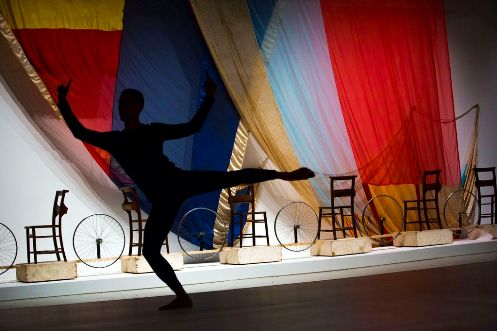
Against a background which may include the random chimings of a self-playing grand piano intoning a Satie-like piece by Cage, several of the Bride-linked Cunningham dance pieces are re-enacted on the exhibition's stage several times a week. I was lucky to catch one performance on Thursday evening.
All four Americans owed so much to Duchamp, sometimes without knowing it: Cage, using the hexagrams of the I Ching, the ancient Chinese Book of Changes for his musical 'chance operations', only later found out that Duchamp had 'composed' his own chance pieces long before in a family game extracting notes from a hat. Below: Cage preparing a piano in 1964.

Such connections make this an endless hall of mirrors, metaphorically speaking, though the show is brilliantly designed by Philippe Parreno and fits the Barbican spaces both downstairs and up perfectly*.

The Barbican, moreover, had cast its net wider in its Dancing around Duchamp season. I was there to review the Théâtre de la Ville-Paris's production of Ionesco's Rhinocéros. Let's have one of the production photos by Jean-Louis Fernandez I didn't use on The Arts Desk: Hugues Quester and Valérie Dashwood in the last, oddball love-duet of the play.

I had no idea this was such a great play: funny, lucid, chilling, even profound. Reading it was a revelation; seeing it I found it less uproarious, but the show was pacy and imaginative all the same. In its thesis of a sane seeming-mad protagonist against a faceless majority, it has something in common with Giraudoux's lesser entertainment The Madwoman of Chaillot; so it was a happy coincidence that I'd seen, liked and review-raved about Jerry Herman's long-buried musical on the subject, Dear World, the previous evening. How I love its hit songs and its ingenious musical-theatre trio for the old-timers, played here by Annabel Leventon, the deservedly legendary Betty Buckley and the outrageously funny Rebecca Lock (photo by Eric Richmond).

The many waltz-songs in this show, I reckon, are as strong as those in Sondheim's A Little Night Music. While we wait with not a little trepidation for Liza Minnelli's appearance at the Southbank's The Rest is Noise festival this coming Friday, let's see and hear her singular delivery of Countess Amelia's 'I don't want to know'. This was 1986, and Liza was still in fabulous form.
As for the Barbican, there are many more fantastical treats in store, and I'll certainly be dropping in on the exhibition again. For filmed entertainment, in the meantime, I'll leave you with naughty John performing his Water Walk.
*As Sue reminds me in her comment, the exhibition originated with the above-mentioned Philadelphia Museum of Art, so it's all the more impressive how well it must have been tailored to suit the Barbican Gallery's tricky space.
Exhibition image credits:
Marcel Duchamp The Bride Stripped Bare by Her Bachelors, Even (The Large Glass), 1991-92 (replica of 1915-23 original) Moderna Museet, Stockholm
Marcel Duchamp Nude Descending a Staircase (No. 2), 1912 and Bride, 1912 Philadelphia Museum of Art, The Louise and Walter Arensberg Collection © Succession Marcel Duchamp, 2013, ADAGP/Paris, DACS/London
Marcel Duchamp as Belle Haleine, 1921 Photograph by Man Ray Private collection © Succession Marcel Duchamp, 2013, ADAGP/Paris, DACS/London © Man Ray Trust, 2013 / Artists Rights
Society (ARS), New York / ADAGP, Paris
Robert Rauschenberg Minutiae, 1976 (replica of 1954 original) Collection Walker Art Center, Minneapolis. Walker Art Center, Merce Cunningham Dance Company Collection © The Robert Rauschenberg Foundation. DACS, London/VAGA, New York 2013
Installation photographs (dance and exhibition) by Felix Clay
John Cage preparing a piano, c.1964 Photographer unknown Courtesy of the John Cage Trust (Documentary image – not in exhibition)


 Posts
Posts