Showing posts with label Lewis Carroll. Show all posts
Sunday, 28 December 2014
Mirabel's wonderland, 1927's dystopia
It's been a staggering year for opera in the UK: quite how staggering I didn't realise until I tried to compile a shortlist 'Best of 2014' for The Arts Desk, and even then there wasn't time to slip in a mention for one of the best children's operas I've seen, partly because this was its second year of performances - Will Todd's Alice's Adventures in Wonderland around the lawns and glades of Holland Park.
It isn't my intention to go over that magical ground again - I've already done so in review and on the blog - but it crops up again because Mirabel, my youngest goddaughter by 16 years, deep joy to go back into childhood again with words and music, is still caught up in the wonderland magic. She's pictured up top with the enchanting Alice of Fflur Wyn after the show - 1927's production of The Golem, seen above in the first of Bernhard Müller's production photos, will have to wait to move into the limelight - and below treading the Mad Hatter's teapot carpet.
I went up to Islington to deliver gifts for her fourth birthday just over a week before Christmas: Lewis Carroll's own under-10s version The Nursery Alice, the only time John Tenniel ever hand-coloured his own illustrations (specimens below) and with a very different if sometimes, for us, slightly cloying, wit and wisdom for the tots, plus the DVD of the Royal Ballet Alice's Adventures in Wonderland and my own CD compilation of music to go with the book. Note to self of what's on it as I didn't keep a copy, and I can cut and paste this in an email to Mirabel and ma Edwina:
The White Rabbit - 'The Interrupted Departure', No. 17 of Prokofiev's Cinderella
Wonderland and Alice's growing/shrinking - 'The Aquarium' and 'Personages with Long Ears' from Saint-Saëns' Carnival of the Animals
Swimming in the Pool of Tears - 'Panorama' from Tchaikovsky's The Sleeping Beauty
The Caucus Race - Galop from Khachaturian's Masquerade Suite
The Caterpillar - 'Arabian Dance' from Tchaikovsky's The Nutcracker
Alice arrives at the Duchess's house, the crying baby and lost in the woods - Sequence from the 'child at play' movement of Strauss's Symphonia Domestica
The Mad Hatter - Polka from Shostakovich's The Age of Gold
Court of the Queen of Hearts and Lobster Quadrille - March and Gavotte from Britten's The Prince of the Pagodas
Trial - second half of Debussy's 'Fêtes' from Nocturnes
Back on the river bank - closing sequence of Debussy's Prelude à l'après-midi d'un faune
It later occurred to me that I could also slip in the end of 'The Tale of Squirrel Nutkin' from John Lanchbery's marvellous score to the Royal Ballet's The Tales of Beatrix Potter' for Bill the Lizard shooting through the chimney and ' Puss in Boots and the White Cat' from Tchaikovsky's The Sleeping Beauty for the Cheshire Cat.
But enough already. The results of this chez Mirabel I have yet to see, but while I was there the young miss bossed ma and me around in scenes from the book in which we both had to play various parts (ma did well when assigned the Duchess) but M was always Alice. I was dead impressed that she cited 'Caucus Race' as one of our scenes, but then I would be, wouldn't I? And apparently 'baroque' is a palace in the sky, stemming from an Aurora Orchestra performance she attended in which that image stood for the style of music.
Before I finish the adoration of young Dancing Delice, as I call Mirabel - as she may or may not embark on the Suzuki method, she may also become Fiddling Felice - I have to put up three shots by mama of her spontaneous and (Edsy swears, and she wouldn't lie) unassisted Lego response a week after she'd been to Holland Park. The Caterpillar:
The Mad Hatter:
and Mr Pantz as the White Rabbit.
I should explain that Mr Pantz is a bad-tempered toy elephant, excluded from Mirabel's christening service but caught eating cake and quaffing champagne at the reception, who is central to artist Edsy's film mythology. Watch him animated (or rather not) in pursuit of mammal studies besides Lake Leman here. And behold him below pictured with some batty friend (apparently).
It's not too tenuous to link the weird and wonderful E Ashton world to the genius I saw on the Young Vic stage the other Saturday. The young and brilliant company 1927 - still not got to the origin of the date-name, but I assume it's to do with a heyday of silent film expressionism - gave us their own 90-minute take on the Jewish myth of the Golem (pronounced Goe-lem, hence not to be confused with Tolkien's little monster), that clay mannekin which takes on a life ot its own. My colleague Alexandra Coghlan's five star review on The Arts Desk was all the encouragement I needed to go back to my favourite London theatre. If you think video production has been overdone in theatre, think again. This is one long animated film, brilliantly realised by Paul Barritt, in which the cast of five play live parts.
Not only that, but two or more of them keep the piano and percussion score by Lillian Henley going. It's based almost entirely on tritones and obsessively monothematic, never monotonous, and for the second time at the Young Vic since Richard Jones's sensational Annie Get Your Gun, with its anti-choreography, we get show numbers which are the antithesis of showy. Except, that is, for the songs of the punk band run by the sister of the protagonist, who narrates this fable of technological 'improvement'.
Should I give the story away? I think I'll let you see how they tell it for yourselves; suffice it to say that Golem One sets in the rot, Golem Two is a control-freak who helps the 'hero' to what he wants, including two girlfriends
and Golem Three is IN US. I have only one slight cavil, that the material is a touch overstretched, but there's so much to take in at every point that it's never exactly boring. It ought to run off with every award for theatrical ingenuity; certainly it's one of my shows of the year.
When senior goddaughter Rosie May asked me what she should take her 15 year old brother Paddy to see, I suggested this. As it turned out we didn't go to the same performance that Saturday - we got in to the matinee, she and Paddy attended the evening show - but we still met up for a burger lunch at the excellent Young Vic cafe. As not all adults in the below photo wish to have names attached to the jolly pic, suffice it to say that Paddy and Rosie are on the right.
After lunch, the two young 'uns went off to the Imperial War Museum, we were ready for the show and after we came out were rewarded by a sunset on The Cut
which simply got richer as we stood outside chatting.
Half the country may be groaning under heavy snow, but here in London it's been more often than not bright and crisp. And now I must go out for a bike ride while the sun is still shining before the next bout of entertaining.
Monday, 16 May 2011
Supping in Wonderland

Dining with Alice was the focal point and original purpose of our two days in Norwich, though it was bracing to crack the nut of at least a handful of city churches, and no doubt Moroccan-tumbler-team-in-artshow Chouf Ouchouf, which we caught in the Theatre Royal, outstripped the dramatic side of the Wonderland experience.
Yet strange and disconcerting, at times, Alice certainly was, and impeccably handled as a logistical nightmare of what has now become hugely popular as 'site-specific theatre'. Let's not forget that the Bubble company got there first, and my benchmark for wanders around old houses and through park and woodland with a purpose remains their Chiswick House Midsummer Night's Dream (Through the Looking Glass in Greenwich Park running it a very close second). Dining with Alice's motley crew of Carroll characters and their random knockabout couldn't compare, but maybe that's not the point; this was chaotic and without the logic a more prominent Alice would have brought to it, and no doubt deliberately so. In terms of the 'script', I can only agree with the shrewd theatre critic who turned up on one of our tables, Susannah Clapp, and her comment in yesterday's Observer that 'it is too light on incident and too leisurely always to capture the disconcerting jostle, the eerie fright of Carroll's nonsensicality.'
But I haven't explained the setting or the concept. We were bussed out from Norwich in the company of Mad Hattered youth - some, perhaps, encouraged by the sellout Punchdrunk experience - to Elsing Hall, which as you can see from the above is a (much-restored) 15th century house in the country. The show is the enterprising Artichoke's resurrection of a 1999 hit at the Salisbury Festival, presumably much re-adapted.
I'm told I should put in a *spoiler alert* here for anyone who's going and wants to be surprised. If not, read on. Next two photos, more people-friendly than mine, are by Sophie Laslert for Artichoke.

You walk through a formal garden with a darting Alice and a wood with amplified sounds of peacocks, crows and unidentifiable birds to a marquee where you quaff gin and ginger ale. The show begins. The actors spout some slightly alienating, half-Carrollesque nonsense. It's the melee of the two Alice books I always get a bit hot-under-the-collar about. But no matter; the tale isn't being told and Alice only pops up at a late stage to protest at her own inventions. I would have liked flamingoes and hedgehogs on the croquet lawn, though, Humpty Dumpty perched on the wall above the herbaceous border and perhaps a helium-filled Cheshire Cat. But that's my production, not theirs.

A gong sounds. 56 waiters in turbans of diverse colours come to lead the 240-odd guests to separate tables. That's right: one per person. It's like the Mad Tea Party - so many places laid, the visible guest at one end - except for the fact that you're completely on your own.

Solo musicians serenade you with assorted Victoriana: a viola here, a cornet there, sometimes counterpointing in Ivesian manner. The nine characters dart around, declaiming their little set-pieces. You're not really supposed to interact or comment; largely they ignore you, though when I asked the Duchess if I'd change shape on drinking the little phial, she managed 'I do hope so!' before bustling off.

The mock turtle soup, not what the Victorians made of it which was a calf's head dressed with condiments and sauces to resemble a turtle (which is why the creature in Tenniel's illustration is a combination of the two), consists of 'potatoes, olive oil, onion, watercress, spinach, vegetable stock, lemon juice, perfumed quail's egg [which I took up expecting to bite into a radish], basil seeds, nettles'. It's accompanied by the 'drink me' phial of quinine and bitter orange.

Gong sounds again. Your waiter leads you to another table under the trees (this one I liked, overlooking a grand old oak, though truth to tell it was cold and damp, Norfolk having that afternoon experienced its first downpour in months. But beautiful skies atoned). I think the idea was that the table should be for two, but I was still alone, which I didn't mind at all.
Third gong. This time we reached the walled garden, and our nearest and dearest fellow guests. Cue one more Laslert/Artichoke shot of the White Queen (Tamsin Dalley) accosting diners.

There I found J and our Norwich friend Kate sitting ready to share an excellent Holkham Pie. This is where Susannah joined us. Queen of Hearts and White Rabbit had an unseemly spat before us.

Fourth gong. Now the real magic began: lights everywhere as darkness fell, not least across the waters of the moat as we all processed to tables on a pontoon. There we watched a masque or divertissement of the Alice folk played out on a stage in front of the house.
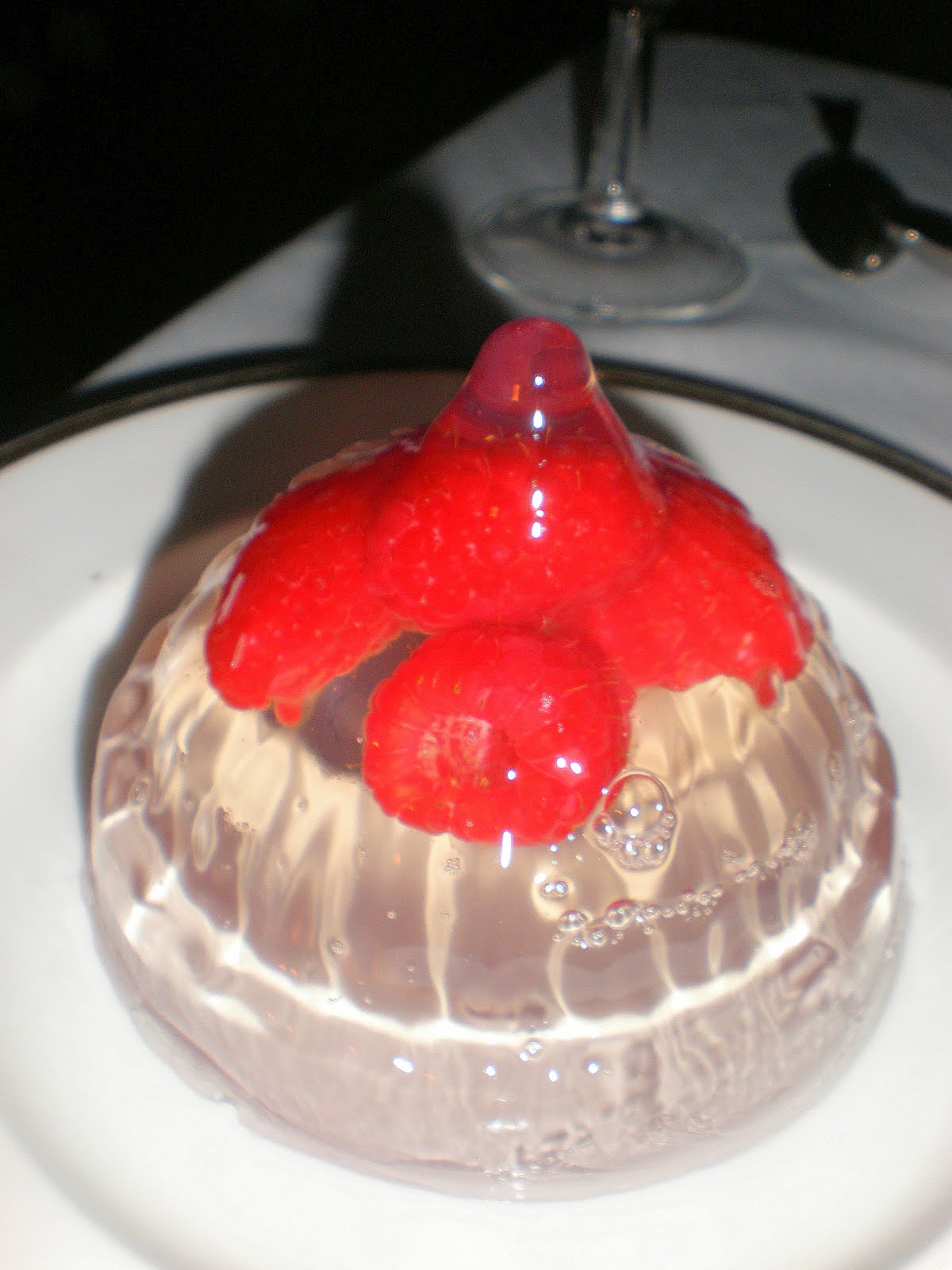
Don't you like my nippled violet-and-elderflower Jellateena?

Surely that's the piece de (non) resistance of Bompas and Parr's food experience. And it was just as well we were all so chilled in both senses now, because the entertainment went on at purposefully purposeless length. We all sang 'Come into the garden, Maud'; a (deliberately?) banal setting of the spider's invitation to the fly went on for ever; we liked the White Rabbit's idea of a good trick, pulling a man out of a hat; and a raucous screechfest was terminated by the five Alices, who like the waiters had not perhaps played as big a part as the flagging up of local involvement might have suggested. Here's a final Laslert/Artichoke shot of Queen of Hearts (Di Sherlock) and Duchess (Heather Keen) in full vocal flight.

And so back on the bus after a chat in the field with Susannah and Lyn Gardner, who saw the original back in 1999 and thought some intimacy, but not the splendour, had been lost on this occasion. As for me, well, I gave up on the expected telling link between book and drama, and eventually succumbed to the weirdness of it all. One fact will surely be true for all: the experience will stick in the mind long after more shapely and better-performed theatre has vanished from the memory.
Friday, 6 May 2011
Looking-glass spies

Someone in Robert Littell's CIA epic The Company is obsessed with Through the Looking-Glass, and What Alice Found There: a nasty piece of work, as it turns out, with a queasy side-line in maintaining a household of pre-pubescent girls.
The literary references are what one might expect from a master plotter whose earlier novel, An Agent in Place, keeps Akhmatova very much to the fore (son Jonathan of The Kindly Ones is very much in his father's mould, though with loftier ambitions). Sacred Anna pops up quite a bit here, too, but one senses market forces more doggedly at work in the cruder delineation of relationships and plenty of bad sex.
There wasn't, for me, much of a mystery in the leading question (who is the mole within the CIA?) Given the limited lead dramatis personae, the possibilities have to be whittled down fairly quickly - though there's a twist. Yet, though it's hardly Tolstoy or even the novelistic equivalent of the sublime West Wing in its broadly-brushstroked characters, you've got to admire Littell's sweep, showing us how the objectives shifted from Berlin to Budapest, the Bay of Pigs, Brezhnev's Soviet Union, Afghanistan, Gorbachev's Russia. And through all this historical personages are deftly woven, the Kutuzovs, tsars and Napoleons of late-20th century history.

I've been steeped in Alice and will continue to be so next week when we go to a Wonderland-themed 'unique dining experience' as part of the Norfolk and Norwich Festival. Cursed the fact that I didn't book tickets for the Royal Ballet's Alice's Adventures in Wonderland, its first new full length-ballet to a commissioned score in 20 years. But now I get to write about it for Opus Arte's DVD release, and for that I had the great pleasure of talking to choreographer Christopher Wheeldon as well as seeing the film.
It may well be that disappointments voiced by some of my colleagues at the Royal Opera House are mitigated by the close-ups which allow us to concentrate more on the delightfully expressive Alice of Lauren Cuthbertson (pictured below in the first of two Royal Ballet production images by Johan Persson in a scene which works superbly well on DVD). I actually think it's bold to try and tell as much of Carroll's first Alice book without overloading the scenario with looking-glass characters (even then I still miss the Gryphon and the Mock-Turtle, but as Wheeldon points out, by the time they appear he's decided to tighten the focus on the Queen of Hearts's court).

Too many special effects, not enough dance? I don't think so - again, there's much more formal choreography in Act Two, with Zenaida Yanowsky's consummately funny Queen/Mother (below) doing a genuinely witty parody of the Rose Adagio. But there's certainly old-fashioned magic achieved through contemporary means for Alice's fall, a lovely homage to the Sleeping Beauty Panorama as she and the White Rabbit (Edward Watson, full of twitching neuroses, anything but bunny-cute) travel through the forest - Wheeldon says I'm the first to pick up on that - and brilliant puppetry to manipulate the components of a giant Cheshire Cat.

Joby Talbot's score glitters, snaps and coruscates, taking its tinta from the obsession with time passing. No great melodies here, but plenty of contrast, and some pathos, too, especially for Alice's 'lost' solo towards the end of Act One. I liked the Caucus Race Polka, too, and thought it bold to try and feature that episode at all, though many folk seem to hate it. Anyway, the whole thing is very classy indeed, as you might expect from a company on top form. What will happen after the departure of gracious Dame Monica Mason, and who'll take over? Wheeldon, I note, is among the candidates.
Subscribe to:
Posts (Atom)


_-_The_Nursery_Alice_(1890)_-_BL.jpg)
_-_c06543_03.jpg)
_-_c03757_07.jpg)