Showing posts with label Lucerne Easter Festival. Show all posts
Saturday, 14 April 2018
Haitink tops the BBC Music Magazine Awards
Semyon Bychkov's Vienna Philharmonic recording of Franz Schmidt's Second Symphony was the one I hoped the public would choose from our choice of three orchestral discs, if only to encourage record companies to take risks in big orchestral repertoire; and then either that or Sean Shibe's English guitar music CD, most persuasive playing I've ever heard on that instrument, as CD of the Year. But I'm still very pleased that Haitink's fourth Mahler Three on disc with the gorgeous-toned Bavarian Radio Symphony Orchestra was the ultimate choice - especially since news about it just preceded my visit to Lucerne to hear the 89-year-old BH - nb not 'Sir Bernard' nor 'Maestro Haitink', he rejects both - giving his eighth year of conducting masterclasses.
I was only able to attend the last of three six-hour days, but I still count it as one of the key experiences of my life to set alongside Abbado's Mahler in Lucerne, and I try to get to grips with it on The Arts Desk. Above: Haitink with perhaps the most assured of the eight young conductors on the course, Vitali Alekseenok, photographed (like Jansons below) by Peter Fischli.
That has enriched the piece I've written on Haitink to coincide with the Awards issue of BBCMM due out shortly. So, too, did the fact that I also caught the Bavarians in Lucerne with Mariss Jansons, and talked to the young Swiss co-principal cellist of the orchestra, Lionel Cottet, about the Haitink Mahler 3 just before the performance (there he is among the players on the left in the ensuing Beethoven Mass in C, a first for me in concert, and it flowed beautifully with a fine choir and four excellent soloists). I also spent 15 engaging minutes on the phone with leader/concertmaster Radoslaw Szulc, and wasn't able to use as much of what he told me in the short final piece as I'd have liked - his eulogy, for instance, to Martin Engerer, superlative soloist in the Hummel Trumpet Concerto at the first of the two Lucerne concerts - pictured with Jansons below - and the one-of-a-kind posthorn he used (not a flugelhorn) in the Mahler.
Must say that though only one of my personal favourites won its chosen category - Bram van Sambeek's Aho and Fagerlund works for bassoon and orchestra (van Sambeek's little film with phrases of the Fagerlund was a delight, while legendary Robert von Bahr of BIS was on hand to praise the Lahti Symphony Orchestra) - I was delighted with very nearly all the choices. Of the trophy-receivers below, Bertrand Chamayou, pictured in the front below (all Awards ceremony photos by Johnny Millar),
gave a live performance of Debussy's 'Clair de Lune, Fenella Humphreys chose an odd pair of pieces and most promising newcomer Julien Brocal played some of Mompou's variations on Chopin's A major Prelude. Can't say they sounded to me like much more than slightly ungainly improvisations on a piece whose charm is its simplicity, but I do love the disc, pushing for it wholeheartedly at the jury session, and I had a fascinating conversation with Julien after the ceremony.
Like the best of his generation (he's just turned 30), he is supportive of his colleagues, speaking very enthusiastically about Roman Rabinovich when I told him of hearing RR play three historic keyboards at Hatchlands, and a very thoughtful as well as friendly fellow. His brand new disc of Ravel and rather more enigmatic Mompou offers a rainbow of pianistic colours and subtleties.
The ceremony at my favourite London venue, Kings Place, was a model of its kind, just the right length. BBCMM Editor Olly Condy set it up engagingly, and regular James Naughtie emanated wry naturalness as usual. There were essential speeches from Lionel Meunier of Vox Luminis, winning the Best Choral award for the beautifully-presented Luther tribute, and the witty-in-English manager of the Bavarian RSO Nikolaus Pont. Nicholas Daniel and Harriet Harman - pictured up top with Olly and BR Klassik co-founder Stefan Piendl - made a special plea for music education in the UK (watch this space). Non-irritant good humour came from Anneke Rice and Vikki Stone, pictured below with Olly and Chamayou.
It become apparent that we seemed to favour Frenchmen, something we certainly weren't aware of at the time of the judging, but they all deserved their success, and if the whole thing has the intended effect of encouraging the classical recording industry to carry on its chosen path of the rich and rare, of doing what seems artistically worthwhile at whatever cost rather than simply trying to make money (nice if that happens too), then it's done its bit.
Tuesday, 27 March 2018
Devilish music-drama in Zurich and Lucerne
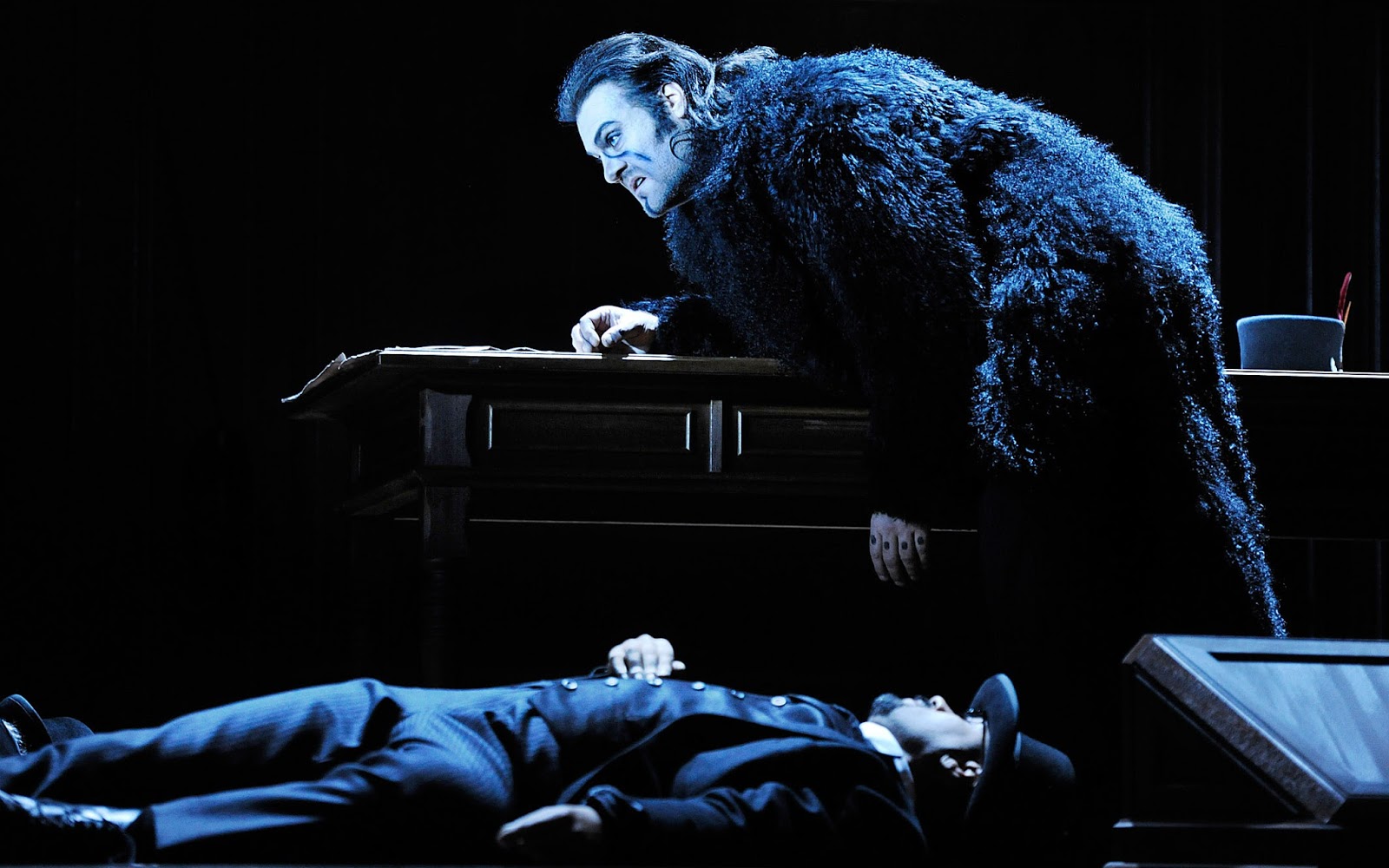
Catching Wagner's Der fliegende Holländer at Zurich Opera with the greatest living interpreter of the title role was serendipity, a bonus preface to my days at the Lucerne Easter Festival,
and I wasn't expecting an optional extra in Lucerne, the resident opera company's site-specific experiment with Schumann's Faust-Szenen, to have such an impact.
None of us present will ever forget the Zurich concert performance of Dutchman at the Royal Festival Hall. There Anja Kampe (pictured below with Terfel in production photos of the first run - no new ones were taken for this cast, sadly) and Matti Salminen were very much Bryn's equals in holding the stage. This time Steven Humes was, as they used to say, merely faxing it in as Daland; though if Camilla Nylund's more-lyric-than-usual Senta kept something in check in Act 2, it was worth it for the final transfixing commitment before the abrupt end of the tragedy (Zurich's version sticks to the brutal Dresden original, without the Tristanish epilogue in Overture and finale). There was huge intensity and interest in Marco Jentzsch's imposingly psychotic Erik, and promise for that role and other Wagnerian tenor parts from Omer Kobeljak's Steuermann.
If Bryn has suffered some of the vocal wear and tear inevitable in singing Wagner round the world across the four-plus years since his first Zurich Dutchman, he is still totally compelling. The colour and inflexion are there from the very first phrase ('Die Frist ist um,' spine-tingling), and the hyper-flexible, sensitive conducting of Markus Poschner enabled him to hover just that little bit longer in mid-phrase. Besides, he only has to stand there - or even, in one effective instance, sit to the left of the stage with his back to chorus and audience - to command the stage with his undeniable charisma. Irrelevant to the performance, perhaps, but a chorus member who told me that he was always solicitous in helping her find her way in the wings without her spectacles signalled that he's still the same team player whom I first encountered in person making tea for everyone in the Dundee recording sessions for Mendelssohn's Elijah.
The original photos of 2012 had made me keen to see Zurich Intendant Andreas Homoki's production. The concept is handsome in Wolfgang Gussmann's design: it all takes place in a 19th century merchant's headquarters, but seascapes hang on the walls and in one instance the red ship bobs across turbulent waves as the central painting comes to life. The chorus are very hard-worked and onstage for much longer than usual; they play some of it for comedy, though I wasn't quite convinced by the colonial statement made in the crucial choral Act 3 confrontation between what should be two ships' crews. The expanded map of Africa with settlements marked catches fire - fine, up to a point - and a black, be-fez-zed servant turns into a warrior, rather cheesy.
Some overacting though no cheesiness bedevilled the Lucerne Scenes from Faust, but the impression it's left is far bigger than that. At 9pm on my last evening in town, I'd made my way straight from Mariss Jansons' first, unstintingly impressive Bavarian Radio Symphony Orchestra concert in the KKL - more on that in my forthcoming Arts Desk piece - and stood outside the Jesuit Church witnessing hollow-eyed, bleeding-from-the-mouth kids holding up religious placards as the scattered chorus began a Lutheran chorale. Then the doors of the church were flung open and Schumann's Overture began from the excellent orchestra under young conductor Clemens Heil.
Forbidden to sit and listen, kept at the sides, we then moved quickly to the theatre where Part One and two-thirds of Part Two were played out in near-darkness, the stage in the tiny auditorium built out so that we were very much involved in Faust's fantasies, the orchestra relayed from the church through speakers. Plausibly, the Gretchen scenes were played out as phantasms of the protagonist in (one presumed, though fortunately there were no props or set to underline it) an asylum. A parallel with Schumann's madness, but not a contrived one; director Benedikt von Peter gauged his alternative psychodrama very sensitively. As in a remarkable production I've seen of Ibsen's Peer Gynt - many parallels there with Goethe's Faust - the narrative running through a tormented man's head made the supernatural dimension more, not less, convincing, with spirit voices unseen from upstairs and only a couple of video projections to detract from the Faust-Gretchen-Mephisto dynamic, plus a mesmerising descending light-bulb which gradually became the artificial sun of Faust 'out in the world'.
Baritone Sebastian Geyer had a hard task keeping the constant state of anxiety and horror going, but he carried it off, sang well and was plausible when still; and I bought the general idea, Rebecca Krynski Cox's heroine as lily-carrying Madonna wafting across the stage and then spectral distressed, pregnant girl wiping blood over the hallucinating Faust.
Bass Vuyani Mlinde, familiar from his days with the Royal Opera's Jette Parker Young Artists Programme, was quite a brooding presence. The dynamic between Faust's negative force, the essence of his madness, and the beset inmate reached its climax in the scene of Faust's death outside in the Theaterplatz - Mlinde declaiming from an upstairs window of the theatre across to Geyer on the roof of a wooden construction beside the church.
To the sounds of Schumann's magnificent brass chorus - I'm completely in love with this music, which like the Beethoven Mass in C earlier in the evening I've never heard live before - we were escorted back inside the Jesuitenkirche.
I was anxious - did the clergy know what they were in for when they gave permission (especially as we know the Catholics are less happy about profane events in their ecclesiastical buildings)? The quasi-religious 'Journey to Heaven' continued to be stage-managed by Mephisto with mockery from adult and childrens' choruses.
But the giant Madonna-Gretchen on a screen was contradicted by the real human being, perhaps the girl who had lost her man to the asylum.
The ending was very moving - a now completely still and blank Faust approached by an elderly person from the street who took off coat and became helper, guiding him to the west door. And so, nearly five hours after the first work in the KKL concert had struck up, a remarkable evening came to an end. Quite an alternative Passion for Easter. I can't wait to hear the music again - must get Britten's recording with Fischer-Dieskau. Even outside the less obviously inspired and fantastical moments - the garden scene, the Ariel music, certain choruses in the final journey, which Schumann treats in quite a different way to Mahler in his Eighth Symphony - the idiom now feels right to me, thanks to John Eliot Gardiner's recent journey of rediscovery.
Lucky Lucerners: I hope that anyone with an interest in theatre will rush to this. Needless to say, the surfeit of great events precluded catching the new Holliger opera with Christoph Gerhaher in Zurich the following afternoon; we spent it recuperating in the warm spring sunshine in the Rietberg Park with Lottie and friends. More on the al fresco side of the trip anon; I need to catch up on my Arctic experience first. Meanwhile, a full report on the Lucerne Easter Festival experience, with more succinct words of praise for the Faust-Szenen is now up and running on The Arts Desk.
Production photo credits: for Dutchman, T + T Fotografie / Toni Suter + Tanja Dorendorf; for Scenes from Faust, Ingo Höhn
Wednesday, 7 April 2010
Orieltown

Erkerstadt or 'town of oriel windows' has long been the well-deserved nickname of Schaffhausen, thanks to the 170-odd adornments the good burghers had built to show their wealth in Renaissance times. Lottie and I hadn't intended to spend so much time there on her day off from duties at the Zurich Opera and the last of my visit: a short wander, perhaps, lunch and then on to the celebrated river falls downstream at Stein-am-Rhein.
In fact we were captivated. A good lunch certainly helped: we chose a winner down near the Schwabentor by virtue of a table in the hazy March sun: the SchuetzenStube, a restaurant popular with the locals which has a small theatre inside. It's run by two delightful ladies, Annegreth Eggenberg and Anita Schwegler, who've been together for twenty years. 'As business partners?' asked Lot. 'Business - and family' one replied, affectionately pinching the other's cheek. You see, we may abhor Switzerland for its minaret-banning and suchlike insularity, but in other ways it can be surprisingly tolerant (horrid word) and bordertown Schaffhausen is a good example of integration, host to a large Sri Lankan community. Just how well integrated, though, I couldn't say.
Anyway, it was after this that we began to examine the oriel windows more closely. Two of the finest houses are on Vorstadt: the Grossen Kafig at No. 43, with a mural of Tamerlane's triumphal procession


and the 1608 decoration of Zum Ochsen at No. 17. The ladies on the oriel window depict the five senses with mirror, glove, flower, musical instrument and cake.


Rococo elaboration adorns Zum Steinbock round the corner at Oberstadt 16.


The most famous Renaissance fresco north of the Alps, we're told, is that of Zum Ritter, with knightly virtues on display including Odysseus's constancy in the Land of the Lotus Eaters.


Alas, though, this isn't the 1570 original, which is in the local museum, but a 1930s copy. Our route then took us round the corner to the Munster, with more handsome oriel-windowed houses up the slope opposite.

Even some of the less elaborate oriels have the charm of a dragon waterspout or two aloft: was there a citizen-craftsman who specialised in these, I wonder?


The Munster precincts include a neat herb-garden, favoured by a couple of resting citizens basking in the afternoon sun, and a grand Romanesque-Gothic cloister with spring flowers emerging in its pretty garden.


I'd like to have lingered longer, but there was a flight to catch later in the afternoon, so we hastened on to the Rhine falls and then back to Zurich. And I've finally done my willing duty by the Lucerne Easter Festival and written up some of the best concerts ever in my Arts Desk letter from Lucerne. So let's end by coming back up to date with Jean Nouvel's KKL Luzern.
Subscribe to:
Posts (Atom)