Showing posts with label Wagner. Show all posts

Monday, 8 September 2025

Fire and water


CDs Adams to Prokofiev after the fire in my London study: Kiefer-worthy, don't you think? Puccini to Zemlinsky safe, if a bit smoke-blackened, in the hall and opera DVDs OK next door. The water input here was necessary but has of course caused further damage. But how glad I was to be by the waters of Lake Vesijärvi a week later, after one of the superb concerts in the Lahti Sibelius Festival.

And right now I'm back in Dublin and immersed myself in the waters of the bay last Thursday, with swimming friend Catherine and visiting artist pal Marcelle happy to look on in the sunshine at Seapoint. 

I see looking back on this that I didn't say how it happened. I'd returned two hours earlier from Dublin, lying on the bed in my t shirt and underpants looking at emails. Smelled burning, checked the rooms four times, then saw an orange light. The curtains by the desk were on fire, ignited by one of those awful tungsten lamps which always got too hot, and the blaze was spreading. Singed my hair trying to pour water on it, then neighbours at the door got me out and had called the fire brigade, which came quickly. I was taken to hospital to check I didn't have carbon monoxide poisoning - I didn't - but the blood tests revealed I had a severe potassium shortage, so I was put on a drip feed for two hours. 

The two weeks of kickstarting insurance action and leading a nomadic existence, shared between my friend Cally's Chiswick place and my late mum's flat in Banstead, in the process of being sold, had many good moments, but I look back on it with a kind of horror, and such relief that I'm temporarily away from the chaos. Contents insurer via NatWest has been on the case, and I'm impressed with the professionalism of the assessor. The buildings assessors have been very slow but are now finally firing on various cylinders. with  news about alternative accommodation now very urgent.

No clearance has begun, so the place still looks like this. A photographer on Bluesky suggested I should get it all snapped in black and white. The burnt CDs could become a kind of installation.

Two big paintings by Ruth Addinall have been completely destroyed, inter alia, but the other two rooms are more or less OK, if smoke-blackened. While the single Adams CDs are also a goner, the Earbox which I kept on the other side of the study is soggy, but JA's personal signature, which he made after I'd interviewed him before a BBC Symphony Orchestra concert, survives.

The smell is overwhelming. There have been silver linings. One is that at Charing Cross Hospital, where I had tests to make sure I didn't have carbon monoxide poisoning, they discovered I needed a two-hour infusion of potassium. And the fact that my precious study as I knew it is gone may affect the decision on where to live when J retires.

I didn't think I'd be able to carry on my Zoom courses as the hifi has melted down - I need the big burner to make clips - but in the back room, in the black filing cases, I found my snippets from the last time I 'did'  Tannhäuser, so that's been continuing, and it's another happy place for me. I even retrieved the Dover score from the other side of the room - books and LPs have been slightly damaged, but not gone. I can do the same with Tosca and The Makropulos Case for Opera in Depth starting in early October, but will need a place and equipment for the late Schubert course. One step at a time...

Monday, 18 August 2025

From Walküre to Tannhäuser on Zoom


 What a spectacular parade of greats we had to visit across 10 Monday afternoons on Die Walküre, which completes my Wagner Ring on Zoom (we started with Siegfried when lockdown meant I couldn't go to Gartmore for my annual course for the Wagner Society of Scotland, moved on to Götterdämmerung, Tristan, Meistersinger and Parsifal before going back to Rheingold). A Siegmund came first (the adorable Jay Hunter Morris, previously welcomed to talk Siegfried and Tristan), then two Sieglindes (Linda Esther Gray and Natalya Romaniw), a Wotan (John Tomlinson, just before we watched the big Act 2 monologue in the Kupfer Bayreuth production, still peerless alongside Chéreau's) and a Brünnhilde (Anne Evans, ditto before the final scene in the same production).  

Natalya's visit was a first. And of course she was a delight, sure of where she's going now but doubtful of the Wagnerian path before Sieglinde came her way (I remember a student from continental Europe who said she was cancelling her Royal Opera visit because Lise Davidsen, expecting twins, had pulled out - I told her the replacement wouldn't be second best). 

Of course the Royal Opera isn't looking too good now, having gone for former Putin supporter Anna Netrebko as Tosca to launch Jakub Hrůša's first season as Music Director in September when it could have highlighted La Romaniw, a Welsh-Ukrainian exponent of the role worldwide. Natalya is in any case singing Tosca for Welsh National Opera, so that's where to see it. I've decided I'll cover the Royal Opera version for The Arts Desk when Aleksandra Kurzak takes over. 


We've now plunged into the Venusberg in the first Zoom class on Tannhäuser, with six more Wednesdays to go. Irish soprano Jennifer Davis, who made such an impact as Elsa in Lohengrin at the Royal Opera, is preparing her first Elisabeth for Geneva Opera, and I hope she'll join us. In dealing with the background for the first class, I compared the original 1845 Overture (Klemperer) and the 1860 elision with a big Venusberg ballet for Paris, very much post-Tristan. John Neumeier's choreography for Gotz Friedrich at Bayreuth is very impressive. I have it on DVD, but it's all here on YouTube with English subtitles.


It's still not too late to join, since I can send the first class on video (and indeed you can always get the instalments that way if live attendance is difficult). Details below (click to enlarge).


Sunday, 27 April 2025

Last hoiotoho for Walküre on Zoom

We begin our ten-week exploration of Wagner's second Ring opera tomorrow in my Opera in Depth Zoom course, tying in with Barrie Kosky's new production at the Royal Opera which opens on Thursday (at 4.30pm, which means I have to postpone Part Two of the Debussy/Ravel course for a week). UPDATE: review now up on The Arts Desk, with photos by our resident Bill Knight. I include two more here: above, Elisabet Strid as Brünnhilde; below, Natalya Romaniw as Sieglinde and Stanislas de Barbeyrac as Siegmund.

Yes, I've been here before, both at Gartmore House in the last live course for the Wagner Society of Scotland and at the Frontline Club, but so many new discoveries have accumulated since then, not least the complete Wagner recordings of the amazing Albert Coates, about whom I gave a talk for the Wagner Society of Ireland. It won't be a repeat, and it WILL complete the Ring survey on Zoom. Full details below (click to enlarge).

You can join live on Monday afternoons or get the videos (or both).  You'll find a very welcoming and lively crowd.

Saturday, 3 August 2024

Sailing towards Wagner's Dutchman

'The Complete Wagner' experience on Zoom actually has its source in the Trossachs, where I stepped in to take over a summer course at the beautifully-located Gartmore House for the Wagner Society of Scotland. With only a week's notice, I had to adapt what I'd already done - an Opera in Depth term on Das Rheingold. The Scottish Wagnerites liked it, asked me back for successive summers on the other Ring operas. I did the same for Die Walküre, but then in 2020 Covid struck, so Siegfried needed to transfer to Zoom. Online, I've since gone through Götterdämmerung, Tristan und Isolde, Die Meistersinger von Nürnberg and Parsifal. Keen Zoomers from America and elsewhere will be able to catch up on Die Walküre in the summer term of the Opera in Depth course, to coincide with the second instalment of Barrie Kosky's Ring at the Royal Opera. Special guests? Who knows, just yet. But I'm so proud and happy that Antonio Pappano and Richard Jones actually overlapped in one of our Puccini Trittico classes (click to enlarge).

Where next, for summer Wagner? Back to the beginning, of course. Die Feen, Das Liebesverbot and Rienzi seemed only to merit one two-hour session each, and Der fliegende Holländer, being much shorter than the big 'uns, needs five classes rather than 10. So it is that next Tuesday afternoon we embark on the early journey. Do join us: if you can't attend live, I can send the videos. Full details on the flyer below (click to enlarge).


Saturday, 26 August 2023

ENO Xerxes, Class of '85


The wonderful Jean Rigby (on the right top in the above Zoom class, with Ann Murray top left and Christopher Robson bottom right) played her part, back when I was running my five classes on Britten's Albert Herring, getting others to come along who'd been in the immortal Glyndebourne production directed by Peter Hall. So we had, not all at the same time but all with so much to say, Nancy (Jean), Sid (Alan Opie), Albert (John Graham Hall, so funny), Mr Upfold (Alexander Oliver, ditto) and Florence Pike (Felicity Palmer, another hoot). I think that counts as some sort of historical reunion - and of course all concerned said it was among their favourite operatic experience of a lifetime. 

With Serse, I'd originally hoped that we might reassemble some of the stars of the new English Concert recording following on from an electrifying live performance. It's become my Desert Island Handel. Emily D'Angelo, Lucy Crowe and Paula Murrihy are megastars, but the first two very kindly told me they were busy (Emily on a new Handel production, Lucy on end-of-term stuff with her kids), while Paula I'd already prevailed upon to talk Octavian just before the Irish National Opera Rosenkavalier, along with conductor Fergus Sheil (and what a triumph that turned out to be). In the end Harry Bicket, whose skill is total in entwining orchestra with voices and who was working on a new production of Pelléas et Mélisande in Santa Fe, came along for a much-appreciated ten minutes at the beginning of one class. Before I move on, tell me if you know a more fiery piece of Handel than D'Angelo singing 'Crude Furie' (there is an equal, below, from La Murray, but can you get better than either?)

Get this recording: it's superlative in every way. 

Then we hit another bullseye - not only Jean, who'd played Amastre, Xerxe's discarded lover disguised as a man, in the groundbreaking ENO Xerxes directed by Nicholas Hytner, but also Christopher Robson, the Arsamene - and, wonder of wonders, the great Ann Murray, thanks to an Irish friend who knew her well, Joe Brennan.

She turned out to have as wicked a sense of humour as La Palmer, and had us all in stitches with candid reminiscences (not least about Charles Mackerras, who of course was never the easiest conductor to work with, but rightly a perfectionist). Yes, it was history: the production which marked the start of the Handel opera revival. It's been revived frequently and would still work now. The whole Channel 4 film is up on YouTube, but horribly distorted (I picked up a second-hand DVD). Three clips are, I hope, to the point. In the first Jean's major solos as Amastre have been stitched together.

The second has a duet everyone remembers - and not just because duets are rare in Handel operas, more because the English translation helped to make it such fun (the whole thing works in English, I think): Robson's Arsamene in a lovers' spat with the wonderful Valerie Masterson's Romilda.

And finally, the English version of 'Crude furie' from Murray. Piquant that the subtitles are the Italian original. Special visual rewards here, as always thanks to Hytner and the commitment of his singers. Ticks all boxes as a Great Operatic Performance.

What miracles of substance and design the ENO programmes were in those days. I still miss the chameleonic and brilliant Nick John, whose untimely sudden death was a shock to all of us. This is the cover of my first Xerxes programme - I caught it for the first time in the 1988 revival, which included the above three singers.

Inside, style and useful detail were one.

Now three weeks into my summer Wagner course on Zoom, and enthralled as ever by the peculiar world of Parsifal, I dug out my ENO programme from 1986. The articles and quotations within are numerous and useful even now. I confess to some shame in not remembering more about it than I do, since Goodall was conducting (I wasn't a fan in those days of his extended lengths) and - will you look at this insert, placed to the right of the programme cover. Jerusalem singing in German to an otherwise English cast was parallel to an earlier experience I had at the Royal Opera, when Rita Hunter sang the Trovatore Leonora in English to Carlo Bergonzi's very Italian Manrico ('what are you saying? I cannot understand you').

Only ten two-hour-plus Zoom classes will do for Parsifal, especially as I have to make way for guests. John Tomlinson will return towards the end, when we go back to his Gurnemanz in the Kupfer production, but already in the second class we had sense and inspiration from Andrew Gourlay, whom I saw in action live for the first time in a terrific complete Firebird score with the National Youth Orchestra. He's made a very careful selection of music to form a suite, with minimum interference and hardly any filling-in of vocal lines. Here he is top right, and this time I've done a close-up in case it's too difficult to make him out (I have 60 students and even though not all can make it live, we're still on two screens).


You can watch Andrew conduct the LPO in the whole suite here on YouTube, though I heartily recommend the Orchid CD:

Still my favourite performance of the Prelude is Bruno Walter's.


Wednesday, 28 September 2022

Kosky's Meistersinger: falling at a late hurdle

Wednesday afternoon sees the 10th and final class in my Zoom course on Wagner's Die Meistersinger von Nürnberg, and the end should crown the work, as well as our grand finale: our special guest is Ben Heppner, who for me sings the most beautiful Prize Song of any I've heard (on the Sawallisch EMI recording: glorious sound, though my overall favourite on CD is Kubelik's. The below film is clearly from a gala, but it will certainly do). 

We've also spent a wonderful hour with Mark Wigglesworth, who conducted one of the Royal Opera revivals of Graham Vick's splendid production, and while Jane Eaglen (whom I saw as Eva at ENO, one of her first major roles for the company) had to pull out of a chat because of a crucial meeting about fundraising - she'll visit some other time - John Tomlinson will give of his time when he comes back from holiday, a very welcome postscript.

I previously covered Meistersinger when the course ran at the Frontline Club and Richard Jones's WNO production - still the best I've ever seen - was pending; he also came to talk to us. But every time it just gets richer. I don't look at previous course notes; it's important to start from scratch. This time we've been more preoccupied with the question of Wagner and antisemitism because, although I don't think it figures in this work (the comic villain Beckmesser is seen as a target, but that's been ignored by most UK directors, Jones included), Barrie Kosky, as the first Jewish director of the opera at Bayreuth, felt he had to tackle it. And I felt we had to follow some of the scenes in the DVD of his production (it's also on YouTube, by the way, but only with German subtitles). 

Felt the Wahnfried tableau restricted the scope of the Prelude, and it sets massive problems to solve: Sachs, Walther AND David among multiple Wagners; Cosima as Eva; Pogner as Liszt; Beckmesser as Hermann Levi. To his credit, Kosky makes the scenes between Beckmesser and Sachs laugh-out-loud funny. The ever- brilliant Johannes Martin Kränzle is at his most outrageous in this production. He's not at any point a Jewish stereotype, but Kosky makes the laughter freeze when the crowd turns him in to one. Personally, I'm happier with a view which treats Beckmesser as a Malvolio within a Shakespearean comedy. But I do understand why, in Bayreuth of all places, the peripheral questions need addressing. 

The point where I lose faith is when Eva enters Sachs's study - here the room in which the Nuremberg Trials were held - in Act Three. We lost the sentiment in favour of swift humour in the comparable Act 2 scene, but although I adore Anne Schwanewilms, the silly mock-girlish skipping she's asked to do defuse all the emotion in the situation. And if Michael Volle's Sachs and Klaus Florian Vogt's Walther are both aspects of Wagner, where's the crucial love triangle? I turned back to Lehnhoff's stripped-back production for Zurich Opera, and having doubted the scene's power, the tears flowed again. It was with good reason that Strauss and Hofmannsthal saw in this a blueprint for the Marschallin-Octavian-Sophie triangle in Der Rosenkavalier.

Excellent cast. Real-life couple Peter Seiffert and Petra-Maria Schnitzer keep it real, too. Some find José Van Dam's Sachs too dour, but I like the introspection, the pain is real, and he's very much an attractive older man.

Every class has brought big emotions. As Mark pointed out, every transition is a thing of wonder, and strictly speaking you could say it's ALL transition. I'm especially happy with the two hours we spent on the Act Three Prelude and the Wahnmonolog, with the help of Brian Magee's eloquent words on the Schopenhauer connection in Wagner and Philosophy to help us out. There's also another of the few really good books on Wagner which I re-read with pleasure, because all the elementary points in it are put so well - this brief but pithy journey through the opera by Catholic priest, professor and author of numerous books on literature and music M. Owen Lee. 

The art, ultimately is what matters, and among the many miracles of this great masterpiece is how it bears out all its claims with musical chapter and verse - everything is perfectly executed. Can it really be, as Mark wrote he was inclined to believe, in our initial email exchange, 'western civilization's greatest achievement'? While engaged on it, I'm inclined to believe so, Bach Passions and Mozart operas notwithstanding.

Verdi's Aida, of course, is a different case - the kind of plot all too familiar from early 19th century Italian opera, but ah, the music, the orchestration, the great string of duets! The writing is as masterly as that of its late successors Otello and Falstaff. I've had trouble persuading some students we should spend five Mondays on it, still more that G&S's The Yeomen of the Guard deserves two (I'm splitting the second half of term between that and Britten's The Rape of Lucretia. 

We start tomorrow (Monday 3 October), probably hitting 'Celeste Aida' before we get to 'Morgenlich leuchtend' on Wednesday. Full details here - click to enlarge.

Thursday's non-operatic course this term is devoted to the symphonies of Elgar, Vaughan Williams (the bulk of the classes) and Walton. I thought after the Russians, Czechs, Hungarians and Finns it was time for British - I hesitate to say Engish - music to have a look in. I wanted some words of commendation different to Sue Bullock's for the opera course - and Mark wrote what I'm sure he thinks, so proud of that. Again, click to enlarge.

Onwards! I hope a few more will be tempted to join up; good numbers for the opera course, fewer for the symphonies, but that's always been the case.

Thursday, 21 October 2021

Harp swirls for Czech Music Zoom class 1


My Opera in Depth course this term - half devoted to Janáček's Jenůfa, the other to Martinů's Julietta - had already been under way for three weeks before I launched the Thursday class, a more general survey of a genuinely Czech music from Smetana through to Martinů, with a preludial look at 18th and early 19th century works by Bohemian composers in the European lingua franca of the time. 

The main point, though, was to reach the epic at the heart of Czech musical experience, Smetana's Má vlast, which launches every Prague Spring Festival on the exact anniversary of this founding father''s death. And I was lucky to know the Czech Philharmonic's principal harpist since 2005, the vivacious Jana Boušková, who with her colleague Barbara Pazourová usually kicks off the stirring first symphonic poem in a magnificent sequence, 'Vyšehrad', capturing the essence of the proud castle which stands above the River Vltava.

Jana accepted the invitation without hestitation. I'd become friendly with her at Paavo Järvi's Pärnu Music Festival, the best in the world for connecting with musical hearts and souls; and indeed she was invited there because she'd played in the Má vlast which Paavo conducted in the 2016 Spring Festival.

That year Jana and Barbara played the opening statements of the work's main theme, plus cadenzas, together; as it's written in the score, the second harp plays the melody and the first elaborates. Jana has actually played alongside five of her students in a Prague Conservatoire opener conducted by the late, great Jiří Bělohlávek. The one I had to hand to show the class was with a mere five harpists (students minus Jana). 

Another beauty of our introductory session was that I moved on to the most celebrated of the six symphonic poems, 'Vltava' (still better known outside Czechia as 'The Moldau' - but in the transcription made by the harpist and contemporary of Smetana Hanuš Trneček, in Jana's performance at a Czech Philharmonic fundraiser in the Rudolfinum during the first Covid spare, to help fund Prague hospitals (the number you see on the top right is the figure in Czech korunas, which shot up throughout).On the CD featured up top, Jana has referred to Trneček's work, but the transcriptions of the first three symphonic poems and of the rest of the works on a superb disc are her own.


The students warmed immediately to Jana - how could anyone not? - and there was much emotional discussion of the high level of musical education and literacy in that remarkable country. It was also vital, when Jana grew up, to have music as the world you inhabited when life under the Soviets was not so good - and to think of touring to the unimaginable rest of Europe or America as a top player, as her mother did (her father was a flautist in the Czech Philharmonic, so the couple played beautiful Mozart, inter alia, together). If you click to enlarge the image, Jana isn't difficult to spot - she has the Prague Old Town skyline behind her.

Today we move on to the Hussite chorale used in the last two symphonic poems of Má vlast, 'Tabor' and Blanik', as well as in crucial works by Dvořák (Hussite Overture), Suk (Prague) and Karel Husa (Music for Prague 1968). I'm still mapping out what the other eight classes will bring, though I'll divide fairly equally between 19th and 20th centuries, and the four greats, as depicted in this postcard of which I'm so fond, will have the lion's share.

The 10-week course on Wagner's Tristan und Isolde ended the week before we started this one. We had a virtual post-course drinks on the Friday, to which Dame Anne Evans was able to return, having been voiceless in the final class. Many laughs were had by the small but very vocal group on that evening  (Annie second from left in the bottom row).

I was also  delighted to record a Tristan chat with Robin Ticciati on the heels of his run at Glyndebourne, concluded with an orchestrally unforgettable Proms performance.


Equally thoughtful (and the other great British conductor as far as I'm concerned) was Mark Wigglesworth on Jenůfa, squeezing in the time to speak during work with the BBC Philharmonic in Salford (hence the dull hotel room background).

Just recorded another Jenůfa conversation, this time with tenor Nicky Spence, which I hope to air on Monday. Indebted to Mark for suggesting Nicky would make an excellent guest when I was running the course at the Frontline Club. As he did, and I love the generosity of all these exceptional artists, true Menschen all - that goes for Jana and Anne every inch as much as the men. Further guests, TBC, will materialise on the Czech music course anon. Not too late to join - just comment with your email here; I won't print but I promise to respond.

Sunday, 5 September 2021

Strauss conducting Tristan

'Now I’ve conducted Tristan for the first time, and it was the most wonderful day of my life'. I used the same quotation - the 27-year-old Richard Strauss to Wagner's widow Cosima, on 17 January 1892 - to introduce my review of the Glyndebourne performance at the Proms earlier this week, because I surmised Robin Ticciati felt that way on conducting his first Wagner opera for the first time too.The above photos were sent, signed, from Weimar to fellow-composer Humperdinck, whose Hänsel und Gretel Strauss premiered in that beautiful town in 1893. 

Tristan und Isolde at Weimar starred Strauss's future bride, Pauline de Ahna (also a favoured Elisabeth at Bayreuth) and his pupil Heinrich Zeller, for whom he wrote the insanely taxing role of Guntram in his hyper-Wagnerian first opera. There were no cuts - rare then, and still not so common now (the Aix production conducted by Rattle this year has a whopping one in the dialectics of night and day, love and death, the lovers indulge in before the Liebesnacht proper gets going. I think we should hear it all - there are no commonplace bars in Tristan). 

We have one precious sound-document of how Strauss approached this most elusive of all great masterpieces: a recording of the Prelude made in 1928 with the Berlin Philharmonic Orchestra (the best sound is on the DG pressing, but that's not downloadable here).

Yes, it's fastish - difficult to compare timings with other Preludes because there's a 'concert ending' which takes us to the Liebestod music - but the rubato, the ebb and flow, are masterly and above all human. That's the difficulty for the conductor to decide: human or oceanic? Others prefer slower tempi, surprisingly so Toscanini (but then remember that the biggest discrepancy in Parsifal Act Ones at Bayreuth was between Strauss and Toscanini, who took half an hour longer...). In my first Opera in Depth class on Tristan und Isolde, I played both the Strauss and this NBC recording.

All the students who spoke preferred the Strauss; I was delighted. Though it's very much a matter of choice and temperament, when Wagner only writes 'Langsam' ('slow') at the start. Conductors would be wise to observe his tempo fluctuations thereafter. Anyway, in the second class, I played the way to the climax in performances by Stokowski (very volatile, masterfully conducted, and played by the Philadelphia Orchestra) and, for slow-burn intensity, by Mravinsky and Pappano. Personally, I felt a 'yes, this is how it should be' once the drama of the Prelude properly flows from Ticciati at the Proms. You would be well advised to listen to the complete performance while it's still available on BBC Sounds (until the end of this month).

We've now passed the halfway mark in Class Five last Wednesday, and of course I have nothing in my head but the sounds of the 'Liebesnacht'. The compelling but deeply unsettling way that director Krzysztof Warlikowski handles it in Munich, with spellbinding performances from Jonas Kaufmann and Anja Harteros (pictured above) and superlative conducting from Kirill Petrenko, seems to me the best approach I've seen. 


Soundwise, I'm constantly shifting in examples between so many recordings, but predominantly Lauritz Melchior and Kirsten Flagstad with Beecham (or Reiner), Bayreuth '66 (Nilsson and Windgassen with Böhm conducting), Vickers and Dernesch with Karajan, Margaret Price and Rene Kollo with Carlos Kleiber, Linda Esther Gray and John Mitchinson with Goodall. Linda is returning to talk to us next week, and Peter Rose will appear to discuss Marke's monologue. Later we hope to welcome Robin Ticciati and Antonio Pappano, and Anne Evans in the final class. More in the pipeline. It's rich!

Friday, 23 July 2021

Another journey with Tristan and Isolde

Staring next Wednesday afternoon (UPDATE - now 4 August owing to an emergency hospital visit last week), I'm back on Zoom again along with anyone who cares to join me for ten glorious (I hope) two-hour sessions on Wagner's Tristan und Isolde. This course is under the auspices of the Wagner Society of Scotland, for whom I embarked on what should have been four weekend courses at beautiful Gartmore House in the Trossachs on the Ring. We managed Das Rheingold and Die Walküre - that was during a September heatwave, sun burning early morning mists away outside my bedroom window pictured below - 

then Covid struck, so Siegfried had to go online, and I followed up with Götterdämmerung later in 2020. We had hoped to return to live events this September, but apparently the booking for two options fell through. So here we are on Zoom once again, and in my experience it's been a great opportunity to welcome more special guests than we could have done live. On the Wagner front, I've welcomed John Tomlinson to talk about Wotan-as-Wanderer and then again about Hagen; Susan Bullock, Anne Evans and Richard Jones, in what turned out to be a fascinating three-way conversation; Linda Esther Gray (the greatest of all Isoldes? Discuss - we will, hopefully with her); and, belatedly, Jay Hunter Morris, perhaps the best Siegfried currently with us. Who knows who we'll get this time, probably not so easy as artists return to work? But I'm making enquiries. 

If you're interested, message me here with contact details; I won't publish them, but I shall respond. It's £100 for the course, which I think is a bargain at £10 per session (which may well be longer than two hours, dependig on interest). If you can't attend all or any of the classes, I can send out Zoom videos the day after.

Sunday, 3 January 2021

Fidelio/Leonore and more Russians: Zoom 2021

Zoom has been my salvation in 2020, and not just in terms of keeping financially afloat. To realise how much it's meant not just to an ever-expanding group of students but also to the great performers who so generously found the time to make special guest appearances has been (and I don't use the term lightly) humbling. We've had wonderful appearances from Sue Bullock, Anne Evans, Richard Jones and John Tomlinson (captured below, looking more Gurnemanz than Wotan - he was in fact talking Hagen - at the class by a student) over the 10 Mondays on Wagner's Götterdämmerung, completing our Ring survey over three and a half years. In the latest Russian music term covering 1910 to 1917 there's been enlightenment on Stravinsky's Petrushka from Gergely Madaras, on his Rite of Spring from Andrew Litton and Catherine Larsen-Maguire (extended to two whole classes), and on Scriabin from Alexander Melnikov and Peter Jablonski.

For all of us involved on a regular basis, it's given a shape to the week, and for many, an alternative to live performances (for which, of course, there's no real substitute, but needs and circumstances must). Take the two one-offs on the Tchaikovsky ballets - The Sleeping Beauty on 30 December and The Nutcracker on the 21st. They came about because one student lamented that she would no longer be able to go to any of the planned, socially distanced Nutcrackers given the third, and severest, lockdown of the year. We could at least share our pleasure in the beauties of these amazing masterpieces. I can't resist featuring again the late, much missed Maria Björnson's most ravishing design for the Royal Ballet Sleeping Beauty that came in for so much stick (I hymned the whole achievement on the blog here). Watched the entire DVD again yesterday and for me it's still the most magical Beauty. This is the Panorama from the second act, turned into a winter's tale.

These were also interludes between terms on Russian music - the first two have taken us from Glinka to Prokofiev's observations on the end of 1917, while the next covers 1917 to 1953, mainly but not exclusively Soviet (we have to follow the adventures of Prokofiev and Stravinsky in the west, too). I planned the Opera in Depth term to begin on 11 January with Beethoven's Fidelio (image up top, of the excellent Garsington Opera concert staging, by Johan Persson) and its original version, Leonore - on the special urging of Mark Wigglesworth, who's just conducted Fidelio for Opera North and wants most of all to 'do' Leonore at English National Opera - before moving on for the following five Mondays to Prokofiev's The Fiery Angel; as far as I can remember - and my records are still stored on the previous computer which went bust - I haven't covered it in over 30 years of Opera in Focus/Depth and it would tie in with what we're doing in the other course. It's also unclear what the main companies will be staging, so why not take advantage of an opera that's not appearing in any repertoires for the foreseeable future? By summer it should be clearer what the two last operas of the season should be.

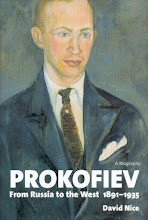
Here's my planned itinerary for Russian music 1918-1953, subject to change depending on circumstances and special visits. Pictured below: Nikolay Myaskovsky and Sergey Prokofiev, friends born 10 years apart, in 1927, detail of a photo taken from the first volume of my Prokofiev biography (sorry to link to Amazon, but my online seller of choice, hive.co.uk, reports it out of stock).


1: Adventures abroad, dark times at home  7 January

Prokofiev travels to America while Myaskovsky stays at home and remains true to his characteristic moods of gloom and pessimism. Myaskovsky's Fourth and Fifth Symphonies contrasted with Prokofiev's shorter works of 1918-19 and the exuberance of The Love for Three Oranges.

2: Stravinsky in Switzerland; the Ballets Russes transformed   14 January

Stravinsky's Russian trilogy begins with the small-scale experiments of Renard (Baika) and L'Histoire du soldat. Ever the seeker after novelty, Diaghilev engages a fresh range of artists to work with composers old and new. With special emphasis on Prokofiev's Chout (Larionov design pictured below) followed by Stravinsky's Pulcinella and Les noces (Svadebka).

3: Enter Shostakovich  21 January

With a prefatory look at Myaskovsky's biggest and darkest symphony, the Sixth, followed by the First Symphony with which the precocious teenage Shostakovich, Petrograd/Leningrad Conservatoire student, burst upon the scene. His first total masterpiece, the Prelude and Scherzo for string octet, is followed by a singular marking of the 10th anniversary of the October Revolution in what became known as his Second Symphony of 1927

4: 1927  28 January

The apogee of Soviet modernism, still strongly connected to developments in the west. We look at machine-age music by Prokofiev, Mossolov and Deshevov, and through Prokofiev's detailed diary entries for his first visit to the Soviet Union in 1927 look at the young musicians whose music he heard while he was there, chief among them Gavriil Popov with his remarkable Chamber Symphony.

5: A Gogol opera and two ballets  4 February

The young Shostakovich's reputation continued to grow with his wildly expressionistic opera The Nose and his two full-length ballets, The Golden Age and The Bolt - though proletarian musicians' organisations were now on the attack.

6: Two edicts, two masterpieces, 1932-6  11 February

The move to bring the querulous proletarian musicians' groups under one banner, the Association of Soviet Music, in 1932, looked like a good thing at the time, though it spelled trouble ahead. Shostakovich's Lady Macbeth of Mtsensk, completed at the end of that year, ran successfully in Moscow and Leningrad for two years before the blow fell with the Pravda attack on it in January 1936. Still he pressed ahead with his outlandish Fourth Symphony, but it was withdrawn before the scheduled public premiere at the end of the year. With special guest Elizabeth Wilson.

7: Soviet film scores, 1929-1938 - from New Babylon to Alexander Nevsky  18 February

Shostakovich worte his first film score for Kozintsev and Trauberg's New Babylon in 1929; Prokofiev worked on Feinzimmer's Lieutenant Kije four years later before becoming a true Soviet artist in 1938 with his music for Eisenstein's Alexander Nevsky. With clips from those films as well as Alone, Counterplan and Volga-Volga.

8: The 'Soviet' Symphony, 1935-1945  25 February

Picking up on the first Russian symphony to cause real controversy, Popov's First, performed in 1935, we see how Shostakovich followed a superficially safer trajectory in his Fifth before ringing the changes in the Sixth. We end with Prokofiev's own special circumventing of socialist-realist formulas in his Fifth, premiered at the beginning of 1945 and seen (wrongly) as a victory symphony. Pictured below; Prokofiev, Shostakovich and Khachaturian in 1940.

9: Chamber and instrumental 1938-45 4 March

Shostakovich's new journey in chamber music began with a kind of neoclassical purity, but Russia's dramatic entry into the Second World War opened up freedom in music again: the Second String Quartet and Second Piano Trio mark a dramatic change in course. Alongside them we also look at Prokofiev's so-called 'War' piano sonatas (6-8).With special guests Steven Osborne and Boris Giltburg.

10: The dangerous path to 1948   11 March

Two more towering symphonies, Shostakovich's Eighth and Prokofiev's Sixth, dare a naked sense of despair. After the war, it was time for the authorities to turn the screw again, which they did with Zhdanov's notorious trials of 'formalism in music', banishing the possibilities of dissonance and anguish expressed in music. Pictured below: Shostakovich in Leipzig, 1950.

I can see from this that I haven't managed to fit everything in: there will be two extra classes on Prokofiev's War and Peace. If anyone wants to join who isn't already on my list of students, just leave a message here with your email address. I won't publish it, but I shall certainly reply.