Showing posts with label Aida. Show all posts

Sunday, 8 January 2023

Zoom courses: from Lucretia to Rosenkavalier

"S'ist mein Leiblied' - 'it's my favourite song' - declares Baron Ochs in Der Rosenkavalier of his signature waltz-tune. By the same token, Rosenkavalier is probably my Leiboper - certainly the one I know best, the intricacies of which, in both Hofmannsthal's libretto and Strauss's music, seem inexhaustible. This coming term's Zoom course, starting tomorrow (9 January) will be my third visit in the opera classes, but since the last time there have been new recordings and new productions on video (including Bruno Ravella's for Garsington, the exquisite and Grace-Kelly-stylish Miah Persson's Marschallin and Hanna Hipp's fine Octavian pictured in it above by Johan Persson; Irish National Opera takes on this staging in March with a fine cast led by Celine Byrne, the fabulous Paula Murrihy and Claudia Boyle). There's always more to discover. And as always when I repeat a classic, I don't look back on old notes. 

Last term ended rather more positively than I was expecting. I'd been reluctant to revisit Britten's The Rape of Lucretia, so whittled it down to three rather than five classes (Rosenkavalier will have seven, Korngold's Die tote Stadt also three). Ronald Duncan's often excruciating libretto troubled me even more in Oliver Mears' production when I saw it at Aldeburgh. 

I'd always wondered about André Obey's play Le viol de Lucrèce - about which all the contributors to the Rape of Lucretia symposium book I picked up are so cagey that an addendum slip had to be printed giving it proper credit. Then I found that Thornton Wilder had translated it in 1933. Surely Eric Crozier, at least, knew this? It's so much better, in every respect, than the drama Duncan fashioned. For a start there's no Christian overlay. There ARE two narrators, a man who follows Tarquin's progress, a woman who reflects Lucrèce, but they don't appear until Obey's second act (the first has two soldiers relay, chorus-like, what's going on in Collatine's tent). The aftermath is much more acceptable today: Lucrèce as powerful tragic heroine, knowing that her divulging of the rape will trigger Collatine's vengeance and a Roman uprising, not some self-disgusted victim. 

At the beginning of the last and third class I continued the comparison between opera and play. But joining us were Jean Rigby, the most moving Lucretia I've ever seen on stage, and her husband Jamie Hayes, who'd directed the work for British Youth Opera. Jean had already instigated a kind of cast reunion of the original Glyndebourne Albert Herring - since I don't seem to have written about it here, I must boast about the other visitors: John Graham Hall, Alan Opie, Felicity Palmer, Alexander Oliver and Felicity Lott (who sang Lady Billows in a revival) - and I knew what a fun and generous person she is. 

Everything Jean had to say about the circumstances around that remarkable Graham Vick Lucretia at ENO back in 1987 informed what we were about to watch - namely Act Two from the moment Tarquinius awakens Lucretia to the end of the opera. And the film itself was testament to how, when every singer has worked on phrasing and meaning so intensively - not just Jean, but everyone else in an extraordinary cast - reservations about the infelicties of the text vanish in the face of such consummate music-making, such singing-acting. The whole film is available on YouTube but in a fuzzy picture, so I recommend you get the DVD. 

We were blessed with our guests this last term. I'm so happy that John Savournin, our most innovative living Savoyard as singer and director, was able to join us for the two classes on The Yeomen of the Guard (I still didn't manage to persuade two students that G&S is worthy of keeping company with the best). John's brilliant re-imagining of Patience for nine singers at Wilton's Music Hall was the big surprise in my operatic 'Best of 2022' for The Arts Desk. When we spoke he was preparing for the last performance of Golijov's Ainadamar at Scottish Opera, a production I long to see; hence, I think, the moustache.

And right at the end of the five classes on Verdi's Aida, I suddenly remembered that Tamara Wilson, one of the most generous of guests way back when I was still giving live classes at the Frontline Club and she was performing Leonora in The Force of Destiny at ENO, had sung the title role all round the world (but not, sadly, in the UK, and after a bad experience in Verona which I think may have had to do with a refusal to sing it in blackface, as the vile Netrebko recently did, she has retired the role from her rep). 

When we met online, Tammy was preparing to revisit the role of Turandot, this time for Barrie Kosky in Amsterdam (I was so hoping we could go and stay with our friends there, and see it, before Christmas, but too many hospital appointments got in the way). I remembered how revelatory she had been on the previous visit about how she marks up the score, and includes intentions, and so requested she did the same here. The 'intention' behind 'straniero, ascolta!', for instance, reads 'feel pleasure that I'm going to kill him'.

So yes, what fun we had. And I'm hoping we'll be able to welcome at least one Marschallin, Octavian, Sophie and Ochs to the Rosenkavalier sessions; watch this space. Still not too late to join if you can - from anywhere in the world, time depending. And if you can't make the class, you get the video. Full details below; click to enlarge.

Wednesday, 28 September 2022

Kosky's Meistersinger: falling at a late hurdle

Wednesday afternoon sees the 10th and final class in my Zoom course on Wagner's Die Meistersinger von Nürnberg, and the end should crown the work, as well as our grand finale: our special guest is Ben Heppner, who for me sings the most beautiful Prize Song of any I've heard (on the Sawallisch EMI recording: glorious sound, though my overall favourite on CD is Kubelik's. The below film is clearly from a gala, but it will certainly do). 

We've also spent a wonderful hour with Mark Wigglesworth, who conducted one of the Royal Opera revivals of Graham Vick's splendid production, and while Jane Eaglen (whom I saw as Eva at ENO, one of her first major roles for the company) had to pull out of a chat because of a crucial meeting about fundraising - she'll visit some other time - John Tomlinson will give of his time when he comes back from holiday, a very welcome postscript.

I previously covered Meistersinger when the course ran at the Frontline Club and Richard Jones's WNO production - still the best I've ever seen - was pending; he also came to talk to us. But every time it just gets richer. I don't look at previous course notes; it's important to start from scratch. This time we've been more preoccupied with the question of Wagner and antisemitism because, although I don't think it figures in this work (the comic villain Beckmesser is seen as a target, but that's been ignored by most UK directors, Jones included), Barrie Kosky, as the first Jewish director of the opera at Bayreuth, felt he had to tackle it. And I felt we had to follow some of the scenes in the DVD of his production (it's also on YouTube, by the way, but only with German subtitles). 

Felt the Wahnfried tableau restricted the scope of the Prelude, and it sets massive problems to solve: Sachs, Walther AND David among multiple Wagners; Cosima as Eva; Pogner as Liszt; Beckmesser as Hermann Levi. To his credit, Kosky makes the scenes between Beckmesser and Sachs laugh-out-loud funny. The ever- brilliant Johannes Martin Kränzle is at his most outrageous in this production. He's not at any point a Jewish stereotype, but Kosky makes the laughter freeze when the crowd turns him in to one. Personally, I'm happier with a view which treats Beckmesser as a Malvolio within a Shakespearean comedy. But I do understand why, in Bayreuth of all places, the peripheral questions need addressing. 

The point where I lose faith is when Eva enters Sachs's study - here the room in which the Nuremberg Trials were held - in Act Three. We lost the sentiment in favour of swift humour in the comparable Act 2 scene, but although I adore Anne Schwanewilms, the silly mock-girlish skipping she's asked to do defuse all the emotion in the situation. And if Michael Volle's Sachs and Klaus Florian Vogt's Walther are both aspects of Wagner, where's the crucial love triangle? I turned back to Lehnhoff's stripped-back production for Zurich Opera, and having doubted the scene's power, the tears flowed again. It was with good reason that Strauss and Hofmannsthal saw in this a blueprint for the Marschallin-Octavian-Sophie triangle in Der Rosenkavalier.

Excellent cast. Real-life couple Peter Seiffert and Petra-Maria Schnitzer keep it real, too. Some find José Van Dam's Sachs too dour, but I like the introspection, the pain is real, and he's very much an attractive older man.

Every class has brought big emotions. As Mark pointed out, every transition is a thing of wonder, and strictly speaking you could say it's ALL transition. I'm especially happy with the two hours we spent on the Act Three Prelude and the Wahnmonolog, with the help of Brian Magee's eloquent words on the Schopenhauer connection in Wagner and Philosophy to help us out. There's also another of the few really good books on Wagner which I re-read with pleasure, because all the elementary points in it are put so well - this brief but pithy journey through the opera by Catholic priest, professor and author of numerous books on literature and music M. Owen Lee. 

The art, ultimately is what matters, and among the many miracles of this great masterpiece is how it bears out all its claims with musical chapter and verse - everything is perfectly executed. Can it really be, as Mark wrote he was inclined to believe, in our initial email exchange, 'western civilization's greatest achievement'? While engaged on it, I'm inclined to believe so, Bach Passions and Mozart operas notwithstanding.

Verdi's Aida, of course, is a different case - the kind of plot all too familiar from early 19th century Italian opera, but ah, the music, the orchestration, the great string of duets! The writing is as masterly as that of its late successors Otello and Falstaff. I've had trouble persuading some students we should spend five Mondays on it, still more that G&S's The Yeomen of the Guard deserves two (I'm splitting the second half of term between that and Britten's The Rape of Lucretia. 

We start tomorrow (Monday 3 October), probably hitting 'Celeste Aida' before we get to 'Morgenlich leuchtend' on Wednesday. Full details here - click to enlarge.

Thursday's non-operatic course this term is devoted to the symphonies of Elgar, Vaughan Williams (the bulk of the classes) and Walton. I thought after the Russians, Czechs, Hungarians and Finns it was time for British - I hesitate to say Engish - music to have a look in. I wanted some words of commendation different to Sue Bullock's for the opera course - and Mark wrote what I'm sure he thinks, so proud of that. Again, click to enlarge.

Onwards! I hope a few more will be tempted to join up; good numbers for the opera course, fewer for the symphonies, but that's always been the case.

Thursday, 7 April 2016

BBC Music Mag Awards: with a smile and a song


Happy for all the award winners at this year's ceremony, without having actually heard any of the CDs in question (the nearest I come is the world premiere of James MacMillan's Oboe Concerto, pretty much a masterpiece like all the other concertos he's composed to date). None of the candidates I'd reviewed - Barry's The Importance of Being Earnest at its London premiere, Tchaikovsky's Queen of Spades from Jansons and Strauss's Symphonia Domestica along with a revelatory Die Tageszeiten from Janowski - actually won, but that's not really the point. In those categories, I don't doubt that Sakari Oramo's Nielsen is superb - his BBC Symphony Orchestra cycle was the concert highlight of last season for me - or that Pappano's Verdi Aida with dream team led by the great Harteros and Kaufmann deserves its accolade as a studio rarity in the current climate.


A copy arrived this morning, and just dipping into the Nile scene - I infinitely prefer the last two acts to the first two - I can tell why it's so special. Producer Stephen Johns spoke movingly of how Pappano, hearing the offstage chorus, said 'I wish my father had lived to hear this' (they played through the opera and sang all the roles when he was young). Harteros communicates so much in 'O patria mia'; it was obvious when she first appeared at the Royal Opera as Amelia in Simon Boccanegra that this was the best Verdi soprano since Mirella Freni - see the 2008 (!) blog post 'The real thing' - and so it's proved in the performances I was lucky enough to catch of Otello and Don Carlo in which she appeared.

It was a fun evening, not least because I got to sit next to my best pal in the business, Stephen Johnson, whose Behemoth Dances are (is? Must ask him whether second word is meant as verb or noun) due to be premiered in Moscow followed by first London performance in the Cadogan Hall on 12 May. He's just sent me score and preliminary sound which I look forward to seeing and hearing. We were attentive to the many splendid speakers, with editor Olly Condy kicking off with an amusing clip from Call Saul in which a character reads the first issue of BBCMM in bed, and James Naughtie being naughty as often, and presumably off the cuff with his wit. There were two oddities, though, whom I won't identify, but one seemed high as a kite and the other - well, I've got into trouble enough already referring to her as La Fragrantia (sexist? insulting? Not particularly, IMO), so let's just leave it at that.


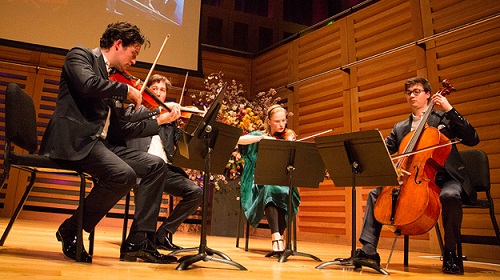
The two live performances were totally engaging - the Schumann Quartet (pictured above), voted best newcomer (though how do you decide when there are so many first-rate quartets emerging all the time?),  in the typically quirky, quote-conscious second movement of Ives's Quartet, and Tenebrae pitch and tone perfect in Bruckner's motet 'Christus factus est' (pictured up top; had to remind Stephen that we'd sung 'Locus iste' at his wedding to the marvellous Kate). Most astonishing for me was a film of Nick Daniel with two fellow oboists playing MacMillan's Intercession for that unique combination - not even Martinů wrote for it - in honour of the composer, whom it was good to see again in person.


Best speech, no question, cellist Paul Watkin (second from left above in his Scottish Chamber Orchestra trousers - he's Welsh) claiming his award for the six Bach Cello Suites on Resonus Classics (have ordered them up). He stood up for music education in the clearest terms and  recommended learning about musical narrative from reading to children (claimed to have got through the entire Lord of the Rings with his kids); at least I know something about that from touting around Russian fairy stories to various godchildren with bits of music on cassette - that dates us - to accompany. John Eliot Gardiner's introduction was equally eloquent, showing how good he can be at heartfelt, precise tribute to a loved fellow musician. I had no idea at the time that Watkin can't play any more following diagnosis of an auto-immune condition called scleroderma; that adds post-event pathos, but it was touching enough then and there.


As far from perfunctory coda, let me sincerely hymn the praises of two discs I was sent by the performers or people close to them. If I hadn't thought much of them, I'd simply have kept stumm. That phenomenal harpist and most generous of human beings Sioned Williams had me sent a disc of works by Michael Stimpson, performed by her and the equally wonderful-on-both-counts baritone Roderick Williams in a recorded concert programme, part of which I'd been hoping to hear repeated at RIBA (in the end I couldn't make it). The Drowning of Capel Celyn I'd seen and heard in Sioned's 60th birthday concert at the Purcell Room. The song cycle Dylan is rich and varied, a marvellous introduction to some Dylan Thomas I didn't know, and all the better for the spoken passages (Roddy doesn't attempt to sound Welsh; Sioned's sing-songy native tone comes in useful for Mrs Cherry Owen). A beautifully presented disc, too.


I won't say much about the other CD because Rebecca Franks at the BBC Music Magazine has just accepted it for review. The background is important: the best of all press officers during her long stint at ENO, Jane Livingston, sent the disc to me because she wanted to support Julian Gavin, the tenor who gave so many extraordinary performances at ENO and, indeed, the Royal Opera (I saw his Don Carlo on the night when Roberto Alagna wasn't singing, and loved it). The year after he recorded this disc with his sister May (both pictured below) he was diagnosed with encephalitis, which called a halt to his international career. Val, their extraordinary mother, died only three weeks apart from their father in 2013.


Even if you knew none of this, I'm certain that the extraordinary emotional fervour of Gavin's very distinctive voice - lyric verging on the helden - would impress; and the songs, too, are late romantic in style and yet, it seems to me, genuinely inspired at times, with melodic writing of truth and beauty. It's useful to have settings of Housman's A Shropshire Lad which offer just as much as Butterworth's. More in the July issue of the BBC Music Magazine.


There, too, you should find my review of a disc which has sent me giddy with delight, the Smetana Piano Trio's recording of all Martinů's major works for that combination. This is already on my shortlist for best of year, and I can't stop playing the ecstatic dance-finale of the Third 'Great' Trio.

Saturday, 12 March 2011

Those Figners


That's the by all accounts outstandingly musical but - on the recorded evidence - not exactly rock-solid tenor Nikolay and his Florence-born wife, Medea Mei-Figner. There they are flanking Tchaikovsky, for whose Queen of Spades they created the roles of Hermann and Lisa (they were also the first Vaudemont and Iolanta).

Why my interest all of a sudden? Because having embarked on Rimsky-Korsakov's vocally rewarding Tsarskaya Nevesta (The Tsar's Bride) with the City Lit students, we were all smitten with the invention as well as the performance of the Act 1 Lyubasha/Gryaznoy duet as sung by Borodina and Hvorostovsky. Of course the descending scales must be indebted to Tchaikovsky's example, but it reminded me of something else, which eventually came to me - Amneris and Radames in Act Three of Verdi's Aida. Checked performances in Russia, and found that not only was Aida first performed at the Mariinsky in the mid-1870s - dates conflict - but that the Figners sang in it together on one of the many revivals.


I'm assuming that the plumptious Medea sang Aida, though since she was trained as a mezzo, it could have been Amneris. On recordings kindly copied for me by the indefatigable Roger Neill, she emerges - in Lisa's midnight aria - with greater honours than her husband, who gets rather amusingly shouty at the end of a number from The Oprichnik. But we're lucky to have these recordings, from 1901, at all. And thanks to Roger, and his friend Roger Beardsley, for another splendid disc I'm listening to at the moment, of great folk and classically-trained singers, from Plevitskaya and Kruszelnicka to Chaliapin and Smirnov in traditional numbers. And here, as I write, is Chaliapin in 'Stenka Razin' - I had no idea that was the original of 'The carnival is over'.


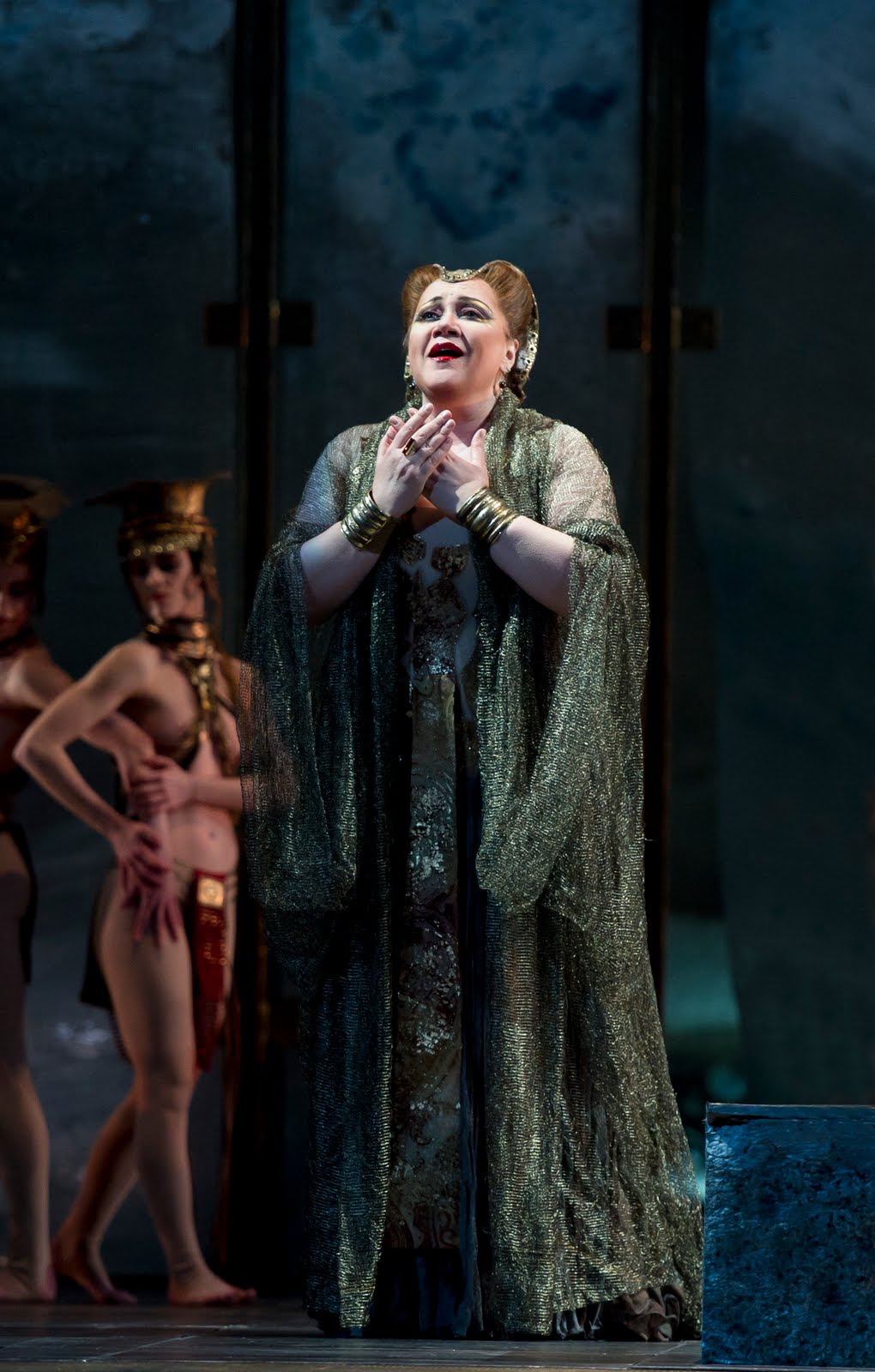
Anyway, The Tsar's Bride (can't resist reproducing again the gorgeous cover of my vocal score) has so much good music tied up in an impossibly melodramatic, why-should-we-care plot. Much like Aida, in fact. And there last night at Covent Garden, in the revival of one of David McVicar's less interesting efforts, was Borodina producing her usual incredible vocal lustre but barely moving. Ditto Alagna - see the Arts Desk review. Here's our stately Amneris, anyway, in the first of two production images for the Royal Opera by Bill Cooper.


You could hardly, on the other hand, blame Liudmyla Monastyrska for doing the bare minimum; she was a last minute replacement for the Aida of Micaela Carosi, who pulled out pleading pregnancy(?). Monastyrska's is a major voice - I haven't had such a thrill from a laser-soprano in an ensemble since Dame Gwyneth, and she can do all the soft stuff too with what seems like a rock-solid technique. That augurs well, as I wrote, not just for her Lady Macbeth, due later this season, but also for a potential Brunnhilde. And when did that last happen? Here she is with Alagna in a visually unatmospheric but musically transporting tomb scene.