Showing posts with label Die Walküre. Show all posts

Monday, 18 August 2025

From Walküre to Tannhäuser on Zoom


 What a spectacular parade of greats we had to visit across 10 Monday afternoons on Die Walküre, which completes my Wagner Ring on Zoom (we started with Siegfried when lockdown meant I couldn't go to Gartmore for my annual course for the Wagner Society of Scotland, moved on to Götterdämmerung, Tristan, Meistersinger and Parsifal before going back to Rheingold). A Siegmund came first (the adorable Jay Hunter Morris, previously welcomed to talk Siegfried and Tristan), then two Sieglindes (Linda Esther Gray and Natalya Romaniw), a Wotan (John Tomlinson, just before we watched the big Act 2 monologue in the Kupfer Bayreuth production, still peerless alongside Chéreau's) and a Brünnhilde (Anne Evans, ditto before the final scene in the same production).  

Natalya's visit was a first. And of course she was a delight, sure of where she's going now but doubtful of the Wagnerian path before Sieglinde came her way (I remember a student from continental Europe who said she was cancelling her Royal Opera visit because Lise Davidsen, expecting twins, had pulled out - I told her the replacement wouldn't be second best). 

Of course the Royal Opera isn't looking too good now, having gone for former Putin supporter Anna Netrebko as Tosca to launch Jakub Hrůša's first season as Music Director in September when it could have highlighted La Romaniw, a Welsh-Ukrainian exponent of the role worldwide. Natalya is in any case singing Tosca for Welsh National Opera, so that's where to see it. I've decided I'll cover the Royal Opera version for The Arts Desk when Aleksandra Kurzak takes over. 


We've now plunged into the Venusberg in the first Zoom class on Tannhäuser, with six more Wednesdays to go. Irish soprano Jennifer Davis, who made such an impact as Elsa in Lohengrin at the Royal Opera, is preparing her first Elisabeth for Geneva Opera, and I hope she'll join us. In dealing with the background for the first class, I compared the original 1845 Overture (Klemperer) and the 1860 elision with a big Venusberg ballet for Paris, very much post-Tristan. John Neumeier's choreography for Gotz Friedrich at Bayreuth is very impressive. I have it on DVD, but it's all here on YouTube with English subtitles.


It's still not too late to join, since I can send the first class on video (and indeed you can always get the instalments that way if live attendance is difficult). Details below (click to enlarge).


Sunday, 27 April 2025

Last hoiotoho for Walküre on Zoom

We begin our ten-week exploration of Wagner's second Ring opera tomorrow in my Opera in Depth Zoom course, tying in with Barrie Kosky's new production at the Royal Opera which opens on Thursday (at 4.30pm, which means I have to postpone Part Two of the Debussy/Ravel course for a week). UPDATE: review now up on The Arts Desk, with photos by our resident Bill Knight. I include two more here: above, Elisabet Strid as Brünnhilde; below, Natalya Romaniw as Sieglinde and Stanislas de Barbeyrac as Siegmund.

Yes, I've been here before, both at Gartmore House in the last live course for the Wagner Society of Scotland and at the Frontline Club, but so many new discoveries have accumulated since then, not least the complete Wagner recordings of the amazing Albert Coates, about whom I gave a talk for the Wagner Society of Ireland. It won't be a repeat, and it WILL complete the Ring survey on Zoom. Full details below (click to enlarge).

You can join live on Monday afternoons or get the videos (or both).  You'll find a very welcoming and lively crowd.

Sunday, 19 September 2021

Evviva la Nilsson/Birgit for ever


'Two roles - two worlds,' announces this spread in a programme for one of Birgit Nilsson's local events in Båstad on the Bjäre Peninsula, southwest Sweden, which I was so lucky to visit this summer for the Birgit Nilsson Days. On my return, I eagerly read, finally, from cover to cover La Nilsson - My Life in Music the autobiography translated into English, and handsomely republished (though with rather too many typos) by Verlag für moderne Kunst,Vienna.

Part of Birgit's abundant legacy - I'll call her that, as do the good museum folk of her family home, since I feel in an odd way I know her, and not as some ossified legend - to have allowed music lovers like me to experience her roots in the mostly happy, if physically tough, farm work which grounded her for life. And as she tells her story, there is no personality split, despite the superhuman talent she had as one of the greatest singers of the 20th century (no need even to qualify that with 'one of the greatest Wagner and Strauss singers' - I've been listening to her recently in Scandinavian song, and she's consummate there too). 

The second chapter, 'When the little one came into the world,' gives as beguiling an account of a rural childhood as Carl Nielsen's, though Birgit's circumstances were far from poor, and she was an only child, rather than one of 12 (the Danish composer's situation) or nine (the case with her father Nils). Most folk I met around the locale were delightful, natural and very down to earth. This is the farmstead where Birgit spent the first year of her life before moving to the ensemble now housing the museum.

The first of our walking expeditions - see the Hovs Hallar blog entry for the second - was an admirably signposted trail in the footsteps, or more often the bike tracks, of young Birgit.

Ingrid, aforementioned in that previous entry, was our guide, but I very much liked the way you could (if you had a sophisticated phone, which I certainly don't) access carefully chosen music sung by oour versatile heroine at various stopping posts. The most charming was in front of a hillock where young Birgit joined her friends in al fresco dancing - a polka and a folksong were the choices. They put a spring in our step as we walked on.


The route led along minor roads and farm tracks through gently undulating landscapes with distant views of the sea and the Danish-style church at Hov

and eventually to the bigger edifice at Västra Karup where Birgit's formative choral training took place, and where all this year's concerts of the Birgit Nilsson Days took place.

The diva always returned to give concerts to the locals

and also to visit her parents' grave. Relations with her father were not always easy - though he bought her a house organ when she was a young girl, the idea that the natural heir to the farm, who should marry a strong man and settle there, wanted to go on to study singing  was abhorrent. He gave her not a penny for her studies in Stockholm, but fortunately her mother had some money of her own. In the house-museum, we heard a recording of Stina Nilsson singing, made at the fair in Gothenburg - not just a natural voice, but also a professional-sounding one, very lovely. Lucky how posterity preserved that. In later years, Nils inevitably became very proud of his world-famous daughter.

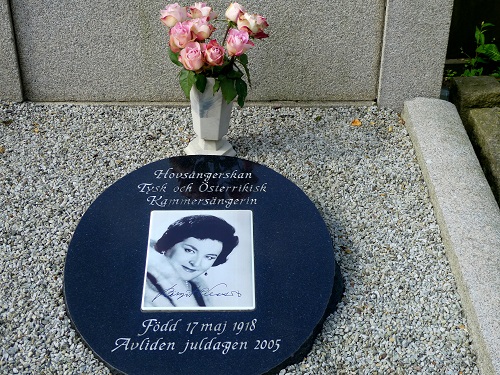
So this was always the spot, right by the church - no special privileges for La Nilsson, who also chose to be buried there (much to Vienna's disappointment) alongside her beloved husband of 55 years, Bertil Niklasson. Though she refers to him throughout the autobiography, Birgit leaves their story until the last and, by implication, the most important chapter. The down-to-earth portrait of a marriage, not sparing of either her or Bertil's faults, is as much of a gem as any of the other highlights in the book. Forgive me if I don't show the full inscriptions which place them both equally on the plot in front of the parents' headstone (she gets the picture, though).

It's not my intention to follow the extraordinary Nilsson story through, and there are way too many fascinating insights in the autobiography to quote (not least on how the singing voice ought to work). One thing especially struck me, though: how artists at the highest level can be professional when it comes to themselves, but totally the opposite in often abysmal attitudes to their fellow musicians. The account of lessons at Stockholm's Royal Academy of Music with Scottish one-time famous tenor Joseph Hislop is a case in point of a teacher nearly wrecking a young voice, applying deadly pressure to the vocal chords, and dealing out devastating snobbery ('Birgit should be aware that it is not really possible for a farm girl to become a singer'). This photo of Birgit around that time shows she was not one to be deterred, though the effect was temporarily devastating.

Simply gobsmacking, and often very funny to us, though clearly not to the unfortunates under his baton, is the behavious of Herbert von Karajan as reported here. Quite often, I'm told, conductors ask for pianissimos from their singers in rehearsals, and then conduct mezzo forte in performance because they can't help it. Karajan, Nilsson observes, went for loud in performance quite deliberately, having asked for the same quiet dynamics from singers earlier. And the performers would often be kept waiting for up to 45 minutes in morning rehearsals, only to be told that the 'Maestro' was held up - they had to come back in the evenings. 

In Vienna and New York, we read, Karajan fancied himself an expert in lighting his own Wagner productions (in this sphere he was absolutely an amateur). The Vienna Philharmonic was more than a little piqued that Karajan had granted it two rehearsals compared to 80 for the lighting. 'The technical personnel...decided, in their own charming, Viennese way to teach him a lesson in giving him a laurel wreath to celebrate the 75th lighting rehearsal'. Can you imagine how ludicrous the vain creature looked, raised up with a light shining on him (the lucky one), baton in one hand, telephone to give lighting cues in the other? 

This splendid piece of satirical wear, a miner's helmet with red light for a Brünnhilde groping in the dark, now on display among the items on Nilsson's dressing table and mirror in the museum, was sent to Nilsson on the evening of her Walküre premiere at the Met. Karajan wanted to know the sender but never found out. We learn from the afterword to the new edition of La Nilsson that the writer, high-up Met secretary Peggy Tueller who became great friends with Birgit, was the culprit. The Valkyrie duly modelled it in her dressing room (though I don't think she went on stage in it during a rehearsal with Karajan, as has also been asserted).

As I wrote in the piece for The Arts Desk, I've never laughed more going round a museum: Nilsson had a wonderful sense of humour to counter all the weird flummery of the opera world. I wonder what she thought of all these dolls, sent by one fan, though she became firm friends with the lady and godmother to her son.

Warm and honest with genuine fans, Nilsson recalls the less funny side in her autobiography: a long and terrifying story of a glamorous stalker which might make a good subject for a film, a play or even an opera. I'll leave you to read about that.

Anyway, her reading was eclectic - or maybe she just displayed the books given to her in the farmhouse which became a summer home. Did she ever learn any of The World's Best Dirty Jokes?

While you're free to wander at will through the museum, in the converted cow barn, the house can be seen by guided tour. Our young guide Klara, a perfect English speaker with real flair in delivery giving her first tour in the language, couldn't have been nicer, and in that she was no different from all the staff who work at the museum. That's a portrait of Nils on the wall, by the way, next to some traditional Swedish furniture and fabrics.

Just a few more shots from the farmhouse: the kitchen

which also has a copy of the Met Cookbook open at the page of Birgit's recipe for gravad lax; two of her cakes are also available from the excellent cafe (where the pigs used to be kept, appropriatedly enough); and a view of the piano surmounted by photos - I love the treated one, top row left, of a Stockholm debut as Agathe.

So thankful that the house organ given by dad to talented young daughter is on display in the pastor's house at the Boarp Museum of Local History above Båstad,

because otherwise we might not have discovered this delightful open-air collection of buildings or been treated to a very special tea in a cosy back room of the wooden building in which refreshments are served. My gorgeous friend Pia was doing up a house only fifteen minutes up the coast by train , and she joined us for the afternoon. I love this pic of her pouring coffee while the splendid lady who spoiled us stands in the background.

I need to return to Båstad for a blog entry about the supremely beautiful church there, another local venue for Birgit of Bjärehalvön. A final word on the autobiography: it's so mich more than a series of anecdotes. And while our incorruptible heroine does not spare the timewasters and troublemakers of the operatic world, she is infallibly generous about the majority of her colleagues (even Karajan is granted the ability, when he feels like it, to pull something absolutely sensational out of his oversized hat). And, I'm sure, absolutely truthful.

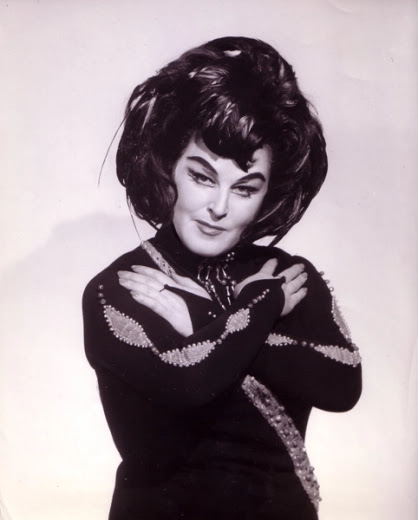
By way of coda, since we haven't seen much of Birgit in the roles for which she was most celebrated, see how different she could look on stage according to costume and make-up. The cover of the Decca Salome - although I have it on CD, I couldn't resist picking up the LP box set in a charity shop the other week - has always been a hoot, an audition before its time for RuPaul's Drag Race

but then look at my favourite glamour shot of our heroine in the same role. Very Emma Peel as played by Diana Rigg in The Avengers, don't you think?

The museum sells postcards and even spectacle cloths with this on. Needless to say, I bought four.

Tuesday, 8 October 2019

Once more into the flames with Wotan


I did it - sent Brünnhilde to sleep on the rock surrounded by fire after nearly 20 hours of lectures and screenings for the Wagner Society of Scotland at crumbling but magnificent Gartmore House in the Trossachs near Stirling. For that greatest of final scenes - possibly the richest in all opera - it had to be Donald McIntyre (pictured above) and Gwyneth Jones within the surprising glow of Boulez's interpretation  and Patrice Chéreau's lacerating direction. Die Walküre is the most flawless of his four Ring stagings, starting with pure heat between the best-looking Volsung twins you'll ever see on a stage (Peter Hoffmann and Jeanine Altmeyer; Kaufmann and Westbroek, looking too glossy in Lepage's Met production, don't begin to compare, even though they're second best).


Steeped as I was in Bartók quartets, having finished off the last of the notes for the LSO St Luke's series just before I took the train for Scotland, I wondered if I'd get back into the Wagner world mentally and emotionally. It only took a class... And this year's group, with many faces from last year, was a joy, constantly enquiring and giving back a great deal in their comments - starting with stalwart Joy Millar, who after I'd played Goodall's Sadler's Wells recording of Siegfried's Funeral March (to set up all the Volsung themes) told me that she and friends had arranged to take the first trombonist on that recording to Bayreuth this summer, since he'd never been.

I had a prime view over the grounds from my three-windowed room. Each morning was different, and somehow chimed with Wagner's nature-pictures (how much more so will that be the case when we go into the woods with Siegfried next September). Following on from my end-of-August sojourn in Edinburgh, the Borders and Perthshire/Fife, it was HOT again for the first two days. Morning mists set up the magic


and after breakfast, with 10 minutes to go to the first lecture of the day at 9.15am (ouch!), had withdrawn to this:


We were prepared for rain on the Sunday, but that meant red sky in the morning, a very different and equally captivating scene.


And the Trossachs in the wet have their magic too (Monday morning, just before leaving).


Back in town, Hunding's Watch from Götterdämmerung was the last thing I expected in a charity gala to raise funds for St John's Smith Square in peril. I'll say we got our moneysworth in a stocking full of plums, outstandingly so from my New Best Friend Anush Hovhannisyan and true mezzo-contralto Angharad Lyddon (idiomatic in French songs and arias). Sir John Tomlinson had to, shall we say, crank up his vintage bass to Liza Lehman's 'Myself When Young' in the first half, but the beginning of the second was somewhat more idiomatic, and inky-black scary as one would expect from one of the finest Hagens probably ever. Malcolm Martineau intensified the atmosphere: boy, did he need to be versatile that night.


Dame Felicity Lott only had to extend an arm to exude her natural charm duetting with JT in a nicely pitched 'I Remember It Well', and the evening ended officially with the bass previewing his Mikado, which will be a star attraction of ENO's umpteenth Miller revival. Here are the golden oldies with Anush.


The laurels of the new season so far seem to have been going not to ENO, with fell reports of its first two Orpheus productions, but to English Touring Opera. As I'm spending two Mondays of my Opera in Depth class on it, I had to catch the second Hackney Empire performance last night of The Silver Lake, Kurt Weill's third collaboration with George Kaiser - not quite a Brecht, to put it mildly. The 'singspiel', originally four hours text to 85 minutes' music, didn't work, and even in a better production than James Conway's, which made the mistake of going back to Brechtian Verfremdunseffekt with way too many banners and placards, I don't think one would be totally gripped. In that respect, I'm in agreement with Boyd Tonkin, who went to see it with proper consideration, as always, while I was heading back from Estonia, and wrote it up for us on The Arts Desk. Production images by Richard Hubert Smith.


Weill's music, though, is uniformly magnificent, and I guess he sussed that, Nazi ban or not, the score wasn't going to take hold, and repackaged a lot of the style and substance into an unquestionable masterpiece, The Seven Deadly Sins.


Even so, there are quite a few numbers which are very much sui generis, and they were all well delivered by a uniformly strong cast including three very different tenors (David Webb as Severin, Ronald Samm as alter ego Olim, pictured above, and James Kryshaw, a Jimmy Mahoney in the making, surely, doubling Lottery Agent, pictured below, and corrupt Baron).


Amazing results, too, from the small orchestra under a master of this music, James Holmes, with special credit to the first trumpet (Ruth Ross, I think). Thanks at least for the opportunity, ETO.

Friday, 18 January 2019

Bucked up by The Valkyrie


As the hospitalisation dragged on, I realised I'd have to postpone the start of my 10 Opera in Depth classes on Wagner's Die Walküre this term by a week. Of course coming home is often more tiring than you expect, and the stent is a nuisance, especially when you have to carry your class kit of heavy books and scores in a rucksack - I'm not up to cycling, probably won't be until after the op - but I felt I could battle that and found myself inspired by the preparatory reading. As I was by the musical side, at least, of the Royal Opera's Queen of Spades on Sunday afternoon, my first outing since I left C&W three days earlier.

I have on the shelves the Poetic and Prose Eddas in several translations as well as the Nibelungenlied, but I only recently bought the neat little Penguin edition of The Saga of the Volsungs which was Wagner's sole source for the tragic history of Siegfried's parents.


As always, one has to marvel at how he followed in the footsteps of the great mythic reworkers (Sophocles and Euripides, for starters) in adapting brutal material to a more compassionate end. You have to take your hat off to the warring, scheming women in this saga, but surely you draw the line at infanticide: Signy, the Sieglinde character, bumps off, or has bumped off, four of her children by a man she doesn't love, but Gudrun, the Gutrune character, takes the biscuit in serving up the Attila figure the hearts of their children on a spit. Pure Titus Andronicus.

So much for the great incestuous love story of the siblings who fall in love before they know (consciously, at any rate) who they are: Signy changes shape with a witch, goes in disguise to her brother Sigmund in the forest and sleeps with the unknowing hero, presumably to 'get with child' and produce something that will grow up to be a Real Man. That's not Siegfried; he - as Sigurd - is Sigmund's son by a third marriage some time after Signy has accepted her guilt in getting what she wanted and shuffled off this mortal coil. There are also several generations between Odin/Wotan and his beloved Volsung. Clever Wagner to make the terrible twins Wotan's own children.


I always stress to students that most studies of The Ring deal too much with the sources and the libretto, and not enough with the music. If only Deryck Cooke had lived long enough to get to the musical side of I Saw the World End; the torso we have is still my primary secondary source, as it were. Which is why we're going through each opera, starting with Das Rheingold last January, scene by scene, theme by theme, highlighting all the most interesting musical transformations. But it was high time to get to closer grips with the original myths. Wagner left behind a seminal letter highlighting his particular interest in the Volsung Saga before recapping his method of writing the 'book' backwards and then the four operas in chronological sequence.


So far we've only taken Siegmund through the storm. The opening has to be more running than trudging through mud; some conductors just don't get it, but Karajan and Böhm are superbly graphic. More minimalist music, unmodulating for a while, just like the Rhine Prelude and the Entry of the Gods into Valhalla. You could - and I did - spend half a class just talking about and illustrating that, with its roots in Rheingold. I also traced the major themes of the act as they unfold in Siegfried's Funeral March. There I chose the other extreme - Reginald Goodall's first recording of excerpts from the final opera with what was then the Sadler's Wells Opera Orchestra. The brass playing is in a league of its own.


Next week - on to the lurve. Anyway, it's so good to be back in Pushkin House, with its helpful staff - shame about the decadence of the Frontline Club after Ian Tesh's departure, much as I love the place - and to feel the support of my wonderful, responsive and devoted students. It's not too late to join us - e-mail me at david.nice@theartsdesk.com if you're interested, but you might also feel like signing up with the Wagner Society of Scotland for its Trossachs retreat in September. The good news is that after stepping in at the last minute in 2018 and proposing Rheingold because I had already prepared, I'm booked for the next three years. And I won't simply repeat myself up there - so much thinking about Wagner always goes on between engagements.