Showing posts with label Salome. Show all posts

Tuesday, 2 April 2024

Opera in Depth Summer 2024: the human comedy


Dante's Divina Commedia was Puccini's model for the trajectory of his most comprehensive masterpiece, even if the subject-matter is quite different for the most part. You can, of course, take Il tabarro, Suor Angelica and Gianni Schicchi separately, or put the individual operas alongside other one-acters, but it's reassuring to see the trilogy most often presented these days as the composer intended (and no, IMO it is NOT acceptable to reverse the orders of the convent drama and the Florentine comedy). 

The beauty of it is that each is a supreme masterpiece of timing and atmosphere on its own terms.  Each makes use of finely observed vignettes in the first third of the drama before the screw begins to turn. There is something hellish about the barge couple's existence in Il tabarro, but it's offset by an almost Debussyan impressionism and gently comic vignettes. Puccini surely drew some of the details of cloistered life from meeting with his sister in her monastic community. And the better I know my Dante - THE big revelation of recent years since the free course with Alessandro Scafi and John Took at the Warburg Institute - the more pleasure I can take from the passing references to so many Dantean names and places in Schicchi, even though its source is a mere line and a bit in Inferno.

Then each opera packs its punch (and never more so than in Richard Jones' Royal Opera production - we'll be referring to the above regularly). Suor Angelica is the most heartbreaking, on a level with Madama Butterfly; Gianni Schicchi is laugh-out-loud funny tinged with youthful romantic love. It will always be a desert island opera for me since it was on an Edinburgh Fringe week of performing it with the Rehearsal Orchestra that my so far 35-year-old relationship with other half, later civil partner and husband, began. 

I'm hoping the infinitely generous and warm Ermonela Jaho can be persuaded to join us after her unforgettable visit to the Butterfly course (when we also had two hours of Antonio Pappano, but I guess he's even busier now. Just got a proof copy of his autobiography and there's wisdom on every page). Meanwhile, here's the flyer for the forthcoming term with full details of how to join - click to enlarge.

For the last four Mondays I can't wait to revisit John Adams's Nixon in China - for me, the best opera of the last 40 years, though there are comic rivals to Schicchi in Gerald Barry's The Importance of Being Earnest and Alice's Adventures Under Ground). One plus since the last time is that other productions have appeared since Peter Sellars' initial hit toured the world (partner and I saw its UK premiere in the Edinburgh Festival at the aformentioned time). To return to operas I'd studied in live classes is never to repeat; I don't look at the old notes. Picture below by Ken Howard from the Met staging of the Sellars production.

How fresh and wondrous we all found Salome and Carmen this past term.  The most rainbow-hued of Strauss's operatic scores is surely also his most perfectly structured. And seeing it a week after the last class in Bruno Ravella's so richly-layered Irish National Opera production in Dublin was a wonder (image below by Patricio Cassinoni for INO). 

Hpw delighted I am that it will be appearing on the superlative free OperaVision website (YouTube connected) later this month, with Ravella's unsurpassably well-cast Garsington Ariadne auf Naxos). How lucky we were, too, with tie visit of Bruno and conductor Fergus Sheil just before the production opened.

Bizet's instrumental and harmonic felicities in Carmen seem limitless: surely this has to be the opera to take a newcomer to if the performances nail it. And I don't think we'll ever see or hear surpassed the duo of Elīna Garanča and Roberto Alagna in Richard Eyre's Metropolitan Opera production*. 

I used scenes from other productions, but no central relationship goes to the edge in its visceral quality as this one does. I've previously state that the DVD of Glyndebourne's Janáček Jenůfa should be the first port of call for anyone who comes to opera from the world of theatre; for the perfect mix of aria, duet and ensemble form with high drama, the 2010 Met Carmen should be the one.

*UPDATE: Damiano Michieletto's new Royal Opera production comes nowhere near, alas, or certainly not with its first cast, marvellous though Aighul Akhmetshina is. And of course I wanted it to succeed, but the review has to tell the truth.

Sunday, 19 September 2021

Evviva la Nilsson/Birgit for ever


'Two roles - two worlds,' announces this spread in a programme for one of Birgit Nilsson's local events in Båstad on the Bjäre Peninsula, southwest Sweden, which I was so lucky to visit this summer for the Birgit Nilsson Days. On my return, I eagerly read, finally, from cover to cover La Nilsson - My Life in Music the autobiography translated into English, and handsomely republished (though with rather too many typos) by Verlag für moderne Kunst,Vienna.

Part of Birgit's abundant legacy - I'll call her that, as do the good museum folk of her family home, since I feel in an odd way I know her, and not as some ossified legend - to have allowed music lovers like me to experience her roots in the mostly happy, if physically tough, farm work which grounded her for life. And as she tells her story, there is no personality split, despite the superhuman talent she had as one of the greatest singers of the 20th century (no need even to qualify that with 'one of the greatest Wagner and Strauss singers' - I've been listening to her recently in Scandinavian song, and she's consummate there too). 

The second chapter, 'When the little one came into the world,' gives as beguiling an account of a rural childhood as Carl Nielsen's, though Birgit's circumstances were far from poor, and she was an only child, rather than one of 12 (the Danish composer's situation) or nine (the case with her father Nils). Most folk I met around the locale were delightful, natural and very down to earth. This is the farmstead where Birgit spent the first year of her life before moving to the ensemble now housing the museum.

The first of our walking expeditions - see the Hovs Hallar blog entry for the second - was an admirably signposted trail in the footsteps, or more often the bike tracks, of young Birgit.

Ingrid, aforementioned in that previous entry, was our guide, but I very much liked the way you could (if you had a sophisticated phone, which I certainly don't) access carefully chosen music sung by oour versatile heroine at various stopping posts. The most charming was in front of a hillock where young Birgit joined her friends in al fresco dancing - a polka and a folksong were the choices. They put a spring in our step as we walked on.


The route led along minor roads and farm tracks through gently undulating landscapes with distant views of the sea and the Danish-style church at Hov

and eventually to the bigger edifice at Västra Karup where Birgit's formative choral training took place, and where all this year's concerts of the Birgit Nilsson Days took place.

The diva always returned to give concerts to the locals

and also to visit her parents' grave. Relations with her father were not always easy - though he bought her a house organ when she was a young girl, the idea that the natural heir to the farm, who should marry a strong man and settle there, wanted to go on to study singing  was abhorrent. He gave her not a penny for her studies in Stockholm, but fortunately her mother had some money of her own. In the house-museum, we heard a recording of Stina Nilsson singing, made at the fair in Gothenburg - not just a natural voice, but also a professional-sounding one, very lovely. Lucky how posterity preserved that. In later years, Nils inevitably became very proud of his world-famous daughter.

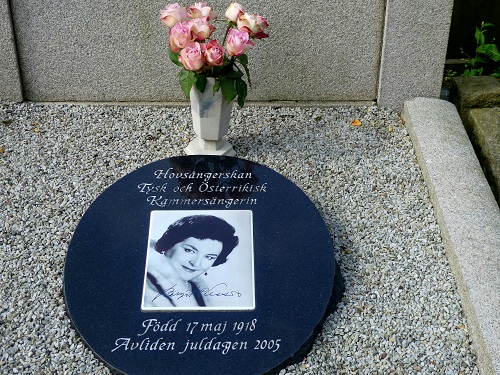
So this was always the spot, right by the church - no special privileges for La Nilsson, who also chose to be buried there (much to Vienna's disappointment) alongside her beloved husband of 55 years, Bertil Niklasson. Though she refers to him throughout the autobiography, Birgit leaves their story until the last and, by implication, the most important chapter. The down-to-earth portrait of a marriage, not sparing of either her or Bertil's faults, is as much of a gem as any of the other highlights in the book. Forgive me if I don't show the full inscriptions which place them both equally on the plot in front of the parents' headstone (she gets the picture, though).

It's not my intention to follow the extraordinary Nilsson story through, and there are way too many fascinating insights in the autobiography to quote (not least on how the singing voice ought to work). One thing especially struck me, though: how artists at the highest level can be professional when it comes to themselves, but totally the opposite in often abysmal attitudes to their fellow musicians. The account of lessons at Stockholm's Royal Academy of Music with Scottish one-time famous tenor Joseph Hislop is a case in point of a teacher nearly wrecking a young voice, applying deadly pressure to the vocal chords, and dealing out devastating snobbery ('Birgit should be aware that it is not really possible for a farm girl to become a singer'). This photo of Birgit around that time shows she was not one to be deterred, though the effect was temporarily devastating.

Simply gobsmacking, and often very funny to us, though clearly not to the unfortunates under his baton, is the behavious of Herbert von Karajan as reported here. Quite often, I'm told, conductors ask for pianissimos from their singers in rehearsals, and then conduct mezzo forte in performance because they can't help it. Karajan, Nilsson observes, went for loud in performance quite deliberately, having asked for the same quiet dynamics from singers earlier. And the performers would often be kept waiting for up to 45 minutes in morning rehearsals, only to be told that the 'Maestro' was held up - they had to come back in the evenings. 

In Vienna and New York, we read, Karajan fancied himself an expert in lighting his own Wagner productions (in this sphere he was absolutely an amateur). The Vienna Philharmonic was more than a little piqued that Karajan had granted it two rehearsals compared to 80 for the lighting. 'The technical personnel...decided, in their own charming, Viennese way to teach him a lesson in giving him a laurel wreath to celebrate the 75th lighting rehearsal'. Can you imagine how ludicrous the vain creature looked, raised up with a light shining on him (the lucky one), baton in one hand, telephone to give lighting cues in the other? 

This splendid piece of satirical wear, a miner's helmet with red light for a Brünnhilde groping in the dark, now on display among the items on Nilsson's dressing table and mirror in the museum, was sent to Nilsson on the evening of her Walküre premiere at the Met. Karajan wanted to know the sender but never found out. We learn from the afterword to the new edition of La Nilsson that the writer, high-up Met secretary Peggy Tueller who became great friends with Birgit, was the culprit. The Valkyrie duly modelled it in her dressing room (though I don't think she went on stage in it during a rehearsal with Karajan, as has also been asserted).

As I wrote in the piece for The Arts Desk, I've never laughed more going round a museum: Nilsson had a wonderful sense of humour to counter all the weird flummery of the opera world. I wonder what she thought of all these dolls, sent by one fan, though she became firm friends with the lady and godmother to her son.

Warm and honest with genuine fans, Nilsson recalls the less funny side in her autobiography: a long and terrifying story of a glamorous stalker which might make a good subject for a film, a play or even an opera. I'll leave you to read about that.

Anyway, her reading was eclectic - or maybe she just displayed the books given to her in the farmhouse which became a summer home. Did she ever learn any of The World's Best Dirty Jokes?

While you're free to wander at will through the museum, in the converted cow barn, the house can be seen by guided tour. Our young guide Klara, a perfect English speaker with real flair in delivery giving her first tour in the language, couldn't have been nicer, and in that she was no different from all the staff who work at the museum. That's a portrait of Nils on the wall, by the way, next to some traditional Swedish furniture and fabrics.

Just a few more shots from the farmhouse: the kitchen

which also has a copy of the Met Cookbook open at the page of Birgit's recipe for gravad lax; two of her cakes are also available from the excellent cafe (where the pigs used to be kept, appropriatedly enough); and a view of the piano surmounted by photos - I love the treated one, top row left, of a Stockholm debut as Agathe.

So thankful that the house organ given by dad to talented young daughter is on display in the pastor's house at the Boarp Museum of Local History above Båstad,

because otherwise we might not have discovered this delightful open-air collection of buildings or been treated to a very special tea in a cosy back room of the wooden building in which refreshments are served. My gorgeous friend Pia was doing up a house only fifteen minutes up the coast by train , and she joined us for the afternoon. I love this pic of her pouring coffee while the splendid lady who spoiled us stands in the background.

I need to return to Båstad for a blog entry about the supremely beautiful church there, another local venue for Birgit of Bjärehalvön. A final word on the autobiography: it's so mich more than a series of anecdotes. And while our incorruptible heroine does not spare the timewasters and troublemakers of the operatic world, she is infallibly generous about the majority of her colleagues (even Karajan is granted the ability, when he feels like it, to pull something absolutely sensational out of his oversized hat). And, I'm sure, absolutely truthful.

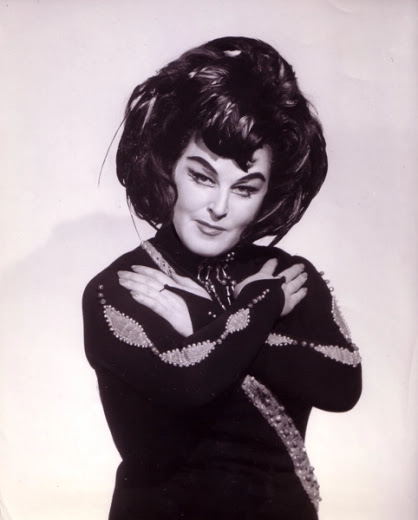
By way of coda, since we haven't seen much of Birgit in the roles for which she was most celebrated, see how different she could look on stage according to costume and make-up. The cover of the Decca Salome - although I have it on CD, I couldn't resist picking up the LP box set in a charity shop the other week - has always been a hoot, an audition before its time for RuPaul's Drag Race

but then look at my favourite glamour shot of our heroine in the same role. Very Emma Peel as played by Diana Rigg in The Avengers, don't you think?

The museum sells postcards and even spectacle cloths with this on. Needless to say, I bought four.

Saturday, 7 October 2017

Puccini's Café Momus at the Frontline Club


...where the food is possibly better. One of the delights of hosting my Opera in Depth course at the marvellous Frontline is that we can choose our menu from the downstairs restaurant, open to the public, and consume it in the comfort of the club room, with maître d' Tomas, for whom nothing is too much trouble, to tend to our every need. Pictured above: Simona Mihai's Musetta presents her knickers to Mariusz Kwiecień's Marcello at Covent Garden, image by Catherine Ashmore.


Anyway, it's finally time for the new 'academic year', starting later than usual this time - on Monday afternoon, the 9th, to be precise, the first term then running straight through to before Christmas. Richard Jones's Royal Opera production of Puccini's La bohème has been in full spate for some time now, but I chose to spend five weeks on it (again!) because he's vouchsafed to come and talk to us (also again, after fascinating chats on Die Meistersinger, Gloriana, Der Rosenkavalier and Boris Godunov). I hope he still will since in my Arts Desk review, I had to be honest and say that, in the first-cast realisation at least, this didn't strike me as one of his more unusual shows. I know he believes, as any director with any sense should, that Puccini and his librettist leave the minutes details for the scenario and you shouldn't mess with that. But there were some less than fully realised characterisations in the first run, and the Momus act was - again, very surprisingly - a bit of a mess. Troubles with lack of lighting rehearsals, I understand, didn't help.


My second choice in the Autumn term, Musorgsky's Khovanshchina, was made on the strength of realising for the first time what a total masterpiece Shostakovich's performing version is, thanks to Semyon Bychkov's magnificent Proms performance, with a superb cast - possibly my favourite Prom of the year, though it's been very hard to choose (Bychkov pictured above at that Prom by the peerless Chris Christodoulou - don't miss his annual gallery of conductors in action on The Arts Desk). Students can see the WNO production if they're prepared to travel.


Spring operas: the first of four January Ring instalments to tie in with Jurowski's Wagner cycle at the Royal Festival Hall. Das Rheingold will take us into February, and then - finally! - I get to cover Janáček's From the House of the Dead since it's being staged at the Royal Opera for the first time (WNO also has a production coming soon). Best news of all is that Mark Wigglesworth is to conduct in place of the capricious Teodor Currentzis, so we can (I hope) welcome Mark back quicker than we expected.

Summer will see plenty of moonshine in Britten's A Midsummer Night's Dream and Strauss's Salome, for which I have renewed appetite having been very impressed by the theatrical room devoted to it, and Dresden in 1905, in the Victoria & Albert Museum's stunning exhibition Opera: Passion, Power and Politics. There's the room below, picture courtesy of the V&A, but read my review on The Arts Desk today to find out why everything works.


It's been a long time away from lecturing, but to warm up I got to talk to members of the Art Fund at the Royal Over-Seas League last night. This was in connection with the V&A show, but by the time I had to give a clear theme, the details of the exhibition weren't clear. So I thought a general look at how opera swung from strict dramatic principles to display, and back and forth until the end of the 19th century, would allow me to sneak in something of Strauss's Capriccio before homing in on the difference between two Otellos: Rossini's in 1816, and Verdi's in 1887: from bel canto to pure music-theatre. The two scene settings, Willow Songs with Prayers and very different treatments of the fatal last encounter between Otello and Desdemona followed by Otello's suicide would permit some interesting comparisons - not always to Rossini's detriment, though Verdi's penultimate opera is, as we rediscovered with awe during our five weeks on it for Opera in Depth, the perfect masterpiece.

 
This Opera Rara set is a good resource - negatively for wicked entertainment, showing how not to depend on a tenor who may have the very high notes needed for the daft role of Rodrigo but no musicality whatsoever, positively for Bruce Ford and Elizabeth Futral, and for including an appendix which even gives us the later lieto fine or happy ending drawn from a duet and an ensemble in other Rossini operas.

Needless to say there wasn't nearly enough time to play all the examples I'd intended, but it was crucial to end with the very fine filming of Elijah Moshinsky's Royal Opera Otello with Domingo and Kiri. Not possible to go and see Kaufmann when we were focusing on Domingo on the opera course earlier this summer - and it's very hard for anyone to come anywhere near to Domingo, who simply owned the part.


As I think audiences on both occasions very much agreed. This is the only Otello you'll ever want on DVD, though the choice is wide indeed when it comes to CD (Toscanini, Levine, Karajan with Vickers and Freni, live Carlos Kleiber for starters).

If you're still interested in attending the Opera in Depth course either this term or later, do drop me a note by way of a comment here - I won't publish it, and if you leave me your e-mail, I'll respond.

Sunday, 31 August 2014

Roaring our heads off


...for these two, Nina Stemme and Donald Runnicles (which also means the Deutsche Oper Berlin orchestra), in a shatteringly great Proms Salome. No need to add much to the rave over on The Arts Desk but I wanted to include a few more of Chris Christodoulou's photos, which arrived as usual punktlich not long after I got back from the Albert Hall last night.

The above came from him after I'd asked for a landscape of Nina, preferably with Donald, to lead. Before he fired them back, I'd already cropped the money shot, and unless he objects don't want to replace it. Hence the second home. There were also others I couldn't use over there. Doris Soffel, having made little impression on us as the Countess in the Zurich Queen of Spades, really had a ball with Herodias, and Runnicles let her hold on to her top A at 'schweigen!' for what seemed like an infinity. Here she is with Stemme.


I mentioned the shame about the slight dependence on scores and music stands from most of the men - Samuel Youn's Jokanaan honourably excepted - but this shows that character tenor Burkhard Ulrich wasn't beyond acting it out as Herod.


Cheers, too, for the Narraboth, Belgian Thomas Blondelle


and Ronnita Miller from St Petersburg, Florida, now a Deutsche Oper principal, as a lustrous 'Page'.


It was a company show, no doubt about it: what a team Runnicles has in Berlin. But ultimately it had to be Nina's night. Doesn't she look, in relaxed mode, like our own intense non-singing (as far as I know) actress Olivia Colman?


Oh, and if you're curious to know who the boors were behind us, shouting 'sit down!' when I rose unhesitatingly to my feet after the shield-crushing, I'll go so far as to say that the only one of them I recognised - and they were all obnoxious in their self-expression before the invisible curtain rose - was a distinguished and, by all accounts, Mensch-like singer who must have welcomed a few standing ovations himself in his time. Shame on them.

1/10 As outlined in a comment below, this was everything the following (last) night's Elektra was not. Ed Seckerson expresses everything I felt in his review for The Arts Desk, not least so eloquently nailing the problem of Christine Goerke's upper register. And he's also right to say that Felicity Palmer's Clytemnestra was the star of the evening. What's the caption here? 'Yes, I'm still better than you, my girl, even at 70'?


Even so, in an ideal dramatic world, Clytemnestra shouldn't be either so old or so visibly raddled. After all, she's the mother of a 20 year old girl, and her decay is inner. Which is why you'll never see a better portrayal than Waltraud Meier's in the great Patrice Chereau's last stand. In fact this is one of the most riveting opera DVDs ever made, and Evelyn Herlitzius - slight of frame, searing of voice - IS Elektra as far as I'm concerned. For some reason my BBC Music Mag five-star review isn't up on the erratic website, but need I say more here? Don't waste time on the iPlayer broadcast of the Prom; buy the DVD.

Wednesday, 7 July 2010

Holy German art


Yes, that would certainly include - and right at the top of the list alongside Wagner - Gustav Mahler, whose 150th birthday we celebrate today (and I still haven't got to the omphalos, Jihlava).* As Paul Steinberg's brilliant dropcloth for Richard Jones's still simmering-in-the-mind production of Wagner's Meistersinger left us in no doubt, 'heilige Deutsche kunst' extends from Bach and Beethoven to Brecht and Bausch, embracing all German-speaking 'imaginers', as Jones calls them. You can enter the Welsh National Opera competition to guess (or know) all the faces in the collage by e-mailing the answers to marketing@wno.org.uk or post them to WNO. As the above photo seems to be cropped you'll need to get hold of the original postcard. And I confess I still haven't by any means sussed them all.

Great Jones, only visionary of our British theatre (as I keep saying, and I mean it), came to talk to me and the students on Monday. He raised so many interesting points I hadn't even thought of, and here's no place to ennumerate them, but I will add that he told us - in response to one of many articulate questions from my bunch, of whom I was inordinately proud - how a couple of German intendants who came to see the show found this all-inclusive perceived 'apology' for Wagner's definition harder to swallow than we Brits. While we heave a sigh of relief and say, at last we've moved on from the Wagner-and-the-Nazis question, they still seem to be mired in it, perhaps because they haven't been able to discuss it in their own art properly until recently. And then what do you get? Stodgy, trad films like Downfall. Hate to sound superior, because it's their issue, but they still have some way to go.

Had to raise the old 'is Flieder lilac or elder' question again. Richard didn't face it directly, but by talking of the heady sex-magic - my phrase, not his - which the scent seems to work on Sachs, he would seem to incline to the elder-as-aphrodisiac theory. Anyway, having been in enchanted Visby, I can tell you that Sweden, or at least Gotland, is a place where lilac and elder DO flower simultaneously around midsummer; everywhere else, including Nuremberg, lilac is over. But here's the ocular proof:


My thanks to the quietly brilliant Jan Brachmann for drawing my attention to the lilac as I walked around Visby in a bit of a daze.

Can anyone identify this plant, another heady smeller, high on the hill above the Baltic?


I reckon Visby would make a marvellous setting for an outdoor production of Meistersinger, moving from venue to venue. We could start in the Domkyrkan (seen behind the elder in the first picture) - though the modern glass might be a bit of a problem - and move on to Transhusgatan near the botanics for Act 2. No linden is close to hand, but I do think Magdalena-as-Eva could appear at this rose-flanked window.


Then it would be out on to the flowery heath for the final pageant.

And if you want to celebrate Mahler's birthday, what better way to do it than to watch what is bound to be the deepest, most meaningful First Symphony, a just-released DVD of last summer's Lucerne Festival/Abbado performance. Better not enlarge on it now, since my BBC Music Magazine review hasn't yet appeared, but I'll just say, buy it and watch it over and over: you won't regret it.


The third in the great triumvirate, Richard Strauss, also deserves a mention. I hadn't intended to see the revival of David McVicar's very bloody, Salo-esque Salome, but as I was talking before it last night and the Arts Desk hadn't covered it in my absence, I went on to the show after my half-hour Linbury 'performance', and marvelled, as with the ENO Tosca, how a great performance makes you respect the score as the real mover and shaker. Angela Denoke redeemed the tonally awful Nadja Michael performance from the first run, too. More over on The Arts Desk.

Led me to think of all the Salomes I've seen. In a crude nutshell, the ones I can call to mind are: Behrens (goddess), Barstow (goddawful), Tierney (not bad at all), Barker (vocally lustrous, good acting too), Some American in Wales (forgettable, but did bring a bit of tenderness to the final scene), Ewing (dreadful), Gwyneth (vocally tops, acting less good), Malfitano (squally, bit wild in the acting too), Michael (vocally the pits). And now Denoke (almost as good as Behrens, not quite, but probably the most detailed characterisation I've seen).

Finally, on a sobering note, my NBB (New Best Blogfriend) Minnie reminded me in the most eloquent way possible that today may be Mahlerday, but it's also an occasion of sober commemoration. Her focused anger is, at least in my opinion, fully justified. Do take time to read what she has to say.

*but hang on - is it just me or is Mahler really missing from that assemblage of just about all Austro-German greats? Unmoeglich!