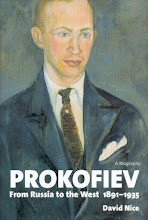
What a spectacular parade of greats we had to visit across 10 Monday afternoons on Die Walküre, which completes my Wagner Ring on Zoom (we started with Siegfried when lockdown meant I couldn't go to Gartmore for my annual course for the Wagner Society of Scotland, moved on to Götterdämmerung,Tristan, Meistersinger and Parsifal before going back to Rheingold). A Siegmund came first (the adorable Jay Hunter Morris, previously welcomed to talk Siegfried and Tristan), then two Sieglindes (Linda Esther Gray and Natalya Romaniw), a Wotan (John Tomlinson, just before we watched the big Act 2 monologue in the Kupfer Bayreuth production, still peerless alongside Chéreau's) and a Brünnhilde (Anne Evans, ditto before the final scene in the same production).
Natalya's visit was a first. And of course she was a delight, sure of where she's going now but doubtful of the Wagnerian path before Sieglinde came her way (I remember a student from continental Europe who said she was cancelling her Royal Opera visit because Lise Davidsen, expecting twins, had pulled out - I told her the replacement wouldn't be second best).
Of course the Royal Opera isn't looking too good now, having gone for former Putin supporter Anna Netrebko as Tosca to launch Jakub Hrůša's first season as Music Director in September when it could have highlighted La Romaniw, a Welsh-Ukrainian exponent of the role worldwide. Natalya is in any case singing Tosca for Welsh National Opera, so that's where to see it. I've decided I'll cover the Royal Opera version for The Arts Desk when Aleksandra Kurzak takes over.
We've now plunged into the Venusberg in the first Zoom class on Tannhäuser, with six more Wednesdays to go. Irish soprano Jennifer Davis, who made such an impact as Elsa in Lohengrin at the Royal Opera, is preparing her first Elisabeth for Geneva Opera, and I hope she'll join us. In dealing with the background for the first class, I compared the original 1845 Overture (Klemperer) and the 1860 elision with a big Venusberg ballet for Paris, very much post-Tristan. John Neumeier's choreography for Gotz Friedrich at Bayreuth is very impressive. I have it on DVD, but it's all here on YouTube with English subtitles.
It's still not too late to join, since I can send the first class on video (and indeed you can always get the instalments that way if live attendance is difficult). Details below (click to enlarge).
My Opera in Depth course this term - half devoted to Janáček's Jenůfa, the other to Martinů's Julietta - had already been under way for three weeks before I launched the Thursday class, a more general survey of a genuinely Czech music from Smetana through to Martinů, with a preludial look at 18th and early 19th century works by Bohemian composers in the European lingua franca of the time.
The main point, though, was to reach the epic at the heart of Czech musical experience, Smetana's Má vlast, which launches every Prague Spring Festival on the exact anniversary of this founding father''s death. And I was lucky to know the Czech Philharmonic's principal harpist since 2005, the vivacious Jana Boušková, who with her colleague Barbara Pazourová usually kicks off the stirring first symphonic poem in a magnificent sequence, 'Vyšehrad', capturing the essence of the proud castle which stands above the River Vltava.
Jana accepted the invitation without hestitation. I'd become friendly with her at Paavo Järvi's Pärnu Music Festival, the best in the world for connecting with musical hearts and souls; and indeed she was invited there because she'd played in the Má vlast which Paavo conducted in the 2016 Spring Festival.
That year Jana and Barbara played the opening statements of the work's main theme, plus cadenzas, together; as it's written in the score, the second harp plays the melody and the first elaborates. Jana has actually played alongside five of her students in a Prague Conservatoire opener conducted by the late, great Jiří Bělohlávek. The one I had to hand to show the class was with a mere five harpists (students minus Jana).
Another beauty of our introductory session was that I moved on to the most celebrated of the six symphonic poems, 'Vltava' (still better known outside Czechia as 'The Moldau' - but in the transcription made by the harpist and contemporary of SmetanaHanuš Trneček, in Jana's performance at a Czech Philharmonic fundraiser in the Rudolfinum during the first Covid spare, to help fund Prague hospitals (the number you see on the top right is the figure in Czech korunas, which shot up throughout).On the CD featured up top, Jana has referred to Trneček's work, but the transcriptions of the first three symphonic poems and of the rest of the works on a superb disc are her own.
The students warmed immediately to Jana - how could anyone not? - and there was much emotional discussion of the high level of musical education and literacy in that remarkable country. It was also vital, when Jana grew up, to have music as the world you inhabited when life under the Soviets was not so good - and to think of touring to the unimaginable rest of Europe or America as a top player, as her mother did (her father was a flautist in the Czech Philharmonic, so the couple played beautiful Mozart, inter alia, together). If you click to enlarge the image, Jana isn't difficult to spot - she has the Prague Old Town skyline behind her.
Today we move on to the Hussite chorale used in the last two symphonic poems of Má vlast, 'Tabor' and Blanik', as well as in crucial works by Dvořák (Hussite Overture), Suk (Prague) and Karel Husa (Music for Prague 1968). I'm still mapping out what the other eight classes will bring, though I'll divide fairly equally between 19th and 20th centuries, and the four greats, as depicted in this postcard of which I'm so fond, will have the lion's share.
The 10-week course on Wagner's Tristan und Isolde ended the week before we started this one. We had a virtual post-course drinks on the Friday, to which Dame Anne Evans was able to return, having been voiceless in the final class. Many laughs were had by the small but very vocal group on that evening (Annie second from left in the bottom row).
I was also delighted to record a Tristan chat with Robin Ticciati on the heels of his run at Glyndebourne, concluded with an orchestrally unforgettable Proms performance.
Equally thoughtful (and the other great British conductor as far as I'm concerned) was Mark Wigglesworth on Jenůfa, squeezing in the time to speak during work with the BBC Philharmonic in Salford (hence the dull hotel room background).
Just recorded another Jenůfa conversation, this time with tenor Nicky Spence, which I hope to air on Monday. Indebted to Mark for suggesting Nicky would make an excellent guest when I was running the course at the Frontline Club. As he did, and I love the generosity of all these exceptional artists, true Menschen all - that goes for Jana and Anne every inch as much as the men. Further guests, TBC, will materialise on the Czech music course anon. Not too late to join - just comment with your email here; I won't print but I promise to respond.
Ian Page, inspirational founder of what was originally Classical Opera and now goes by the collective vocal/orchestral heading of The Mozartists, wondered if his e-mail comment wouldn't look a bit pretentious out of context when I asked him if I might quote it. I'll still do so because it expressed what I've felt about those especially magical Zoom classes where musicians who haven't seen each other for some time - or even decades - find themselves together in the class and start conversing. Ian was referring to meetings with that wonderful mezzo Jean Rigby and her husband, the director Jamie Hayes, whom he hadn't seen for a quarter of a century, then with Mark Wigglesworth and Linda Esther Gray in the last Fidelio class, and added 'I've never been a particularly religious person, but it was almost like a vision of the afterlife, being able to chat about music with loved and respected friends and colleagues in a haven of timelessness!' Above, Mark (second from the right in the bottom row) is making us laugh. Ian is at the right next row up, Linda is on the left on the row above that and of course that's me second from left at the top (click if you want a bigger image).
The other three-way (four if you count myself as interlocutor) 'heavenly conversation' that brought us so much joy was between director Richard Jones and Wagnerian sopranos Sue Bullock and Dame Anne Evans. It was originally supposed to be spotlight on Richard, to talk about Act 2 of Götterdämmerung, but Sue and Anne had said they wanted to come along to see him. Sue was ready to speak, Anne had been wondering whether Zoom was for her and had asked to be a silent observer, but the other two shouted 'C'mon, Annie', so she did - and was still there at the very end as we were still shaking from emotion at her performance in Kupfer's Bayreuth Act 2. You can get a sense of the fun that was had from the below screen shot (Richard top left, Anne with a bit of husband and distinguished writer John Lucas top right, Sue centre of the second row).
So many connections made with the great and good in what now amounts to nearly a year of Zoom classes, starting out of pure necessity, have been serendipitous and charmed. I asked Ian to the Fidelio/Leonore classes because he's just released two superb CDs of 'Sturm und Drang' music familiar and obscure, and I wanted him to comment on Pizarro's raging. He then said that he'd been thinking the night before about scores he really wanted to conduct, which he was thinking about studying with a view to that, and Fidelio was at the forefront. So he came for the next four sessions. Similarly a New Best Friend made as a result of all this, the conductor (and top bassoonist) Catherine Larsen Maguire, based in Berlin, was recommended for my fourth class on the symphony, to talk about Schumann 2 and Brahms 1, and has been with us, on and off, ever since. Sometimes one of her cats, Lily, makes an appearance, though I confess the golden shot below isn't from one of our encounters.
It seems hard to believe that coming up to a year ago, I was grappling with the implications of taking my Opera in Depth class on to Zoom (we managed to reach the top of the mountain with Siegfried at Pushkin House on 9 March 2020). I was surprised and impressed by the number of students, especially the senior members, willing to give the format a try. The first class was bedevilled by poor sound quality for the excerpts, but I got some help before the second in finding how to do it perfectly. YouTube and DVD clips fell into place at a later date. The symphony course got more takers than I'd expected - after my 'Inside the BBC Symphony Orchestra' course at Morley college ended because the BBC doesn't support private classes, it had been difficult to drum up numbers for orchestral music. I'm eternally grateful to Dale Bilsland of the Wagner Society of Scotland for suggesting that, since the usual Gartmore House Ring adventure was out of the question in September, I should repeat Siegfried on Zoom. Many of the new visitors not only joined me for Götterdämmerung but have also signed up for other operas and the Russian music course which will enter its fourth term in mid-April. so we've been hitting the 60-students mark. A special debt of thanks to Kirk Davis of Southern California, who rises at 6am to join us at 2.30pm UK time: a born giver.
And so we've reached the Easter break, going out on a high with the second of my extra classes on Prokofiev's War and Peace, which ran to three hours and 40 minutes thanks to the unstinting and ceaselessly fascinating presence of Graham Vick (now a 'Sir', knighted in January) who stayed with us as I ran scenes from his 2014 Mariinsky production. He'd also been responsible for the 1991 Kirov experiment, again with Gergiev, and so was a witness to history - the new adventure beginning in the 1990s, which I also witnessed on my first visits to Leningrad as it transitioned back to St Petersburg, the shutdown well under way by 2014, when Putin invaded Crimea and an amazingly radical production had to jump through all sorts of hoops to reach the stage (I'm still surprised it did). Graham told us, among other things, that the manager of the Louis Vuitton shop below where he was staying told him that their prices were higher than any other store in the world. The Russian kleptocrats expected to pay more. Needless to see, this found its way into the 'Frenchified', corrupt world of Helene and Anatol. What I hadn't realised was that the 'retreat from Moscow' was supposed to represent the exit of western values in 2014.
It looks like boasting, but actually the below list is just a record for my own benefit of the astonishing number of visits we had from musical stars. All were happy to feel part of something at a time when isolation was the norm.
The Symphony
Class 1: Haydn with
Jonathan Bloxham and Ian Page
Class 2: Mozart's 'Jupiter' and Beethoven's
‘Eroica’ with Mark Wigglesworth and Jonathan Bloxham
Class 3: Berlioz's
Symphonie fantastique with Nicholas Collon
Class 4: Schumann's
Second and Brahms's First with Catherine Larsen-Maguire
Class 5: Brahms's Fourth
and Tchaikovsky's ‘Pathetique’ with Vladimir Jurowski
Class 6: Mahler's Third
with Paavo Järvi
Class 7: Mahler's Ninth
and Elgar's Second with Vasily Petrenko
Class 8: Sibelius's Fifth
and Nielsen's Fifth with Kristiina Poska and Andres Kaljuste
Class 9: Martinů's Third,
Prokofiev's Sixth and Vaughan Williams's Sixth with Mark Elder
Class 10: Shostakovich's
Fifteenth with Elizabeth Wilson and Peter Manning
Class 11: Adams's
Harmonielehre with Catherine Larsen-Maguire
Russian Music 1:
Musorgsky’s Pictures at an Exhibition with Samson Tsoy; Tchaikovsky piano music
with Pavel Kolesnikov
Russian Music 2:
Stravinsky’s Petrushka with Gergely Madaras; Stravinsky’s The Rite of Spring
with Andrew Litton; Scriabin with Alexander Melnikov and Peter Jablonski (Peter was driving to a recording session at the time but made a beautifully produced short film from his home in Sweden).
Russian Music 3:
Shostakovich’s Fourth Symphony and Lady Macbeth of Mtsensk with Elizabeth
Wilson; Prokofiev ‘War Sonatas’ and Shostakovich Second Piano Trio with Steven
Osborne and Boris Giltburg; Prokofiev’s violin sonatas with Alina Ibragimova
and Benjamin Baker.
Opera in Depth Summer term: Strauss’s Elektra with regular
commentary from Susan Bullock, Puccini’s Madama Butterfly with three separate
visits from Ermonela Jaho, Antonio Pappano and Mark Elder
Wagner’s Siegfried (Wagner Society of Scotland) with John
Tomlinson
Opera in Depth Autumn term: Wagner's Götterdämmerung with Susan Bullock and Richard Berkeley-Steele, John
Tomlinson, Anne Evans and Richard Jones
Opera in Depth Spring term: Beethoven's Fidelio/Leonore with Elizabeth Watts, Jay
Hunter Morris, Ian Page, Linda Esther Gray and Mark Wigglesworth
Prokofiev's War and Peace, two extra classes: Graham Vick
These wonderful people have all come along for the love of music. I do like to send them various thanks, preferably books. My good Estonian friend Kaupo Kikkas could be called upon to supply the book of his Ansel exhibition to three contributors I knew would appreciate it. I won't mention the third yet because it needs to be a surprise, but the first two delighted recipients were Jay Hunter Morris, mighty Met Siegfried, whose YouTube film of the amazing Souper Jenny Kindness Tour he undertook with wife, son and friends around America showed me they'd visited the big natural wonders, and Boris Giltburg, who's a talented photographer as well as a great pianist. Kaupo sent me shots of the notes and dedication - this one to JMo.
And now, time to gather forces again, and enjoy what looks like it might be a rather clement Easter break. We return on 19 April to begin the summer term of Opera in Depth with Britten's Albert Herring and Mozart's La clemenza di Tito (coinciding with a new production at the Royal Opera: director Richard Jones and conductor Mark Wigglesworth have promised to visit us - hopefully together). Russian Music 4 begins with the shadow of the Zhdanov trials of 1948 on 22 April. If you'd like to join, drop me a message here with your email; I won't publish it but I shall respond.
I'm not overstating the case, even if I do regard both as friends.
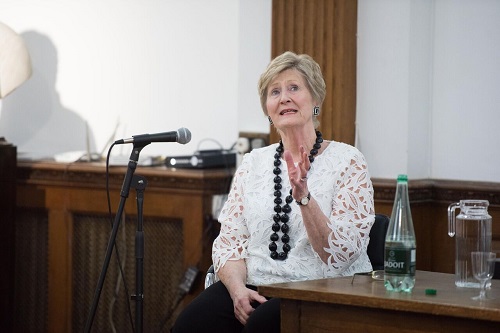
Dame Anne Evans was the Brünnhilde I saw in what remains by all accounts the last great Ring seen at Bayreuth to date, Harry Kupfer's, with Barenboim conducting and John Tomlinson as Wotan. She was also a superb Isolde with Mackerras. But her career embraced many surprises, as we heard at the Wagner Society. Everything there beautifully organised - for the first time in my experience of composer societies - by Henry Kennedy*, down to photographs taken by Ben Tomlin.
Kaupo Kikkas I first spotted moving very silently around the concert hall in Pärnu, with a muffler on his camera's click button. He took superb photographs of the Järvis and the Estonian (formerly Pärnu) Festival Orchestra, and continues to be the best musical portraitist, in my opinion. But he also surprised me when he sent a file of his 'Treescape' project, definitively answering the question 'is photography art?' with a resounding 'yes'. I was very honoured when he asked if I'd be the 'moderator' in an event to mark the end of his exhibition at the Estonian Embassy, about which I'd earlier written here. The above photo was taken by Roger Way; the other two of the talk below and lower down by Helen Mäerand.
In order of appearance, then, Ann(i)e first. I interviewed her about Wagner in the 1990s, but I first started to get to know her when she came to my Opera in Depth class with Susan Bullock. And to prepare for the talk, I paid a visit on a sunny afternoon to her, delightful husband John Lucas (biographer of Klemperer and Goodall, inter alia), and adorable one-eyed dog Izzie - as in Isolde, though a sex-change to Wotan would be even more apt - at their Islington home. We decided on the examples we'd play from an impressive archive which went back as far as her first Wagner in December 1967 - a snippet of her Wellgunde in Das Rheingold. As John remarked, and I sincerely agreed, you could tell the voice immediately; her sound has always been warm and distinctive**. She was then a student in Geneva, and she and two colleagues (one was Katherine Pring) got to sing Rhinemaidens, Valkyries and Norns in a professional staging.
Verdi and Mozart were more often on the cards in those days. We heard a very Italianate portion of the 'Libera me' from Verdi's Requiem conducted by John Barbirolli in the Royal Albert Hall on 3 March 1969 - another collaboration with students - and a stunning Traviata 'Sempre libera' with Mackerras at the Coli in the autumn of 1973. Because of CM, no high E flat just before the end, but the rest proves she could have done it. Lovely ornamentations in the da capo of 'Dove sono,' also under Mackerras's guidance.
And then, of course, Brünnhilde, with snippets from the film of Kupfer's Ring. Much discussion of the 'coming on running' instruction from Kupfer, how a dancer told Anne to hold the breath so that she could release it on arrival. And of how for the awakening scene in Siegfried, he wanted her to imagine a butterfly released from its chrysalis. Jerusalem was as much of a great colleague as John Tom, she says.
Our grand finale moved everyone, I think. If I were to go for an Immolation Scene on CD, it would be Flagstad's with Furtwängler in Rome, 1950 (Michael Tanner played it in his contribution to the German Romantic Opera study day I curated in Birmingham). On DVD, it would be not from a production, but this - Anne with the stunningly good National Youth Orchestra of the Netherlands conducted by a hirsute younger Mark Wigglesworth in a hot open-air summer concert in Nijmegen on the banks of the Rhine. 14 July 1995. The second half of the concert was excerpts from Götterdämmerung, all worth watching; for the Immolation, go to 19'35.
Next talk at the Wagner Society is with Peter Conrad, always a thought-provoking speaker and writer, on Wagner and Shakespeare on 12 July; I look forward to being enlightened...
As I was by humble Mensch Kaupo a couple of weeks after the Wagner Soc event. I was delighted to receive a Treescape photo in a thick glass block - namely this one -
and a copy of the book based on his latest project, Saja Lugu, a centenary project to photograph 100 Estonians of all ages and from all walks of life. It had its origins in a similar venture Kaupo worked on in Tyneside with our mutual friend Jonathan Bloxham at his Northern Chords Festival. If only every town and every country had the resources to honour its people like this.
After spending two hours in his subjects' company, he took two photos - one a close-up portrait in black and white,
the other a colour image of the person in a setting dear to him or her. There is no better way to connect with that wonderful country as it is today.
I marvel at the candour with which the folk engage with Kaupo. There isn't so much the culture of smiling inanely at the camera which makes so many photos here unnatural, as if everyone is always having a jolly time. You can see the history in the older folk, the openness of the young.
Kaupo's natural curiosity and lack of arrogance ensure all his portrait subjects are themselves, in a true dialogue with the photographer. He is especially proud of his many photographs of Arvo Pärt,
and in addition we discussed his several stays with the Matsés tribe down the Amazon; he won't do it again, he says, because the relationship between the gringo and the native is too precarious not to damage something. He pointed out that while the tribespeople do follow their traditions in certain rituals - the older women still sport decorative whiskers in homage to the jaguar -
they more often dress in t-shirts and baseball caps. But their cooking and essential ways of life remain the same as they always have been.
I should add that Kaupo trained at first as a musician at the Tallinn Music School and the Estonian Academy of Music before going on to study photography in Helsinki. Typical of his multifacetedness is that here in London he was guiding fellow Estonians around his own 'secret' places along with the familiar - many of this haunts I don't know myself, so I must take them up.
By way of footnote, I should mention one more Embassy event - this time at the Czechs' handsomely renovated Brutalist building in Notting Hill. It was a chance to hear the first-rate Pražák Quartet, who've recently taken on a new first violinist, Jana Vonášková. Her great artistry shone especially in the improvisatory feel to her solos in Dvořák's 'American' Quartet.
Their all-Czech programme was generous, but the revelation for me, because I hadn't heard it before and fell instantly in love, was Josef Suk's Quartet No. 1 in B flat, full of personal touches both harmonic and melodic, rarely predictable.
While I do find the Asrael Symphony rather long in getting to its devastating payoff, I'd count this relatively early work as a masterpiece. There's even a recording - trust YouTube, at least for the first movement - with Suk himself playing it as second violinist of the Czech Quartet in 1928.
*Young and very enterprising conductor and clarinettist who's just completed his studies at the Royal Academy of Music. He's put together a concert in aid of Parkinsons' UK at St John's Smith Square this Friday (15 June), with fellow students playing and a senior Beethoven Piano Society of Europe prizewinner, Andrei Iliushkin, in Beethoven's Third Piano Concerto, followed by Bruckner's Third Symphony. Book here.
**And now she may have an Irish successor. As one of the Royal Opera's Jette Parker Young Artists, Jennifer Davis sang Mozart, Nielsen and Bizet, very meaningfully, at our 2017 Europe Day Concert (pictured here with Jonathan Bloxham by Jamie Smith)
and took over the role of Elsa in Wagner's Lohengrin at the Royal Opera from Kristine Opolais. Total, if unflashy, triumph, winning the loudest applause, cheers and footstamping of the first night. Rupert Christiansen, in the Torygraph, went for the 'star is born' line in the opening paragraph. I felt I ought to keep perspective in my Arts Desk review since we regard her as 'our Jenn', but there was no denying the evenness throughout the range, the brilliant top - in marked and not inappropriate contrast to Christine Goerke's Ortrud - or the authority of goodness she brought to bear against her hater in Act Two. Here she is in Act Three as the wedding night starts to unravel, photo by Clive Barda.
Three came along to my Opera in Depth class at the Frontline Club, head- and heart-devoted this term to Wagner's Tristan und Isolde, and what amazing times we had.
First there was Linda Esther Gray, one of the greatest Isoldes ever as her studio recording and the live performance on YouTube for Goodall testify. We're now long-term friends, as you can perhaps tell.
Relatively new friends are Dame Anne Evans and Susan Bullock CBE, Annie and Sue as I think they prefer it, who visited yesterday, and a better double act I couldn't imagine. See way down this blog entry for another, slightly more embattled Wagnerian duo-chat at a Birmingham 'Brunch with Brünnhildes'.
Linda's talk was very emotional; she didn't mind my playing excerpts from the Goodall recording but inevitably it stirred up deep feelings, and you know from every phrase she says that this is a woman who can't be anything other than she is, a total giver. I'll save the insights until I can reproduce them in her own words from the recording I made of most of that session - a good two hours' talking with a fun photosession at the end.
The plan with Anne and Sue was that they should arrive for lunch - always excellent at the Frontline Club, since the owner stocks it with food from his huge estate in Norfolk - and then talk for an hour and a quarter, after which I could finish Act 3 by going through the last of Tristan's huge monologues with examples all around it and on to the Liebestod (which in fact we got earlier in the shape of Anne's very beautiful performance with Tony Pappano, conducting his first Tristan at the Monnaie). It was clear, though, that not only were the two ladies totally relaxed with my adorable, engaging and loyal students, but that there was no end to what they had to say. Looks as if I'm alarming or boring them here; can only assure you that wasn't the case.
So we heard about the generosity of Anne's coaching Sue as Isolde - SB remembering chapter and verse about what helped her - and their joint memories of Reginald Goodall, complementing Linda's several weeks earlier. About the directors who know the music and can demonstrate it on the piano - David Alden and Richard Jones - and those who arrive at the first rehearsal 'and you hear the spine of the score crack' (ie it's only just been opened). Or the ones who just use a CD booklet; expectations ran high for a Ring at Bayreuth from a distinguished director, who disappointed by doing just that and bringing nothing fresh to it.
To complement Anne's Liebestod, I also played Sue's 'Träume' from the Wesendonck Lieder, on a recital disc I rated very highly for the BBC Music Magazine; such clarity in the text, such marvellous dramatic pauses - Reggie's wisdom, though Malcolm Martineau must also be praised for his part in that. Frida Leider came out tops for her long-term youthfulness and bel canto approach; Margaret Price's peerless recording was also cited, and the advice she gave both singers (a modest woman, she ascribed her success there to Carlos Kleiber). We also, ahem, discussed the problems with the ENO Tristan that's just finished, and what an Isolde needs to do to get through the part and deliver the great Liebestod at the end that everyone's been waiting for.
It also became abundantly clear: these two great ladies should be running ENO. Then Mark Wigglesworth, having achieved a quadruple whammy of musically amazing productions this season, could come back and - how about this? - the Artistic Directorship be shared between David Lan of the Young Vic and Richard Jones (because I didn't think for a minute that Richard would want to do it on his own). Most important, perhaps, they would revive ENO's role as a training ground for young British-based singers, as they both were when they learned their trade there. It seems to me that the flood of talent from the music colleges has never been greater, but how many of these singers are appearing there? Whereas, you just look at the Garsington Idomeneo and see what a difference sensible thinking and wise casting can make.
Not going to happen? Well, as with Brexit, we can dream, can't we?
So, I owe the students a precis of what I would have talked about re the last 20 minutes of the opera in our tenth and final class. But what we did watch was the Tristan fantasia sequence from the best film I've ever seen about the dedication of a great performer, Humoresque (1947).
John Garfield is talented, hard-working violinist Paul Boray, his hands and his sounds represented superbly by Isaac Stern. Joan Crawford strikes a rare note of truth as the married society woman who starts out by thinking of a musician as a plaything, then falls deeply in love but can't share her man with his music.
There are some wonderful moments in the score by Franz Waxman, not least to accompany a giddying New York montage which must owe something to Eisenstein, but the climax of the film - and I don't think there's a spoiler here, as we start in 'the present' with the violinist distraught by his loss - is the suicide of Crawford's character while we hear a kitsch-brilliant arrangement of music from the Act Two love scene and the Liebestod arranged for violin, piano (Oscar Levant, brilliant throughout - I've just bought a second-hand copy of one of his autobiographies) and orchestra.
We get ten whole minutes of music accompanied by telling details in Jean Negulesco's direction like the man on the beach throwing a stick for his dog as Crawford's Helen Wright wanders distractedly, distressedly past and finally into the waves and under the water (whereupon the soundtrack goes temporarily blurred as well). Here's the trailer, which inevitably accentuates the melodrama and underplays the wise, wisecracking commentary of Levant's character - who comes off very well in the screenplay by Clifford Odets and Zachary Gold - but does give you a sense of the musical lushness; sounds like Waxman stitched together some of the themes especially here.
If you'd like to catch more Wagner chat, I'll be in conversation with Stuart Skelton, on recent evidence the best living Tristan, at a Wagner Society event on 21 July. Details here. Before that, I'm offering some Proms-related classes in what I hope will be a mini summer school next week, starting on Tuesday 19 July. Next season's Opera in Depth course is more or less planned if not carved in stone: Don Giovanni (five or six weeks), The Nose (two or three weeks) and Le Grand Macabre (two weeks) in the autumn term; Der Rosenkavalier (six weeks) and The Snow Maiden (four weeks) in the spring term; and Otello (five weeks) and Pelléas et Mélisande (five weeks) in the summer term. If you're interested, email me at: david.nice@usa.net
Finally, we are getting some bitter laughs about our looking-glass land at the moment from the likes of Frankie Boyle, John Crace and Marina Hyde, but for sheer pleasure this treatment of Cameron's farewell ditty comes tops. I noted in sending the link to anyone who might not have seen it - gone viral, apparently - that Cameron hums the tritone, used among other things by Wagner for Fafner-as-dragon and as a dreaded putative 'Stalin subtext' in Shostakovich and Prokofiev (they knew, at any rate, when to use it).
All observations, questions and challenges are welcome: resistant to tweeting and Facebook (though long converted to LinkedIn), I still like to exchange ideas. You don't have to be signed up, and you can be anonymous, but comments are moderated.
Copyright
If you wish to use any of my own photographs featured in the blog, or any of the text, just let me know in the comments. Acknowledgment and a link are all it takes.




 Posts
Posts