Showing posts with label Wagner Society. Show all posts

Friday, 9 November 2018

An audience with Siegfried


I'll admit I had my doubts about interviewing Heldentenor Stefan Vinke for the Wagner Society. I'd only heard a touch-and-go tenor solo in Mahler's Eighth at the Proms; I asked the keen young organiser, Henry Kennedy, if I could wait and see until I'd reviewed the Royal Opera Siegfried in the recent revival of Keith Warner's Ring cycle. After all, it would be ungallant and embarrassing to be sitting there with him if I'd written anything adverse.


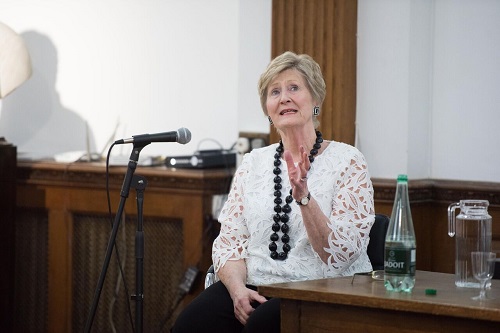
My doubts were more than banished: this was easily the best Siegfried I've heard after Jerusalem's in Kupfer's Bayreuth Ring. A colleague whispered in my ear at the end of Act One, 'I shouldn't be saying this to another critic, but that was sensational, wasn't it?' - and it was. Though at the beginning of Act Two he was recovering from an allergy attack in the interval, Vinke had all the extraordinary stamina needed to come out sounding fresh as a daisy in the final duet with Nina Stemme's  Brünnhilde- indeed, it's the only time I've heard that with both singers sounding equally good. Talk  photos courtesy of the Wagner Society's Ben Tomlin - I'll spare you the ones of me gesticulating, but I rather like them for once - while the images of the Royal Opera Ring are by Bill Cooper.


Unsurprisingly, given his well-acted characterisation, Vinke turned out to be a supremely intelligent and engaging person. Which leading Wagner singer isn't? Well, both he and Stemme the following week in Stockholm could mention one exception each to the general rule of collegial Wagner singers (though they didn't name names, and I didn't press). But they both agreed that, yes, supportiveness and team spirit were paramount in Wagnerworld.


How I wish this interview had been recorded, since all he had to say was fascinating and often very funny (Wagnerians need a sense of humour too - look at Birgit Nilsson)  It turned out that, though the splendid idea of Siegfried's kissing Mime on the top of the head before rushing out into the forest in Act 1 was Warner's, the likable characterisation was one with which Vinke was in agreement. He certainly doesn't see the young hero as brute or born killer, more wild child who has the intuition and intelligence to learn from his experiences in a way we should find touching.


If a director wants a different view, then he expects to be told why, as he was by Graham Vick, whose ability to listen, think over and return to explain, one way or the other, he very much admires. It was clear he had no respect for Frank Castorf at Bayreuth, who could never come up with a convincing justification for his random ideas. We listened to Vinke in the end of the forging sequence on the Seattle recording, complete with rhythmically accurate hammering - not possible, he said, at Kirill Petrenko's fast tempo in Germany - and he reacted by acting a lot of it out while listening: critical, but not unduly so, of what he'd achieved there. I can't embed it but it's here, and worth a listen.

Vinke loves working with the top Mime of our time, Gerhard Siegel, who's also sung Siegfried, and will listen to his suggestions; at one point. Siegel asked why he was wearing himself out with so much stuff before a big entry, advising him to save himself a bit, which he did.


Conductors: he made an interesting comparison between Antonio Pappano, who marks out key points but allows singers some freedom in between before everything comes back in line, and Kirill Petrenko, who controls more bar by bar, note by note: he prefers the former, but respects both approaches.

Trained in organ studies and choral music, Vinke has a firm favourite in the concert repertoire - Elgar's The Dream of Gerontius, which following its heyday when Strauss commended Elgar as 'the first English progressivist' at the 1902 Lower Rhine Festival in Dusseldorf, still meets with resistance in Germany (so do the symphonies; so does Sibelius, so Elgar's in good company). Still on the list? The Emperor in Die Frau ohne Schatten, coming soon, and the time when he can sing Loge, Siegmund and Siegfried in a single Ring cycle (two of the three are imminent). Lively responses to some interesting questions, and then he was off on a rainy Saturday afternoon to indulge his kids in shopping down Neal Street. Great guy.

Tuesday, 12 June 2018

Talks with two great artists


I'm not overstating the case, even if I do regard both as friends.


Dame Anne Evans was the Brünnhilde I saw in what remains by all accounts the last great Ring seen at Bayreuth to date, Harry Kupfer's, with Barenboim conducting and John Tomlinson as Wotan. She was also a superb Isolde with Mackerras. But her career embraced many surprises, as we heard at the Wagner Society. Everything there beautifully organised - for the first time in my experience of composer societies - by Henry Kennedy*, down to photographs taken by Ben Tomlin.


Kaupo Kikkas I first spotted moving very silently around the concert hall in Pärnu, with a muffler on his camera's click button. He took superb photographs of the Järvis and the Estonian (formerly Pärnu) Festival Orchestra, and continues to be the best musical portraitist, in my opinion. But he also surprised me when he sent a file of his 'Treescape' project, definitively answering the question 'is photography art?' with a resounding 'yes'. I was very honoured when he asked if I'd be the 'moderator' in an event to mark the end of his exhibition at the Estonian Embassy, about which I'd earlier written here. The above photo was taken by Roger Way; the other two of the talk below and lower down by Helen Mäerand.


In order of appearance, then, Ann(i)e first. I interviewed her about Wagner in the 1990s, but I first started to get to know her when she came to my Opera in Depth class with Susan Bullock. And to prepare for the talk, I paid a visit on a sunny afternoon to her, delightful husband John Lucas (biographer of Klemperer and Goodall, inter alia), and adorable one-eyed dog Izzie - as in Isolde, though a sex-change to Wotan would be even more apt - at their Islington home. We decided on the examples we'd play from an impressive archive which went back as far as her first Wagner in December 1967 - a snippet of her Wellgunde in Das Rheingold. As John remarked, and I sincerely agreed, you could tell the voice immediately; her sound has always been warm and distinctive**. She was then a student in Geneva, and she and two colleagues (one was Katherine Pring) got to sing Rhinemaidens, Valkyries and Norns in a professional staging.


Verdi and Mozart were more often on the cards in those days. We heard a very Italianate portion of the 'Libera me' from Verdi's Requiem conducted by John Barbirolli in the Royal Albert Hall on 3 March 1969 - another collaboration with students - and a stunning Traviata 'Sempre libera' with Mackerras at the Coli in the autumn of 1973. Because of CM, no high E flat just before the end, but the rest proves she could have done it. Lovely ornamentations in the da capo of 'Dove sono,' also under Mackerras's guidance.

And then, of course, Brünnhilde, with snippets from the film of Kupfer's Ring. Much discussion of the 'coming on running' instruction from Kupfer, how a dancer told Anne to hold the breath so that she could release it on arrival. And of how for the awakening scene in Siegfried, he wanted her to imagine a butterfly released from its chrysalis. Jerusalem was as much of a great colleague as John Tom, she says.


Our grand finale moved everyone, I think. If I were to go for an Immolation Scene on CD, it would be Flagstad's with Furtwängler in Rome, 1950 (Michael Tanner played it in his contribution to the German Romantic Opera study day I curated in Birmingham). On DVD, it would be not from a production, but this - Anne with the stunningly good National Youth Orchestra of the Netherlands conducted by a hirsute younger Mark Wigglesworth in a hot open-air summer concert in Nijmegen on the banks of the Rhine. 14 July 1995. The second half of the concert was excerpts from Götterdämmerung, all worth watching; for the Immolation, go to 19'35.


Next talk at the Wagner Society is with Peter Conrad, always a thought-provoking speaker and writer, on Wagner and Shakespeare on 12 July; I look forward to being enlightened...

As I was by humble Mensch Kaupo a couple of weeks after the Wagner Soc event. I was delighted to receive a Treescape photo in a thick glass block - namely this one -


and a copy of the book based on his latest project, Saja Lugu, a centenary project to photograph 100 Estonians of all ages and from all walks of life. It had its origins in a similar venture Kaupo worked on in Tyneside with our mutual friend Jonathan Bloxham at his Northern Chords Festival. If only every town and every country had the resources to honour its people like this.


After spending two hours in his subjects' company, he took two photos - one a close-up portrait in black and white,


the other a colour image of the person in a setting dear to him or her.  There is no better way to connect with that wonderful country as it is today.


I marvel at the candour with which the folk engage with Kaupo. There isn't so much the culture of smiling inanely at the camera which makes so many photos here unnatural, as if everyone is always having a jolly time. You can see the history in the older folk, the openness of the young.

Kaupo's natural curiosity and lack of arrogance ensure all his portrait subjects are themselves, in a true dialogue with the photographer. He is especially proud of his many photographs of Arvo Pärt,


and in addition we discussed his several stays with the Matsés tribe down the Amazon; he won't do it again, he says, because the relationship between the gringo and the native is too precarious not to damage something. He pointed out that while the tribespeople do follow their traditions in certain rituals - the older women still sport decorative whiskers in homage to the jaguar -


they more often dress in t-shirts and baseball caps. But their cooking and essential ways of life remain the same as they always have been.


I should add that Kaupo trained at first as a musician at the Tallinn Music School and the Estonian Academy of Music before going on to study photography in Helsinki. Typical of his multifacetedness is that here in London he was guiding fellow Estonians around his own 'secret' places along with the familiar - many of this haunts I don't know myself, so I must take them up.


By way of footnote, I should mention one more Embassy event - this time at the Czechs' handsomely renovated Brutalist building in Notting Hill. It was a chance to hear the first-rate Pražák Quartet, who've recently taken on a new first violinist, Jana Vonášková. Her great artistry shone especially in the improvisatory feel to her solos in Dvořák's 'American' Quartet.


Their all-Czech programme was generous, but the revelation for me, because I hadn't heard it before and fell instantly in love, was Josef Suk's Quartet No. 1 in  B flat, full of personal touches both harmonic and melodic, rarely predictable.


While I do find the Asrael Symphony rather long in getting to its devastating payoff, I'd count this relatively early work as a masterpiece. There's even a recording - trust YouTube, at least for the first movement - with Suk himself playing it as second violinist of the Czech Quartet in 1928.


*Young and very enterprising conductor and clarinettist who's just completed his studies at the Royal Academy of Music. He's put together a concert in aid of Parkinsons' UK at St John's Smith Square this Friday (15 June), with fellow students playing and a senior Beethoven Piano Society of Europe prizewinner, Andrei Iliushkin, in Beethoven's Third Piano Concerto, followed by Bruckner's Third Symphony. Book here.

**And now she may have an Irish successor. As one of the Royal Opera's Jette Parker Young Artists, Jennifer Davis sang Mozart, Nielsen and Bizet, very meaningfully, at our 2017 Europe Day Concert (pictured here with Jonathan Bloxham by Jamie Smith)


and took over the role of Elsa in Wagner's Lohengrin at the Royal Opera from Kristine Opolais. Total, if unflashy, triumph, winning the loudest applause, cheers and footstamping of the first night. Rupert Christiansen, in the Torygraph, went for the 'star is born' line in the opening paragraph. I felt I ought to keep perspective in my Arts Desk review since we regard her as 'our Jenn', but there was no denying the evenness throughout the range, the brilliant top - in marked and not inappropriate contrast to Christine Goerke's Ortrud - or the authority of goodness she brought to bear against her hater in Act Two. Here she is in Act Three as the wedding night starts to unravel, photo by Clive Barda.


Friday, 5 August 2016

Stuart Skelton speaks


He mostly sings, of course - and this is his first Tristan year, making him for me the most convincing interpreter of the role I've ever seen on stage. I missed Vickers, of course,though his Act Three for Karajan is the only one in my opinion, and in our email exchange before the Wagner Society's evening on 21 July - Stuart answering questions in St Botolph's Church Hall at the end above, while pianist Kelvin Lim and I grin at the camera wielded by Jan Leigh - Stuart wrote back to my praise with the line that 'Vickers has always been, in so many ways, my hero, my example, my Vorbild'.

Anyway, how he can talk, too. The first half of our conversation focused on his role in the flawed but fitfully insightful ENO Tristan and Isolde (production images by Catherine Ashmore). Owing to transport meltdown - I should have gone on my bike, though I didn't want to turn up all sweaty on a hot evening -  I missed some of Stuart's preliminary chat about that production. What I did hear from him was how the video projection somehow changed according to how they were singing - voice-responsive, how fascinating. Shame the ubiquitous follow spot had to clash with it.


It was interesting to learn that the killer part is actually Siegfried, upon the altar of which/whom Stuart has no intention of sacrificing himself. Yes, emotionally Act Three of Tristan is the ne plus ultra, and you simply can't not give of yourself. But Wagner helps in the pacing of Act Three, those three amazing curves. You can afford to die vocally just as Tristan expels his last 'Isolde!', but not a minute sooner. (Below, with Heidi Melton in the ENO production).


Act Two is if anything tougher (ENO helped with the big cut in the night-day dialogue before 'O sink hernieder').

Stuart talked about the feelings engendered as he lies there, curtain up or down, during the dark strings of the Act Three Prelude, an amazing experience; the pianist he brought along, the excellent Kelvin Lim, demonstrated it for us. That helps the Tristan to be in the right 'zone'. He hopes to keep the role in his repertoire for as long as his career lasts, though he won't be singing it in English again; that was a special favour to ENO as he knew it. Imagine the mind leapfrogging between languages throughout the year in a role like that.


After the break, due to popular request, we discussed Stuart's career in the round, the amazing nurturing experience in Cincinnati and how timely everything seemed to be. Peter Grimes remains his touchstone role and informs everything else he does; Erik in The Flying Dutchman he could happily retire. Desert Island Discs? He listens almost exclusively to symphonic music; Celibidache's Bruckner 8 would be top of the list. Directors and conductors? He was discreet, but used the same phrase about those who haven't done their homework as Anne Evans had at the Frontline the previous week: 'when you hear the score crack, your heart sinks'. After two hours' chat, he boldly undertook to sing Siegmund's 'Winterstürme' to round it all off; Kelvin's playing suggested he could have gone on to give us Liszt's transcription of the Liebestod.


A very happy evening it was in the presence of a generous and very together top-rank artist. I've said it before, but these Wagner singers don't have the energy to spare for being dive/divi. That was born out by the four wonderful human beings I've had the privilege of interviewing over the past month or so - three Isoldes and, finally, a Tristan. I'm lucky.