There was Pears, of course - it was a surprise to me to find how fine an actor he was, as well as a singer, in the 1969 film of Peter Grimes conducted by Britten. But in my opera-going experience no-one can possibly be greater than the late Philip Langridge.

I saw him three times, twice in Tim Albery's very fine English National Opera production, and once in a Barbican concert performance conducted by Richard Hickox, where his pacing around at the foot of the stage before the final scene seemed horribly real. In fact his madness came across as not acted at all, which is why when we watched the scene in Grimes's hut in the fourth of my Opera in Depth Zoom classes on the work a few weeks ago, the students expressed concern for the (surely too young) boy he roughs up.
That of course wasn't a problem in Deborah Warner's production, now running at the Royal Opera, where the character of Grimes is softened to the point of sentimentality and he never manhandles his apprentice; the boy can touch him tenderly but it doesn't work (as far as I remember) the other way around. Cruz Fitz and Allan Clayton pictured below by Yasuko Kageyama.

Surely we're all in agreement that Allan Clayton manages every vocal aspect of the role superbly, but for me this fisherman wasn't a credible character. Note to director: you don't have to love the protagonist to feel pity for him.
The libretto does present difficulties, of course - how to tie up the visionary with the rough, abusive outsider? But not to have him strike Ellen in Act 2 Scene One - he knocks her to the ground in a scuffle as he makes off with the boy - is a step too far. I didn't like the keening over the corpse to the 'relief' of the Moonlight Interlude, either. This isn't the first time there's been a shying-away from the uncomfortable: I was astonished to discover that Jon Vickers changed two of the lines in the hut scene to avoid the physical assault on the boy (thus avoiding the con violenza written into the score)
Anyone coming to Grimes for the first time, or even after a long time of not seeing it in action, is bound to think 'this is the greatest' - that's partly because of the nature of Britten's inspiration, which as Mark Wigglesworth, recording a Zoom chat with me for one of the other classes after we'd listened to his Glyndebourne/LPO performance of the Passacaglia - the most electrifying I know - is 'bulletproof'.

Our first guest was the ever-generous and articulate Sue Bullock, who spoke with shocking frankness about playing Ellen Orford in the first run of the Albery ENO production - she alternated with Josephine Bartstow - to Langridge's Grimes. They both felt that the tension of the scene outside the church had built to such a pitch that to fake the slap diffused it. So SB gave PL the licence to hit her (that's me being astonished as she tells me below). And she remembers standing in the wings crying while Langridge himself wept real tears in the 'mad scene', then going home - still in tears - fretting that she hadn't done enough to save him.

Talk about the role taking over (but I also remember Simon Keenlyside telling me how he paced the streets of London in the small hours after singing the finest Prince Andrey I think I'll witness in Prokofiev's War and Peace).
I was saving the equal generosity of Richard Jones, another regular visitor, for Samson et Dalila next term, which he convinced me was worth spending four or five Monday afternoons on (as did Nicky Spence, but alas, he's had to withdraw because of the steady convalescence needed to restore his two broken legs to full health). But we were so stunned by RJ's Milan production, which I ended up using the most when it came to playing full scenes on DVD, that I asked if he'd be willing to talk about it.

Richard always declares that these things were too long ago to remember much, but then he goes and delivers fascinating and unexpected takes with great vividness. He was especially good (and funny) on the disjunct between music and text: 'part of my affection for it is this very extraordinary, eerie and incredibly memorable music combined with this Listen-With-Mother, Ealing vowel text, and I like that disparity very much'.

Responding to Mark's comment about Grimes being 'bulletproof', he declared that 'there are certain pieces where you can have your day in the sun as a director - one is Jenůfa, another is Grimes'.
So far he's only directed it once, but would be up for another shot (which, given his capacity for re-imagining, would probably be very different). I just don't think there could a more intense and upsetting experience than what he and his choreography Sarah Fahie get out of the Teatro alla Scala forces and the principals: all the more remarkable given the chorus's threat to walk out at one stage (or perhaps because of it: needless to say Jones enjoyed facing an angry mob).

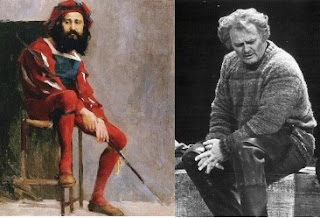
The two leading performances are devastating. John Graham Hall may not have the tonal beauty of a Pears or a Clayton, but like Langridge's, his is a Grimes on the edge from the start.

It's the only time I've seen the Apprentice played by a teenager (Francesco Malvuccio, who spoke no English, but as Richard says, that may have been an advantage). So there's a boy who can stand up for himself a bit, but is still physically dominated by the abuser.

The biggest rethink is the role of Ellen Orford. Jones believes there are no good people at all in Grimes, and she's horribly deluded, an ex-cultist who never notices what's really going on. That doesn't stop us feeling pity for her as she falls apart.

Susan Gritton sings and acts better than any other Ellen I've seen. Wigglesworth conducted her too, and advised me to get her along. By which time, alas, it was too late in the course and she was taken up with performances on the weekend we might have spoken. But we had a splendid email exchange.
I was also hoping for another appearance from the supremely eloquent Robin Ticciati, who conducts the La Scala production magnificently, and who was looking forward to telling some memorable stories. But he was taken into hospital to be operated on for a kidney stone, so that was not to be ditto Felicity Palmer, who gives an interesting Auntie, but declared it wasn't a role she felt close to. No matter; we watched so much of the film, and I urge you to do so if you think a Grimes can't be more intense than the Royal Opera one. For me this is the greatest Grimes, while Langridge is the greatest Grimes. Get hold of the Arthaus Musik DVD of Albery's ENO production too, if you can.

These, for me, are benchmarks, and yet there was so much new and perceptive in the latest comer. I just didn't come away from it wrung out. To me it seemed that Clayton was a truly great singer who acted well, not a born singer-actor. But then RJ, who hadn't seen the production at the time of our conversation, reminded me of his astonishing delivery in the Royal Opera 4/4 staging of H K Gruber's Frankenstein!!!, and yes, that did make me think it was the director's job to bring out the best in him. I think the RO should bring back the film complete now that a star is truly born, but this minute is good enough to show you the audacity, weirdness and agility.



 Posts
Posts



