This lockdown is very different from the last. The
most beautiful spring I can remember, lengthening days and discovering more of London's parks and gardens on long afternoon walks made that one more than bearable. The start this time was promising - we had a few days of clear autumn weather, during which the gingko tree just beyond the English garden of Battersea Park, pictured above with skeletons of artichoke flowers in front, positively glowed - but since then, rain and grey skies have gained the upper hand. The leaves are nearly all off the trees now, so it's time for an autumn retrospective. This 'London autumn' photojournal, unlike the spring one, will take up several posts. I find I've got so many fond photographic memories just for September alone that I'm going to devote this one to that month.
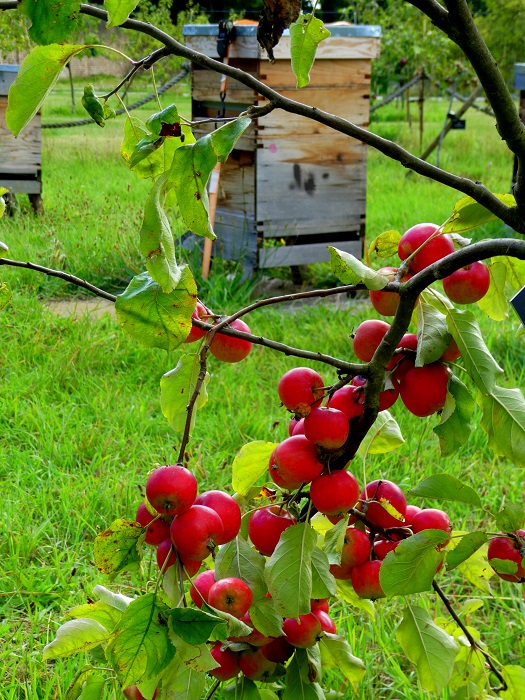
The line between late summer and early autumn varies from year to year. You may remember that our Norfolk Churches Walk, on the second Saturday of September as usual, marked the beginning of 10 days of Indian summer. I'm starting here with one day in the previous week and then going on to the extended glories of that time. The walled garden of Fulham Palace peaks in its bounty of vegetables in late July and early August, but September is apple time and the gathering of honey from the bees - a good crop this year, I understand, though I haven't managed to lay my hands on a jar yet.
Pumpkins lie lazily around the northern beds
and the bees still have plenty of nectar to gather from the dahlias and their kin (only just finished, in fact).
Returning from Norfolk, I had a grand London afternoon on the 14th. The Wigmore Hall had reopened to a select public on Sunday - temperatures taken at the door, careful distancing in the seating, masks on at all times - and I caught the first lunchtime, an excellent one from Alban Gerhardt and Markus Becker.
I realised I could actually go in to the Algerian Coffee Store on Old Compton Street and buy a pack of my favourite beans, so I walked down there and sat outside the falafel shop opposite having a late lunch, looking across a mostly empty street to that and a (very much closed) Admiral Duncan pub.
Then past an (also closed) Maison Bertaux
and down via Trafalgar Square, where the new extravagance on the Fourth Plinth, Heather Phillipson's
THE END offers us (I quote the Mayor of London's What's On page) 'a giant swirl of whipped cream, a cherry, a fly and a drone that transmits a live feed of Trafalgar Square'. Hard to feel in apocalyptic mood on a day like this, though.
Saw a greater variety of ducks, geese and other birds in St James's Park than I can ever remember. I presume this rarity, an Asiatic bar-headed goose (
Anser indicus), is one of various introduced species (I'm beginning to learn a lot about waterfowl as a new member of the Wildfowl and Wetlands Trust, which has given me a whole new area to discover in the London Wetlands Centre just 15 minutes' bike ride away).
Handsome red-breasted geese hanging out with the ubiquitous heron (perhaps the one I caught in the snow back in March 2018),
noisy cormorants in the middle of the lake
and the black swan in the company of the white, as so often here.
St James's resident pelicans, normally seen only from a distance on the rocks in the lake, were hanging about by the shore a little further along. What astonishing birds - how did nature create such a thing?
Back yard bird activity is less exotic, but I did see the dunnock in the company of several others (a new family, perhaps). Recently bees, wasps and hoverflies have been at the ivy flowers, but until a couple of weeks ago the dahlias and lavender were still offering sustenance.
and the big spiders, which usually proliferate in September, did their thing too. This one's on the watering can.
Tuesday 15 saw the last of the superlative Battersea Park Bandstand chamber concerts, which we hope will start up again in spring. Here are friends Cally and Clare some time before the start.
The mayor of Wandsworth and her partner (wife?) eventually sat just in front of us, with other worthies gathered to celebrate the success of the series the council had helped fund. For the first time, the bandstand was lit up to look very lovely after sunset.
Friday 18 was a grand day full of contrasts. We went to lunch with two treasured newish friends, Katharina and Jamie, passing lush vegetation and fruit trees in the Stockwell crescent on the way
and another spider, plus web this time, on the way back.
The Bielenberg-Bullochs lead such a great life, real rus in urbe. Katharina keeps bees, which produce the best honey I've tasted this year
while Jamie grows tomatoes in the neighbouring square, a hive (in the unliteral sense) of activity. We had quite a bit of garden produce for our lunch.
I left early to catch the tube, train and taxi to Garsington for an unexpected single flourish of late-summer opera, a carefully distanced and semi-staged Fidelio which gave the best sense of prison cell atmosphere I've ever experienced in the work - Act 2 (run together with 1 without an interval) began just as there was total darkness, the only lights on the players with patches of blue for the singers. Before that, I got the only glimpse this year of the beautiful setting on the Wormsley estate and the Garsington-impersonating garden to the side of the splendid, award-winning pavilion.
The next day was equally packed - I was working on the assumption that live events might not last for ever. And what enterprise from Tom Fetherstonehaugh and his Fantasia Orchestra to give Sheku Kanneh-Mason the chance to try out the Dvořák Concerto with a chamber group of players (excellent adaptation) in St Mary Abbot, High Street Kensington.
After the first of their concerts in the afternoon I walked through Kensington Gardens and found plenty of avian life on the Round Pond, not just from basking ducks
to bathing starlings.
Unfortunately the lockdown habit of leaving picnic litter everywhere disfigured whole swathes of meadow, but the Albert Memorial, shining in the late afternoon sun along with its marble figures from the four continents, held its head above all that.
Then from Victoria to Peckham Rye for the last Bold Tendencies event in the multi-storey car park, another enterprising double bill from that wonderful couple Pavel Kolesnikov and Samson Tsoy. I knew my goddaughter Rosie-May, who lives nearby, would enjoy this, and she did. First we wandered the roof terrace at sunset.


I've never got on better with my mother (even if she still reads the Daily Mail - though I have to say that whenever I've visited recently and looked through it, I've found much less to explode about - it's the Sunday version, which she doesn't take, which is still poisonous under Dacre). The daily phone calls which I started when lockdown began have become not a duty but a pleasure, and we're so much more relaxed with each other. Plus on recent visits to Banstead - temporarily halted, of course - she's enjoyed coming out with me on her mobility scooter and taking tea at a really good cafe in Banstead High Street, Chai. We get there through the churchyard, very close by. When All Saints is open, I pop in and light a candle. The pampas grass leading up to the porch, which I remember so well from my church choir days, is still flourishing.

Mum is lucky in that, while the neighbour who did so much for her has moved away, another, the very jolly Judith, her gardener, has moved in across the road. Judith won best in show for this specimen from her allotment at the Banstead Horticultural Fair.
She popped in while I was there to present a bouquet. No harm in a pic of mum looking rather good for someone nearing 90.
On 23 September, I got quite emotional about a privileged return to the Royal Festival Hall, in a small group of invitees for the LPO's first filmed concert there, after what seemed like ages. Prophetically, a rainbow hovered over the hall as I crossed one of the Hungerfood footbridges - you can just about make it out here.
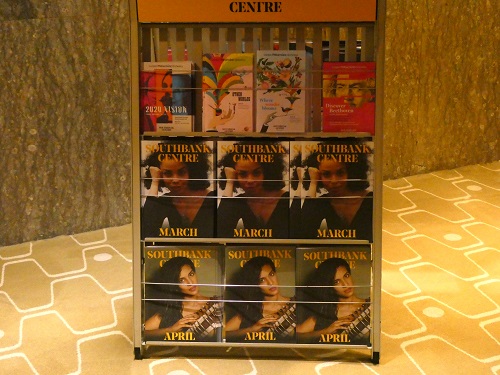
The brochure stands in the foyers were a reminder that nothing had happened here since mid-March.
There was magic in the auditorium, both in the lighting and the sound - to a virtually empty hall, and on a platform specially built out and up for social distancing, an orchestra has never sounded better in here.
Another chance to spend time in a treasured venue came on the Saturday with a beautifully proportioned concert from the Academy of St Martin in the Fields within its church (I've never heard the players there before). The Covidiot protest in Trafalgar Square had just ended, and the ship of fools had sailed on to Hyde Park, but there were still some unpleasant numpties around. This was the ideal escape.
Nights drawing in, and a Kensington Gardens sunset - already beginning in the home square - on my cycle to the Wigmore Hall to hear Angela Hewitt's stunning take on Bach's The Art of Fugue.
Moonlight over the Serpentine on my way back.
A Tuesday excursion to Kew should have been a happy one. It was actually chaotic and frustrating owing to the state of a mentally unwell friend who, against all signs from the very promising previous three weeks, had gone manic and kept disappearing. Still, hanging around in such surroundings is never really a problem. While waiting for her emergence from the Palm House, I visited the Water Lily House to see nymphea and others in their last great flourishing of the year.
and the rose garden, very much thriving, to my surprise, with the multi-headed one called, I think, 'James Galway', probably the star.
After this, I had another half-hour before our next assignation, outside the Princess of Wales Conservatory, so that gave me time to take in quite a bit - fungus (not sure which, though Chicken of the Woods tends to be a firm favourite) at the foot of a splendid Northern Pin Oak (Quercus ellipsoidalis)
and berries reddening the earth at the foot of Crataegus liciniata.
Autumn crocus in the rock garden
were later to be found in abundance in the woods to the west.
Pumpkins and courgettes abundant in the vegetable beds to the east of the PWC, one with a spider and its web slung in front of it.
No sighting of friend outside PWC. Left various messages on mobile (now switched off) and went off for planned fungi hunt in the woods. Only bracket fungus and Chicken of the Woods to be seen this time (an October excursion was much more successful).
Another call, another wait on a bench overlooking Syon House - again, no hardship, and I had a good book too.
Then decided to call it a day, went and had a coffee in the new cafe area replete with vines before cycling back along the river.
Not a wasted trip, as you can see. Next instalment, no Kew, but a discovery of wildfowl heaven.






 Posts
Posts