Showing posts with label damselfly. Show all posts

Sunday, 31 October 2021

Damsels and dragons


Of the -fly variety, that is. I'm far from acquiring expertise in the field of anisopterophilia (no idea if there's such a word, but I claim it using the Latin word for 'dragonfly'), but these amazing critturs, descended from bigger ones who flew around before the dinosaurs, have stolen the scene for me this summer. 

The first I espied on a plank of wood by the smaller of the ponds on Epsom Common - I've already used one shot in my post on the natural discoveries made during hospital visits, but there's no harm in putting up another since I now have reason to believe it's an Emperor dragonfly (Anax imperator), which was to be my final companion of the season back at the Wetlands Centre (zoom to the end of the piece for other images).

Then we have another damselfly to complement the one above, which takes first prize for sheer peacock beauty if not size (the Beautiful demoiselle, I think, Calopteryx virgo; more on the context soon). On the banks of the river Brue at Bruton, where we'd stopped to see the outwardly splendid church with its tall tower. Likeliest candidate here is Large red damselfly (Pyrrhosoma nymphula). 

Even when the wings are spread, you can't see the black spots which make such an impression when the creatures are whizzing about.

This was on the first day of our blissful August stay with friends Andrew and Deborah at Lacock - we'd just been to see the latest exhibitions at the amazing Hauser & Wirth Somerset, which really should have had a post of its own, had I but time. On the sunny Sunday, we walked the valley of the By Brook river via Slaughterford (beautifully situated tiny church) to lovely (deservedly touristed) Castle Combe. Flood damage had closed off what Deborah said was one of the most attractive stretches of the walk along the river beyond Slaughterford, but we rejoined it at a loop, and this is where damsel- and dragonfly activity was at its liveliest. I've never seen a dragonfly curving its back to lay eggs on vegetation and water, but that's what we got from what I'm fairly sure is a Brown hawker (Aeshna grandis).

I think you can just about see an egg being popped out into the water in this film.

It was here, too, that I saw my first Beautiful demoiselle, but there were more on the river banks by the pub where we had a drink before the last, wonderful stretch to Castle Combe.

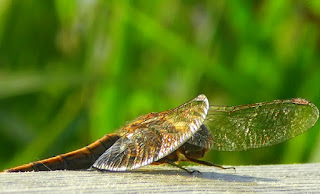
By far our richest dragonfly time was on a magical late afternoon walk around Hickling Broad nature reserve, part of the same Norfolk day the earlier rewards of which I blogged about here. For starters, our way was guided by one particular creature always flying on ahead of us and coming to rest on the ground at times. A knowledgeable nature lover confirms that this is probably that elusive crittur the Norfolk hawker (Aeshna isosceles).

Here's a closer view of the miraculously wrought wings.

The best was yet to come - when we reached the outlook over the Broads, which Jill had promised us would be glorious, dozens of dragonflies were sunning themselves on the wood, or flying around. 

Only Common darters (Sympetrum striolatum), male and female, but in what abundance.


They ignored the ladies in our party, but seemed to like landing on us men.


More sunbathers lined the way along the path - Brown hawkers among them.
Thereafter we were rewarded with a return through a very lovely oak wood, long tailed tits the only avians to spot, but what a libellulously rich excursion. 

In mid-September dragonflies were still abundant at the London Wetland Centre - whole swarms of them one late afternoon along the east side of the sheltered lagoon. And this brings us back to the wonderful, and prolific, Emperor dragonfly, last seen there in early October.


Now it's time for the migrating birds to take over, but the dragonflies were the main event for me during August and September. You can see why.

Sunday, 2 September 2018

Churches around the Dronne


Only a week to go now before our annual Norfolk Churches Walk, so time for a flashback to my first time in the Dordogne last month, a very happy one which let me see what all the fuss about this Herefordshire-on-steroids is all about. Said churches actually sit in different regions, but since the River Dronne is a natural boundary, let's stretch the geography a bit and make it the unifying factor. Unquestionably the two most spectacular are to be found in the perfect hill town of Aubeterre-sur-Dronne - the 11th century facade of the otherwise much-rebuilt St-Jacques pictured above, the town from the river below -


 but the smaller gems are all singular. Since I had to leave the Itinéraire Baroque Festival on the morning of its musical church-crawl - for a wedding in a very English church - I asked Gabriel Fysh, who'd volunteered to be our driver and cicerone, if we could ditch the planned excursion to Brantôme, fascinating though that place sounds, and explore more locally instead.


Not far from our base in Riberac, we stopped at Coutures. Astonishingly, I can find nothing at all online about the Romanesque church. Nor is there a single guide to the churches of the area, or leaflets inside the churches (30-plus served by the same priest), and three don't even get a mention in my Blue Guide. Even Gabriel had not gone to the exterior of the east end where there's a fascinating corbel table not unlike that of Kilpeck.


The inside is interesting, too, not least because it's possible to see where the original garrison-church stopped to accommodate the soldiers' quarters above. The vaults of several churches were added later in converting the building as a whole.


Next stop Saint-Martial-Viveyrol, with very photogenic sunflower fields on the outskirts. Gabriel, whose family has cultivated a large walnut grove adjacent to their house, sighed to say that the local farmers grow nothing other than sunflowers and maize in the summer; few are interested in going back to the more fruitful old ways.


Was St-Martial on the Chemin/Camino to Santiago? The scallop of St James on the font suggests as much.


Its domes are impressive - I'm assuming this wasn't a garrison like several of the others -


and there are some interesting heads on the capitals.


Outside it looks massy-proof


as does the church at Cherval,


the most imposing in its setting at the top of the hill. From below you can see more clearly the barracks above, which in this instance have not been converted.


Lusignac, the local for Gabriel's family, has the church with the most colourful interior design, as you can immediately see approaching via the wooden-roofed porch.


Major Virgin activity here


It's in another fine setting next to a curious castle


and a perfectly-situated tavern with a great view on to the surrounding landscape.


Then it was time to meet up with the other Fyshes and friends for a delicious dip in the river (the Vonnegut 'if this isn't nice, what is?' needed to be invoked)


before we parted company again and Gabriel dropped the remaining three of us in Aubeterre. Down by the Dronne I found more dragonflies and damselflies, even catching this one briefly settled.


 I had been a bit suspicious of the inaccurately-named 'monolithic church' of StJean - it's more accurately a cave church - and its (shock, horror!) admission charge,


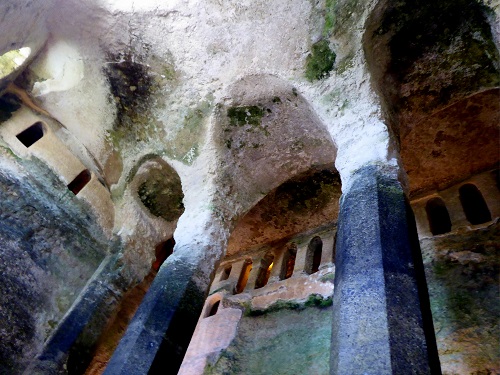
but once inside, stunned by the scale of it, I could see why it would have been worth twice the entry fee. Hewn out of the rock by Benedictine monks in the 12th century, used for burials up to 1865 and then concealed by a rockfall until the 1950s, it's the largest subterranean (can one say interranean?) church in Europe.


Connections with the Crusades include the housing of relics from Jerusalem at various points of what even for the present-day visitor is something of an adventure. The Holy Sepulchre was the model for this Romanesque reliquary.


Twenty metres high, the nave adjoins a necropolis


and offers access to the gallery above (you are asked to keep silence, not so easy for visiting summer families, but then the place was hardly overrun).


After lunch on a terrace looking over to the other part of town, we sweltered even walking the short distance uphill, and keeping to the shade as we did so, to St-Jacques. The central portal of its Romanesque facade is certainly the most elaborate


but there are splendid zodiacal panels matching labours to the times of year above the left door.


Our festival base of St-Cybard, located in flatter territory but with a pleasing end-of-the-world feel to it,


 also boasts a fine doorway


and the carvings on its capitals feature many green men.


I got very overheated taking a short afternoon walk into La Tour-Blanche, chiefly to get a much-needed espresso, though poking around its ruined castle was worth it.


It gives one the creeps, not least because I'd just heard that the old couple who lived there until last year had burnt to death; it awaits a takeover, but in the meantime there traces of the recent life and also a fair bit of charring. Anyway, St-Cybard's setting is idyllic, especially in the evening.


The churchyard overlooks a valley with another church just visible among the trees on the opposite side.


On the first evening, the moon rising already seemed to promise orangey hints of the eclipse to come,


but it was hidden behind clouds on the night in question, even if that did include a spectacular sunset on the other side


and the wait did, as I showed in my most recent Pärnu blog, yield the first of my two summer hedgehogs. I left for Bordeaux airport in the rain which finally arrived the following morning well satisfied with the pleasures of this brief excursion.