Showing posts with label mushrooms. Show all posts

Monday, 2 October 2017

Around a Swedish lake


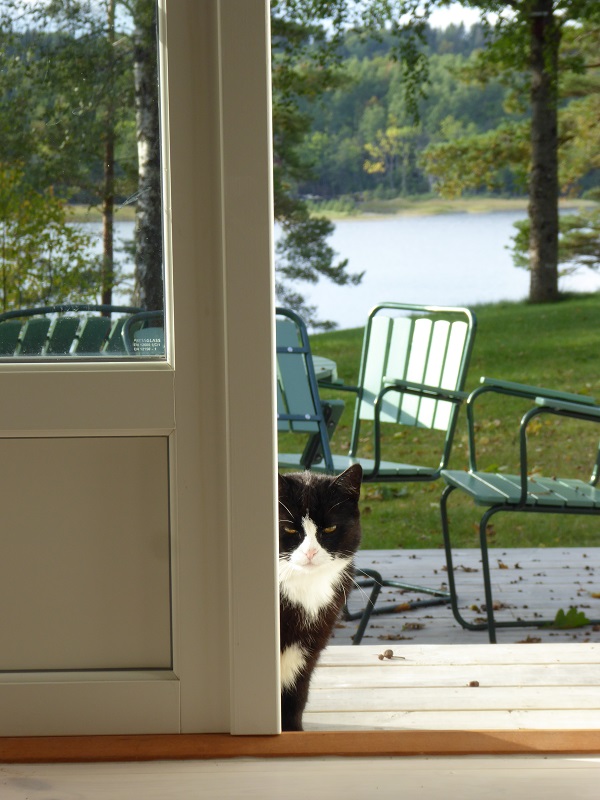
Before the electrifying experience of Santtu-Matias Rouvali's first official concert as Principal Conductor of the Gothenburg Symphony Orchestra - quasi-review here, interview just up on The Arts Desk - I spent just under 24 hours north of the city, in Dalsland at the lakeside home of my friend Lucy and her partner Mats. Plus two cats, one who usually flees but allowed me to get close, Fatty, pictured here at the back door.

They've more or less created a typical red house around the shell of an old building, and renovated the stuga or cottage next door as a perfect holiday home (rates soon to be available on request, if you want perfect peace and quiet, plus steps down for your morning swim and a terrace just above).


The lake, Örsjön, has mostly farmland on one side and wooded hills on the other, We drove round to one of two attractive mills, at Gunvarbyn


and walked up a path behind it.


All walking routes are free-access in Sweden, though the inhabitants of any house you pass might stare more suspiciously than in the UK. This little settlement had recreated a folksy arrangement outside.


Our route took us through woods, with one red autumnal acer in marked contrast to the conifers


and abundant mushrooms. As usual my identification of the browny-greys is fruitless - it was reassuring a couple of years ago, on sending him some of my pictures of fungi in the Göljådalen valley of  Fulufjället national partk in mid-Sweden, to be told by a mycologist at Kew that one would need to provide more than just a photo for correct identification - but this looks more like a Brittlegill, or at least of the group Russula, than a Fly Agaric


while the only correspondent to this phallic specimen is a Shaggy Inkcap


and this is surely a Goblet Waxcap, which like the Brittlegill seems to have had a nibble taken out of it (and discarded beneath).


Lichen foregrounding trees


as well as on them


could be equally spectacular, and black skies over Backen on the opposite shore backgrounded the sunlit shoreline


though it augured inevitable rain, so having reached our destination


we retraced our steps rather than taking the long route back


and having passed this splendid complement of mossy roof and tree


reached the car as it started to pelt. My one great wish was to see an elk, and Lucy had said that one was most likely to appear in the rain. Sure enough, as she drove, a young elk ran alongside the car and darted into the greenery. So you'll have to take my word for it, corroborated by Lucy, that I saw one.

Next morning I took the dip already registered briefly in the Rouvali post - here's a more distant record, courtesy of Lucy -


and toured the grounds.


After an obligatory group shot in the porch,


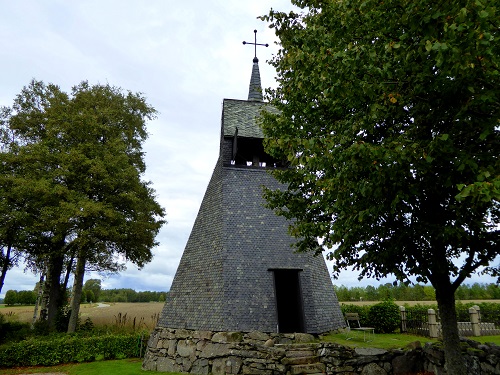
Lucy drove us to Mellerud to catch the train back to Gothenburg via an old church with splendid iron grave-markers


and, typically, a detached tower

as well as the shores of western Europe's largest lake, Vänern.
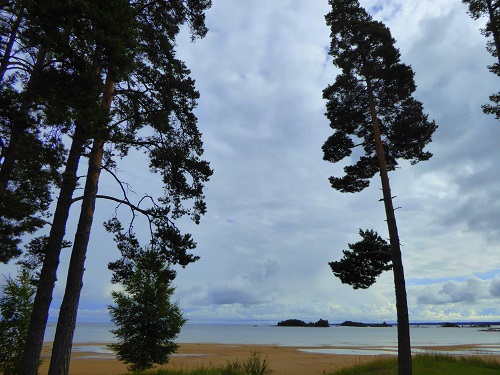

Fungi grew in abundance on the greensward in front of the sands.


The spaciousness of what looked like an open sea, looking across to a wooded island, felt grand and Sibelian, with trees reflected in the water.


though the Sibelius piece with which I want to end, from one of the most individual sets in his huge output of solo piano music, is a hymn to a tree - 'The Spruce' ('Granen'), Op. 75 No. 5. Important to get that space in the wistful tenorial melodic line between upper and lower parts, and I like this performance by Kazumasa Matsumoto. There's a splendid new disc of Sibelius piano music from Leif Ove Andsnes which I'm about to review; the only pity is that it doesn't include all the 'tree pieces' of Op. 75.


Thursday, 17 October 2013

Mycomania 1: Göljådalen


'Mushroom mad' is perhaps too strong a term for it, but 'mycophilia' seemed to carry unfortunate connotations, so let's stick with the above. Which was stirred two years ago in the Tweed valley near our friends the Lambtons and specifically in the glorious arboretum-garden of Dawyck and its 'cryptogamic sanctuary'. This year it was rekindled in the valley through which the River Göljån flows in Sweden's Fulufjället National Partk - a very different landscape from our walk around the Njupeskär waterfall the previous day.

Special circumstances pertain here which mean that most likely - and I'll have to check this out with my New Best Friends in Kew's Fungarium - I was seeing some rather unusual specimens which like to grow on dead wood. What I learnt from Martyn Ainsworth in a revelatory fungal walk around Kew last Thursday was that we can take nothing for granted in the mushroom world. Innocent-looking types can be cannily imitated by the deadlier ones; not all mushrooms have a mutually beneficial relationship with plants, some kill them; species names can change and shift within a year. I'd never risk gathering mushrooms to eat, maybe with the exception of a few boletes and chanterelles.


Not that you'd ever eat the bracket variety, which were in the majority on our walk either side of the Göljån. How were these special conditions created? During 30-31 August 1997 Sweden's heaviest recorded rainfall - over 400 millimetres in a single day - soaked the eastern slopes of Mount Fulufjället and swelled the waters of the little and greater Göljån rivers to 500 times their usual flow. A wave six metres high swept through Göljådalen, uprooting 10,000 cubic metres of timber - mostly spruces 35 metres high and half a metre across.


As the information board put it:

The massive volume of water ploughed new channels through loose soil and on the slopes leading down to the Göljån river, caused numerous landslides that removed nearly all vegetation. Left behind in the forest landscapes was a wide swathe that resembled a newly excavated highway. But only a few years later, flowers, grasses and mosses began to return. 

The compact logjams teem with life, offering ideal conditions for fastidious lichens, fungi and insects, that have difficulty finding suitable habitats, since deadwood is often a scarce commodity in modern forests. Several bird species have acquired an abundant food supply, and the wren has found new dwelling places.

We saw no birds and hardly heard any during either of our walks, though on the drive back from Göljådalen a capercaille crossed the track. But we did encounter plenty of the 'fastidious lichens and fungi' once we'd enjoyed a delicious picnic on this rickety bridge (photo by Jamie; the Diplo-mate permits a distant shot, and that's Susannah on the right).


Most of the rocks either side of the river were covered in extraordinary red lichen


and much else on the miniature scale was competing for attention.


First of the polypores or bracket fungi appeared on dead wood across another bridge


and then we found plenty on upright spruces. I like to think this is Hoof Fungus or Tinderbracket (Fomes fomentarius), though would that account for its astonishing shade of blue?


Two gilled mushrooms on the ground: is this Macrolepiota konradii, with the gills forcing their way upwards on to the cap?


It's highly unlikely this glowing orange-red loner is Caesar's Mushroom, Amanita caesarea, so called because Julius and Claudius prized it so highly, since that tends to flourish in Mediterranean regions, but it's the nearest correspondent in my ever-confusing guide and I like the idea.


New life was springing up in clearings presumably forged by the tidal wave


and the devastation was much more apparent in the lower reaches.


Here, on a dead tree by a tributary, I spotted the three brackets in the top picture - they might be more Hoof Fungus but I hope they are the rarer (except in Scandinavia) Phellinus nigricans.


No mushroom in my book corresponds to one with a growth on top like this one


and finally we have, I reckon, the Blueing Bracket (Postia subcaesia), half-moons glowing in the half-light.


More brackets to come in the Kew ramble write-up, identified by our guide. Now to show this to a nice person in the Fungarium for comment and correction. 

20/10  Part of the detailed reply which arrived sharpish from Kew:  
If only we could identify fungi from photos it would make life much easier; however it is rarely possible. Increasingly, we need to see the fruit body from all angles, measure the spores, study the suites of microcharacters and even obtain a DNA sequence to be certain of an identification. I’m afraid it is just not possible to be authoritative about the fungi you saw from the photos alone, with the exception of Fomes fomentarius, and, as you suggest, the orange one won’t be Amanita caesarea. Postia subcaesia might be correct, but it is one element of a group of similar species that would require an in-depth study to resolve.

Sorry to be so unhelpful, but the sheer number of fungal species on the planet (millions) mean that photos alone are rarely enough.

Thursday, 19 September 2013

Around Njupeskär


We've been tramping relative flatlands more recently, though the terrain of our Norfolk churches chronicle which will still take me some time to assemble did lead us into modest valleys. Nothing, of course, compared to the canyon of  the Njupeskär waterfall and the river Njupån in Sweden's Fulufjället National Park, not far from the Norwegian border in what I suppose, technically speaking, is still Dalarna. Visions of our walk up to and above the waterfall kept me sane during nearly two hours of hideous, if painless, root canal treatment on Wednesday.

This is Sweden's highest cascade, topping 93 metres with a freefall of 70. It flows from the Rörsjo lakes on the c.900m high mountain plateau, which with its 900 million year old sandstone and diabase has been eroded for the past 200 million and kept more or less its current shape for 60 million. These are figures I can't really get my head around; one needs a book like Christopher Potter's You Are Here to put it all into perspective. Nor do I quite understand the principle of 'retrogressive erosion', but that's why we have the waterfall, its boulders and its canyon.

The first two kilometres from the visitors' centre, with its excellent Naturum, are accomplished by even the most timid or toddler-encumbered of visitors and take you past 400 year old larches and sparkling lakelets


along a boardwark near to the base of the waterfall. The sun only hits the cascades for a couple of early morning hours in midsummer.


Jamie coped with the spray and the boulders more nimbly than I did, so has the best shots close up.


We then retraced some of our steps and climbed towards Rörsjöarna


with the views north-east opening up all the time and the boulders covered with bright-green map lichen.


Clouds were rolling in and the wind strengthening, so we stopped for our packed lunch in a sheltered nest of rocks before pressing on for the plateau (third of Jamie's four pics).


J was content to sit and survey


while I clambered nearer to the upper falls


and Jamie once again got closer than the rest of us to view the cascade proper from above.


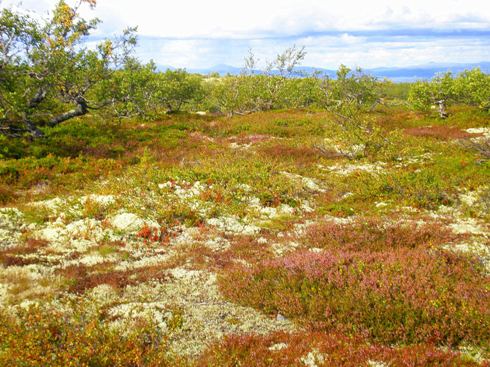
The Fulufjälllet plateau is famously unique in remaining ungrazed by reindeer, so the lichen called reindeer moss grows in thick carpets.


The terrain is also covered in dwarf birch and mountain heather


and boggy ground sometimes gives way to further lakelets.


One so wants to think of this sky-neighbour where mind-chains do not clank as untainted, but I read that due to acid rain the fish in the high lakes died out in the 1950s. Nowhere is quite safe from human fallout.

I'd like to have spent more time roaming the uplands, but by now it was late afternoon and we wound round the other side of the high ground above Njupeskär.


This is where I found my cloudberries. Indulge one more shot, with moss more in focus than my artfully sited discovery (not by any means the only one, but the most cumulus-like).


Back down we headed towards the waterfall zone, with lichened trees in profusion.


Here I had my first glimpse of the miniature fungi world - Roger Phillips' beautifully produced volume Mushrooms, a copy of which I'm now proud to own, suggests to me that the tallest specimens here might be Mycenae/bonnets, but then again they might be Hygrocybes/waxcaps -


which would give way to spectacular larger specimens on our walk the following day. To which, of course, I'll return, as it was a whole new landscape.