Showing posts with label Dalarna. Show all posts
Tuesday, 13 August 2019
Summer bathing places
It has become a point of honour that I must immerse myself in sea or lake if either is available on a summer trip. Hardest was the North Sea off Crail, Fife, last year, in a haar that made the outside cold too. My pal Kari Dickson, who shared the dip and came out equally sharpish, claimed it was colder than the Firth of Forth on New Year's Day, so I do get a brownie point for that one. The five ventures this summer so far have been relatively simple, though I do bear battle scars from one. Despite that, it's rather boring how everyone now goes on about 'wild bathing', with encouragement from the media. There's nothing to it once you make up your mind.
Norfolk (1) I've already covered in a post on a very full day. Most pleasant of all were the daily plunges very close to the idyllic wooden house I had to myself (and an unaffectionate cat called Sebbe) by the water at Vattnäs in Sweden's lake district of Dalarna (pictured up top with the sauna, which I didn't use). Here's my wonderful host Gun-Britt by the shore, from the window. The lupins, by the way, are beauties, but the locals are in two minds about them - they're invasive, nothing can grow around them. But so long as they can be controlled, I'd be happy to have hosts of them around me. You just need to cut off the heads once the flowering is over to stop the seeds spreading.
I felt immediately welcomed into the bosom of the Andersson family on the evening I arrived, when folk music was being played with a friend who knows all about these things, Lars Thalén, his wife Ingela on the zither, grandson Victor as second fiddle and Victor's girlfriend Anna on saxophone.
The young 'uns were involved in Anna Larsson and Göran Eliasson's latest project in the nearby barn-theatre, a uniformly well cast and superbly played Das Rheingold; for more on that, see the Arts Desk coverage.
Weather was changeable, but that made for many magical lights on the lake - like this one, when I woke up at 5am and snapped before going back to sleep,
and this one after the rains.
Two more, one from above when we went to pick up a fellow writer from his accommodation
and the other from close up again, near to sunset (around 11.30pm, I think).
A blog entry on excursions to the wonderful Anders Zorn Gallery and House in Mora and the rift valley of Styggforsen will have to wait. A full report on my fifth Pärnu Music Festival is, on the other hand, imminent.
How I love Estonia's summer capital; even knowing that the permanent residents have a nasty habit of supporting the country's newly emergent far right, with its links to Marine Le Pen, I feel comfortable among the summer visitors who know how to have fun without the excesses of British holidaymakers. Bathing here requires a considerable wade out in the shallow waters of the eight-mile sandy bay, but it's worth it - especially at midnight, encouraged by doyenne Lucy and several other companions. The disco on the beach throbbed and twinkled boisterously, but there was also a blood-red moon rising. None of this documented, of course, but I have the usual beach pics, most dramatic on the day when I went for a knee-deep paddle and the third of the day's storms threatened beyond the dunes.
It looked so impossibly calm out at sea, despite the cumulo-nimbus forms on the horizon
that I didn't make much haste heading back in the heat - until I saw a spectacular forked lightning display up the river. And the cloud formations over the wetlands looked almost cyclonic.
So I ran through the woodland and into the Villa Katariina where we'd stayed last year, for a drink and a snack, just as the heavens opened. It was over in 20 minutes, so I just had time to dash back to the hotel and on to the evening's concert. All was calmer by the time J arrived - four days of uninterrupted sunshine. I rely on him to offer proof that I did bathe,
eventually swimming out towards the masts of the annual yacht race around the Estonian coast, and then we just water-waded along the coastline
to a river mouth this time without a hint of threat, solitary tansy in the dunes a magnet for bees,
and the shoreline cattle doing their thing as luxury yachts incongruously sailed past them.
More of our bovine friends at the water's edge were to be seen by Lake Windermere nearly two weeks later.
I had a totally wonderful time in Ambleside and Kendal, giving two talks on Shostakovich as part of Lake District Summer Music's day of events which I'll outline anon. I only had the morning of my departure free, and could have gone up to the fells, but wanted the swim so headed for the lake out of town. The National Trust is responsible for fair meadows at Waterhead
and English Heritage looks after the remains of Galava Roman Fort. Not much to see here since most of the stones were carried off for building in Ambleside, but it's an attractive setting, especially with no-one else around.
Clearly bathing where the Romans would have done so wasn't ideal, so I found a rocky outcrop in nearby Borrans Park.
A warning about a rather nasty blue-green algae in the lake made me wary, but the damage actually came from a rock which left me with a black toe - amazing how quickly the bruising went down with Arnica cream. Didn't much like the oozy weeds twisting around my legs either, but otherwise managed to keep swimming towards the boats and back. It was a sticky but mostly rain-free weekend; the bad weather only set in when I was sitting on Windermere Station for the train to Oxenholme and thence back, uneventfully, to London. A week later, and there would have been trouble.
We were very much on the fringes of that while staying in North Norfolk with our friend Jill for the Southrepps Music Festival - the best yet, that I've experienced, at any rate, with unsurpassable performances from, among others, Ben Baker (best Bach Chaconne either I or David Parry have ever heard live), festival doyen Ben Johnson (peerless in Britten's Serenade, with the equally magnificent Martin Owen and Parry conducting a first-rate string group led by Ben), guitarist Sean Shibe creating his usual hold-your-breath magic, Jonathan Bloxham on a flying visit as cellist in breathtaking Mendelssohn Second Piano Trio - ah, that chorale moment! - and two young pianists, Martin James Bartlett and Daniel Lebhardt who both dazzled in two different concerts on the same day and who, I kid you not, cast an erratic Martha Argerich at the Proms last night in the shade, for fine tuning with colleagues, at any rate.
But there are also the swims, walks and crab/lobster lunches at the Overstrand shack to be accommodated. We managed two of the three on Saturday afternoon, but high winds and sea swells meant friend Cally and I didn't take the plunge then. You can see the white horses here,
and just over this cliff with the last of the Alexander there had been a big collapse in June.
Anyway, we got our bathe on Sunday lunchtime between Bach/Mendelssohn and an excellent lunch at the Vernon Arms back in Southrepps. Thus the beach
and the view from above on the walk back.
In about a month we return for our annual churches walk. The gifts of these wonderful retreats just keep on giving - but I hope, in terms of fundraising for the Norfolk Churches Trust, we give back a bit too.
Thursday, 19 September 2013
Around Njupeskär
We've been tramping relative flatlands more recently, though the terrain of our Norfolk churches chronicle which will still take me some time to assemble did lead us into modest valleys. Nothing, of course, compared to the canyon of the Njupeskär waterfall and the river Njupån in Sweden's Fulufjället National Park, not far from the Norwegian border in what I suppose, technically speaking, is still Dalarna. Visions of our walk up to and above the waterfall kept me sane during nearly two hours of hideous, if painless, root canal treatment on Wednesday.
This is Sweden's highest cascade, topping 93 metres with a freefall of 70. It flows from the Rörsjo lakes on the c.900m high mountain plateau, which with its 900 million year old sandstone and diabase has been eroded for the past 200 million and kept more or less its current shape for 60 million. These are figures I can't really get my head around; one needs a book like Christopher Potter's You Are Here to put it all into perspective. Nor do I quite understand the principle of 'retrogressive erosion', but that's why we have the waterfall, its boulders and its canyon.
The first two kilometres from the visitors' centre, with its excellent Naturum, are accomplished by even the most timid or toddler-encumbered of visitors and take you past 400 year old larches and sparkling lakelets
along a boardwark near to the base of the waterfall. The sun only hits the cascades for a couple of early morning hours in midsummer.
Jamie coped with the spray and the boulders more nimbly than I did, so has the best shots close up.
We then retraced some of our steps and climbed towards Rörsjöarna
with the views north-east opening up all the time and the boulders covered with bright-green map lichen.
Clouds were rolling in and the wind strengthening, so we stopped for our packed lunch in a sheltered nest of rocks before pressing on for the plateau (third of Jamie's four pics).
J was content to sit and survey
while I clambered nearer to the upper falls
and Jamie once again got closer than the rest of us to view the cascade proper from above.
The Fulufjälllet plateau is famously unique in remaining ungrazed by reindeer, so the lichen called reindeer moss grows in thick carpets.
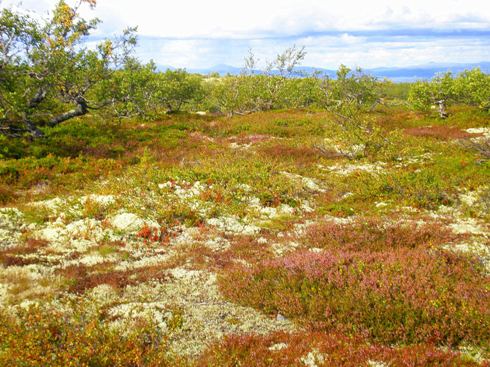
The terrain is also covered in dwarf birch and mountain heather
and boggy ground sometimes gives way to further lakelets.
One so wants to think of this sky-neighbour where mind-chains do not clank as untainted, but I read that due to acid rain the fish in the high lakes died out in the 1950s. Nowhere is quite safe from human fallout.
I'd like to have spent more time roaming the uplands, but by now it was late afternoon and we wound round the other side of the high ground above Njupeskär.
This is where I found my cloudberries. Indulge one more shot, with moss more in focus than my artfully sited discovery (not by any means the only one, but the most cumulus-like).
Back down we headed towards the waterfall zone, with lichened trees in profusion.
Here I had my first glimpse of the miniature fungi world - Roger Phillips' beautifully produced volume Mushrooms, a copy of which I'm now proud to own, suggests to me that the tallest specimens here might be Mycenae/bonnets, but then again they might be Hygrocybes/waxcaps -
which would give way to spectacular larger specimens on our walk the following day. To which, of course, I'll return, as it was a whole new landscape.
Labels:
Dalarna,
Fulufjället,
lichen,
mountain plateau,
mushrooms,
national park,
Njupeskär,
Sweden,
waterfall
Tuesday, 10 September 2013
Late summer fruitfulness
Lingonberries, cloudberries, raspberries, blackberries, blackcurrants, redcurrants: the Swedish countryside yielded up its riches in August. Large bears can consume 100kg of berries each in a single day, my Fulufjället National Park leaflet tells me; we were more modest but could have lived off them quite happily. What I'm proudest of is discovering the rarest, the sensational cloudberry (hjortron)- so called because of its imitation of a cumulus, not because of the altitude at which it's found - the piquant taste of which when it bursts in the mouth no jam, with its added sweetness, can convey.
I read that cloudberries are most likely found on Alpine slopes in boggy areas, so it made sense to look out on the Fulufjället mountain plateau above Njupeskär waterfall. Which must be revisited in a blogramble, but for now here's the kind of terrain we're considering
and there, either side of several boardwalks were the occasional cloudberries - posed here, of course, because they do not readily reveal themselves in the vegetation.
Their strawberry-like leaves were already autumnal in colour, suggesting the end of the season, but Jamie and I feasted on most of what we found before taking back a handful each to the other two who'd gone ahead back down the cliff.
The more cultivated but still lovely terrain around Lake Siljan, further south-east, yields its fruits, too. There are wild raspberries
though the bushes of the other berries tend to belong to the owners of the attractive red-painted wooden houses in the villages on the shores. One such had a notice with an arrow, 'please help yourselves', alongside it. So Sophie (pictured with the sign behind her), J and I did
and gathered plenty of redcurrants
to go with Sophie's mother Inger's sublime baking.
Could we have had a more delightful traditional time in the little house by the lake? For starters, Inger had decked herself out in Swedish national costume to welcome us fresh from the campovan driven by Gillis, the adorable man Sophie has always called on her blog MNL (Mother's New Lover) followed by MNH (Mother's New Husband). Inger is in her early 80s and Gillis is 87, can you believe.
He was a forester, a hunter and a pilot, decided at 80 to give up shooting and flying before he killed someone but still knows a friend who can supply an elk. Which is why we had elk balls (as in meat balls, not testicles, I hasten to add) with breakfast
as well as elk tongue - thanks, Gillis, for pointing out the tip - elk liver and elk kidneys.
We didn't see a real life specimen but Gillis was happy to pose alongside a stuffed one in the Naturum at the Siljansnäs Nature Reserve.
Inger is about to explode with mirth, as she did when we played her the incomparable Florence Foster Jenkins as the Queen of the Night. Gillis sat straight-faced, hearing nothing amiss. Nature is his element; I only wish we'd gone on a forest walk with him so that he could have pointed out his huge knowledge. Here he is, followed by his stepdaughter, on the jetty at the bottom of the garden.
I love it that, though officially belonging to the house, the little beach is accessible to all under the Swedish Rights of Access. Rambler-persecuting Jeremy Clarksons wouldn't have a leg to stand on here. Houses rarely have fences around them; the communal spirit remains strong, for better mostly and also for worse (read one man's account of the ambiguous social legacy in Andrew Brown's Fishing in Utopia). And certainly in Dalarna you can park anywhere and for free. My kind of country.
Can I detain you with one more ritual before we leave Leksand? I loved the national costume, the elkmeat, the Schnappslieder (to which traditional specimens I could only retort with the Iolanthe Nightmare Song). I hated more than any food I've ever tasted - and remember I love Palermitan spleen in a bun plus other offal - the seasonal delicacy of fermented Baltic herring, the infamous surströmming.
This can is a stink bomb waiting to be released. Which it can't be until around 15 August every year, and then not in public unless you've hired a restaurant or a railway carriage specially for the purpose. Why is this? I read that the herring are caught in April or May just before they begin to spawn. 'The fermentation starts from a lactic acid enzyme in the spine of the fish, and so the fermentation is by autolysis; together with bacteria, pungent smelling acids are formed in the fish such as proponic, butyric and acetic acids. Hydrogen sulphide [for God's sake!] is also produced'. At the end of the 1940s a Swedish royal decree prevented improperly fermented fish being sold. That's no longer law, but the trade still relies on the mid-August release date.
The family told us that the smell about to be unleashed in the picture was much milder than usual. But when the horror was served, I had to hold my breath so as not to gag on the ammonial stench. I did eat one - texture as vile as taste - and then had to endure the smell in my nostrils all night.
No such monstrosities were inflected on us down in gentle Lacock, where the beloved hosts of the best outdoor birthday party ever welcomed us back for a long weekend of walking and eating. Here, along with beans, courgettes and sensational baby corn on the cob, which you eat husks and all, were blackcurrants (thank you for the nudge below, Deborah) from the garden
and the sweetest of plums.
You've seen the hedge sculptures and the garden rooms before if you've been visiting for long, but in addition to an inedible giant pear by Deborah
and a fruit cornucopia of a hairdo
let me indulge fresh angles on the ascendable tower
and the earth mother, who waxes in strength of legs
and curvaceousness
We could have been quite content with the treasures on our doorstep and bracing local walks up to the ridge and back, but I'm mighty grateful Deborah and Andrew took us to the stunning garden at Iford, designed by Italophile Harold Peto who bought the house and grounds in 1899.
The assembly of Roman and Renaissance sculptures adorning pastiche historical structures, the beautiful integration of these with serene planting, seemed familiar - and then I read that Peto also designed one of the most beautifully located gardens I've ever seen, the island idyll of Ilnacullin in Ireland's Bantry Bay, visited on a day I'll not forget. This was almost as ravishing. Thus Peto in The Boke of Iford: 'Old buildings or fragments of masonry carry one's mind back to the past in a way that a garden of flowers only cannot do. Gardens that are too stony are equally unsatisfactory; it is the combination of the two, in just proportion, which is the most satisfying'.
The setting is daring, on a steep slope down to the house and the River Frome beneath. I'd better admit the serendipitous concatenation of events which led us to have the garden to ourselves, not knowing for a while the reason why. The narrow road down to the house and car park was blocked by a broken-down car so Andrew parked at the top and we walked along the coach lane, entering the terrace from above. When A went down to see about paying, he found that the garden was officially closed on Fridays. Well, we didn't linger much longer but we'd already enjoyed the whopping great mulberries
and one fig each from the tree so aptly planted alongside the beautiful cloister where every summer operas are performed.
Much better, I reckoned, to enjoy it in tranquillity, with a fig to heighten the pleasure.
This little miracle of nature, though, found by the side of an upper pond, is definitely not for eating. Please note a great sculptor's fingers.
Finally we did get to the bottom of the valley, with the lovely old bridge over the Frome surmounted by the statue of Britannia Peto placed there, beneath which two gilded youths disputed as if, Deborah thought, in an advertisement for the romance of Oxbridge. You're fortunate that for that and the subsequent early evening whizz around Bradford-on-Avon the camera battery was flat. But this isn't the last you'll hear of BoA. We must return at the first possible opportunity and see again whether it would, as I impulsively thought gazing enviously on a Georgian weavers' terrace high above the Avon, be the perfect place to live.
Labels:
Bradford on Avon,
cloudberries,
Dalarna,
elk,
Fulufjället,
Harold Peto,
Iford Manor,
Lacock,
Leksand,
Siljan,
Sophie Sarin,
surströmming,
Sweden
Subscribe to:
Posts (Atom)