Showing posts with label Overstrand. Show all posts
Tuesday, 13 August 2019
Summer bathing places
It has become a point of honour that I must immerse myself in sea or lake if either is available on a summer trip. Hardest was the North Sea off Crail, Fife, last year, in a haar that made the outside cold too. My pal Kari Dickson, who shared the dip and came out equally sharpish, claimed it was colder than the Firth of Forth on New Year's Day, so I do get a brownie point for that one. The five ventures this summer so far have been relatively simple, though I do bear battle scars from one. Despite that, it's rather boring how everyone now goes on about 'wild bathing', with encouragement from the media. There's nothing to it once you make up your mind.
Norfolk (1) I've already covered in a post on a very full day. Most pleasant of all were the daily plunges very close to the idyllic wooden house I had to myself (and an unaffectionate cat called Sebbe) by the water at Vattnäs in Sweden's lake district of Dalarna (pictured up top with the sauna, which I didn't use). Here's my wonderful host Gun-Britt by the shore, from the window. The lupins, by the way, are beauties, but the locals are in two minds about them - they're invasive, nothing can grow around them. But so long as they can be controlled, I'd be happy to have hosts of them around me. You just need to cut off the heads once the flowering is over to stop the seeds spreading.
I felt immediately welcomed into the bosom of the Andersson family on the evening I arrived, when folk music was being played with a friend who knows all about these things, Lars Thalén, his wife Ingela on the zither, grandson Victor as second fiddle and Victor's girlfriend Anna on saxophone.
The young 'uns were involved in Anna Larsson and Göran Eliasson's latest project in the nearby barn-theatre, a uniformly well cast and superbly played Das Rheingold; for more on that, see the Arts Desk coverage.
Weather was changeable, but that made for many magical lights on the lake - like this one, when I woke up at 5am and snapped before going back to sleep,
and this one after the rains.
Two more, one from above when we went to pick up a fellow writer from his accommodation
and the other from close up again, near to sunset (around 11.30pm, I think).
A blog entry on excursions to the wonderful Anders Zorn Gallery and House in Mora and the rift valley of Styggforsen will have to wait. A full report on my fifth Pärnu Music Festival is, on the other hand, imminent.
How I love Estonia's summer capital; even knowing that the permanent residents have a nasty habit of supporting the country's newly emergent far right, with its links to Marine Le Pen, I feel comfortable among the summer visitors who know how to have fun without the excesses of British holidaymakers. Bathing here requires a considerable wade out in the shallow waters of the eight-mile sandy bay, but it's worth it - especially at midnight, encouraged by doyenne Lucy and several other companions. The disco on the beach throbbed and twinkled boisterously, but there was also a blood-red moon rising. None of this documented, of course, but I have the usual beach pics, most dramatic on the day when I went for a knee-deep paddle and the third of the day's storms threatened beyond the dunes.
It looked so impossibly calm out at sea, despite the cumulo-nimbus forms on the horizon
that I didn't make much haste heading back in the heat - until I saw a spectacular forked lightning display up the river. And the cloud formations over the wetlands looked almost cyclonic.
So I ran through the woodland and into the Villa Katariina where we'd stayed last year, for a drink and a snack, just as the heavens opened. It was over in 20 minutes, so I just had time to dash back to the hotel and on to the evening's concert. All was calmer by the time J arrived - four days of uninterrupted sunshine. I rely on him to offer proof that I did bathe,
eventually swimming out towards the masts of the annual yacht race around the Estonian coast, and then we just water-waded along the coastline
to a river mouth this time without a hint of threat, solitary tansy in the dunes a magnet for bees,
and the shoreline cattle doing their thing as luxury yachts incongruously sailed past them.
More of our bovine friends at the water's edge were to be seen by Lake Windermere nearly two weeks later.
I had a totally wonderful time in Ambleside and Kendal, giving two talks on Shostakovich as part of Lake District Summer Music's day of events which I'll outline anon. I only had the morning of my departure free, and could have gone up to the fells, but wanted the swim so headed for the lake out of town. The National Trust is responsible for fair meadows at Waterhead
and English Heritage looks after the remains of Galava Roman Fort. Not much to see here since most of the stones were carried off for building in Ambleside, but it's an attractive setting, especially with no-one else around.
Clearly bathing where the Romans would have done so wasn't ideal, so I found a rocky outcrop in nearby Borrans Park.
A warning about a rather nasty blue-green algae in the lake made me wary, but the damage actually came from a rock which left me with a black toe - amazing how quickly the bruising went down with Arnica cream. Didn't much like the oozy weeds twisting around my legs either, but otherwise managed to keep swimming towards the boats and back. It was a sticky but mostly rain-free weekend; the bad weather only set in when I was sitting on Windermere Station for the train to Oxenholme and thence back, uneventfully, to London. A week later, and there would have been trouble.
We were very much on the fringes of that while staying in North Norfolk with our friend Jill for the Southrepps Music Festival - the best yet, that I've experienced, at any rate, with unsurpassable performances from, among others, Ben Baker (best Bach Chaconne either I or David Parry have ever heard live), festival doyen Ben Johnson (peerless in Britten's Serenade, with the equally magnificent Martin Owen and Parry conducting a first-rate string group led by Ben), guitarist Sean Shibe creating his usual hold-your-breath magic, Jonathan Bloxham on a flying visit as cellist in breathtaking Mendelssohn Second Piano Trio - ah, that chorale moment! - and two young pianists, Martin James Bartlett and Daniel Lebhardt who both dazzled in two different concerts on the same day and who, I kid you not, cast an erratic Martha Argerich at the Proms last night in the shade, for fine tuning with colleagues, at any rate.
But there are also the swims, walks and crab/lobster lunches at the Overstrand shack to be accommodated. We managed two of the three on Saturday afternoon, but high winds and sea swells meant friend Cally and I didn't take the plunge then. You can see the white horses here,
and just over this cliff with the last of the Alexander there had been a big collapse in June.
Anyway, we got our bathe on Sunday lunchtime between Bach/Mendelssohn and an excellent lunch at the Vernon Arms back in Southrepps. Thus the beach
and the view from above on the walk back.
In about a month we return for our annual churches walk. The gifts of these wonderful retreats just keep on giving - but I hope, in terms of fundraising for the Norfolk Churches Trust, we give back a bit too.
Friday, 5 October 2018
Norfolk churches 192-206: Metton to Hanworth
After last year's grand coastal sweep, this was an easy walk through fields and woods inland, touching on several other previous routes taken for the Norfolk Churches Trust (thanks to all those who have donated so far, taking us well past the £2000 mark; if you still want to give, you can do so here). Every church out of 14 (including chapels) in 14 miles had its idiosyncratic treasure, and the area is especially rich in brasses - detail of John Puttok's in All Saints, Thwaite above - and round towers. It was an overcast day, but not without subtle shifts in light and cloud, and there was only one downpour just before we reached the last church.
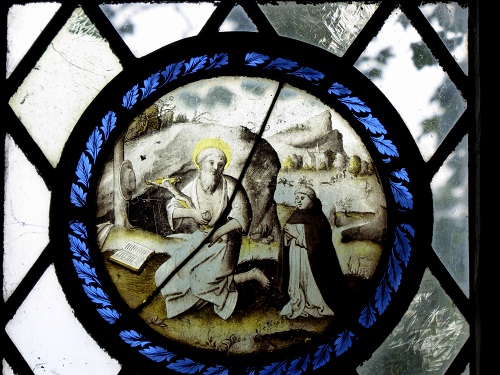
We started at Saint Andrew, Metton, and somehow missed the novelty - the arches for processions to pass through the medieval tower, as at the much grander edifice at Walpole St Peter. The interior felt a bit gloomy and slightly underloved, but the eye is drawn to the 16th century Flemish roundels in the east window, installed in 1956 in memory of Mrs. Ketton-Cremer, mother of the last squire of Felbrigg Hall, the very literary friend of Anthony Powell R W Ketton-Kremer, who bequeathed the hall to the National Trust when he died in 1969. There was a local hullabaloo about his being outed in a short film, narrated by Stephen Fry, to mark the 50th anniversary of the decriminalisation of homosexuality, in which the NT admirably decided to join with its 'Prejudice and Pride' initiatives.
No St Sebastian here, but Jerome and Laurence feature according to the leaflet (wrong in one respect, I fancy, as that's surely a reaper below), and in premonition of the National Trust's acorn symbol, there's an oak on the angel-held heraldry which is nicely reflected in the ones beyond the window.
Handsome trees and birds in abundance. including an untimely barn owl, accompanied our first walk to the Felbrigg estate.
Two bee hives in a hedgerow were buzzing with activity
while rooks were cawing and flapping in the field in front of St Margaret, Felbrigg, prettily shielded by a smaller wood than the one we'd just come through.
The church stands at some distance from the house and is outside the care of the National Trust; it belongs to Roughton Parish and needs a bit of work. Simon de Felbrigg's badge is in several places on the outside of the building, including the west door.
while they've found a statue of St Margaret to put above the porch entrance.
The glories of St Margaret are its brasses, one of the finest in the country, stretching across two and a half centuries, chronicled in detail in the excellent church guide with its fine drawings by a Victorian rector. Much pulling away and replacing of carpets necessary here. The foursome behind the altar rail was commissioned in c.1380 by Sir Simon de Felbrigg in honour of his grandfather, also Simon, and father, Roger, and their wives, Alice de Thorp and Elizabeth Scales.
Half concealed by the altar is Jane Coningsby, a daughter of another local family, the Windhams. She died in 1608 at the age of 67 - hence the Jacobean attire - and has a fine eulogy in verse.
Her brother, Thomas Windham, d.1599, is in the aisle.
There's a chronicle at Felbrigg recounting the transportation in 1612 of these brasses on their Purbeck marble slabs from London to Felbrigg via sea to Yarmouth and 'long boate' to Coltishall Bridge, from whence they were transported in two carts.
Most glorious, as befits his rank as standard-bearer to Richard II, and as knight of the garter who lived on to serve Henry V in the French wars, is Sir Simon Felbrigg, d.1416, with his first wife Margaret of Bohemia, maid of honour to that same Lady Anne so slimily wooed by Shakespeare's Richard III. They're somewhat squeezed in between the box pews, and best seen from the pulpit..
Last but not least is a brass of about 1480, sans inscription, representing a young girl with hair flowing down to her waist.
If these were not riches enough for one church, the Felbrigg connection also yields us a fair number of monuments. That to Thomas Windham, made by Martin Morley of Norwich in 1669 for £45, is dismissed by Pevsner as 'rustic', but the naive can charm, as in the trumpeting angels.
More controversial is the monument to statesman William Windham (1750-1810) facing it. Undoubtedly the bust by Nollekens is very fine
but both that and the marble sarcophagus below, with its eloquent inscription (click to read in larger form),
break up a beautifully-wrought sedilia of about 1400
and dominate it.
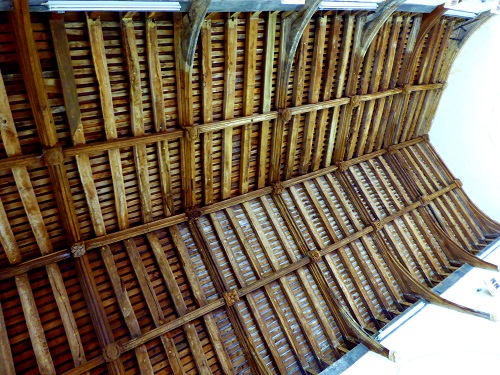
The 15th century roof still has its original timbers
though some of the bosses, damaged by death-watch beetles, were replaced in 1956. Whether these are among them, I don't know, but they're very splendid.
So we walked through the park,
past a group of cows framing the house
and looking back to the church
past the lake, before the brow of the next hill revealed our third destination, St Peter and St Paul Sustead, the first of our round towers.
This has been the best year for fat, juicy blackberries, which refreshed us at almost every turn.
St Peter and St Paul is nicely fringed with trees, like most of its companions
and beyond the graveyard there's a handsome house all on its own to complement the church, just glimpsed here.
This was the first of the churches we found manned, by a lady with her dog.
He counterpoints the lions on on the coats of arms around the octagonal font.
The dolphins on the shield here
are replicated in the village sign (after our visit we took a detour to collect a converted Methodist church).
There's a 'rustic' (Pevsner) Jacobean font which came from another church
nicely adorned with angel heads
but the best angels are to be found, headless, in the tracery of the south nave windows. One is playing a rebec, the other bagpipes with a lion head.
Their companions in the next window are an intact female saint carrying a book and St Catherine with her wheel.
The Arts and Crafts Prodigal Son windows are rather fine, too - this is the second pair.
Onwards, past flint-fronted houses with sunflowers and roses
to our first active 'Primitive' Methodist Church in Sustead
where, as always with the Methodists, we received the warmest welcome from a jolly lady
and the best refreshments until Aldborough. Next stop Gresham, its name that of the next big family in the area. Sir Thomas Gresham's grasshopper is also on the weathervane of the Royal Exchange, which he founded in 1565.
All Saints has little sign of aristocratic patronage and the Victorian restoration is clear on the outside, though of course the round tower with early 14th century bell openings is an adornment.
Simon Knott in his excellent Norfolk Churches guide - we shall never catch up with his 900-plus citings - entertainingly recounts Protestant-puritan Lt Col Batt's battle against an Anglo-Catholic priest here which resulted in the removal of richer furnishings. The poor army man's wits might have been turned by the loss of three sons in the Second World War, movingly recorded in the chancel.
There is, however, one treasure here which a more militant Puritanism seems to have missed, since most of the faces are intact: the great font with its seven sacraments.
The carving looks so modern, but it's all apparently original. The eighth side of the font shows Christ's baptism
while the others all vividly illustrate scenes from contemporary life.
A falcon was hovering above the trees surrounding the church
as we headed into more open country. Someone must have sown this semi-wild, bee-friendly flower patch just beyond a bend in the road.
Then we were in the remoteness of Bessingham. The churchyard of St Mary is maintained by the Norfolk Wildlife Trust - forgive me if I repeat the photo which headed my earlier 'trailer' -
and there were some splendid mushrooms among the grasses.
Our lunch was the usual, in memory of Jill's mother Mary, for whom we still walk as much as for ourselves. As the other three took up the bench, I borrowed the organ stool.
The Anglo-Saxon tower is fine indeed, with slightly different stone,
and while the inside was rather dark on a cloudy day,
the thorough restoration does include some bold glass both in the orangey-yellow east window by workshop of Powell and Sons
and in the south windows by Kempe.
Along lanes we never shared with a single car, treelined between big Norfolk fields on high ground,
we came to All Saints, Thurgarton, a prime example of why we raise money as we do. Although it lost its tower in the late 19th century,
All Saints was well worth the loving ministrations of the Churches Conservation Trust and the Redundant Churches Fund.
The simplicity to which the CCT restores the buildings in its care usually makes them the most visitor-friendly, and I liked this bright and airy interior the best
even before close inspection of its treasures, the 15th century benchends.
Victorian varnish probably helped to preserve them. The profane imagination of the woodworkers runs riot here.This lion looks more like a friendly pug.
This dragon seems to have got the better of an unfortunate human.
The elephant and castle/howdah is also found in two other Norfolk churches, possibly carved by the same hand.
One of two tuns, which the guide conjectures may be a play on the village's name, though I don't get it (tun? Thurgarton?)
There's also a complete rood stairway,
and next to it one of several statue niches (the church also has its piscina and sedilia).
An Elizabethan or Jacobean wall-painting would have been decorated for instructive purposes after the Reformation's whitewashing-over of the originals
and there is a delightful local Commandment board of about a century later.
The restoration included fine re-thatching - I bet the locals never thought they'd see that again -
and in the graveyard are uplifting lines on a tombstone for Richard Sperrell (d.2009).
Then came my favourite stretch of the walk - the last of the lanes with fabulous lichen on every tree
and a path alongside a field with a wood on the other side: more blackberries
and a pheasant (common, but so colourful).
Finally, we were back in a settlement, ticking off a second converted Methodist chapel - the owner genially told us that walkers had in previous years come straight through to his kitchen -
and the village green at Aldborough.
I got a good feeling about this place, not least because the villagers were clearly welcoming much-loved local Lib Dem MP Norman Lamb, according to the parish noticeboard
and the hunch was confirmed by our friendliest welcome of all in the least promising church, the very recent Prince Andrew's Chapel (yes, that Prince Andrew, no idea why).
The ladies here made us tea and coffee and told us about village life.
The pub has only just reopened, and reverted to its unfortunate name of The Black Boys (formerly changed to 'Black Cat'). Of course there's no major church here to serve the community; you have to walk out of the village some distance and turn right on the Holt to North Walsham road, and there on the left is St Mary, Aldborough, another victim of tower collapse (in 1790), with an attractive bell turret added in 1906.
The little dog here was exceptionally friendly, and distracted me from looking at the details. But J did point out the amusing motto of the Gay family, which may serve as a Christmas card.
The tracery in the east window features flowers associated with the Rev. John Gudgeon Nelson, who planted bulbs in the churchyard
and there are an attractively detailed St Francis and St Michael in the north aisle.
Now, however, we're back to the brasses - in this case Herwards Robert (d.1481)
and Anne (d. 1485)
as well as Richard Richards in his fur-lined gown (d.1493)
There's a remarkable concentration of churches around here, including one across the fields not on our itinerary
and two within a quarter of a mile of each other on the same road as St Mary. We were lucky to find them open past 6pm. The first, its round tower handsome of approach, is All Saints, Thwaite
which has another fine pulpit, of 1624, next to bright Victorian windows of faith, hope and charity
and brasses of one John Puttok (d. 1442) and his wife (d.1469).
St Ethelbert, Alby, is less welcoming,
though I liked the shaded graveyard.
One vicar here had assembled fragments of Victorian and Edwardian glass
and the other attraction, a clock by one 'J. Fitt of Aylsham', lovingly restored.
And so, in a sudden heavy shower, fortunately the only one of the day, down another valley and up the other side to St Bartholomew, Hanworth
which looks handsome from every angle and sits facing the early 18th century front of Hanworth Hall with a deer park in between - a more perfect rural fit of church and manor couldn't be imagined.
Heavy restoration of the spacious interior has taken its toll, but I didn't mind the Arts and Crafts paintings.
The overall impression is still handsome
and this inscription has its interest.
What more beautiful setting for owls to inhabit?
Then an easeful final stretch back to Metton, first heading down the Hanworth valley with views back to the church
and across (with more food for free) to the house,
after which - my camera ran out of juice, you may be relieved to know, we crossed the fascinating common on the other side with a few settlements lining it - not your usual village green - and then, back in car, headed to Cromer for fish and chips in the posh(er) upper bit of an undeservedly celebrated joint, complete with stressy staff under strange orders to delay serving us. Won't be going back there. Further unwinding the next day, when the sun finally deigned to appear fitfully, at favourite Overstrand.
A dip was on the cards no matter what the weather. The sea, having been so warm (Cally said) in August, was too cold to swim in for long, but we did it, overlooked by a solitary cormorant.
Then it was our habitual feast of fresh crab and lobster from the shack
which we quickly polished off
and back on the train to London within the hour.
Here, as before, are the links to narratives of previous Norfolk church walks:
Happisburgh to Winterton 2017
Honing to North Walsham 2016
Cromer to Southrepps 2015
Mileham to Bittering, 2014
Beechamwell to Gooderstone, 2013
Ingoldisthorpe to Thornham, 2012
East Rudham to Helhoughton, 2011
Wormegay to Castle Acre, 2010
Walpoles to Wiggenhalls, 2009
King's Lynn to Sandringham, 2008
Labels:
Alby,
Aldborough,
church brasses,
Felbrigg,
Gresham,
Hanworth,
Metton,
Norfolk Churches Trust,
Overstrand,
Sustead,
Thurgarton,
Thwaite
Subscribe to:
Posts (Atom)