Showing posts with label robin. Show all posts

Sunday, 1 May 2022

The peony in Glasnevin

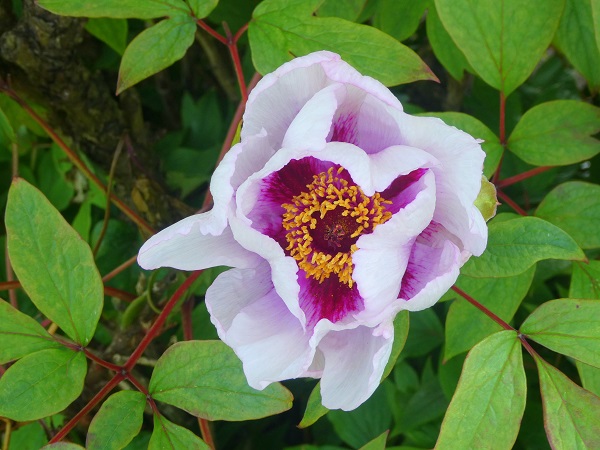
I'll stick my neck out and declare that not even Kew Gardens can compare with the peony walk of the Irish National Botanics in Dublin's comfortable northern suburb of Glasnevin. I certainly never saw this hybrid tree peony, Paeonia delavayi 'Anne Rosse' in London. And it turns out to be a native speciality: a hybrid of the yellow Paeonia delavayi var. ludlowii and a red Paeonia delavayi, raised by the Sixth Earl of Rosse at Birr Castle Gardens, County Offaly, Ireland and named after his wife. I've not seen it anywhere else, certainly not in Kew.

Said ludlowii, named after Londoner Frank Ludlow who found them in Xizang, Tibet,  in 1936 - North Yunan was the territory where Father Jeam Marie Delavey made his discovers in 1884 - was the only one producing a few flowers when we first visited close to the beginning of my two weeks in Dublin. Otherwise, there were promising buds, with the attractive oak grove behind the hedge as backdrop

where the grouind was carpeted with anemones that first Saturday.

The peony walk is so well planted, one one side the tree varieties with the O'Connell Tower of the extraordinary Glasnevin Cemetery - tourist attraction complete with cafe and visitors' centre - in the background, an 1858 homage to the medieval versions to be seen elsewhere in Ireland ('Rapunzel, Rapunzel' chanted a little girl who passed us as we were walking around it),

and on the other side the herbaceous varieties

which, a local told me, are a riot of colour in peak peony season. The shooting is always attractive - those first sentinels appearing in early spring - and so are the leaves and buds of the fernleaf peony (Paeonia tenuifolia)

which nearly a fortnight later were flanked by various types of narcisii 

forming interesting dialogues with their so-far smaller neighbours.

The one spectacular flower out in the herbaceous border was just emergent on Paeonia daurica subsp. macrophylla.

On this second visit (21 April) more blooms were in evidence along the tree-peony side: Paeonia suffruticosa 'Feng Dan Zi',

Paeonia rockii 'Zi Hai Yin Bo'

and plain (in nomenclature, not appearance) Paeonia delavayi.


But that hybrid Irish strain was the star of the show, both collectively - with the leafing of the oaks behind now also advanced - 

and in the variety of its individual flowers.


As I was talking to the local resident - a mine of information about wild-ish Irish gardens in the north - a peacock butterfly landed; it seemed rude to divert for a snap. But soon various bees were at the flowers


and for ocular proof that the butterfly was around and about, here's it is settling on the leaf mould below the peony trees 

where on the first visit a dunnock was rather well camouflaged.

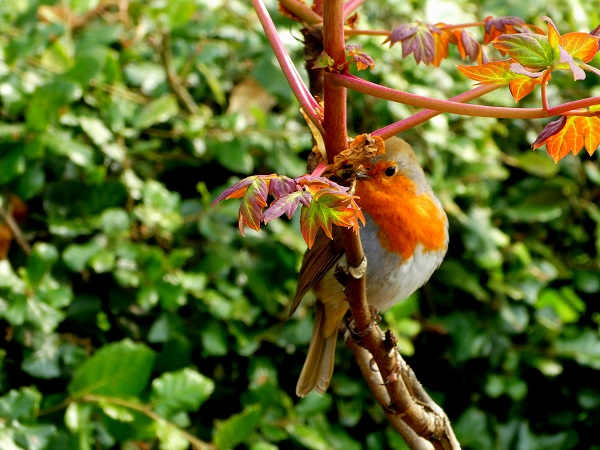
Robins are frequently impertinent inquisitors, but especially so here - I wish I could show the photo of the Other Half in conversation with one. But let's stick to an exquisite colour-clash

and a Peeping Tom.
As at Kew, peonies aren't confined to their special zone. There were more in the rock garden 


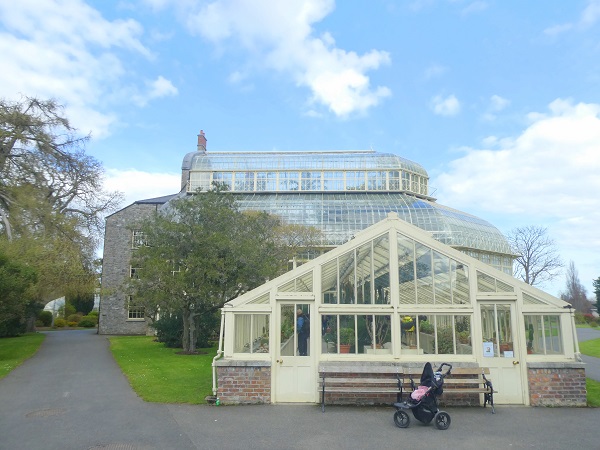
and a clump of Paeonia rockii just in front of the wrought-iron Curvilinear Range glasshouses.


By way of an extended coda, I should put up some snaps of these centrepieces at Glasnevin Botanics. The Curvilinear Range was designed by Dublin iron-master Richard Turner and built in 1849. Its 1990s restoration has received a Europa Nostra award for excellence in conservation architecture. The nearby Victoria House, previously containing the great water-lilies, is currently being restored. Anyway, palms against iron and glass

and a Strelitzia further on.

The Great Palm House was originally erected in 1884 


 and in its 20m high central zone feels more jungly within even than its counterpart at Kew.

I can well understand why Wittgenstein liked to come here (beyond keeping warm).

The east wing houses orchids,


the west wing cacti and succulents.


To the north, there are ponds

and waterways; the boundary here is the River Tolka.

And all this for free, a happy resource for everyone living in Dublin or visiting it (I count myself halfway between the two right now). Next stop: the glorious cliff walks to the north and south of Dublin Bay.

Friday, 27 March 2020

Adieu to Kew and Fulham Palace Gardens


What a shame people couldn't do the right thing and resist flocking in groups to the places that keep us sane. I hope I've scrupulously observed the social distancing but saw packs picnicking in both places. Well, there's still the bike, and the Royal Parks remain open for now - I understand a rumour about enormous Richmond Park closing was a misreading of roads through being closed to traffic (and what bliss it was on Wednesday to cycle up there and see stags in a stream - more Richmond Glen than Park. But that's for another post).

Anyway, I'm truly thankful for catching the onrush of spring while I could. While I made a conscious effort on Sunday to cycle down to Bishop's Park and Fulham Palace Gardens, knowing closure was imminent for all Hammersmith and Fulham enclosed spaces, it was serendipity that not only did I make the effort to get to Kew once or twice a week, and finally on Saturday, when there was no warning of what was about to happen (but again, I can't blame them).

First visit on a bitterly cold, showery, intermittently sunny February day, passing early-blossoming Prunus subhirtella 'Pendula rubra'


and carpets of the Greek Scilla forbesii (glory-of-the-snow) beneath the Temple of Aeolus


was mostly Alpine House, rockery and magnolia grove centric. Irises and Mediterranean tulips were flourishing outside, and these saxifrages


while under glass much was made of the heavenly-scented Narcissus papyraceus


and a couple of anemones were flowering early. Pulsatillas next.


Steps quickened,  as black clouds loomed beyond the sunshine, towards the magnolias. Coming from the north, the one you tend to see first is Iolanthe, beautifully budding.


Then there's the grove over the lawn, dominated on that first visit by Magnolia campbellii, the pink tulip tree. Trust the remarkable Joseph Hooker to be behind it. He introduced the tree to Kew in 1848, the information tells us, 'naming it after his friend Dr. Archibald Campbell, Political Resident at Darjeeling, India, as a result of an eventful expedition they took through the eastern Himalayas'.


Around the Big One, others were in various stages of flower and bud.


That ensured revisits. My second trip focused on Magnolia X loebneri, 'Raspberry Fun' (maybe stick to the Latin name)


while there were pearls on a line from Magnolia cylindrica


Magnolia X soulangeana further north


is more or less opposite Iolanthe, flourishing on that second visit.


and here's the other side of the pine, where Acer opalus, the Italian maple, is beginning to flourish.


Third visit was to catch the cherry blossom around the Temperate House, so heading south. The vegetation around the Temple of Bellona had evolved in a fortnight.


There are more magnolias here, including a high-towering soulangeana (understandably sub-specied as superba)


and a tree coming into leaf with which I wasn't familiar, Tilia heterophylla or White Basswood, from south-eastern America.


So to the cherry avenues. The one north of the Temperate House is still in bud, but my absolute favourite, the profuse and fluffy Yoshino (Prunus X yedoensis), was much frequented - it's often used as a background for shots of models. One with her photographer had cleared off by the time I took this.


In the apple-tree groves few were flourishing, but Malus x purpurea 'eleyi' was shining dark-red with the pagoda in the background.


Another glory is Prunus 'taehaku', the Great White Cherry', in front of the Japanese temple.


We have a man as remarkable as Hooker to thank for its survival. Captain Collingwood 'Cherry' Ingram. There's an excellent article about him by his biographer, Naoko Abe, in the latest Kew magazine. 'Taihaku' became extinct in Japan, but Ingram reintroducd it there from cuttings taken in Sussex. Down the slope there's a cherry bearing his name, 'Prunus Collingwood Ingram'.


More cherry trees flourish at the back of the Palm House,


and in 2017 a group from Gifu prefecture in Japan donated 35 Somei-yoshino trees  which flourish at the edges of the rose garden.


Heading back to the magnolia grove for the third and final time, I found to my amazement that the fritillary meadow had sprouted. There was nothing but grass the previous week, and here were those most fascinating of flowers with their snakeshead/chess-board patterns, in abundance.


One public asset is staying open for the foreseeable future - the park of Chiswick House. The walk there from home took us along a jogger-laden riverside, admiring the gardens separated by the road from their houses on Chiswick Mall, with the curious little eyot beyond.


There's a clump of bushes and shrubs where I always hear the most vocal of blackbird song, but that day it was robin singing its little heart out.


We did our usual circuit of the lake over the splendid bridge, with bird activity lively as ever, and daffodils opposite the back of the temple.


The cafe was still open then - I had a good distance chat with the Polish manager, who said how proud she was of the staff's adapting to (even) higher levels of hygiene, and how good it was to have the park to walk through on her way to and from work - but the camellia house not, for obvious reasons. Soon the wisteria outside it will be blooming in spring's next stage.


but at least there are splendid specimens outside


and quite a few around Fulham Palace.


My farewell visit was too late for the walled garden of Eden, as I always call it (maybe it hadn't opened that day at all),


but not to walk around the outside, for which I'm grateful not only for different perspectives over walls and through gates


but also for the discovery of what had been done to the former no-man's-land between the churchyard and the entrance on that side, a wonderful planting of daffodils


and, thanks to a couple of feeders, a fine presence of birds. I thought this was a goldfinch, but the colourings aren't quite right. UPDATE: Robin Weiss in a comment has identified it as a chaffinch - very common bird, but I wasn't familiar with it beyond the name.


Horse chestnut in the drive beginning to flourish, and that's a farewell to the roof of the palace for now. We're lucky that this is early spring and not autumn declining into winer, to still have our one-a-day exercise, and to be able to take it - in the case of those who can get there without public transport - in the Royal Parks. There was decent space in Kensington Gardens yesterday.