Showing posts with label fritillary. Show all posts
Friday, 27 March 2020
Adieu to Kew and Fulham Palace Gardens
What a shame people couldn't do the right thing and resist flocking in groups to the places that keep us sane. I hope I've scrupulously observed the social distancing but saw packs picnicking in both places. Well, there's still the bike, and the Royal Parks remain open for now - I understand a rumour about enormous Richmond Park closing was a misreading of roads through being closed to traffic (and what bliss it was on Wednesday to cycle up there and see stags in a stream - more Richmond Glen than Park. But that's for another post).
Anyway, I'm truly thankful for catching the onrush of spring while I could. While I made a conscious effort on Sunday to cycle down to Bishop's Park and Fulham Palace Gardens, knowing closure was imminent for all Hammersmith and Fulham enclosed spaces, it was serendipity that not only did I make the effort to get to Kew once or twice a week, and finally on Saturday, when there was no warning of what was about to happen (but again, I can't blame them).
First visit on a bitterly cold, showery, intermittently sunny February day, passing early-blossoming Prunus subhirtella 'Pendula rubra'
and carpets of the Greek Scilla forbesii (glory-of-the-snow) beneath the Temple of Aeolus
was mostly Alpine House, rockery and magnolia grove centric. Irises and Mediterranean tulips were flourishing outside, and these saxifrages
while under glass much was made of the heavenly-scented Narcissus papyraceus
and a couple of anemones were flowering early. Pulsatillas next.
Steps quickened, as black clouds loomed beyond the sunshine, towards the magnolias. Coming from the north, the one you tend to see first is Iolanthe, beautifully budding.
Then there's the grove over the lawn, dominated on that first visit by Magnolia campbellii, the pink tulip tree. Trust the remarkable Joseph Hooker to be behind it. He introduced the tree to Kew in 1848, the information tells us, 'naming it after his friend Dr. Archibald Campbell, Political Resident at Darjeeling, India, as a result of an eventful expedition they took through the eastern Himalayas'.
Around the Big One, others were in various stages of flower and bud.
That ensured revisits. My second trip focused on Magnolia X loebneri, 'Raspberry Fun' (maybe stick to the Latin name)
while there were pearls on a line from Magnolia cylindrica
Magnolia X soulangeana further north
is more or less opposite Iolanthe, flourishing on that second visit.
and here's the other side of the pine, where Acer opalus, the Italian maple, is beginning to flourish.
Third visit was to catch the cherry blossom around the Temperate House, so heading south. The vegetation around the Temple of Bellona had evolved in a fortnight.
There are more magnolias here, including a high-towering soulangeana (understandably sub-specied as superba)
and a tree coming into leaf with which I wasn't familiar, Tilia heterophylla or White Basswood, from south-eastern America.
So to the cherry avenues. The one north of the Temperate House is still in bud, but my absolute favourite, the profuse and fluffy Yoshino (Prunus X yedoensis), was much frequented - it's often used as a background for shots of models. One with her photographer had cleared off by the time I took this.
In the apple-tree groves few were flourishing, but Malus x purpurea 'eleyi' was shining dark-red with the pagoda in the background.
Another glory is Prunus 'taehaku', the Great White Cherry', in front of the Japanese temple.
We have a man as remarkable as Hooker to thank for its survival. Captain Collingwood 'Cherry' Ingram. There's an excellent article about him by his biographer, Naoko Abe, in the latest Kew magazine. 'Taihaku' became extinct in Japan, but Ingram reintroducd it there from cuttings taken in Sussex. Down the slope there's a cherry bearing his name, 'Prunus Collingwood Ingram'.
More cherry trees flourish at the back of the Palm House,
and in 2017 a group from Gifu prefecture in Japan donated 35 Somei-yoshino trees which flourish at the edges of the rose garden.
Heading back to the magnolia grove for the third and final time, I found to my amazement that the fritillary meadow had sprouted. There was nothing but grass the previous week, and here were those most fascinating of flowers with their snakeshead/chess-board patterns, in abundance.
One public asset is staying open for the foreseeable future - the park of Chiswick House. The walk there from home took us along a jogger-laden riverside, admiring the gardens separated by the road from their houses on Chiswick Mall, with the curious little eyot beyond.
There's a clump of bushes and shrubs where I always hear the most vocal of blackbird song, but that day it was robin singing its little heart out.
We did our usual circuit of the lake over the splendid bridge, with bird activity lively as ever, and daffodils opposite the back of the temple.
The cafe was still open then - I had a good distance chat with the Polish manager, who said how proud she was of the staff's adapting to (even) higher levels of hygiene, and how good it was to have the park to walk through on her way to and from work - but the camellia house not, for obvious reasons. Soon the wisteria outside it will be blooming in spring's next stage.
but at least there are splendid specimens outside
and quite a few around Fulham Palace.
My farewell visit was too late for the walled garden of Eden, as I always call it (maybe it hadn't opened that day at all),
but not to walk around the outside, for which I'm grateful not only for different perspectives over walls and through gates
but also for the discovery of what had been done to the former no-man's-land between the churchyard and the entrance on that side, a wonderful planting of daffodils
and, thanks to a couple of feeders, a fine presence of birds. I thought this was a goldfinch, but the colourings aren't quite right. UPDATE: Robin Weiss in a comment has identified it as a chaffinch - very common bird, but I wasn't familiar with it beyond the name.
Horse chestnut in the drive beginning to flourish, and that's a farewell to the roof of the palace for now. We're lucky that this is early spring and not autumn declining into winer, to still have our one-a-day exercise, and to be able to take it - in the case of those who can get there without public transport - in the Royal Parks. There was decent space in Kensington Gardens yesterday.
Saturday, 13 April 2019
Iffley on the Isis
'Isis' as in the Thames from its source in the Chilterns to Dorchester in Oxfordshire, but more specifically in the environs of Oxford. I should have followed its route years ago from near Christ Church Meadows up to this prettiest of villages - swamped at weekends, I'm told - and one of our most remarkable churches. We approached it on this occasion from the new home of our friends (and newlyweds, though far from newly together) Juliette and Rory, Fellow of Magdalen College, where he currently teaches in the Department of Oriental Studies, though soon he'll be off to take up a new post at Durham University. Very tempting that you can be out in the country within five minutes. I'd especially wanted to see Iffley Meadows which, like Magdalen, are famed for their fritillary display at this time of year, but in neither were the snakeshead bells flourishing. In fact we didn't see a single one other than in someone's front garden, but at least I'd had my vision in Kew a few days earlier.
Iffley soon looms into view with the church beacon-like above the Isis
and you approach via a series of bridges
and islets with a series of locks, an attraction in itself, before walking up the hill to the Church of St Mary the Virgin. We ended up approaching it from above, with a good view downwards to the Rectory, the ground plan of which is 12th-13th century, though its (Tudor?) brick chimneystacks are the most impressive feature from the outside.
Primroses were flourishing in the shade as we approached from the north-east what Pevsner calls 'a magnificent little church, lavishly decorated with sculpture'.
The first door you see from this side is the north one, of three from the time of the church's building (1170-80, courtesy of the wealthy St Remy family), with scallop capitals - plain compared with what's to come, though treasurable enough in itself.
Then you round the corner and are struck by the fabulous west door pictured up top. The ensemble looked like this in the 1830s
and you'll see that the Perpendicular Gothic window has now been replaced by what is deemed 'a successful reconstruction of the original Romanesque oculus, carried out by the architect and antiquarian J. C. Buckler in 1856' (the church guide I bought is superb and well illustrated, though a bit pricey at a fiver).
Not quite sure about the application of limewash to this and the south door. It was applied in 1981, with a 'new sheltercoat by Sally Strachey Historic Conservation' added in 2017.
The gable was raised in 1845; the detail around the top window is in tune with the authentic work below.
As the guide neatly describes it, 'the ceremonial doorway at ground level is flanked by blind niches with moulded arches. This doorway has three continuous orders, one decorated with chevron, one with beakheads on a spiral roll moulding and the third with beakheads on a plain roll', best seen here
and, later when the sun was fully on them, the two orders of beakheads in closer range.
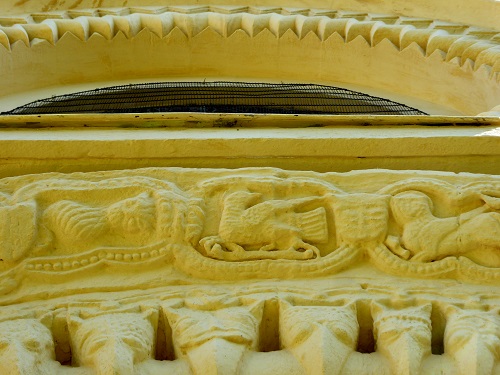
Around and above are medallions containing sculptured figures and beasts, starting in the above photo with Aquarius, Pisces and Virgo. Close up on Virgo with ?gryphon? below.
In the centre, a dove (for the Holy Ghost), followed by the Lion of St Mark.
Now let's head in through that door, now the main entrance of the church. leaving J, Juliette and Rory in the sunshine on a bench where one could spend many happy hours with a good book - on a quiet weekday, at any rate (and no-one else came or went for the whole time we were there).
Looking east, the whole is of unity and a rich perspective which the photo doesn't quite capture, looking towards the sanctuary through two tower arches with Tournai marble octagonal shafts.
The first 'cell' as approached this way is the Baptistery. There's a fine unsculpted font, also in Tournai marble, and the rose window glass is fine, of 1856 by the firm of John Hardman & Co, but in tune with medieval precepts.
Much more remarkable, though, are the two contemporary artworks which fill the Romanesque windows here. In the north window, Iffley resident Roger Wagner's inspiration happily mixes Christ on the cross, a tree in May blossom and the river of life.
Especially felicitous is the flock of sheep by the river under the blossom. Very Samuel Palmerish in design if not in colouring.
Opposite it is the more famous design of John Piper, a very unusual treatment of the Nativity executed by David Walsey. At its foot there's a quotation from Christopher Smart's 'Rejoice in the Lamb' (set to music by Piper's good friend Benjamin Britten), and in this Tree of Life, the cockerel crows 'Christus natus est' ('Christ is born'), while the goose asks 'Quando? Quando? ('When? When?'), the rook replies 'In hac nocte' ('On this night'), the owl hoots 'Ubi? Ubi?' ('Where? Where?) and the lamb baas 'Bethlehem! Bethlehem!'. I'd seen a reproduction before but didn't know it was here.
I missed the Gothic angel high up in the Nave - a detail of this fine one in Oxford's oldest parish church, St Michael, which I visited the previous afternoon, will have to do -
but not the Coat of Arms of John de la Pole after his marriage in 1452-3 to Elizabeth, sister of Edward IV and Richard III (hence the Tudor rose).
Here's a view looking westwards from the tower
and beyond is the Romanesque sanctuary (now the chancel) with its fine boss at the centre of domical vault, depicting a winged serpent entwined and animal heads at each of the cardinal points, and pinecones pointing outwards towards the chevroned vaulting.
The sedilia seems to have been installed late in the 13th century, after the death of the anchoress Annora. Her cell may have been behind where the aumbry and piscina (beyond) are now.
And so out into the brighter light - though the church is far from dark on a sunny day - and to examination of the third glorious door, on the south (also limewashed).
Its fine state of preservation may be due to the fact that it stood within a porch which was removed in 1807. Here, as in the north door, there are three orders and a band of rosettes, but again the detail is fascinating. Here you might make out Samson and the lion, Ourobouros and a bird with a snake (in the slightly over-exposed middle band),
Curiouser are a merman,
a green cat (rather than a green man)
and a beast seemingly trapped behind a pillar.
And so we strolled back down to the Isis
and walked back along the other bank to lunch with Juliette and Rory, after which we went our separate ways - J in a cab to the station, I along the river this time Oxford bound, to catch the trusty Oxford Tube.
Soon the dome of the Radcliffe Camera and the tower of St Mary came in sight, with Merton Chapel's tower through the trees
and Magdalen's, the noblest, across Christ Church Meadows.
I passed Christ Church
where the previous evening we'd heard half of a superb Evensong with the choir still in residence (though university term time had ended, the cathedral school boys keep this one going). There I heard for the first time Kenneth Leighton's Mag and Nunc of 1959 (his 'Magdalen Service', no less); you hear where MacMillan, a slightly older contemporary of mine at Edinburgh University, got some of his juicier chord sequences from. The Leighton work is counterintuitive in that neither Gloria is a blaze, but they're all the better for that. And why only half a service? Because we were due at Worcester College at 7 for a dinner to celebrate the Irish presence in the Oxford Literary Festival, and I'd forgotten that Saturday evensongs are longer than the ones in the week.
So - returrning to the Sunday retreat - round towards Magdalen
and time for a quick spin around the Botanic Gardens, courtesy of my Kew card. They're slow to come to life in early spring, as I remember from previous occasions, but there are the daffs, of course, Merton tower in the distance,
some splendid miniature tulips on the Alpine rockery
and the last of the magnolias in profusion (I realise I haven't bored you with the magical glade in Kew Gardens yet).
In 24 hours we found ourselves in front of another fine church facade, this time that of the Duomo in Sarzana, quickly reached from Pisa Airport en route to Lerici and Tellaro on the Ligurian coast. But that chronicle is for another day.
Subscribe to:
Posts (Atom)