Saturday, 12 March 2011

Those Figners


That's the by all accounts outstandingly musical but - on the recorded evidence - not exactly rock-solid tenor Nikolay and his Florence-born wife, Medea Mei-Figner. There they are flanking Tchaikovsky, for whose Queen of Spades they created the roles of Hermann and Lisa (they were also the first Vaudemont and Iolanta).

Why my interest all of a sudden? Because having embarked on Rimsky-Korsakov's vocally rewarding Tsarskaya Nevesta (The Tsar's Bride) with the City Lit students, we were all smitten with the invention as well as the performance of the Act 1 Lyubasha/Gryaznoy duet as sung by Borodina and Hvorostovsky. Of course the descending scales must be indebted to Tchaikovsky's example, but it reminded me of something else, which eventually came to me - Amneris and Radames in Act Three of Verdi's Aida. Checked performances in Russia, and found that not only was Aida first performed at the Mariinsky in the mid-1870s - dates conflict - but that the Figners sang in it together on one of the many revivals.


I'm assuming that the plumptious Medea sang Aida, though since she was trained as a mezzo, it could have been Amneris. On recordings kindly copied for me by the indefatigable Roger Neill, she emerges - in Lisa's midnight aria - with greater honours than her husband, who gets rather amusingly shouty at the end of a number from The Oprichnik. But we're lucky to have these recordings, from 1901, at all. And thanks to Roger, and his friend Roger Beardsley, for another splendid disc I'm listening to at the moment, of great folk and classically-trained singers, from Plevitskaya and Kruszelnicka to Chaliapin and Smirnov in traditional numbers. And here, as I write, is Chaliapin in 'Stenka Razin' - I had no idea that was the original of 'The carnival is over'.


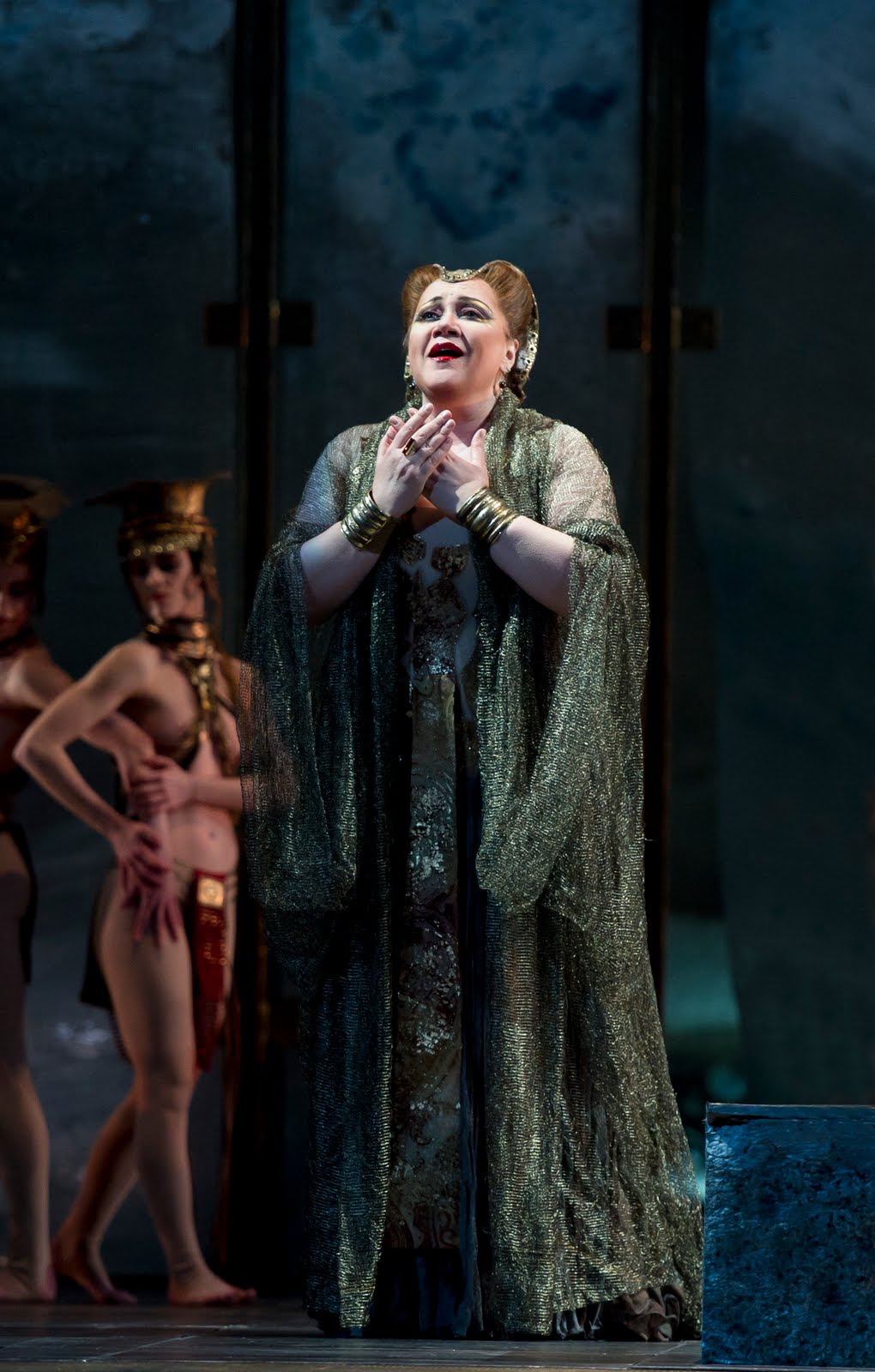
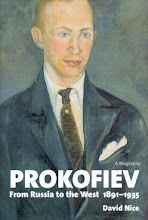
Anyway, The Tsar's Bride (can't resist reproducing again the gorgeous cover of my vocal score) has so much good music tied up in an impossibly melodramatic, why-should-we-care plot. Much like Aida, in fact. And there last night at Covent Garden, in the revival of one of David McVicar's less interesting efforts, was Borodina producing her usual incredible vocal lustre but barely moving. Ditto Alagna - see the Arts Desk review. Here's our stately Amneris, anyway, in the first of two production images for the Royal Opera by Bill Cooper.


You could hardly, on the other hand, blame Liudmyla Monastyrska for doing the bare minimum; she was a last minute replacement for the Aida of Micaela Carosi, who pulled out pleading pregnancy(?). Monastyrska's is a major voice - I haven't had such a thrill from a laser-soprano in an ensemble since Dame Gwyneth, and she can do all the soft stuff too with what seems like a rock-solid technique. That augurs well, as I wrote, not just for her Lady Macbeth, due later this season, but also for a potential Brunnhilde. And when did that last happen? Here she is with Alagna in a visually unatmospheric but musically transporting tomb scene.

Thursday, 10 March 2011

Apocalypse Lear


It doesn’t get much bleaker than the end of Grigory Kozintsev’s King Lear, released in the USSR in 1970 (well, perhaps there’s one exception – Klimov’s horrifying anti-war film Come and See). Silence, cinematography, landscape, music (by one D Shostakovich – the last of his 40 or so film scores), sound-montages, speech, silence again…is it possible to go further than this in the perfect, distilled marriage of all these elements?

On Tuesday evening, prior to the BBC Symphony’s Maida Vale performance of excerpts from the score tomorrow, I showed those last 23 minutes to the students, and all, I think, were stunned. One particularly commended the duel between Edmund and a disguised Edgar: no music beyond the fanfares at the beginning, few blows, much of it out of sight, and yet so brutal, culminating in an extraordinary angle on Edmund dying on the ground, upside down as it were. The burning of the settlement around the huge castle – in Estonia, I believe – takes place to the same wailing unaccompanied chorus that starts up when Edgar buries Gloucester (the sequence at the foot of this entry unfortunately starts after that – here's a glimpse of the cracked landscape through which dying father and disguised son walk).


Lear’s howls resound from a distance, high up on the battlements; Cordelia hangs above a rushing river, the camera then lingering on its eddies once her body has been cut down and removed. And the ending is better than in any staging of the play I’ve seen (though Michael Grandage's recent production starring the unsurpassable Derek Jacobi was as clear and stark as any) – the fool playing his pipe (E flat clarinet) while Edgar wanders blankly through the ravaged town.


The music, too, is distilled genius by a composer who, like Kozintsev and his one-time collaborator Leonid Trauberg (pictured with him below), lived through the major upheavals of the Russian 20th century. All three were there, too, at the birth of sound film; their first collaboration, the extraordinary Noviy Babylon of 1929, was devised with a live orchestral accompaniment, in which form it sometimes still resurfaces; Odna (A Girl Alone) exists in two versions.


I love every instalment of their trilogy about cheeky proletarian and freedom-fighter Maxim; even when the agitprop gets stronger in the mid-1930s, you still love the central character. A shame there doesn’t yet exist a DVD with English subtitles, but this one will do.


And so, passing over decades of what was perforce much hackier film work, Shostakovich arrived at Kozintsev’s Hamlet and Lear. The first may have the edge in the compelling central performance of Innokenty Smoktunovsky (though Yury Jarvet looks amazing as a wizened gnome king with unsuspected reserves); but the last masterpiece is a fusion that goes even beyond even Eisenstein’s work with Prokofiev on Alexander Nevsky and Ivan the Terrible, in that Shostakovich’s skeletal music really is undetachable from its context. A total work of art, gripping from first image to last. Here's the final sequence. Don't forget to double-click on the moving image if you want the full screen, widescreen effect (essential).

Tuesday, 8 March 2011

Plus ça change


It was admirably bloody-minded of gay filmmakers Olivier Ducastel and Jacques Martineau to forge an epic in which the subject closest to their hearts doesn't rear its head until half way through. Born in 68 is, for its first hour or so, the tale of a beautiful woman (played by the luminous Laetitia Casta) torn between two men when she goes to live in a country commune following the student uprisings in Paris.


She has two children by one of them; the other continues to lead a fraught resistance against authority; the parents part; the children grow up. Which would all be the stuff of pure soap were it not for the fact that, like Heimat if without quite the same ambition, Born in 68 draws telling parallels and symmetries in history, in this case between the freedom-fighters of '68 and the son's Act-Up activities nearly twenty years later (this is where one of the filmmakers' direct experience kicks in).


I can't really imagine what the extended telly version must be like, but the very long film certainly has its fascination once you get used to the pace and the two wings of the action. It's especially rich when the children diverge, the daughter choosing a relatively conventional marriage to go against everything her wild-child mother stood for. Casta ages well, her grief-ravaged face speaking volumes about the hopeless love that's wearing her down, and most of the conversations have the ring of truth. I thought it was done, by and large, with lightness of touch; J found the signifiers of time passing - oh look, a big mobile phone, and is that the first laptop? - a bit overdone. But its heart and its performances are all in the right place. And how could one not wish to see everything made by the directors of the exquisite, and at times very sexy, Drole de Felix?

In the meantime, we've finally been swept up by even finer ensemble work in the first series - at least five more to go, I understand - of The West Wing, since I picked up a box worth of 44 episodes for a fiver from the local charity shop.


I know that to the converted I'm probably going to sound like someone who announces that e-mail is a wonderful thing, you should try it, but anyway: here's slick, witty characterisation, people you can care about, a bit of eye candy (Rob Lowe) and a performance of screwball-comedy grace from Allison Janney, as well as perfect set pieces, from monologues to septets, all giddyingly well stitched together. The only thing that jars for me is the saccharine score, which is so much more conventional than the script and makes the sentimental moments seem gluier than they are; but even that couldn't too much disfigure the episode we've just reached, about the state dinner for the visiting Indonesian dignitary, which is absolutely consummate in its changing tones from ironic start to emotional quiet curtain.

All this was balm to the spirit last night when I returned home prematurely from my first and last brush with a residents' committee - believe everything you're told about the backbiting, the defensive hostility towards newcomers, the pettiness - to watch more congenial White House round tables and to wish I belonged to them.

Sunday, 6 March 2011

Tyrolean with massage balls


This is one of the most engaging composers of my generation - heck, he's even a bit younger than I am: Innsbruck-born and mountain-based Thomas Larcher, whose overwhelmingly dramatic Violin Concerto had its first UK performance at the Barbican on Friday with the glorious violinist who gave the Vienna premiere, Isabelle Faust, and the phenomenally gifted Kazuki Yamada, also turning up in London for the first time with the BBC Symphony Orchestra, who seem to adore him.

I went over the top trying to give my impressions of the concerto on the Arts Desk, so I won't expand here except to explain that the massage balls are rolled around the piano strings towards the eerie end of the piece (apparently you can hear the effect a lot better in one of Larcher's chamber works, which I can't wait to discover, and maybe on the iPlayer broadcast of the concert - you have five days left to listen; don't miss any of it).

I met Thomas for ten impression-packed minutes of my pre-performance talk, having earlier been misinformed that he wouldn't be appearing as his English wouldn't be up to it. Regardless of the fact that it was bound to be better than my German, nothing could have been further from the truth: he speaks clearly, directly and idiomatically, a composer completely sure of his aims and effects, though never in a big-headed way (he's also a very fine pianist, student of my goddess Elisabeth Leonskaja in Vienna).

We talked about the expanding and contracting effects of time in the piece, its two riveting dramas - I'd just heard it for the first time in rehearsal - and the inevitable impact of the mountain scenery onto which Larcher looks most days from what the programme biography told us is an 'architectural prize-winner' of a modernist home. That left me a mere quarter of an hour to go through some of the more remarkable features of the Rachmaninov Second Symphony, but the stepwise, orthodox chant-based element did seem to strike some of the audience as novel (those, that is, who didn't get up and clear off after the little composer interview, bit rude, I thought, especially as they couldn't have told then if I was going to be boring or not).

The BBC Symphony Orchestra have been on a real roll, starting the year with John Wilson in Hollywood classics and reaching a zenith of hard work - sectional rehearsals and all - for the Ferneyhough day which was so enthusiastically received by my idiosyncratic colleague Igor on The Arts Desk (I couldn't pass the chance to see Turnage's Anna Nicole that evening). In fact as I was ennumerating the orchestra's various triumphs with the Elgin Trio from the orchestra, who came to play for my lucky class on Tuesday, their viola-player, Kate Read, said how good it was to actually think it over and realise, yes, it's been good - they're so busy not just with the concerts but also with studio recordings (including, that very day, Delibes' gorgeous Sylvia ballet music with Yamada) that they rarely have time to take stock. Here, anyway, are the Elginers in the far from dreary City Lit board room where we meet - Kate centre with violinist Anna Smith and cellist Michael Atkinson.


They played through elements of the programme they're giving on the last Saturday of the month - I need to check details - an early, mostly Mozartian Schubert trio movement; the first and last movements of Martinu's first, mostly fierce and not easily identifiable-as-him string trio from his Paris years; and ineffably beautiful arrangements of Bach's three-part inventions; if anything, the F minor No. 9 sounds even more expressive on strings than it does on the keyboard. As I said, I'd be happy to have that at my funeral - not that I'm planning on going anywhere, and in any case the list changes from month to month... Told viola-playing Ruthie in Edinburgh about these, since her quartet is temporarily a trio, and they took them up immediately with delight, already having the trio-version of the Goldberg Variations in their repertoire. Dmitri Sitkovetsky's recording of his now celebrated version, 'in memoriam Glenn Gould', with Gerard Causse and Misha Maisky, is one of the CDs I take off the shelves most regularly.

Saturday, 5 March 2011

Five times round the Sand-walk


Four of us only managed the one circuit when we visit the Darwins' Down House in the Weald of Kent over a week ago, just before the gardener came to tell us that closing-time approached, but the great man habitually walked around his 'thinking path' five times a day at noon, striking the iron tip of his walking-stick rhythmically on the ground.


The Sand-walk was very much Darwin's intellectual property, as granddaughter Gwen Raverat wrote in her childhood memoir Period Piece:

It was a path running round a little wood which he had planted himself; and it always seemed to be a very long way from the house. You went right to the furthest end of the kitchen garden


and then through a wooden door in the high hedge, which quite cut you off from human society. Here a fenced path ran along between two great lonely meadows, till you came to the wood. The path ran straight down the outside of the wood - the Light Side - till it came to a summer house at the far end [it's been replaced by a sheltered seat]; it was very lonely there; to this day you cannot see a single building anywhere, only woods and valleys [still true].


The path then turns to the left and loops along what Raverat as a child called 'the Dark Side, a mossy path, all along the trees, and that was truly terrifying'. She cites a hollow ash and an elephantine beech tree as the biggest horrors of the place.


Clearly more of a comfort in the 1890s was the mulberry tree which grew up against thw windows of the nursery: 'the shadows of the leaves used to shift about on the white floor, and you could hear the plop of ripe mulberries as they fell to the ground'. Too early for that in late February, but the gnarly skeleton of the propped-up tree is impressive in itself.


One more arboreal specimen impressed us before we headed back for the suburbia of Orpington - the one at the very centre of Downe village. I was too preoccupied with sorting out a timetable crisis - the youngest member of our party didn't have the energy to walk back another three and a half miles the way we come - to check out what it was, but clearly it's a beauty, even if the shoots have that peculiarly living quality Darwin notes in his insectivorous plants.


The bus situation may have been in a state of confusion, but the last kindness of the day was the driver ushering me on when my Oyster card - yes, we were still on the London fringes - had run out of juice. It was curious to see, and be seen by, the suburban world in the disguise of a respectable putative father, to find out how much nicer most people are to you - in this country, at any rate - if they think you're a family man with wife and kids in tow than if you happen to be two men, obviously a couple, together. Sad but true, though I don't think it pertains in the metropolis proper.

Thursday, 3 March 2011

A masterclass in titwillow'ry


Richard Suart (pictured above with Anne-Marie Owens in the first of Chris Christodoulou's images for English National Opera reproduced here) slipped in to the Jonathan Miller Mikado under the presumably small feet of Bill Oddie back in 1988, two years after its first airing. Which of course makes this classic of the operatic world a veteran production at 25 - I've written about this at length in the programme and on The Arts Desk - and though there were one or two things which could still have been brought into tighter focus when I saw the revival last night, Suart's Lord High Executioner is certainly not among them; custom has not staled his infinite comic variety.

Credit for a couple of the gags - Ko-Ko licking the Mikado's shoes, pure Monty Python, and, having been pressed to Katisha's ample bosom, spitting out a couple of her pearls - seems to have originated with the first Lord of the Chopper, Eric Idle. But I'm guessing Suart has built on the part in many ways since those two December '88 performances. Of course his ever-adapted little list is now a sacred and still hilarious rite (the audience applauded Berlusconi's 'bunga bunga' and a last-minute reference to the equally unfunny pronouncements of John Galliano last night). I can only say yet again that Suart's book on the subject in conjunction with A S H Smyth, They'd none of 'em be missed, is a delight from cover to cover and beautifully produced. But I did reel in admiration not just at the Lewis Carroll absudity of Gilbert's lyrics for the ballad of tit-willow - imagine a bird suffering from cold perspiration and a rather tough worm in his little inside - but also the new creativity brought to it last night.


It's treated as a cautious exercise in winning over the Margaret Dumontish Katisha (Owens, it has to be admitted, had some difficulty in manoeuvring her ample mezzo around the text and being heard, though my friend Clare's young son, who loved Trovatore at Covent Garden, observed that she was surely the only singer on the stage capable of 'doing dark and heavier opera'. Well, Donald Maxwell, the Pooh-Bah, used to sing Wozzeck, but that was some time ago). In a stroke of genius, when the 'echo arose from the suicide's grave', it's Owens who sings the 'tit willow'. She's hooked at last, and Suart's hitherto abject Ko-Ko waxes Pythonsequely confident.

It was such fun being part of the 45 minute whistlestop Join the Conversation Live event expertly guided as ever by Christopher Cook up in the Coli's balcony bar (yes, we've moved from the wacky set-up in the noisy Apple Store - scroll down to read about the last event I participated in there. CC actually asked me then about Parsifal, and I said that though I know it well, I'd actually rather talk about The Mikado). I was there loftily to draw comparisons between Sullivan and Puccini: 'The sun whose rays' is as much of a mostly-pentatonic master-aria as Liu's 'Signore, ascolta'). And you could have knocked me down with a horse-feather when my fellow panellist, Michael Simkins, told me he'd played Pish-Tush in Mike Leigh's masterpiece of let's-put-on-a-show thespian shenanigans Topsy-Turvy (time to get it on DVD and watch it even more carefully).


So Mike's achievement quite casts my junior efforts as Sir Joseph Porter and my endlessly recycled Nightmare-Song party trick in the shade. Even so I was quite amused, touched even, listening back to my patter of 1973 with the army of recorders and cellos (the only 'serious' instrument taught at Banstead Junior School) as accompaniment.

We also had a tasty appetiser from the Pish-Tush of the evening, William Robert Allenby, covering Ko-Ko and delivering for us the little list as originally set by Sullivan. He was allowed to make much of his relatively small role in the show itself, and I thought it was jolly nice of him after the talk to address my friend's two children, who of course had a whale of a time, especially with the special-guest wigmakers (Allenby explained that he was the only person on stage with his own hair, cut into Bertie Woosterish style by a lady of the wardrobe). Everything still looks dazzlingly beautiful in its crazy way, and it's a long time since I've heard an audience applaud a stage tableau, as they did when the curtain went up on the braiding of the raven hair at the start of Act 2.


By the way, the dressing-room board of pictures the staff brought with them to the talk included a droll composite picture of Felicity Palmer playing Margaret Dumont to Groucho Marx. Yesterday I took delivery of the Bell Telephone Hour potted Mikado of 1960 starring the great Groucho - Ko-Ko to glorious former Isolde Helen Traubel's Katisha (God, that woman was a marvel, from her 1930s Wagner Wesendonck Lieder with Stokowski through to a genuinely funny duet with Jimmy Durante in the 1950s as well as this). Their scene together is one highlight; Stanley Holloway's drolly low-key Pooh-Bah is another. The abridgement can be frustrating, but it's a curiosity well worth having.


Anyway, what a timeless work of genius The Mikado still is: I don't think there's a single line of dialogue which doesn't really fit today, even if a few need footnoting. Remember I grew up knowing most of this by heart, and it really was as fabulous a verbal education as going on to learn Latin or Greek. Not every singer is a natural at the spoken word in this revival, though all sing very well indeed: Donald Maxwell's Scots dignitary Pooh-Bah doesn't quite get the laughs in the right places, and though Alfie Boe moves well, he slightly gabbles his lines. But he makes a spiffing, gormless foil for Sophie Bevan's hard-as-nails Yum-Yum - really excellent in the dialogue, consummate as she has to be in her little ray of sun- and moon-shine - and they dance well, too.


You'd have thought Richard Angas's Mikado was a hundred now, but he too puts across the text with charm, and I love the slightly furtive delivery of 'My object all sublime'.


Conductor Peter Robinson handles the lovely woodwind solos well but could move it all along a bit more zingingly, a la Mackerras. Even so, the dancing is huuuge fun and the gags still work. This is a show ENO simply won't be able to replace, and although it seems to me that Miller quickly fell into wish-I-was-back-in-the-world-of-medicine diffidence, his Mikado and Rigoletto remain testaments to a once-sharp sense of luxuriant imaginative detail.

I put up this documentary on the making of the original show at the foot of the Arts Desk incarnation of the programme article, but there's certainly no harm in having it to hand here. Dig those 80s fashions...

Tuesday, 1 March 2011

The Darwins at Down House


Though contented with my lot, I'd rather like to have been a son of that noble being Charles Darwin, and to have grown up in the ordered but often playful atmosphere of the house he lived in with his wife Emma and their children from 1842 until his death 40 years later. Yes, there were the all too familiar tragedies of Victorian child mortality - the death of ten-year old Annie is so sensitively covered in that underrated wonder of a film Creation, while Charles Waring Darwin only lived for two years. But by and large it must have been marvellous to grow up under the wing of so clear-sighted and enthusiastic a lover of the natural world, a genius who always had time for good people and his own children.

Maybe I sentimentalise overmuch. But nothing in Darwin's lucid and loveable Recollections leads me to believe otherwise, and Down House is an enchanting place, now in the not over-fussy care of English Heritage. 'I was pleased', he writes in that short, modest autobiography, 'with the diversified appearance of the vegetation, proper to a chalk district, & so unlike what I had been accustomed to in the midland counties; and still more pleased with the extreme quietness and rusticity of the place.'

That pertains even now; the many half-term visitors last Thursday seemed to be absorbed into the calm atmosphere. I went on a day-trip with friend Clare and her two children. It was - ah, how short-lived - a mild and eventually sunny early Spring day. We walked there from the very fringes of south-east London suburbia, getting out of the train at Orpington station, with a first stop at the village of Farnborough. There the sprawl finally stops just as you reach the church on the hill with its huge ancient yew and fanciful gravestones (here are the children, delighted to find their family name on several tombs, reading an inscription).


Sadly the church was locked, as was the one in the even prettier village of Downe itself (the 'e' was added in 1850 to distinguish it from its Irish counterpart).


We took a steady amble there via fields, woods and lanes, past clumps of snowdrops by the stables of High Elms (now one of many golf courses in the vicinity) with a pretty clock tower


loving the lichen, the catkins and the old man's beard.


They've done a fine job at Down House of explaining the great man's extraordinary life in a series of exhibitions upstairs, which are worth spending a long time mulling over before you descend to the recreated family rooms. Briefly a girls' school, which moved premises in 1921 but kept its name, the grounds only passed into English Heritage hands in 1996 and were reopened to the public two years later. Thanks to co-operation with many other Darwin-related institutions, chiefly the Natural History Museum, they lodge many of his most treasured notebooks, specimens, books and tools of the trade here. Clearly the most impressive room is the study, rather dark and sombre as it faces east, as opposed to the rooms on the west side (chiefly the Drawing and Dining Rooms) which thanks to sundry extensions and alterations allowing big windows are flooded with light. No photos to be taken inside, reasonably enough, so I've taken English Heritage's silence on reproducing a study shot as consent, hoping that a link to their website will suffice.


The areas around the not especially attractive Georgian-plus house, inevitably, are the highlight, above all the elegant blue-painted greenhouses in the kitchen garden.


It's exciting to see the kind of specimens Darwin worked on so significantly, bearing in mind that not only did he write On The Origin of Species and Descent of Man at Down but also many of his groundbreaking papers on plants: on the fertilisation of orchids (1862)


on climbing plants (1864 - below is a pitcher plant in the greenhouse)


and on insectivorous plants (1875), having studied Drosera near Hartfield, which led him to cultivate dozens of specimens on the greenhouse benches.


'At present he is treating Drosera just like a living creature', wrote the long-suffering and critical Emma at that time, 'and I suppose he hopes to end in proving it to be an animal.' He did, more or less: 'it has always pleased me to exalt plants in the scale of organised beings', he writes in the Recollections, and sums up his achievement in the insectivorous field: 'The fact that a plant should secrete when properly excited a fluid containing an acid & ferment, closely analogous to the digestive fluid of an animal, was certainly a remarkable discovery.'


After the wonders of the greenhouse, we then had just enough time to follow in the footsteps of Darwin's daily circuits around the Sandwalk at the western fringe of the garden. But I think I'll save the beauties of the trees along that route, their trunks glowing in the silvery-brown afternoon sunlight of late February, for another time.