Deep in the late winter freeze, it's hard to believe that last Friday I and friend Cal were sitting outside warmed by the sun at the Chelsea Physic Garden, where in snowdrop week the excellent, if chaotically run, Tangerine Dream cafe serves up some of the best cakes in London. An hour later, the sun vanished for the weekend.
The lure for galanthophiles is the pretext for the 'psychic garden' opening to the public for a week in February - though of course members can come and go as they please. I hadn't renewed my subscription owing to high dudgeon at what they'd done to the south-eastern corner of the garden: once a glade with winding paths in marked contrast to the formal, educational beds elsewhere, and now a bleak suburban patio to show off medicinal plants. Still, the trees remain and the magnolias are in bud.
As for the snowdrops, there were more clumps in Brompton Cemetery as I cycled through on my way
but you do get a chance at the CPG to see their subtle differences up close in the 'theatre' by the statue of Sir Hans Sloane. This is galanthus plicatus 'Dionysus'
and this 'Trym'.
There's also one unpoetically called 'Grumpy' because it's down at the mouth. On the humorous front, I was taken in at first by this cactus in the little greenhouse abutting the house, though a little suspicious of anything of the sort flourishing in Wales and the Shetland Islands.
Cal laughingly put me right and touch confirmed this was indeed Notacactus.
Our lovely friend Pia Östlund, brilliant graphic designer for the CPG and elsewhere,was offering an all-day workshop on 'the lost art of nature printing'. Simple: you take your leaf or flower, ink it up with a roller between a folded piece of baking paper and then press in on to a folded card so that you get both sides of the leaf/flower in symmetry.
The subtlety of the leaf design comes through in all its glory, and of course it can be very different on each side. Geranium leaves work very well, I thought. Sadly I've lost both my specimens; either I threw them out with the bag in which Pia returned a Bergman DVD with a tiny snowdrop, or they're buried somewhere in this room. But I think it would be a good thing to take up for greeting cards at home.
Pia was inspired by Victorian books which had made use of nature printing, sometimes via more complicated techniques. Here's Pteridium aquilinum in Thomas Moore's 1857 tome on tree ferns, nature-printed by Henry Bradbury.
Back to the time of year. Pancakes were consumed last night, and now Lent begins - as I'm very well aware with my Sunday Bach cantata ritual coming to a temporary halt until Easter*. Last Sunday was Estomihi or Quinquagesima. Its New Testament reading from Luke 18 verses 31-43 finds Christ not only healing the persistent blind beggar in Jericho - represented here by Duccio and an exquisite Rembrandt drawing - but also making the first announcement of his impending passion to the disciples.
'Herr Jesu Christ, wahr' Mensch und Gott', BWV 127 followed directly on the heels of the earth-shaker I chose last week in the Leipzig 1725 calendar. Recorders (I like flauti dolci) soften the floridity around the opening chorale setting, very sensitive to 'endlich starbst' and 'bittre Leidung'. The tenor's fluid recit sets the scene for a total charmer - and a big soprano solo at last (on the Suzuki recording I heard, the estimable Carolyn Sampson). The vocal line of 'Die Seele ruht in Jesu Händen' is complemented by a glorious oboe obbligato and supported by staccato chords from the recorders and pizzicato continuo. In a wonderful moment, the word 'Sterbeglocken' ('bells of death') brings in pizz. strings.
More typical contrast in Bach follows: the bass solo is another of those half-recits which break into arioso. It's the Last Judgment, so sound the trumpet, but only in sporadic animated bursts. It tumbles to earth and signals destruction, but Christ offers comfort. So, of course, does the closing chorale which ends with a sleep of sweet dreams. Here's Herreweghe on YouTube.
*not because I'm observing Lent by not listening to/playing music, but because Leipzig did.
Pausing in the middle of a demented schedule to bring you a topical shot by Simon Annand: the supernaturally brilliant Mark Rylance, whose penultimate Apollo Theatre performance as Richard III I saw on Saturday afternoon thanks to an unexpected return ticket, catches up with the news from a York car park.
I can't wait to burble about one of the great performances I've witnessed in several decades of remarkable Shakespeare (another, of course, was Rylance's Olivia in the Globe's Twelfth Night, which I saw three times on its first and second outings). I count myself lucky also to have witnessed David Troughton's bunchback in a haunting RSC production by the late Steven Pimlott, and Kathryn Hunter preceding Rylance at the Globe in another funny/psychotic characterisation let down by weaker women in her supporting cast (Rylance's team, and Tim Carroll's production, were nigh perfect). Anthony Sher and his thousand and one things to do with a pair of crutches hadn't worked for me in the same way.
Enough: back to the second act finale of Mozart's Magic Flute as I round off six sublimely influenced sessions at the City Lit. More anon on Rylance's theatrical genius.
I've always loved Scotland's rainy city, though I know we students were in danger of romanticising it as a livelier alternative to our more outwardly beautiful stronghold of Edinburgh in the 1980s. Now my beloved godson Alexander is studying at Glasgow University, so a trip like this, to give another talk before one of the BBC Scottish Symphony Orchestra's thoughtfully planned programmes in the beautifully restored City Halls, is also an excellent opportunity to catch up with him in person.
Everything, for once, went smoothly, not least the train journeys either end through hillier territory than the East Coast line (and in my view far more beautiful). A rainbow hovered over one of the city's remaining giant tower blocks as we drew near Central Station.
Then I made straight up the hill for the ABode Hotel on Bath Street, which I've come to welcome for its quiet and comfort as well as for its fairly stylish adaptation of the original building constructed in 1829 by Sir James Campbell. Most of the remaining fittings must belong to the time when it became the family home of British Prime Minister Sir Henry Campbell-Bannerman, including, I'm guessing, this stained-glass panel in my room.
Just as good was a new discovery as I walked around the streets of the Merchant Quarter where the City Halls are situated, looking for a restaurant to have a pre-talk-and-concert supper with Alexander. I settled on the Italian Caffè because its list of Italian tapas-size dishes looked unusual and authentic. We had two dishes each - pasta, chicken livers in marsala, sea-bass in a mussel sauce, superb Italian grilled vegetables - and, most important, a great talk about Glasgow and family life. How times have changed since the two-year-old Alexander used to make a daily early morning visit to our room at Edinburgh when we were there for a seasonal stay, sit on the chair and ask "shall we have a chat about Christmas?" Here he is now, with his permission because even he agrees it's not a bad photo of him, at the end of the concert.
I very much like the room where the talks take place - huge contrast to the Barbican's Fountain Room with its low ceiling and poor lighting. While the City Halls bar is too pink, the pretty colours across the hallway are kept to an acceptable level. Here it is before the punters arrived.
The theme I'd decided on with the BBCSSO's Andrew Trinick and Douglas Templeton was on the legacy of Beethoven's Fifth, part of an extraordinary Viennese programme to be conducted by the great Donald Runnicles. I started with the strangeness of its opening gesture, harking back to a BBC Symphony Orchestra/Robertson concert which had connected Wagner's Tristan Prelude and Schoenberg's Erwartung - a much tougher work to talk about - in its first half. I found that there was a reason for putting those three works together. Look at it carefully, and the world's most famous musical gesture has a lot more to it than meets the ear. I'm only summing up here, so no more on that for now.
The middle section was on composers who'd taken the gesture, and how differently they'd interpreted it. Rachmaninov in his 1900 song 'Fate' (Sudba) for Chaliapin clearly followed the romantic cue of Beethoven's secretary Anton Schindler who claims the composer declared "Thus Fate knocks at the door!" (though I prefer Carl Czerny's notion that it's a joke amplification of a yellowhammer's song in the Prater). I had Boris Christoff and Alexander Labinsky to demonstrate the first stanza; I'm guessing, though a different CD set is suggested, that this is much-missed Elisabeth Söderström with Vladimir Ashkenazy. Especially valuable since Apukhtin's poem is given in English translation:
At the other end of interpreting the "knock" is ever-kooky Charles Ives, who heard in Beethoven's theme "the Soul of humanity knocking at the door of the Divine mysteries, radiant in the faith that it will be opened - and the human becomes the Divine". Here's that amazing third movement of his Concord Sonata (1909-15) which Alexander liked so much. The rhythm's beautiful transformation at the start commemorates the Alcott family, most famous of whom, to us at least, is Louisa May. Of it Ives wrote: "And there sits the little old spinet piano Sophia Thoreau gave to the Alcott children, on which Beth played the old Scotch airs, and played at the Fifth Symphony." On Thursday I chose a pianist I adore, Jeremy Denk, but the Hamelin performance below comes with the score, always a welcome YouTube touch:
Mahler, who conducted Beethoven's Fifth quite a bit in his earlier days, gave up because he lost confidence in how to conduct the fermatas in the phrase. He thought the 'tremendous meaning' of it could more fittingly be summed up as 'Here I am!' ("Das bin ich!"). Which cued me on to symphonies which follow the symphony's trajectory of darkness to light in very different ways - Tchaikovsky's Fourth, Mahler's Fifth (progressive tonality, of course, C sharp minor to D major), Shostakovich's Fifth and all the rhetoric of Beethoven's Sovietization, and finally, richest and rarest in my view, Martinu's Third of 1944. But needless to say 25 minutes proved all too short and I had to cut out quite a few of those examples.
As for the concert, it made excellent sense of its extreme Viennese contrasts, and the afterconcert bonus, a Schubert Violin Sonata from the soloist in the Berg Violin Concerto, Julian Rachlin, with Runnicles at the piano, was such a wonderful way to end that I wish the London orchestras would adopt the practice where appropriate. All about that in my Arts Desk review.
Morning-after plans went slightly but not unpleasantly awry, as usual. I always plan to head back to my favourite gallery, the Kelvingrove, or make another expedition out to Helensburgh to find the Mackintosh house open (as it wasn't when I went before). But time and rain interfered, so I was happy to go and see Alexander's student flat further up Bath Street, with a dozen or so pairs of trainers in the hall seemingly multiplying but good coffee from an espresso machine his dad had given him for Christmas.
Then I headed for a nearish retreat, the Glasgow Gallery of Modern Art in the 18th century building touched up by David Hamilton in the late 1830s. It took up less time than I'd expected on my second visit, because the whole point of the ground floor space - to show off new works in neoclassical surroundings - was obscured by the installation of two large screens in a darkened room. Anyway, in the gift shop I found gifts for our evening hosts back in London and noted for the first time the way Carlo Marochetti's 1844 statue of the Duke of Wellington outside is adorned by Glasgow's celebrated sense of humour, a long-standing tradition:
The mosaic on the architrave is by Niki de Saint Phalle, who has an object in the otherwise not very colourful GoMA collection currently on display in Gallery Two.
A quick look inside the grandiose late 19th century City Chambers was enough to see the Carrara marble and alabaster staircase.
It seemed too soon for lunch, so I wandered to the southern bit of the shopping zone I've never walked around before. Rather surprised by the Victorian Argyll Arcade full of jewellers
and delighted by the earthy pipes and drums of a very hairy street band, Big Peat, which seemed to be very much for local shoppers, though - equally surprisingly - there were quite a few tourists around.
Then along Argyle Street with its fine ironwork
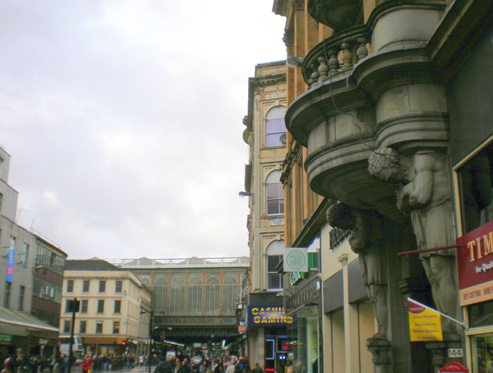
where I passed the Atlantes pictured up top, sculpted by the firm of William Vickers on one doorway of Horatio Kelson Bromhead's vast Stewart and MacDonald Warehouse. Glaswegian wit quickly named the figures Stewart and MacDonald, while the handsome extension of Central Station under which Argyle Street continues to run on its way to the West End - I'm assuming that's the bit added by James Miller in 1901-5 - and which you can see in the distance is known as the Hielenman's Umbrella.
After re-acquainting myself with the famed Glesca friendliness* in a couple of shops and an eatery, I headed back for the train and an utterly restful journey finishing a very gruesome Icelandic thriller and relishing the sharpness of the late afternoon light on the hills that fringe the Lake District (a slightly out of focus shot, this, from the carriage window, but we need a bit of sunshine after all that typical Glaswegian rain).
Two cheers today, anyway, for the passing of the law in the House of Commons to enshrine gay marriage as an equal right. I don't want it for myself - being civilly partnered since that institution first arrived in the UK is good enough for us - but I think it should be there for those who do. The two cheers, of course, are for the fact that 175 voted against, but is that surprising? And anything that splits the already fractured Tory party still further has to be a good thing.
*which can just as easily be replaced by an equally entertaining rudeness, as I discovered from the programme seller in the City Halls...
Preparing the students on my City Lit BBC Symphony course for the orchestra's Total Immersion day of Japanese music, who better to ask back than flautist and shakuhachi player Richard Stagg? Some of us last saw him in 2008 when the course was still running at Morley College, and he was about to leave the BBCSO for an independent existence.
From the above, you'll guess if you don't already know that the shakuhachi is not a type of mushroom (thanks, Fiona M) but the Japanese bamboo flute with a haunting sound all its own; the name actually means '1 foot 8' in Japanese imperial measurement. So Richard brought along not only a couple of shakuhachis - many of which he now makes himself from a special kind of bamboo that grows in the mountains outside the major cities - but also specimens of 2 ft 2 and 2 ft 4, equating to our alto flute.
But then I think even the basic instrument sounds rather alto-fluty in its hollow, whispering lower register. Watching Richard in action was fascinating: as there are only five holes, and the shakuhachi has a range of two octaves, pitch and chromatics, including quarter-tones, can be changed by the angle of the head - up or down, while more discreet side to side gives the degree of vibrato. Embouchure can change pitch and tone, and it's a devil to master the end-blown technique (Richard says his fledgling pupils have good days and bad, when barely a sound will come out). The bore has to be specially shaped in the making or the scale won't function.
The repertoire dates back to the monks of the 9th century, especially the mendicants with their begging bowls (one tune is called '1,2,3, return the bowl'), but having been passed down by oral tradition was only notated between the 17th and 19th centuries. Kurosawa Kinko is the big name among collectors. Most of the pieces Richard played were extremely free, with vivid trills and slide, though 'Kumoi Jishi', the 'Heavenly Lion Dance', was loosely in 6/8. 'Rokudan' comprises the six steps of the title, each 27 bars long; it cropped up again in the Okeanos concert yesterday. The scales can vary, but the shakuhachi has to adapt itself to the Japanese pentatonic scale favoured by stringed instruments and singers. Here's a track played by the man Richard says is the great shakuhachi master, Kifu Mitsuhashi, whom I had to miss on Saturday evening.
The shakuhachi sounds wonderful alone, but the Yamato Ensemble with which Richard plays also includes the thirteen-stringed koto, something like a zither, which comes in different sizes,
and the three-stringed shamisen played with a plectrum.
Both players would traditionally sing along and in the first track on the disc which I needed no encouragement to buy at the end of the session, I was struck by how the shakuhachi, weaving around the voice as well as joining it, behaves like the obbligato instrument in a Bach cantata (only connect below). Here's a track from another of the Yamato Ensemble's CDs.
As I was down to cover the opening night of the English National Opera Traviata for The Arts Desk yesterday, I only managed to get to the late afternoon event in the 'Total Immersion' day. Presentation was rather lugubrious at first: the rather reserved (British) members of the extraordinary group Okeanos included two rather introverted seeming balding guys with specs, and there were no introductions to the traditional sequence. Then they played to their strengths, the creation of contemporary repertoire. Four of Dai Fujikura's Okeanos pieces, although they were more about sound than substance, brought out the best in the strange meetings, dominated by the hainting sound of the shō, best described as a 'free reed instrument' made up of seventeen pipes - a kind of portable organ.
Fujikura's Cutting Sky, a dialogue between plucked viola and koto, riveted in the hands of Bridget Carey and Melissa Holding, who later gave a dazzling cadenza. That was in a haunting stretch of improvisation drawing in our friends Anna Smith and Mike Atkinson from the BBCSO and students from the Guildhall School of Music and Drama (Maaike van der Linde astounding on bass flute). It was a very crepuscular hour and twenty minutes among the serious-minded in the Barbican Hall, but I treasured it all the more when thrown into the hurly-burly of elbowing first nighters at Traviata later. Anyway, if you want an ideal introduction to old and new Japanese music I can't recommend too strongly this disc with ideal annotations by Makoto Hasegawa and Richard. Not difficult to guess that he's the second player from the right.
Back on terra firma, I decided to build on last week's mistake and listen to two Bach cantatas today: one to cover the fourth Sunday after Epiphany, for who knows when that will happen again (I bet someone does, but please don't bother to let me know), and one for Sexagesima. The first, 'Jesus schläft, was soll ich hoffen?', BWV 14, was written for Leipzig in 1724; Bach was not to compose another Sexagesima offering for a decade. I agree, again, with John Eliot Gardiner's notes for his Bach Cantata Pilgrimage, the best possible guide: this is as operatic a response to Jesus's calming of a Galilee storm (the New testament reading for the day) as it would possible to imagine. Illustration wise, we could have more Backhuizen after Tuesday, but let's turn to Delacroix.
The opening is a plaintive lament for alto with lacerating minor-second keenings from the strings and recorders poised rather gently above. Quite a challenge for the soloist, this, twice asked to hold a low B flat for ten slow beats as he or she sees 'with ashen countenance death's abyss gaping wide'. Countertenor William Towers on the surely unsurpassable Gardiner recording manages it to perfection. A dissonant tenor recitative sustains the mood of humanity lost without Christ's guidance; then the storm breaks in rushing violin waves, freeze-framing on the tenor survivor.
The bass takes on the role of the reassuring Christ, almost placid in an arioso before more surges (strings in octaves) meet his greater authority in a number bringing back the beloved oboes d'amore. From the quiescent end to the closing chorale all is calm assurance. The elemental music, though, outdoes even the buffets of the Septuagesima spectacular I covered on Tuesday. Let's have Sigiswald Kuijken's La Petite Bande on YouTube for a change.
'Erhalt uns, Herr, bei deinem Wort', BWV 126, for Sexagesima Sunday 1725, has a militant hymn text kicked off by Luther who asks the Lord to 'deflect the murderous intent of Popes and Turks' - no wonder when I looked up this cantata on YouTube, the entries were led by Evangelical films. The malign elements are, I suppose, related to the bad seeds in this Sunday's Parable of the Sower, seen below left in Brueghel the Elder's great landscape.
The chorale text runs through the cantata, as in Tuesday's choice, heard as before in the sopranos in the trumpet-capped opening chorus and punctuating an original recitative-chorale in which alto and tenor take it in turns to comment on Luther's lines, which they both sing. Both the tenor and bass arias have surprising elaborations in their middle sequences (the tenor's on 'erfreuen' and 'zerstreuen', the bass's on 'verschlingen', to make the battle against the adversaries all the more emphatic). The inspiration I've been singing round the house is the bass's number, with the continuo rushing down the scale before dropping an octave and trying, Sisyphus-like, to clamber up again - totally appropriate illustration of 'bombastic pride' falling to earth to be swallowed up by the abyss. Curious, too, the irregular line-setting of the final chorale with its elaborate Amen. Here's Harnoncourt with some quality voices in tow.
Next week I promise a few digressions from purely musical themes. It's got a bit inward-looking, I know, and some folk don't like that. But the kind of blog I prefer is where one writes as one wants, not what one thinks an audience wants to hear.
I hadn't intended to go to the third concert in John Adams's mini-residency with the London Symphony Orchestra, though I'd certainly been bowled over by the first two (review of no.1 here on The Arts Desk). Rare as the programming looked, Copland's Appalachian Spring is one of those pieces to whose charm I'm deaf - diatonicism taken to artificial extremes? - and Elliott Carter remains anathema to me ('how can you be so hard-hearted?' said my concert companion Hen, 'the poor guy died last year'. That was before she heard his Variations for Orchestra).
It was the Adams piece on the programme that I knew I had to hear after the St Lawrence String Quartet's absolutely stunning performance of his String Quartet on Thursday at LSO St Luke's, where the above photo was taken by Kevin Leighton. I need much more time to get to grips with that complex work, probably a masterpiece.
They were very much at the centre of Absolute Jest, first performed last year with Adams's buddy of 30 years Michael Tilson Thomas conducting the San Francisco Symphony Orchestra. I think, then, this must have been the UK or even the European premiere, but there was no fanfare about it.
I'm not sure what connection the title has with the novel Infinite Jest by David Foster Wallace - though I'm attracted to the book from what I've just read about it, to be sure. What's certain is that this has to be one of music's biggest ever scherzos at around 25 minutes. It begins with the pounding dactyls of Beethoven's Scherzo in his Ninth Symphony, which the orchestra takes to semi-minimalist extremes. But the real subjects are the scherzos of late quartets Op. 131 - that weirdest of chatterboxes - and 135, with its manic repetitions.
It was Adams's idea, presumably, to preface his performance by getting the St Lawrences to play the passages in question, along with the slow fugal introduction to Op. 131 which finds itself interlaced with snatches of the Grosse Fuge in a much-needed if hardly easy slackening of all the frantic activity.
Others like my colleague Alexandra on The Arts Desk have raised the question of whether it's a good idea to submit to your own style the music of a giant. After all, most of Stravinsky's stylisations including Pulcinella, a performance of which was one of Adams's inspirations, are based on lesser composers or lesser music. And co-opting one of the supreme masters is different from finding your own music lined up in a concert programme with Beethoven or Brahms (what Adams charmingly calls 'sharing a bed with the big boys'). Well, I bought Absolute Jest for as long as it lasted, in colour and motion the work of a master. The wind-up from the central section was as accomplished as any of Adams's great transitions, and there was a sequence for the quartet players just before the end that absolutely knocked me for six.
This may be where, I later learnt from Tom May's SFSO note as reproduced on JA's compelling if fitful blog Hell Mouth, the composer references the 'Waldstein' Sonata's opening - you can see how exciting that must have been for Adams in his early almost-minimalist phase. One good result is that Adams has turned me back to the late Beethoven quartets, with which I've always struggled, and I begin to hear them more clearly.
More details about Absolute Jest in Adams's four-minute talk filmed by the San Francisco Symphony Orchestra last year. Good to see he didn't repeat much of this on Sunday.
I can't see that Absolute Jest strikes out for deeper waters and more poignant climes as the first concert persuaded me again that Harmonielehre does, at least in its first movement.
But it is, after all, a scherzo, and Adams's concert sequence had given us a much less approachable Big Boy earlier. As Carter's Variations began their perplexing journey, I could admire the remarkable orchestration even as I resigned myself to not being able to detect the theme the variations were supposed to be tracing. But, like the composer himself in a grisly evening I once experienced of his string quartets where he talked and talked, the piece does go on. And the Neo-Gothic, brass-heavy peroration suffers from a bad case of elephantiasis. Adams writes superbly about his ambivalence towards Carter, and his acquaintance with Copland, too, on the above-mentioned blog, Hell Mouth.
Appalachian Spring passed swiftly and with lively string playing, but the real dazzler was Ives's Country Band March later incorporated into Three Places in New England, a knockout curtain-raiser if ever there was one. And three cheers once again to Adams for three superbly designed concerts. I'm now looking forward to The Gospel According to the Other Mary at the Barbican in March, though reports from the Los Angeles premiere have been very mixed.
Back to Bach as promised, and a cantata for Septuagesima which has nothing to do with either of the Gospel readings for the day, one of which is the parable of the workers in the vineyard (as supposedly depicted by Rembrandt above). 'Ich hab in Gottes Herz und Sinn', BWV 92 (1725, Leipzig again) is more preoccupied with the rough seas, winds and eathquakes God sends to test mankind. It's another of those 'total submission to God's will' texts which don't bear too much examination by agnostics like me. But what invention there is here, as usual.
The chorale that runs through the cantata begins in the sopranos against independent lines from strings and two oboes d'amore, especially winsome in thirds that take some unexpected turns. It punctuates the bass's recitative, where the continuo goes darting and plunging off to imitate the 'cracking and fearful crashing' of mountains and the 'great waters' (an excuse for introducing a stormy seascape by Ludolf Bakhuizen below). The turbulence is sustained in whiplash strings forcing an equally strenuous line from the tenor in his aria.
The bass's comparable number dealing with rough winds, this time in the shape of continuo only, sounded unduly blustery in bass Dominik Wörner's singing for Masaaki Suzuki; I'm sure there are more convincing ways of performing it. But the soprano's calm pastoral after all these elemental surges is a winner, and quite unlike any other Bach aria I know, the vocal line dancing with a solo oboe d'amore against the most delicate pizzicato strings. After the plain sailing of BWV 72 on Sunday, this was a total treat - and rather militates against the 'short cantatas to help choir beat winter cold' theory since it's half an hour long. 13/3 I'm replacing my original YouTube Leonhardt with the superb Koopman, above all because on it is our (re)New(ed) Best Friend Debbie York, who's been to stay as a result of Facebook re-contact with J, her old fellow Glyndebourne chorus pal (and Queen of Spades dance partner). And magic she makes indeed of one of Bach's loveliest arias (around 24'20).
Heading his manuscript copy of The Dream of
Gerontius, Elgar quotes John Florio’s translation of Virgil via Montaigne: ‘Whence so dyre desire of Light on wretches
grow?’ One of James MacMillan’s themes in his lecture for the Royal
Philharmonic Society yesterday was how we wretches today, whether religious in
the narrow sense of the word or the wider, still desire the light that music’s
most transcendent passages can offer us. Actually, that sounds impossibly
pompous, as JMacM’s soft-spoken, reasonable speech, eschewing all mention of
himself in that visionary tradition, did not. I couldn’t quite work out the
connection between his opening thoughts on Blake as an example of a broader
visionary vein in English art and his central assertion of the importance of
Roman Catholicism in Elgar’s life and work, but it was all food for thought. Bust of Beethoven in my shot below there to mark the RPS's 200th anniversary.
It’s true, we do tend to shunt Elgar’s Catholicism rather to
one side, even in discussing the composer’s most overt assertion of his faith
in Gerontius (though what more do you want than the Jesuits’ ‘A.M.D.G’ - ‘Ad
majorem Dei Gloria’, ‘To the greater glory of God’ - at the top of the above
page?). But perhaps it’s also true – a point not addressed yesterday – that the
Catholic fervour which came from Elgar’s mother, and certainly not from his
staunchly Anglican father, dwindled in later years. I can’t find the quotations
I want, but I still have the hunch that the 'single short remark' Elgar made to Ernest Newman
on his deathbed so ‘terrible’ that the younger man never repeated them to
anyone might have been ‘I lost my faith in God’ (more frivolously, on hearsay, I’d wish
it to be ‘I always preferred young men’, but no more of that).
No matter; the speech threw up plenty of points for
discussion and, as Jude Kelly in fine presenting fettle said, we could have sat
and talked for another hour. Nice to chat briefly to The Man afterwards, and I’m hugely
looking forward not only to hearing his Oboe Concerto again in Glasgow on
Friday – he will be elsewhere – but also his new Viola Concerto, due to be
premiered by Lawrence Power as part of The Rest is Noise festival. I think I’m
right in saying, at least from checking the index, that Alex Ross in his book
of that name doesn’t give a single mention to MacMillan, one of the major
voices in music today – and one of my two favourites (Adams being the other, of
course).
Two hours later, I was in the chair alongside venerable composer Anthony
Payne, whom of course we have to thank among other things for that rather
miraculous realization of Elgar’s Third Symphony, and Heather Wiebe, Virginia academic newly
arrived at King’s College London. Our moderator was Tom Hutchinson of the RPS,
and the theme, supposedly, was 'The Edwardian Empire: Society and Culture',
obviously with special reference to the performance of Gerontius due to follow
in the Royal Festival Hall.
I was wrong in thinking that Heather was there as the
cultural historian; she, too, is a musicologist, this time specializing in Britten. So we
all had to readapt as we launched our little presentations by way of a start.
Frankly, I think the esteemed AP should have gone before me, for clearly I’d
stolen some of his thunder with the line about Elgar the European; but I also
managed to contrast that with the perceived notion of the court composer to
Edward VII. And in any case, Anthony was so genial, wise and good at batting
the ball back and forth that it all became a delightful discussion in praise of
our composer’s terrific originality. Maybe an antagonist could have stirred it
all up more productively, but we had fun – even if I seem to have blanked out
chapter and verse in all the after-euphoria (hoping there’s a recording. 15/7 Just discovered there is, here on soundcloud, thanks to The Rest is Noise festival's impressive soundarchiving. James's talk is there too).
We were all of us, JMacM included, seated in what’s supposed to be the royal
box for Elder’s performance in the evening. I can’t say it moved me much. This
conductor works so hard on revelatory textures, gleaming in the hands of the
London Philharmonic Orchestra, and is a superb chorus master, there with every
word for the LPO Chorus and the Clare College Cambridge singers who served as
the semichoir. But he doesn’t strike me as having the natural tempo rubato which
late romantic music like this requires. Everything seems dotted and crossed
with excessive precision; you can see the wheels at work. And sometimes he’s
just too slow, in the tradition of his beloved Goodall, which sank the Angel’s
Farewell for me, resplendently as the ever-dependable Sarah Connollly delivered
it.
I did love Paul Groves’s hard work on extracting every inch
of meaning from Cardinal Newman’s text, though, and in pushing his
far-from-Helden voice to the right limits of agony and exultation when needed.
The clarity of this truly world-class score came across beautifully. But for
me, the desired light never quite shone. Have gone over to Sakari Oramo’s Birmingham recording at
home to find out what was missing, and there is all the magic in all the right
places.
So, from ‘A.M.D.G’ to Bach’s ‘S.D.G.’ (‘Soli Deo gloria’, ‘Glory
to God alone’). Much less heavy weather results from this week’s Sunday cantata
(someone told me Radio 3 is following the same calendar as I am; I had no
idea). ‘Alles nur nach Gottes Willen’, BWV 72, is one of the short cantatas for the third Sunday after Epiphany* - short, it's argued, because the choir would have got very cold at this time of year; they were allowed to slope off before the hour-long sermon. Lucky them; in my treble days we had to sit and read Commando comics under the desks.
God’s will as exemplified,
perhaps, in the day’s reading from Matthew 8 about Christ's healing of a leper (mosaic above from Monreale), is all there is to it. So it
makes for a rather complacent sequence, shorn of questioning or suffering The striking
minor-key launch of darting, rather agitated strings slightly undercuts the
chorus’s sentiments (‘All only according to God’s will’); the music was
re-used, not so interestingly in my opinion, at the start of the Gloria in Bach’s
G minor Mass, BWV 235.
The alto reaches to the still-lively heart of the cantata.
His/her recitative turns to arioso in the nine lines beginning ‘Lord, if thou
wilt’ and moves almost seamlessly into the aria with the addition of two solo
violins to the cello and continuo line, fugueing in one of the ritornellos.
There’s a simple, dancing soprano number and a chorale based on a text by
Albert, Duke of Prussia and an old French theme used in a cantata of the
previous year, 1725. There – I’ve got off lightly this week**, but I’m looking
forward to being tested rather more by JSB in weeks to come. Here's another from Suzuki's Bach series, Robin Blaze replacing Sara Mingardo whom I heard on another instalment of John Eliot Gardiner's Bach Pilgrimage 2000.
*As 'Uncle Toby' points out below, I've got my church calendar in a muddle. This year we miss out on the third and fourth Sundays after Epiphany. This is Septuagesima, so I'll have to add another cantata. But that gives me the excuse of two more (fourth Sunday and Sexagesima) next week.
**Clearly not. The Septuagesima candidate I have to hand is 'Ich hab in Gottes Herz und Sinn', on an altogether grander scale. Shall do my duty willingly some time this week
No doubt those
Little Britainers who want to batten down the hatches against Europe
will be using ‘Nimrod’ or Pomp and Circumstance yet again as the background to
their frothing diatribes. Which makes me mad because no composer was more of a
true European, or for that matter a true citizen of the world, than Edward
Elgar (and I’m talking not of his conservative outer life but his musical
world-within-world). He may have suffused his scores with the essence of
Worcestershire/Herefordshire woods, hills and rivers, but that hardly amounts
to callow nationalism, and it's one of the reasons I love him so deeply.
Forgive me if I
repeat myself, but ‘Nimrod’ is a classic example of misrepresentation. It’s actually the
portrait of an Anglicized German, A J Jaeger (pictured below), and has its roots in a summer evening conversation Elgar held with his beloved publisher friend about Beethoven’s slow movements. The
result is, of course, based on the Adagio cantabile of the ‘Pathétique’ Sonata. So, music
about a German based on a German. The stout and steaky tune seconds in to the
first Pomp and Circumstance March? Listen to the 'Cortège de Bacchus' from
Delibes’s Sylvia, a movement cited by Elgar in a different context, and you’ll
hear where the rhythmic idea comes from, note for note (though not pitch for
pitch). Bizet and Massenet are other strong influences.
Elgar’s phenomenal
orchestration came partly from his many trips to Germany to see Wagner’s operas.
There Richard Strauss hailed him, after a performance of The Dream of Gerontius, as ‘the
first English progressivist’. His love of Italy follows Strauss’s example in
the ‘concert overture’ (essentially tone-poem) In the South, and surfaces
elsewhere when least expected. During the First World War, he didn’t so much
thump a narrowly patriotic tub as show his musical solidarity with Poland
and Belgium.
More than anything, Elgar is truly international and a world-class composer, as my City Lit students agreed when we looked at the First Symphony and went to hear Andrew Litton's outstanding interpretation of it with the BBC Symphony Orchestra at the Barbican. Unfortunately my effusions over Cockaigne the following week - I was amazed to find it has no less than eight memorable themes - were undermined by the bizarre performance of it, which I heard on the Radio: the aptly named Long Yu dragged every slow passage out to an eternity. Inside information told me that the interpretation clocked in at 2m40s longer than the longest previous BBC performance (they keep records of timings, helpfully).
Which for a 15-minute piece is absurd, of course. Elgar as conductor or Boult will put you right. Boult's Cockaigne was twinned on the original LP with the most opulent recording of the Second Symphony (though it was Boult's classic 1944 recording that I chose on Radio 3's Building a Library).
Anyway, I hope I
can enlarge on some of the international and/or European aspects when I join Anthony Payne and Dr Heather Wiebe in a
Royal Philharmonic Society discussion before Saturday’s performance of
Gerontius.It’s dauntingly titled
The Edwardian Era: Empire, Society and Culture, and as I can’t contribute too
much to that, I’ll be hoping to sound the trumpet for Elgar as part of a wider
musical movement. Also hoping to catch James MacMillan’s earlier talk exploring
‘what role faith and mysticism have in artistic vision’.
All the above is loosely connected with Cameron’s
long-awaited speech today. To paraphrase a friend of a friend, what it comes
down to is a case of one foot forward, two feet back, half a foot forward
again: a) the European Union is OK; b) no it’s not, they all have to dance to
our tune and if they don’t we’re not playing; and c) actually we’d better play
after all. In a muddled message that will generate years of uncertainty, the
upshot is that he renegotiates terms to get some of the UK's powers back, and then
asks the British people whether they like that or not. That doesn’t account for
what happens if, as seems likely, he fails to get what he wants from the other EU countries.
At least the pro-Europeans are beginning to get their voices
heard in the surrounding kerfuffle. It’s high time someone of eloquence spelled
out the advantages of Europe to counter all
the falsehoods in the Mail and the Torygraph (apparently the press office at
the European Commission sends correction after correction to the papers, but
they never listen – not even the Guardian, which for some reason is giving the
appalling Farage houseroom as a funny guy).
So – cue lots of facts and links – let’s try and set the
record straight. If this first fact were
spelled out, people might begin to think differently. It’s this: that the size
of the administration is NOT bloated, as most people believe. The entire staff
of all EU institutions, agencies and other bodies totals 55, 000. The Commission
on its own employs 32,000 people – smaller than the staff of Birmingham City Council.
Are EU civil servants overpaid? Hardly. According to one
source, ‘comparative studies confirm
that the remuneration package…is similar to what is offered by other
international organisations that employ expatriate staff. In fact, for many job
profiles the EU civil service offers the lowest entry-level salaries amongst
international organisations’.
What
has the EU/EEC ever done for us? Please read this dazzling list in a letter from Simon Sweeney to The Guardian. That should do
the trick. And the TUC is in no doubt of what our government’s up to here. At an
Executive Committee Meeting on 15 January it declared that ‘the Government wants to take away the rights
working people have gained over the last thirty years from the European Union.
Social Europe has provided working people with
more equality, more protection from redundancy, more information about what's
happening at their workplace, as well as a shorter working week and paid
holidays. The Government wants to take that away from working people, and make
them work longer hours for less pay’. It goes on to point out the obvious, that
Cameron’s ‘dithering’ will play havoc with our economic interests.
If you’re still
with me, the full facts of EU policy can be found here (economic benefits), here (social and employment policy) and here (working time directive). Unfortunately I'm probably preaching to the converted, but it's good to have chapter and verse in hand. Now we need a really charismatic apostle to go out and fight the good fight to halt the re-feudalisation of blinkered Blighty: a recommendation also made by Polish Foreign Minister Radek Sikorski in his Blenheim Palace speech last year, full of further strong arguments from a man who might have been expected to be a Eurosceptic.
Finally, a reconciliatory footnote. 50 years ago this Tuesday de Gaulle and Adenauer joined their countries' hands together again by signing the Elysée Treaty. The BBC put up a lovely little piece about a song that encapsulated a respect regained: 'Göttingen', French chanteuse Barbara's hymn to the German university town she adored (and which I came to love at first sight two Junes ago). The sound version of the song in French there (Barbara also recorded it in German) is the best, but here's a filmed performance to complement it.
Unthinkable, isn’t it? And yet that would certainly have
happened if the Islamist extremists, having taken Konna the other Thursday, had
been able to plough on to Bamako.
There have been well-reported programmes on the World Service filling us in on
the situation in Timbuktu
and elsewhere in the north: no sounds of music allowed, not even on the mobile
phone. The Festival in the Desert has, of course, been a fatality, though by
the sounds of it that had been corrupted from its original Tuareg base to an
international event for very well-heeled tourists featuring a lot of crap bands
from abroad who wouldn’t have been tolerated anywhere else. Sophie tells me
that part of the set-up now reassembles at Segou between Bamako and Djenné.
Just how relaxed the music scene in free Mali is can be
seen from these photos, which I apologise to those with a long enough memory
for repeating from 2009. Yes, women singing, playing and dancing: something not
tolerated in Iran
or any of the more extreme Muslim states. It only goes to show the easy-going
nature of Mali’s
sufi-based religion. We caught the good women of Diabolo (not to be confused
with Diabaly, much in the news of late) performing for their village when we took a horse-driven excursion with Sophie from nearby Djenné, and they were quite
unfazed by our presence, OKd by the local headman. True, they were performing
for tourists the following week, but the crust-earning seemed well deserved.
I’ve been listening to the great, late Ali Farka Touré, guitarist-vocalist
‘king of the desert blues’. The booklet for his last solo album, recorded at
Bamako’s famous Hotel Mandé by World Circuit , is exemplary (and unusual in the
so-called world music scene) in giving us notes by The Man with translations of
the songs. I’ve chosen this one about Beto, the river god of neighbouring Niger, because
the text is appropriate: ‘Beto, will you share with us this special day of the
new year? Yes, Beto, indescribable Beto, Beto, speak, we are listening.
Beto, tell us…are the ancients angry?’
The special sound on the next track, Savane, is that of two ngonis,
unusual west African stringed instruments.
The famous Basseko Kouyaté is
one of the players, and (27/1) was playing at the Barbican last night when I was duty bound to hear Elgar's The Dream of Gerontius over at the Royal Festival Hall; see Howard Male's review on The Arts Desk. The rest of the photos, by the way, obviously aren't mine.
Ali Farka Touré also recorded a Hotel Mandé session with Mali’s
most celebrated exponent of the lovely 21-string harp called the kora, Toumani
Diabaté.
It was, as AFT explained, an unusual conjunction ‘since I am
from the Songra/Peul culture in the north and he is a Mande from the south.
It’s rare that musicians meet like this from different cultures’.All too
familiar contrasts between music’s hand of friendship and more common daily
hostilities has just been strikingly illustrated by intelligence well
documented by Amnesty and in the Guardian that the Malian army, whose fighters are
mostly from the south, has been committing atrocities against the Fulani people
of the north.
Anyway, the result of the meeting between guitarist and
kora-player is, to our ears, pretty basic – improvisations on two chords in
each number – but beguiling thanks to the sonorities of the two instruments. This is 'Monsieur le Maire de Niafunké'*.
Meanwhile the Bach cantata for the week is ‘Meine Seufzer, meiner
Tränen’, BWV 13, composed for Leipzig
performance in January 1726. The Gospel reading for this second Sunday after Epiphany treats of the
Marriage at Cana where Christ miracled water
into wine (detail below from Veronese’s vast canvas of the scene; the musician
on the left is believed to be a self-portrait).
The subject-matter and the prevailing musical mood of Bach's
cantata, however, could hardly be further removed from the expected. Only two
lines deal with the happening – ‘God can with ease/Turn bitterness into joyful
wine’ – and the rest is numberless tears, groaning, the sickness of sorrow, in
other words the earthly misery to be transfigured. John Eliot Gardiner writes
that in the opening aria only the tone of the oboe da caccia we met two weeks ago, intermediary here between the tenor and the two recorders, softens the
dissonances.
The bass lament at the heart of the piece has to be one of
the bleakest numbers ever composed (the Germans have a word for it I found
applied by Hofmannsthal to Elektra: ‘lichtlösigkeit’ or ‘light-less-ness’). This
time the recorders double the violin obbligato at the octave, wraith-like; the
soloist only partly fills the chasm between them and the bass line. Even when
the central portion of the text speaks of solace and joy, there is hardly a
sliver of light. Detail below from Rogier van der Weyden's Deposition.
On the other hand, the alto’s earlier chorale, crying out to
God in vein, is wreathed in joyful strings, as if to contradict the
hopelessness with a promise of better things. Otherwise, this is a stark revelation of the human condition, and
I marvelled at Gerald Finley’s restrained performance of the big number in the
Gardiner Bach Pilgrimage performance. Once again, there's a slightly less special alternative on YouTube, part of Masaaki Suzuki's Bach Collegium series:
We had extremes of joy and despair in last night’s bumper LPO/Jurowski Strauss concert launching the Southbank’s much-touted The Rest is Noise festival,
including a revelation of mighty Richard's death haunted symphonic poem for voice,
violin and orchestra Notturno. Read all about it on The Arts Desk - a long review for a very densely packed programme. Ambitious
though it was, I got more consistent enjoyment out of the execution in John
Adams’s LSO spectacular three days earlier, as recounted here. Much more to come now that the concert season is back on the boil.
*STOP PRESS The ever vigilant Sue Scheid has alerted me to a wonderful video of Mali's great musicians uniting to plead for peace. I can't say I know them all, but if anyone can tell me who's who among the terrific lady vocalists, I'd be grateful. Though Sue has the links below, I'm posting it here for easy access. I believe it's our kora-ist, Toumani
Diabaté, kicking off.
All observations, questions and challenges are welcome: resistant to tweeting and Facebook (though long converted to LinkedIn), I still like to exchange ideas. You don't have to be signed up, and you can be anonymous, but comments are moderated.
Copyright
If you wish to use any of my own photographs featured in the blog, or any of the text, just let me know in the comments. Acknowledgment and a link are all it takes.




 Posts
Posts