Thursday, 9 September 2021

Norfolk Churches Walk preludial

Having reached our 233rd Norfolk church (mostly pre-Reformation, though we've always thrown in a few Methodist chapels) a year ago, we're off on another walk for the Norfolk Churches Trust this weekend. Plans in brief are to rove the Wensum Valley and collect specimens in Elsing, Lyng, Great Witchingham, Little Witchingham (the semi-ruined one with the medieval wall paintings), Swannington, Alderford, Attlebridge, Morton-on-the-Hill and Weston Longville. 

While I have your attention, you can donate via the Norfolk Churches Trust Just Giving website (please say that it is for David & friends). Otherwise, cheques made payable to the Norfolk Churches Trust can be posted to me at home (if you don't have the address, message me privately with an email and I'll send the address). Alternatively, a kind word never goes amiss.


This time we won't be taking in the wonderful Norfolk coastline, as we did on perhaps the most varied walk of all in 2017. We revisited Happisburgh two weekends ago, as these photos attest, more by happenstance since the crab and lobster shack at Overstrand had sold out, and so had the van at Mundesley; the girl blamed Brexit for the lack of foreigners in the trade. Our host Jill drove us southwards, and at Happisburgh to our surprise we found a shop selling what we wanted. So it was down on to the beach, just as the grey skies cleared. for a picnic under the cliffs (but not too close). Rough seas forbade swimming, but walking along the shore brought the usual frissons this quite dramatic part of the coast produces.


Thought we'd also return to the beautifully restored long barn at Waxham, hoping that this time we could get in as back in 2017 there had been a wedding reception. Same in 2021, but of course we stopped for tea. Waxham is a lonely little place behind the dunes which must be very atmospheric in the bleak midwinter. It has a somewhat schizoid existence because of the rather dilapidated farm and church on the one side and the popular tea-place which helps keep the barn in good nick


while the west end looks almost church-like with its lancet windows.

The melancholy pleasure of semi-ruins begins as you walk around what remains of Waxham Hall, a rather dilipidated farm from which the church tower can be seen from the west.


The walls of the old hall are splendid, with what Pevsner calls 'polygonal angle buttress shafts crowned by finials'

and a 15th century gatehouse, seen here from one of the church windows.

St John's feels very lonely on the seaward side

though its treasures are disproportionate to the care (not) lavished on it, starting with the traceried spandrels above the south porch entrance,

the now-mossy/mildewy Perpendicular font with quatrefoils

and the early Elizabethan, effigyless monument to Thomas Wodehouse

which contrasts pleasingly with the restraint and plainness of the church as a whole - I like these unvarnished buildings.

A splendid ruin ('one of the best...in the country,' writes Pevsner) contrasts with a rather lugubrious Victorian church in the grounds of St John the Evangelist Stanmore, which we reached at the end of last Sunday's walk in intense sunshine, led by our friend Jimmy. The old building was consecrated by Bishop Laud in 1632, and its first feature of interest is the red brick.


The interior has been closed since Lockdown, but you can see enough through various gratings. It's dominated by the 1866 Gothic Mausoleum to the Hollond Family of Stanmore Hall - clearly the Victorians were still using the old church as an extra cemetery.


The most striking monument in the graveyard proper foregrounds a perspective on the old church

and turns out to be the grave of W. S. Gilbert and his wife Lucy. Famously, Gilbert died of a heart attack while trying to rescue a young woman whom he was giving a swimming lesson in the lake at his country estate of Grim's Dyke. Handel, incidentally, has associations with Canons and St Lawrence Church a few miles away, owing to the connection with Lord Chandos. We must make another visit to see that splendidly decorated church.

Inside the Victorian edifice, there are several old monuments, best known being that of John Burnell (died 1605) and family, twice restored.

Then, rather unexpectedly in a side chapel, is the marble figure of Sir John Wolstoneholme (died 1639) by Nicholas Stone.

The much more recent glass provides some comedy specials in two saints - the first a Marvel comic hero, the second a simperer who doesn't look capable of slaying dragons.
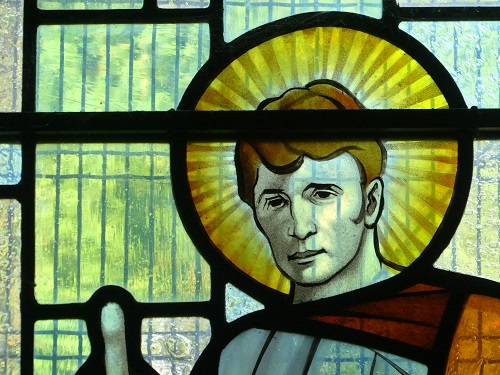
There are, however, two sets of glass which prove noteworthy, though neither is mentioned in Pevsner. First, Burne-Jones angels in an appropriate frame


then, on the other (north) side, peacock wings on angel and lion.


We'll be seeing older glass than this in Norfolk, but the design and execution are surely both first-rate.

Sunday, 5 September 2021

Strauss conducting Tristan

'Now I’ve conducted Tristan for the first time, and it was the most wonderful day of my life'. I used the same quotation - the 27-year-old Richard Strauss to Wagner's widow Cosima, on 17 January 1892 - to introduce my review of the Glyndebourne performance at the Proms earlier this week, because I surmised Robin Ticciati felt that way on conducting his first Wagner opera for the first time too.The above photos were sent, signed, from Weimar to fellow-composer Humperdinck, whose Hänsel und Gretel Strauss premiered in that beautiful town in 1893. 

Tristan und Isolde at Weimar starred Strauss's future bride, Pauline de Ahna (also a favoured Elisabeth at Bayreuth) and his pupil Heinrich Zeller, for whom he wrote the insanely taxing role of Guntram in his hyper-Wagnerian first opera. There were no cuts - rare then, and still not so common now (the Aix production conducted by Rattle this year has a whopping one in the dialectics of night and day, love and death, the lovers indulge in before the Liebesnacht proper gets going. I think we should hear it all - there are no commonplace bars in Tristan). 

We have one precious sound-document of how Strauss approached this most elusive of all great masterpieces: a recording of the Prelude made in 1928 with the Berlin Philharmonic Orchestra (the best sound is on the DG pressing, but that's not downloadable here).

Yes, it's fastish - difficult to compare timings with other Preludes because there's a 'concert ending' which takes us to the Liebestod music - but the rubato, the ebb and flow, are masterly and above all human. That's the difficulty for the conductor to decide: human or oceanic? Others prefer slower tempi, surprisingly so Toscanini (but then remember that the biggest discrepancy in Parsifal Act Ones at Bayreuth was between Strauss and Toscanini, who took half an hour longer...). In my first Opera in Depth class on Tristan und Isolde, I played both the Strauss and this NBC recording.

All the students who spoke preferred the Strauss; I was delighted. Though it's very much a matter of choice and temperament, when Wagner only writes 'Langsam' ('slow') at the start. Conductors would be wise to observe his tempo fluctuations thereafter. Anyway, in the second class, I played the way to the climax in performances by Stokowski (very volatile, masterfully conducted, and played by the Philadelphia Orchestra) and, for slow-burn intensity, by Mravinsky and Pappano. Personally, I felt a 'yes, this is how it should be' once the drama of the Prelude properly flows from Ticciati at the Proms. You would be well advised to listen to the complete performance while it's still available on BBC Sounds (until the end of this month).

We've now passed the halfway mark in Class Five last Wednesday, and of course I have nothing in my head but the sounds of the 'Liebesnacht'. The compelling but deeply unsettling way that director Krzysztof Warlikowski handles it in Munich, with spellbinding performances from Jonas Kaufmann and Anja Harteros (pictured above) and superlative conducting from Kirill Petrenko, seems to me the best approach I've seen. 


Soundwise, I'm constantly shifting in examples between so many recordings, but predominantly Lauritz Melchior and Kirsten Flagstad with Beecham (or Reiner), Bayreuth '66 (Nilsson and Windgassen with Böhm conducting), Vickers and Dernesch with Karajan, Margaret Price and Rene Kollo with Carlos Kleiber, Linda Esther Gray and John Mitchinson with Goodall. Linda is returning to talk to us next week, and Peter Rose will appear to discuss Marke's monologue. Later we hope to welcome Robin Ticciati and Antonio Pappano, and Anne Evans in the final class. More in the pipeline. It's rich!

Friday, 27 August 2021

Hovs Hallar: chess on the beach

I won't pretend that this shot on one of the primeval beaches of Hovs Hallar in south-west Sweden is anywhere near an accurate reconstruction of one of cinema's most feted scenes, where Max von Sydow's knight, washed ashore with his jester-squire Jöns  (Gunnar Björnstrand) and two horses, starts a game of chess with Death (Bengt Ekerot) as a means of playing for time.

Nevertheless it was convenient that Agustin Blanco Bazán had a raincoat with a hood and that Peter Krause's haircut had sufficient correspondence to von Sydow's; and it was a bit of what Bergman would call a 'schnappsidee', though our fuel at this point was coffee in flasks. Our expedition was planned by the Birgit Nilsson Museum magnificent hosts for three glorious days - I've done my bit on the musical side now for The Arts Desk - in conjunction with an excellent local guide, Ingrid Persson Skog. Here she is on the beach with three of us - photo taken by our other excellent cicerona, Lucy Maxwell-Stewart - showing Bergman's sequence on her iPhone.

As for the museum people's thoughtfulness, it's summed up in one piquant detail - the chessboard biscuits they provided with the coffee.


It was here to Hovs Hallar, the rockiest part of the otherwise mild and beautiful Bjäre peninsula in the northwest of Skåne, that Bergman came to shoot two celebrated scenes - the opening sequence with the chess game and the Dance of Death, an improvised shot with two tourists drawn in because some of the actors were hung over after a last-night party, as well as the idyllic picnic shared by young parents Mia and Jof. The whole thing was completed, as stipulated, in a mere 36 summer days, the bulk of it on Svenska Filmindustri's studio plot in Råsunda. Better get the iconic shot of Death in here to complement the above, more or less the same positioning.


I had it in my head that Hovs Hallar was an island because the second film to use it as a location, the horrific The Hour of the Wolf (1966), takes place on an imaginary equivalent. Both films use the relatively level ground before the path descends at times. Johan (von Sydow, this time playing a Bergman alter ego), the tormented protagonist of The Hour of the Wolf, attacks Heerebrand, who describes himself as a curator of souls, as they walk along the upper ground

while knight and squire encounter the first victim of the Black Death as they head towards the nearest settlement.

There's now a hotel in the middle of this nature reserve, and various boards, maps and signposts. The most fascinating tells us that this is a site designated by the European Film Academy as a 'treasure of film culture', a place 'of a symbolic nature for film culture' - one of 11, apparently.

From here, there's little sign of the drama to come, only - in cloudy, windy weather such as we had at the start of our walk - a hint of desolation with a lone tree.

But soon, on the descent, the true nature of the magnificent land and sea scape becomes apparent.

You see something of this close to the beginning of The Seventh Seal when a voiceover tells us of the plague time


and a view of the beach immediately below the path when knight and squire make their ascent.

The rocks are red gneiss, heaving up in a geological fault, as dramatic as the stacks on the west coast of Fårö, the island which Bergman made his home and to which he transferred much of his outdoor magic (I wrote about the unforgettable experience of Bergman Week on theartsdesk).

But note how this is far from being a barren landscape. Rowan trees have sprouted up everywhere; there are honeysuckle, crab apple trees and blueberry bushes.

Lichen grows on the pebbles and rocks...

...if they're left alone. Unfortunately human curiosity has taken upon itself to make stacks on the first beach you reach, 

which look suitably weird but can't rival the real, natural thing. 

The further you walk, scrambling over rocks between beaches, the more wild it seems to become. Not everyone progresses beyond the pile-up bay, though after our coffee break, more folk were arriving; pleased that we started so early.

I thought of the terrifying scene in The Hour of the Wolf where Johan is bitten in the neck by a young demon, whom he kills and hurls out to sea.

Then there we were, on the familiar beach with the cave, seen here behind the Knight in The Seventh Seal.

Lucy and Ingrid are on the beach, Agustin and Peter by the cave.

We were not alone. Cormorants lined the rocks, just as at Pittenweem in the East Neuk, my previous coastal destination.

While there were spots of rain as we listened to Ingrid, sipped our coffee and ate our chessboard biscuits, the expected downpour never came, and the sun came out for our route back.


Then we were off for a picnic and a swim on what I thought would be milder territory - but the sea swell was rather alarming - and an afternoon looking at the concert hall and art gallery just being completed, plus a wonderful if short time in the main town of Båstad. But that's for another post.