Monday, 28 March 2022

The greatest Grimeses

There was Pears, of course - it was a surprise to me to find how fine an actor he was, as well as a singer, in the 1969 film of Peter Grimes conducted by Britten. But in my opera-going experience no-one can possibly be greater than the late Philip Langridge.

I saw him three times, twice in Tim Albery's very fine English National Opera production, and once in a Barbican concert performance conducted by Richard Hickox, where his pacing around at the foot of the stage before the final scene seemed horribly real. In fact his madness came across as not acted at all, which is why when we watched the scene in Grimes's hut in the fourth of my Opera in Depth Zoom classes on the work a few weeks ago, the students expressed concern for the (surely too young) boy he roughs up.

That of course wasn't a problem in Deborah Warner's production, now running at the Royal Opera, where the character of Grimes is softened to the point of sentimentality and he never manhandles his apprentice; the boy can touch him tenderly but it doesn't work (as far as I remember) the other way around. Cruz Fitz and Allan Clayton pictured below by Yasuko Kageyama.

Surely we're all in agreement that Allan Clayton manages every vocal aspect of the role superbly, but for me this fisherman wasn't a credible character. Note to director: you don't have to love the protagonist to feel pity for him.

The libretto does present difficulties, of course - how to tie up the visionary with the rough, abusive outsider? But not to have him strike Ellen in Act 2 Scene One - he knocks her to the ground in a scuffle as he makes off with the boy - is a step too far. I didn't like the keening over the corpse to the 'relief' of the Moonlight Interlude, either. This isn't the first time there's been a shying-away from the uncomfortable: I was astonished to discover that Jon Vickers changed two of the lines in the hut scene to avoid the physical assault on the boy (thus avoiding the con violenza written into the score)

Anyone coming to Grimes for the first time, or even after a long time of not seeing it in action, is bound to think 'this is the greatest' - that's partly because of the nature of Britten's inspiration, which as Mark Wigglesworth, recording a Zoom chat with me for one of the other classes after we'd listened to his Glyndebourne/LPO performance of the Passacaglia - the most electrifying I know - is 'bulletproof'.

Our first guest was the ever-generous and articulate Sue Bullock, who spoke with shocking frankness about playing Ellen Orford in the first run of the Albery ENO production - she alternated with Josephine Bartstow - to Langridge's Grimes. They both felt that the tension of the scene outside the church had built to such a pitch that to fake the slap diffused it. So SB gave PL the licence to hit her (that's me being astonished as she tells me below). And she remembers standing in the wings crying while Langridge himself wept real tears in the 'mad scene', then going home - still in tears - fretting that she hadn't done enough to save him. 

Talk about the role taking over (but I also remember Simon Keenlyside telling me how he paced the streets of London in the small hours after singing the finest Prince Andrey I think I'll witness in Prokofiev's War and Peace).

I was saving the equal generosity of Richard Jones, another regular visitor, for Samson et Dalila next term, which he convinced me was worth spending four or five Monday afternoons on (as did Nicky Spence, but alas, he's had to withdraw because of the steady convalescence needed to restore his two broken legs to full health). But we were so stunned by RJ's Milan production, which I ended up using the most when it came to playing full scenes on DVD, that I asked if he'd be willing to talk about it. 

Richard always declares that these things were too long ago to remember much, but then he goes and delivers fascinating and unexpected takes with great vividness. He was especially good (and funny) on the disjunct between music and text: 'part of my affection for it is this very extraordinary, eerie and incredibly memorable music combined with this Listen-With-Mother, Ealing vowel text, and I like that disparity very much'. 

Responding to Mark's comment about Grimes being 'bulletproof', he declared that 'there are certain pieces where you can have your day in the sun as a director - one is Jenůfa, another is Grimes'. 

So far he's only directed it once, but would be up for another shot (which, given his capacity for re-imagining, would probably be very different). I just don't think there could a more intense and upsetting experience than what he and his choreography Sarah Fahie get out of the Teatro alla Scala forces and the principals: all the more remarkable given the chorus's threat to walk out at one stage (or perhaps because of it: needless to say Jones enjoyed facing an angry mob). 

The two leading performances are devastating. John Graham Hall may not have the tonal beauty of a Pears or a Clayton, but like Langridge's, his is a Grimes on the edge from the start. 

It's the only time I've seen the Apprentice played by a teenager (Francesco Malvuccio, who spoke no English, but as Richard says, that may have been an advantage). So there's a boy who can stand up for himself a bit, but is still physically dominated by the abuser.

The biggest rethink is the role of Ellen Orford. Jones believes there are no good people at all in Grimes, and she's horribly deluded, an ex-cultist who never notices what's really going on. That doesn't stop us feeling pity for her as she falls apart. 

Susan Gritton sings and acts better than any other Ellen I've seen. Wigglesworth conducted her too, and advised me to get her along. By which time, alas, it was too late in the course and she was taken up with performances on the weekend we might have spoken. But we had a splendid email exchange. 

I was also hoping for another appearance from the supremely eloquent Robin Ticciati, who conducts the La Scala production magnificently, and who was looking forward to telling some memorable stories. But he was taken into hospital to be operated on for a kidney stone, so that was not to be ditto Felicity Palmer, who gives an interesting Auntie, but declared it wasn't a role she felt close to. No matter; we watched so much of the film, and I urge you to do so if you think a Grimes can't be more intense than the Royal Opera one. For me this is the greatest Grimes, while Langridge is the greatest Grimes. Get hold of the Arthaus Musik DVD of Albery's ENO production too, if you can.

These, for me, are benchmarks, and yet there was so much new and perceptive in the latest comer. I just didn't come away from it wrung out. To me it seemed that Clayton was a truly great singer who acted well, not a born singer-actor. But then RJ, who hadn't seen the production at the time of our conversation, reminded me of his astonishing delivery in the Royal Opera 4/4 staging of H K Gruber's Frankenstein!!!, and yes, that did make me think it was the director's job to bring out the best in him. I think the RO should bring back the film complete now that a star is truly born, but this minute is good enough to show you the audacity, weirdness and agility.


Friday, 18 March 2022

A tale of cock and despot

English Touring Opera's new production of Rimsky-Korsakov's The Golden Cockerel made me decide to give a one-off Zoom class on his satirical swan-song (the fact that the event itself turned out to be a bit of a turkey is incidental now). It may not be as profound as its immediate predecessor, The Legend of the Invisible City of Kitezh, where the myth of the disappearing city which sinks beneath lake waters to preserve itself from the marauding enemy might be repurposed now for Ukraine, or as bewitchingly lovely as The Snow Maiden, but it does encapsulate many of Korsakov's styles and innovations, taking them one step further down the road of a modernism he professed to hate.

As I made clear in the review, there's one aspect of the fable - drawn by Pushkin from Washington Irving's 'Legend of the Arabian Astrologer' in his delicious Tales of the Alhambra, which he read in a French translation - with obvious connections to now: a capricious ruler sets off on a pointless campaign, with disastrous results. For the poet, disaffection with Nicholas I was part of the picture; for the composer and his librettist Belsky, the evident twilight of Nicholas II's reign and the disastrous Russo-Japanese War of 1905 would have been pertinent. 

There's also a parallel real-life story which makes me very proud to have picked up a copy of the vocal score when I was last in Moscow, albeit a battered edition. As Sergei Bertenson and Jay Leyda, Rachmaninov's best biographers to date, record, the composer, leaving Russia towards the end of 1917, 'carried one small suitcase: the only music in it was his first act of Monna Vanna [the opera he never completed], sketchbooks containing the new piano pieces [the Op. 39 set of Etudes-Tableaux, for me his piano masterpiece], and the score of Rimsky-Kosakov's Golden Cockerel' - the same edition as the one I proudly possess. 

Later, in 1934, Rachmaninov wanted it sent from New York to his wonderful new Villa Senar on Lake Lucerne along with The Legend of the Invisible City of Kitezh. 'Just to read a score by Rimsky-Korsakov always puts me in a better mood, whenever I feel restless or sad,' he declared.

Less valuable but much treasured by me are two editions of Pushkin's original tale. Artist Tatyana Mavrina's illustrations for Pushkin fairy-tales bound together by the story-telling cat of the poem that prefaces Ruslan and Lyudmila were published in 1984 by Detskaya Literatura and won the international Hans Christian Anderson Medal. This was one of the last things I bought from the long-defunct Collets on Charing Cross Road.

You also get the tales of Tsar Saltan, the Dead Tsarevna, the Fisherman and his Wife, and the Priest and his Worker Balda. But the Cockerel is what concerns us. I reproduce two of the three-page spreads below.

The most famous illustrations are those of the great turn-of-the-century artist Ivan Bilibin. They're not part of the beautifully-printed Everyman's Library of Children's Classics volume, from which I used to read to my godson Alexander the Tale of Tsarevich Ivan, the Firebird and the Grey Wolf with sound clips on cassette I took from Stravinsky, Rimsky-Korsakov and Rachmaninov (he remembers that experience to this day, I;m so happy to say). But I found them in a slightly rougher-and-readier Pushkin volume published by Literatura Moscow, accompanying a dual Russian and English text. That's the ill-fated Tsar Dodon being pecked to death up top, This is the tailpiece

this the Tsar being presented with the Cockerel by the Astrologer,

and this the first manifestation of the mysterious Shemakhan Queen.

She's a fine manifestation of woman power, albeit only through using feminine wiles. The female heroines of Angela Carter's The Bloody Chamber and Other Stories aren't all-powerful, but that truly great writer has plenty of interesting new takes on the fairy-tales of Perrault and others. I returned to this beautiful spider's web of fantasies when I was covering Bartók's Bluebeard's Castle in my Hungarian music course, and realised I hadn't read beyond the titular narrative.


I soon realised that the 10 tales are much richer if read in context. 'Puss-in-Boots' serves as a kind of entr'acte, and animal metamorphoses are rife. Most remarkably, there are refrains that serve like musical themes, recurrent but altered by the context, and re-reading makes it all even richer. Stuck on a train without another book, I decided to turn a second time to the two stories I found the most hauting and poetic. 'The Courtship of Mr Lyon' and 'The Erl-King', with its fabulous descriptions of natural detail in a wood, and found even more connections in retrospect. If I still composed - I dabbled as a teenager - I'd be spoilt for choice to make mini-operas here. One could even use the same soprano (or mezzo) and baritone for a triple bill... Well, I can dream, can't I? But the music is already there in Carter's perfect prose. What genius.

Wednesday, 2 March 2022

The bombing of Babyn/Babi Yar

The name has horrific connotations for all of us. Yesterday Russian forces hit not only Kyiv's TV tower but also the memorial which hadn't been constructed at the time Yevtushenko wrote his famous poem, marking the Nazi massacre at the ravine outside the Ukrainian capital. Four people visiting it were killed. I found on YouTube film of a performance of Shostakovich's Thirteenth Symphony, setting this and other Yevtushenko poems I didn't know had taken place - conducted by Thomas Sanderling, Russian-born son of Kurt, on the very site last October, to mark the 80th anniversary of the atrocity. As there are no subtitles, here's a translation of the poem by Benjamin Okopnik. Here's a link to the website where I found his translation. Certain horrible ironies resonate there now.

No monument stands over Babi Yar.
A steep cliff only, like the rudest headstone.
I am afraid.
Today, I am as old
As the entire Jewish race itself.

I see myself an ancient Israelite.
I wander o’er the roads of ancient Egypt
And here, upon the cross, I perish, tortured
And even now, I bear the marks of nails.

It seems to me that Dreyfus is myself.
The Philistines betrayed me – and now judge.
I’m in a cage. Surrounded and trapped,
I’m persecuted, spat on, slandered, and
The dainty dollies in their Brussels frills
Squeal, as they stab umbrellas at my face.

I see myself a boy in Belostok
Blood spills, and runs upon the floors,
The chiefs of bar and pub rage unimpeded
And reek of vodka and of onion, half and half.

I’m thrown back by a boot, I have no strength left,
In vain I beg the rabble of pogrom,
To jeers of “Kill the Jews, and save our Russia!”
My mother’s being beaten by a clerk.

O, Russia of my heart, I know that you
Are international, by inner nature.
But often those whose hands are steeped in filth
Abused your purest name, in name of hatred.

I know the kindness of my native land.
How vile, that without the slightest quiver
The antisemites have proclaimed themselves
The “Union of the Russian People!”

It seems to me that I am Anna Frank,
Transparent, as the thinnest branch in April,
And I’m in love, and have no need of phrases,
But only that we gaze into each other’s eyes.
How little one can see, or even sense!
Leaves are forbidden, so is sky,
But much is still allowed – very gently
In darkened rooms each other to embrace.

-“They come!”

-“No, fear not – those are sounds
Of spring itself. She’s coming soon.
Quickly, your lips!”

-“They break the door!”

-“No, river ice is breaking…”

Wild grasses rustle over Babi Yar,
The trees look sternly, as if passing judgement.
Here, silently, all screams, and, hat in hand,
I feel my hair changing shade to gray.

And I myself, like one long soundless scream
Above the thousands of thousands interred,
I’m every old man executed here,
As I am every child murdered here.

No fiber of my body will forget this.
May “Internationale” thunder and ring
When, for all time, is buried and forgotten
The last of antisemites on this earth.

There is no Jewish blood that’s blood of mine,
But, hated with a passion that’s corrosive
Am I by antisemites like a Jew.
And that is why I call myself a Russian!

And here's heroic President Zelenskyy's reaction yesterday:

Tuesday, 1 March 2022

Hungarian music course: songs of lamentation


Last Thursday I'd spent all morning in a mood of heartsick distractedness, following the latest developments in Ukraine. The plan in our seventh class was to move on to Kodály's Háry János. But I was in no mood for light-heartedness, and at the risk of depriving students of their 'safe space', I turned explicitly to music that somehow reflected the grief and fury we all feel about Putler's senseless invasion.

The biggest work to fit the bill was Kodály's Psalmus Hungaricus, a work I've never heard in the concert hall. And why on earth not? It's a masterpiece, setting a gloss on King David's Psalm 55, "Hear my prayer" (that same text which inspired Purcell's radically chromatic anthem and Mendelssohn's famous anthem for treble and choir, in which I was lucky enough to sing the solo part before my voice broke). The image above is of King David painted on an egg by my dear but long since unheard-from St Petersburg friend Natasha Romashova, who moved to Sacramento some years ago as the wife of a Russian dentist; her wonderful mother Sima joined her later.

The Hungarian version is by the 16th century poet, preacher, and translator Mihály Vég, written at a time when Hungary was under Turkish occupation. The 1923 Budapest concert in which Kodály's work had its premiere was supposed to be a 50th anniversary celebration of the unification of Buda, Pest and Óbuda, so this Biblically derived, plaintive offering must have seemed odd, even though it moves finally to thanksgiving. The wails, the powerful climaxes and above all the transcendent moment when Kodály anticipates Martinů in an extraordinarily levitational passage are all perfectly placed. 

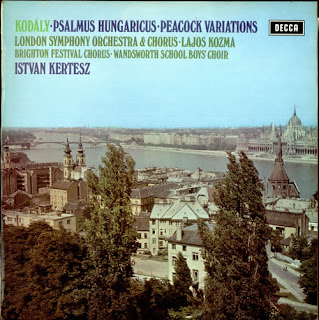
I listened first of all to István Kertész's splendid Decca recording with an excellent soloist, Lajos Kozma, and a not quite incisive enough Brighton Festival Chorus. On YouTube there's a film of Péter Eötvös conducting the International Chorakademie Lübeck and the Frankfurt Radio Symphony Orchestra with tenor István Kovácsházi (not as expressive as Kozma, but the choir is better). but that performance also features in one of those labours of love in which the poster has added the score. Especially useful since you can also read the text in English translation.

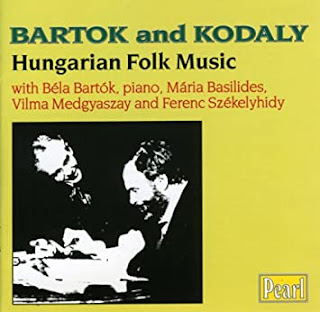
Leading up to this, what I'd already planned made sense last Thursday. First. the three soldiers' songs Bartók added in 1918 to an earlier set. Finding these evocative 1928 performances on YouTube was a revelation. I'm delighted to have got hold of a copy of the long-deleted Pearl CD. That's Bartók and his only close friend Kodály' in 1912 on the cover.

The Hungarian-Greek contralto Mária Basilides is so fine-tuned to Bartók's piano-playing in the first four (one of the original eight is omitted); then at 5m05s comes the tenor Ferenc Székelyhidy - a great voice, a fine artist, one of so many Hungarian musicians of whom I knew nothing until I started this course (and there's not a lot out there). I'll preface it with the texts of the soldiers' songs: 


Recruiting Song 

They are filling the great forest road

Taking away the Transylvanian soldiers,

Taking the unfortunate ones,

Poor Székler young men.

They take them away to that place

Where the road is red with blood,

From the men whom the bullet, the lance,

The sharp sword have cut.


Soldier's Farewell

My work has always been the spring plowing,

Cutting grasses in fields and gardens;

Now my ox is in his place, my horse is saddled,

My whip ready, the halter in my hands.

The day has come when I must leave,

To depart from my home, my country, with a heavy heart,

To take leave of my parents in tears,

To leave my dear wife alone.


Soldier's Spring Song

Snow is melting, oh my pretty little angel, spring is coming.

How I wish to be a rosebud in your garden!

But I can’t be a rose; Franz Josef wilts me.

In the big three-storey Viennese barracks. 


A reminder again that the Soldiers' Songs begin at 5m05s, though it's worthing hearing the full seven. 

From the same recording sessions I took Székelyhidy and Bartók in Kodály's powerful arrangement of 'Rákóczi's Lament', a memorialisation of that early 18th century Hungarian warrior's unsuccessful cause. No translation here, I'm afraid; and translations generally have been a problem. So has English-language study of Hungarian music - I guess few musicologists ever get to grips with the language.

Who'd have thought we would actually comprehend the heroism of taking a stand against an overpowering enemy? But in President Zelenskyy we have it as I've never experienced in my own lifetime. Tomorrow I'm putting up a piece on The Arts Desk celebrating Russian musicians around the world in solidarity with Ukraine, and I'm doing what I can with constant posting on LinkedIn, much as I detest the site's inaction on disinformation. But I'll leave you with this speech for the ages. Zelenskyy has just made another one today to the European Parliament which was even more emotional. Slava Ukraini!


Sunday, 27 February 2022

Green woodpecker in Kew Gardens - again


My green woodpecker shots from Kew last March - among the huge selection of pics I put up recently to mark six months of Friday cycles along the river and picnics in the Gardens - have better backdrops, but this portrait comes with a pleasing history. 

I thought it was time I might see these beautifully marked creatures again on Friday afternoon, so I headed to the huge tulip tree where Cally and I had seen two of them last year.  No sign, but then when I was walking through the woodland zone, I heard the familiar tapping from a dead tree. Waited patiently for 10 minutes; no show. I was just coming to the end of my Rundweg when most unexpectedly this beauty landed right in front of me, and stayed watchfully on the ground just long enough for me to get a snap.

I've been preparing a much more important post in response to the evil time we're now living through - witnessing immense courage as well as mindless destruction - but I thought I'd just drop this here with a few other shots from Kew. Jays, I know, are commoner, but this one also gave me a good glimpse. 

A close up to catch more of that amazing blue and black feather is worthwhile - like the green you find on the side of the now-ubiquitous Egyptian Goose.

It's nearly full magnolia-grove time. One or two flowers on most are now emergent

but only in turning round just before I walked away did I notice that one specimen was in blooming spate - Magnolia campbelii, the misleadingly-named Pink Tulip Tree.

So that deserved a retracing of steps.

Much else is incipient, but early riser Cornus mas, the Cornelian Cherry, is doing well around the lake

while earlier in the week, the plum tree in Fulham Palace's walled garden was heading towards peak blossom.

One last bird shot, more to ask for any ornithologist's advice: is this a Water Pipit I saw at the Wetlands Centre yesterday? UPDATE: my young orni friend Freddie tells me it's a male stonechat, 'still, a very exciting bird! When I was in Spain, I mentioned to the chap I was birding with that, in English, it gets its common name from the male’s call, which supposedly sounds like a stone mason chipping away at a block of stone. He casually replied that its Catalan name roughly translates as “sleeve-shitter,” after the excrement they leave on fence posts…'

Sunday, 13 February 2022

Erratic heroism in Hungary's troubled history


The heroism can apply to women, too, of course, and among the brief flourishings of wholehearted effort, Empress Elisabeth ('Sissi') of Austria's was not the least impressive. That's her above at the coffin of one of the few sober, balanced leaders of Hungarian history, Ferenc Deák (portrait below by Bertalan Székely), briefly Minister of Justice and then the pioneering reformist who even in semi-retirement steered the capricious Hungarian cause through choppy waters. His line was essentially that of passive resistance from 1849 through to the compromise which gave semi-independence in the form of the Magyar wing of the Dual Monarchy, the Austro-Hungarian Empire, in 1867.

What a contrast Deák made to the headstrong, all-or-nothing nationalist Laos Kossuth, who went into exile after the disastrous defeat of the Hungarians when Emperor Franz Joseph called in the Russians in 1849. I'll come back to Kossuth anon, but it's worth briefly paralleling that glorious but doomed venture with the equally celebrated campaign against Habsburg rule organised by Prince Ferenc Rákóczi II (pictured below by Ádám Mányoki). 

This, too, despite its brave premise of a 'people's army', was doomed. It lasted eight years and, lacking as so often in Hungarian history proper help from international allies, came to an end in 1711. But it resonated down the centuries, first with ballads in the 1730s and then the march known in Hungarian as the Rákóczi-induló, published by Nicolaus Scholl in 1819-20. For the Hungarian music Zoom course, which has now reached its fifth class/door with Bartók's Bluebeard's Castle, I found diverse versions on traditional instruments. This track, from a Jánosi Ensemble collection, has various treatments: with the second, you might start to recognise the theme familiar from Berlioz and Liszt.

Berlioz wrote his first dazzling orchestral version, famous to us in its incarnation as part of La Damnation de Faust, for a visit to Pesth in 1846, vividly described in his memoirs. Always good to have a Hungarian at the helm; in class I used a Berlin performance from the great Ferenc Fricsay, but this is quite a YouTube treasure, with that fine composer and human being Ernst von (Ernő) Dohnányi conducting the Budapest Philharmonic Orchestra.

Lizzt's Hungarian-Rhapsody treatment of the march is predictaby wacky, and though I'm not a fan of much of Liszt's piano music, the great Cziffra can persuade me in the fireworks.

The erratic fight for freedom in the 19th century did at least see the talented, pioneering but flawed hero Kossuth offset by two much more stable figures - in the earlier half of the 19th century, Count István Széchenyi, who made so many beautiful improvements to the conglomeration of towns soon to be known as the city of Budapest, and later the aforemtioned Deák. Kossuth's legend spread fast; he had not been long dead when in 1904 the young Béla Bartók composed his first major orchestral work, with the defeated hero as its subject and the symphonic poems of Richard Strauss - whose Also sprach Zarathustra at its Budapest premiere had just turned the young Hungarian back to composing - as its style model. 

It's an impressive work, with a parody of the Austrian national anthem in the vein of the critics/adversaries sequence in Strauss's Ein Heldenleben and a theme very close to the heroic pride of Liszt's Second Hungarian Rhapsody near the end. We listened to it in full as part of the second class, with the benefit of a generous YouTuber's score co-ordination.

Without Elisabeth as passionate advocate of the Hungarian cause, though, matters might not have moved so quickly after Kossuth's hasty departure to avoid execution. Partly in opposition to her powerful mother-in-law the Archduchess Sophie, who preferred Czech, Sissi learnt Hungarian in the face of all advice. In 1866 the 28-year-old Sisi met 42-year-old Count Gyula Andrássy, sentenced to death in absentia after the defeat of 1849 but soon to become Prime Minister. If it was a romance, it had to be one conducted in the public eye - and Andrássy would have been very careful indeed. Hungary's cause was also greatly advanced when Bismarck's Prussians crushed the Austrian army at Königgrätz that same year = the Emperor now needed to look east. 

And so on 8 Jun 1867 Franz Joseph became King of Hungary as well as Emperor of Austria in a ceremony of great, flashy, almost oriental pomp, though most eyes were turned towards the coronation of the Queen-Empress. Liszt composed a remarkably concise and - for him - chaste Coronation Mass. It runs quite a gamut in its 45-minute span - eastern, Rákóczi-song echoes for the 'Qui tollis' of the Gloria, returning in the 'Agnus Dei', straightforward brass pomp for the big blazes, though not overdone, and a chaste harmonisation of Gregorian chant in the 'Credo' with ony organ accompaniment, The students were charmed by the Wagnerian Lohenginesque purity of the 'Benedictus', its violin solo tinged with native fiddle inflections.

I'd always steered clear of finding out more about the celebrated Empress-Queen destined for such a tragic fate, rather repelled by the Sissi 'cult' in Vienna. And of Crown Prince Rudolf all I know is about the scandal of Mayerling, mainly from Kenneth MacMillan's stunning ballet. But Rudolf, too, was a highly intelligent supporter of the Hungarian cause. A friend to Hungarian and Austrian Jews, he had an articulate take on the Hungarians' nationalistic errors, Under a pseudonym, he wrote, for example, this:

The sad thing for Hungary is the Magyars' lack of consideration and inability to understand that nothing can be achieved by bad treatment and contempt and momentary vehemenent regulations with the nationalities, who are numerically superior, and of whom one has absolute need in order to preserve the Hungarian state in the same size, which today it still possesses...In many, in fact most parts of the territories of the Crown of St Stephen, only the nobility, the officials and the Jews are Hungarian - the people belong to other tribes.

What Rudolf writes there is prophetic of trouble to come, especially in the 20th century. Even when there was such hope and growth in the later years of the 19th century, very largely due to the emancipation laws of 1849 and the major presence of Jews in industry and commerce which helped to make Budapest so prosperous a fin de siecle city, the anti-semitic backlash of the 1880s provoked him to write, this time anonymously, in the Neue Wiener Tagblatt, that 'an abyss is opening up in Hungary, and much that still appears viable today can easily fall into it'.

I am indebted for clarity on all this to Paul Lendvai's The Hungarians: A Thousand Years of Victory in Defeat (Hurst). It's been as essential a companion through the Hungarian music course so far as the culturally wider ranging The Czech Reader was in the previous term. Lendvai's chronicle constantly throws up fascinating personalities like the above, and the thriller-nature of the read only increases from 1919 to the present day. You can tell that Lendvai doesn't mince his words by the fact that the final chapter, updated for the 2021 edition, is called 'Viktor Orbán's "Führerdemocracy" ', Perhaps I'll return to later developments in another blog entry. There's a reasonable hope that Orbán might not do so well in the April elections. Meanwhile, onward to 2014-19 this coming Thursday with Bartók's and Kodály's Second String Quartets and Bartók's The Miraculous Mandarin, plus sideways glances at lesser works like The Wooden Prince.