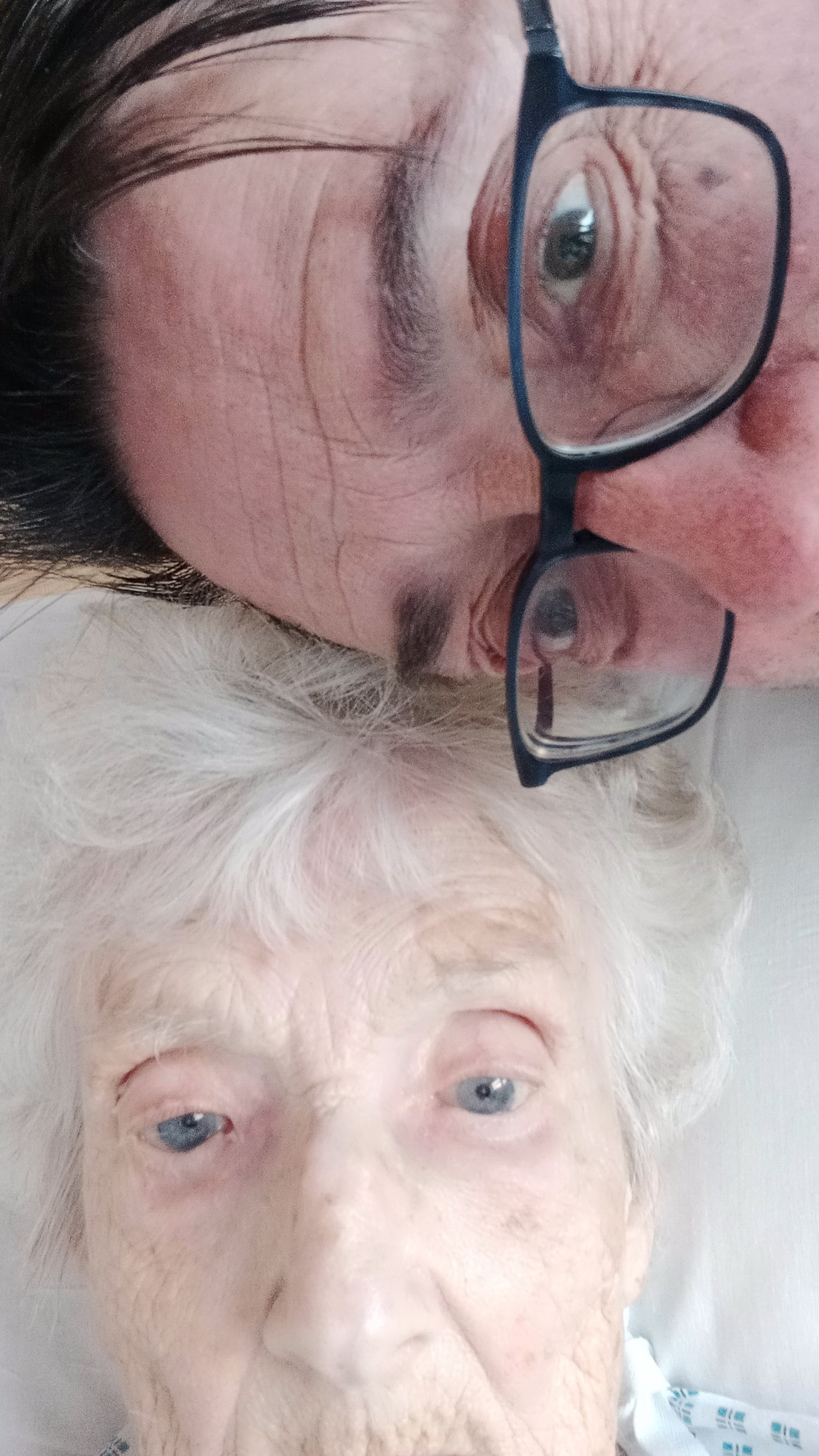
It was the best and worst of days: 4 January, which began with leaving glorious Volterra at 8 in the morning on the first bus as the sun rose, and later continued with heading straight to Epsom Hospital to find my mother delirious from one of several infections (the consultant simply said 'the next 24 hours are crucial').
Well, the rest of January was quite a grind of travelling back and forth for hospital visits, wavering between hope and fear and much else in between. But I'm so glad for our Italian idyll for giving me strength. After I last posted on the subject, we had an ideal New Year's Eve supper at Sophie's Siena guest house, with delightful fellow guests and some round-the-table entertainment. Sophie has written about it on her blog, with photos, so I'll simply give my own brief take: the turns included charming big cheese of the local Onda contrada Loris singing a couple of the team songs and Andrea delivering a brilliant theatrical monologue (I didn't understand it all, but my Italian worked pretty well throughout the evening). The sparklers I'd bought in a Ferrara anything-goes shop came in handy

and after 'Auld Lang Syne' with the Milva alternative, we strolled down the street to the Campo where Italian popstar Emma belted songs out with great spirit to a packed 'arena'. She'd yielded the stage to two comedians by the time I took this photo just before midnight.

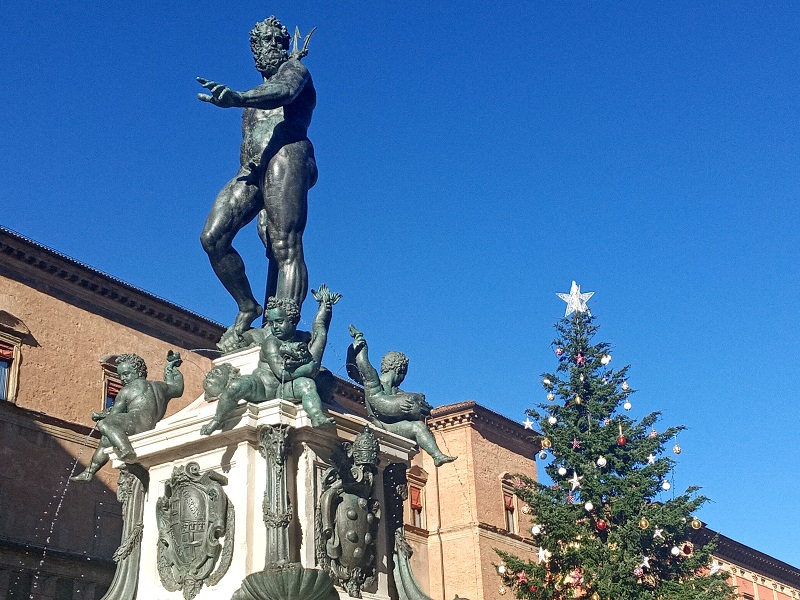
Just to make myself jolly again - I am, in fact, this weekend, with the Man from Dublin here - I wanted to make a very superficial selection of artistic treasures from our wanderings in seven Italian cities, four brand new revelations. I fell in love with Bologna again - we were staying the first night in a glorious area and had a splendid supper in the Ristorante Donatello, its walls covered with signed photos of superstars both operatic and otherwise, and though we only had a morning, it was so enriched by finding San Petronio open (I think it must have been undergoing restoration on the last visit). The original reliefs by Jacopo della Quercia are to be found in one of the chapels, but the replicas make the facade handsome indeed, and all Bologna seemed to be out, with or without dogs, that brilliantly sunny morning.

To try and keep the treasure pictures down, I'm limiting choices where possible. The biggest impact here came from Vincenzo Onofrio's 1480 Lamentation, with its astonishingly expressive wooden figures.

We took a day trip by train from Ravenna to Rimini chiefly to see one of the great unified treasures of the Renaissance, the Tempio Malatestiano, and were more amazed than I'd expected, but my mind's-eye image, aided by photos, is of the Ponte di Tiberio, begun under Augustus's aegis and finished in Tiberius's time (21 AD),

connecting the main Corso d'Augusto with the piquant area of San Martino, full of Fellini homages on the walls of the narrow streets and a Veronese in San Giuliano (with Fellinesque Roman soldiers outside participating in a nearby 'living crib' show). The folly of Sigismondo Malatesta, both monument and church (it is now the city's Duomo), has a west front by Alberti,

but it's the decorative unity of the interior which takes one aback, especially given the way it was lit as darkness fell.

To the right of the entrance is Sigismondo's tomb and the first chapel with his symbols of the elephant and the rose much in evidence

Putti adorn most of the chapels


The fourth chapel on the south side is full of planetary symbols and Zodiacal signs, not exactly what you'd expect in a church.


As if al this weren't enough, there's a fresco by Piero della Francesca of Sigismondo kneeling before his patron, Saint Sigismund of Burgundy,

and a crucifix above the high altar now decisively attributed to Giotto.

Of course the Byzantine mosaics of Ravenna had to be revisited while we were there for Muti's mini opera festival, but there was one site I wanted to see for the first time - the museum of the ancient Roman part at Classe (Classis back then), beautifully set up in a former sugar-from-beetroot factory.

The upper floor was laid out for the most elaborate wedding reception imaginable (said wedding taking place, of course, in Sant'Apollinare in Classe five minutes' walk away). Limiting myself to the glories here, I'll stick to the mosaics, one of which I thought I'd already seen when we got into the city's relatively recently opened Case dei Tappetti to see an ingenious 10-minute dance piece, but that must have been a reproduction.

And there was much more.

Of our three days in Ferrara, two wonders eclipsed the rooms of the rather gloomy and overbearing palace-fortress of the Castello Estense. As you walk further east, the buildings become lower-level, the streets less dark, and a number of palazzi which served as suburban summer homes for the aristocracy stand out. The Palazzo Schifanoia is famous chiefly for the Salone dei Mesi, depictions of the months with scenes partly from everyday life and a beautifully coloured band of zodiacal signs painted by Francesco Cossa with the help of Ercole de'Roberti and other Ferrarese artists, hidden under whitewash and rediscovered in the 19th century. The months we have - two are ruined, three obliterated - are glorious. This is the wall with June, July and August

and here are three close-ups so you can see some of the Zodiacal beauties better.


Right-wing council notwithstanding, Ferrara has done wonders with all the museums and palaces we saw, exceptionally well restored and interpreted. I gather it was no great loss that the interior of the Cathedral was closed for restoration; it's been Baroqued, and all the earlier treasures are in the Museo delle Cattedrale housed in the former Church of San Romano. Just about every item here is a gem, starting with the 24 codices/illuminated choral book in the room on the upper floor. Among the artists involved was Giovanni Vendramin from Padua, who executed the exquisite nativity below.

Surely one of the most beautiful of all Renaissance sculptures is Jacopo della Quercia's Madonna della melagrana (she's holding a pomegranate in her right hand), perfectly lit in the first room you see around the cloister downstairs.

The main body of the church highlights rich tapestries from the Ferrara workshop of Johannes Kircher (d. 1562) framing the great paintings of Cosme Tura on the shutters of the Cathedral's organ, in a display which allows them all to be seen simultaneously - glorious Mannerist representations of the Annunciation and Saint George and the Dragon.

The months here are of stone, carved with incredible refinement between 1230 and 1240. All the details are absorbing, but finest of all, surely, is the grape-harvesting of September.

The glories of Vicenza are more secular than ecclesiastical, though there's one church packed with treasures, Santa Corona. Here I restrict myself again, this time to the two great paintings: Bellini's Baptism of Christ, encased in a grandiose altar,

and Veronese's Adoration of the Magi (detail below)

where the colours, especially the yellow gown sported by the kneeling king, glow from a distance. There are plenty of fine altarpieces in the Museo Civico, housed in Palladio's Palazzo Chiericati, but the other stunner lodged in a church is another Veronese, The Supper of Gregory the Great, still housed in the refectory of the cultish Basilica di Monte Berico (Madonna del Monte).

The canvas was hacked to pieces by the Austrian soldiery in 1848 and repaired at the expense of Emperor Franz Joseph I. Its relatively recent restoration offers another sumptuous spectacle. It's rather surprising to see Chris supping with the Pope.

I love it that the room is lines with cabinets of curiosities, natural and otherwise,

though none as wonderful as the cases of beetles in the humble Natural History Museum next door to Santa Corona. It was absorbing to learn about two dedicated Vicenzan entomologists. though this iridiscent collection isn't, I think, one of theirs.

We actually reached the Basilica towards the end of a splendid round walk taking in two very important villas on the outskirts of Vicenza. The Villa Valmarana dei Nani, so called from the statues of dwarves lining the wall as you approach,

isn't a Palladian construction, but it's simple and elegant, and both the Forestiera (Guest House) and the villa proper are given over to fabulous Tiepolo frescoes - son Giandomenico's (whose Stations of the Cross in Venice's San Polo I've long admired) in the Guest House as well as the more celebrated father Giambattista's work in the main building (the resident family seem to have long preferred the former, a kind of Kensington v Buckingham Palace on a much smaller scale). The entrance hall of the Palazzino has a very familiar scene: the pending sacrifice of Agamemnon's daughter so that the Greek fleet can sail to Troy

where help is at hand from Diana, sending an amorino with a hind on the left as nick-of-time substitute. The narrative is also on the ceiling, where the goddess is sending her missives.

while on the opposite wall the onlookers include soldiers and sailors with a very expressive dog.

Each of the other rooms deserves equal attention, with vivid scenes from the Iliad, Aeneid, Orlando Furioso and Gerusalemme Liberata - Giustino di Valmarana wanted to show what an erudite chap he was - but the splendid picture book I bought does the job. Just a few glimpses of the very different subjects in the Foresteria. Giandomenico did so well with the intriguing figures, not least in the Room of the Gothic Pavilion

but especially in the Room of Carnival Scenes, where a black servant bringing chocolate down trompe-l'oeil stairs seems captivated by the 'Mondo novo' panel.


Our rustic route led us to the gateway of Palladio's most celebrated building, the Villa Rotonda,

which was closed (for the winter?), but we got a good view of the facade and one of the sides. Then through the 'Valley of Silence' - without a hint of wind, it really was dead quiet - and up more steps than I've climbed since the op to a beautiful park with a rather interesting Museum of Italian Independence before walking round to the Basilica and back down to town via the celebrated covered walkway (much like the one in Bologna). Three days weren't enough to see everything covered by the city pass, though I'm glad I didn't miss the Galleria d'Italia in Palazzo Leoni Montanari. The building itself was a dazzling done-up extravaganza of statuary and painted ceilings

and in some rooms Greek vases complemented the surroundings rather. The great treasure had a dark space to itself - Francesco Bertos's minutely detailed, small-scale Fall of the Rebel Angels (1725-30), intricately carved from a single block of Carrara marble.

Archangel Michael wields his sword at the top of this fantastical composition.

Had you only a day in Vicenza, what should you see first, apart from wandering around the loggias of the Palazzo della Ragione, confusingly called the Basilica (the Duomo pales by comparison)? Unquestionably the Teatro Olimpico, completed by Palladio's son Silla following the architect's sudden death in 1580. I love it that the first play to be performed there in the face of civic opposition was Sophocles' Oedipus Tyrannos, its still extant scenery of Theban streets designed by Vincenzo Scamozzi.


It's also worth seeing whatever happens to be on in the great council chamber of the 'Basilica'. What we caught was an austere gem of an exhibition - just three 'capolavori': Caravaggio's St Jerome from Rome's Galleria Borghese, Van Dyck's Four Ages of Man from the Museo Civico and Arcangelo Sassolino's No Memory Without Loss, a revolving disc from which viscous red oil paint drips regularly. It works pefectly in the setting under the extraordinary wooden barrel roof.


Of major works we hadn't seen before in Siena, the revelations were those in Santa Maria dei Servi. But on now to Volterra, another first, unforgettably approached on a near-empty bus along winding roads from the pretty town of Colle Val d'Elsa. No wonder this is a major tourist attraction in the summer; its supreme height alone and the views of the surrounding landscapes makes it worth a visit. But Volterra is an essential treasurehouse, as much for its Etruscan legacy as its medieval and Renaissance gems. On our first morning, we walked down the steep hill from our bijou hotel and already found ourselves, Blue Guide at that point unchecked, going through a gateway restored in ancient Roman times but still with the shapes of three Etruscan heads on it.

The Guarnacci Museum of Etruscan Art has to be one of the most fascinating of its kind anywhere. True eccentric Mario Guarnacci (1701-1785), abbot and would-be academic, left his collection to the town, and 1877 the museum moved to its present premises in the Palazzo Desideri-Tangassi. Thanks to an Erasmus scheme - remember that - the first floor rooms were mostly restored to their 19th century layout, but the outstanding objects have special space. Most intriguing is the bronze known as the 'Ombra della sera' (Evening Shadow), dated back despite archeological context to the third century BC.


The hundreds of Etruscan funeral urns smack of mass production, but some have exceptional reliefs on the sarcophagi beneath the generic figures, and one couple stands out from the rest on the 'ura degli sposi', beautifully lit with cases of Greek and Roman amphorae.

The Pinacoteca Communale in the Palazzo Minucci-Soliani doesn't quite have the love lavished on equivalent collections in Ferrara and Vicenza, but there are fine paintings in every room, including an Annunciation by Signorelli with a gorgeous angel

and they make the most of the standout, Rosso Fiorentino's Deposition, well restored and presented. I need say no more; the images speak very eloquently.


And now, of course, we're closer to Easter than Christmas. But I feel we have to return to Italy again at the end of the year and follow a different trail between cities and towns we've never spent time in. It's a lifelong resource.





 Posts