Showing posts with label hospital. Show all posts

Wednesday, 17 January 2024

And the Emperor said, 'Good morning!'


Thus ends Hans Christian Andersen's fairy tale The Nightingale. The Chinese ruler has been at death's door, but the exquisite songbird he so easily rejected for a mechanical version has vanquished the grim reaper (paper cut by HCA reproduced in my Penguin edition pictured below). 

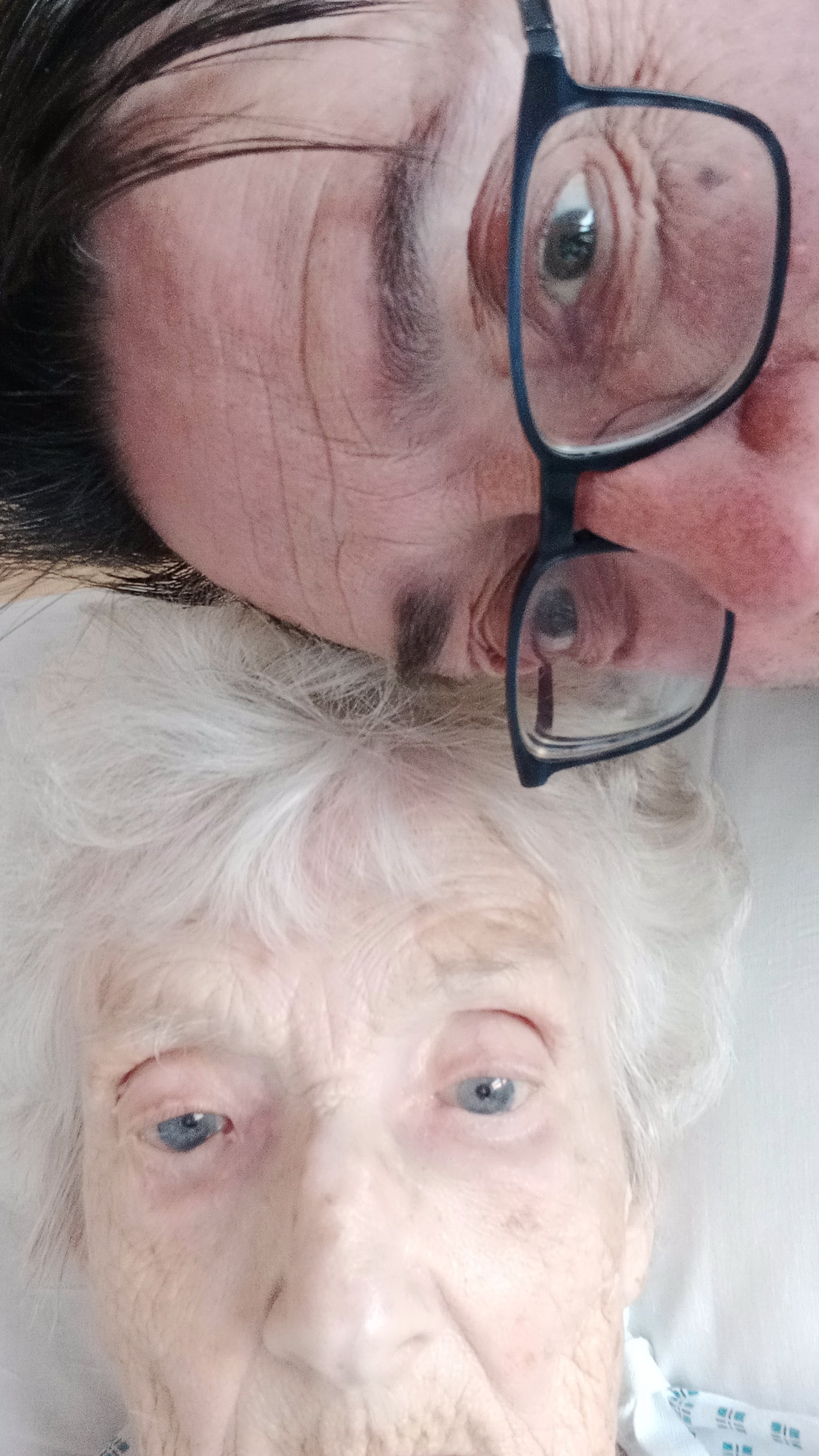
I thought of it when, after two nights of delirium and distress, my nearly-93-year-old mother greeted me on the third visit, back to her old self. She'd been admitted to Epsom Hospital with Covid, the return of her COPD and pneumonia in the right lung. The consultant thought she might decline further. But she rallied, only to get another infection three days later. This time she wasn't beside herself, but still mildly delirious. A second course of antibiotics and more rehydration seem to be doing the trick and, though very tired and barely able to keep her eyes open, she's been lively in all her responses and very much engaged with everything that's going on. I chose the top image because she has yet to be reunited with her dentures, but I decided that the below photo is also fine.


Stravinsky set the Andersen tale in singular fashion, and earlier I'd been reminded of the Bedlam scene in The Rake's Progress, where Anne Trulove calms the troubled spirits of the inmates. The healing power of music struck me twice: on the first visit, straight from landing at Gatwick airport, where I found the finale of Mozart's Clarinet Concerto and the slow movement of Dvořák's Sixth Symphony on my laptop player. She went quiet immediately. And on the second visit, when she seemed worse, I'd downloaded my selection of Mozart slow movements and again, her head off the pillow, me cradling it as best I could, she shut her eyes, occasionally opening them, but otherwise perfectly still, for a full 50 minutes. This was the first track.

Later it was singing along to the ripostes of 'Who Wants To Be A Millionaire?' and the 'hoy's of 'The Deadwood Stage'. We've also been quite interactive with TV; there are quiz shows hosted, to my surprise, by Graham Norton and Stephen Fry, but I also discovered an amazing presenter who's not only very sympathetic but really knows his stuff, wildlife cameraman Hamza Yassin, whom my mother recognised, it transpired, as a winner of 'Strictly Come Dancing'. 


At first it was difficult persuading the staff that my ma isn't in the advanced stages of dementia - over the four months in Greenacres Care Home, she may forget what she's just said, and some details, but I thought she was better when among company. So we showed them photos of how she'd been right up to Boxing Day, when Sara visited with her daughter and grandson Lenny. 

And on the 18th, the day before we left for Italy, thinking all was going just fine, J and I took her to lunch at Prezzo, a short wheelchair ride away from the home. She loved the scarf I'd got her, adorned with flower motifs by Palestinian weavers (see the excellent facilitators, ODE Collective, here).

Today I spoke to the consultant and agreed with most of what he was saying, except for the suggestion that mum is losing interest in her surroundings. Though increasingly more fragile and tired, she was on good form yesterday. She ate four mouthfuls of the coffee marble cake I'd bought (actually for myself) at the Costa Coffee Shop on the second floor, and when I reminded her of how even last year she was still making cakes for the Open Door Cafe of the church, and asked her if she remembered Open Door, said, 'Of COURSE I remember Open Door. Stupid boy' (a reference to Dad's Army). The mock insult was remedied by our farewell, when she called me 'angel child'. She loves the view from her window on the fifth floor, and the curtains. So maybe she rallies when she sees me, but she's far from retreating from the world. 

Even so, both Sara and I had hoped she would be over her suffering the other week, and if this is to be a slow, peaceful fade, so be it.

UPDATE (23/1) - Mum seems to have withdrawn still further. More or less non verbal now, and barely opens her eyes. Not eating or drinking much. I think she wants it to be over, and I want what she wants. Feeling utterly exhausted right now, running on empty.

(26/1) - Another imperial 'good morning!' after I'd had to stay away for four days with nasty virus (not Covid, tested twice, and feeling more or less fine today, though wore a mask; in my absence, Sara visited). Bright eyes and alertness, though very tired. Got two and a half crossword clues right. Slept peacefully duing the last half of my visit - more Mozart on the laptop. The next question is whether Greenacres will be in a position to take her back; reassessment due on Monday.

(27/1) - Dentures are in at long last. Alert to begin with, then dozing. She has a lovely rapport with nurse Joaquin ('Jack') - I don't know who started it but they waggle their eyebrows at each other. He's so funny and kind with her. Was about to persuade her to have some leek and potato soup as I left yesterday. I got her to promise to eat 'the soup, the whole soup and nothing but the soup' and she responded 'so help me God'. 

(Early February) The unanticipated miracle happened - mum returned to her splendid care home, Greenacres, and has been slowly improving to the extent that they get her out of bed for at least one meal with her new friends there. Her voice has got stronger and she's playing things even more for laughs. I feel such relief - and joy after I've visited - and it looks as if I can think of going to Dublin next week.


Wednesday, 23 November 2022

On the beach at night alone*

Context is all-important, and I'd like to be honest on here: last Thursday morning I had a second biopsy under general anaesthetic at Charing Cross Hospital. There's a tumour in my bowel and my vivacious surgeon Maria needs to ascertain the type of cancer before proceeding with further treatment (probably a limited form of chemo- and/or radiotherapy to avoid a big operation). Fortunately it's not spread, so I'm at a fairly early stage, and all should be well.

As with the previous procedure, I had an afternoon nap and then went out to see a life-affirming performance: two Thursdays before this it was Gilbert and Sullivan's The Yeomen of the Guard at beleaguered English National Opera (sign the petition, please) - not the finest of productions, but with some excellent performances, and anyway I have such a soft spot for the work, even if it's not as funny as the vintage topsy-turveydom. Last Thursday it was what turned out to be a very deep and moving Vaughan Williams evening at the Royal Festival Hall, culminating in his first great masterpiece, A Sea Symphony


I've waxed lyrical about the profundity of the experience in my Arts Desk review, but I wanted to say a few more words here in praise of Walt Whitman, whom I scoffed at too much in my youth. The sentiments seem all the more remarkable given the times, but even the long, long lines seem to me to work now. And I appreciate all the more how Vaughan Williams set them, or parts of them, in his first great spiritual achievement. "On the beach at night alone" forms A Sea Symphony's second movement, its dual achievements the beauty and mysticism of the themes and the way the baritone is stilled towards the end so that the orchestra carries the essence alone. 

My image up top is of midnight on a solitary walk around Bergman's beloved island of Fårö - by then, the stars were not up, but it still suits my mood. Whitman's poem, 'Similitude', is worth quoting in its entirety.

On the beach at night alone,
As the old mother sways her to and fro singing her savage and husky song,
As I watch the bright stars shining, I think a thought of the clef of the universes and of the future. 

A vast similitude interlocks all,
All spheres, grown, ungrown, small, large, suns, moons, planets, comets, asteroids,
All distances of place however wide,
All distances of time - all inanimate forms,
All Souls - all living bodies though they be ever so different, or in different worlds,
All gaseous, watery, vegetable, mineral processes - the fishes, the brutes,
All nations, colours, barbarisms, civilizations, languages;,
All identities that have existed or may exist on this globe, or any globe,
All lives and deaths - all of the past, present, future;
This vast similitude spans them, and always has spanned, and shall forever span them and compactly hold them.

Time and again in A Sea Symphony, VW supports the 'all is one' philosophy with themes and colourings of surpassing beauty, reminding us how he was at best a 'Christian agnostic'. In the first movement, there's 'one flag above all the rest, a spiritual woven signal for all nations, emblem of man elate above death...A pennant universal'. And in the finale, it's the soul's sealike journey, 'fearless for unknown shores on waves of ecstasy to sail'. 

You can see why it chimed with my present thoughts on mortality and the universal. For the same reason, I'm inclined ever more to look at the beauty of the infinite - no shame in getting all purple-prosy about this - and after a splendid lunch yesterday with my new best friend Melinda at Daquise, I went back to the Natural History Museum. The late afternoon winter light made the building itself look more glorious than ever (which it is),

I'd seen a pic of the model Tyrannosaurus rex wrapped up in an 'ironic' Christmas jumper, but he was doing without on Thursday afternoon. Still, this was a good excuse to be struck afresh by how much has been dug up of dinosaur remains hundreds of millions of years old. The full frames, whether assembled from real bones or casts, are so impressive

but just look at the armour plating of this Scolosaurus, uncovered from the surrounding sandstone.

What I came for again, though, was the Mineral Gallery at the east end of the ever-amazing building, on the first floor. As it's in effect a dead end, not on the way to anywhere, unless you seek it out you may miss it, as I had done for years. Then I read Richard Fortey's Dry Store Room No. 1: The Secret Life of the Natural History Museum, and he opened my eyes as surely as Simon Winder's Germania did to the fabulously beautiful Vogelsaal of Bamberg's NHM

As Fortey points out, this room is rare in still housing the bulk of the collections originally intended to be housed there, and the display

has been preserved in something like its original state. The Victorian Society is delighted. It is an airy space, well lit from the generous windows, and with glass-topped cabinets running in ranks transversely across the gallery, each of which includes a fine selection of specimens. The arrangement of minerals in the cases is by natural 'families' of minerals - so the sulphides will be found together, as will the native elements like gold and copper, or the oxides, and so on.


It is a teaching collection in a way that no longer exists elsewhere in the building. An eager visitor might spend weeks in here learning, and would emerge at the other end as something of a mineralogist.

I've decided to try and do so with a combination of regular visits, and the museum's own handbook, which arrived today.

That should help me to be a bit more systematic. But I see nothing invalid in the aesthetic approach I took yesterday - simply looking more at the most beautiful things, like the opals.

And the NHM's gorgeous rooms help if you just want confirmation that nothing in art is more wonderful than nature itself. Take, too, this brain coral, which I saw en route from dinosaurs to minerals.

*Whitman's line does without the comma between 'night' and 'alone' which features in the way the poem is punctuated in the score of A Sea Symphony.

Monday, 26 July 2021

Bosky pleasures on hospital visits


Most recent contributor to the long silence here on the blog has been daily hospital visiting - my 90-year old mother is still in New Epsom and Ewell Cottage Hospital convalescing after a difficult time at its big sister in Epsom proper. The smaller establishment is in beautiful countryside, on what was once the mental-hospital conglomeration located on the Horton Estate by London County Council starting in 1900. At one time the patients made up 10 per cent of Epsom's population. I remember going to St Ebba's and West Park with the Epsom Youth Orchestra. Now it's a combination of quite pleasant housing, nurses' training schools, outpatients' facilities and NEECH.

I think I've made the most of visiting. Even when mum was in Epsom Hospital, I found solidarity among the stallholders of the market that's sprung up around the Clock Tower, made by narrowing the high street road to a single lane and building out the pavement area. The coffee and falafel sellaers have been good people to chat to. One Saturday was especially lively, and I was surprised to come across the Caldegrave Ensemble, wind dectet, at the centre of the action.

When slimmed temporarily down to wind quintet, they played some pieces I haven't heard since I played in the Glyn [Grammar School] Wind Quintet - a wayward bolero with a quirky oboe tune I remember having to practise rather a lot. So this was a nice link with the locale as I remember it from more than 40 years ago (daily school journeys were 164 bus to Epsom, 293 to Glyn or a 20-minute walk).

I also discovered how, on days when I didn't take the E10 bus, I could walk to and fro via Epsom Common. Growing up in Banstead, part of the happier aspect of my childhood was biking around Banstead Downs with my chums; but this natural paradise on the other side of Epsom was something I only ever saw from the car. On foot, the quickest route is via West Hill, where there are a few old houses among the suburban build, and down to Stamford Green, where the Cricketers Pub was one of several drinking establishments in the country we used to frequent as teenagers once we had our driving licences. There are also attractive paths nearer NEECH, one on the other side of the road from a rather good garden centre serving the only good coffee (or anything, for that matter) in the vicinity. Twice I startled this deer.

The bus also displayed useful information about local rarities in the fauna. I saw that if I looked carefully, in the shade, on honeysuckle or brambles, I might descry the now-endangered White Admiral - and on an afternoon devoted to that quest across Epsom Common, I finally caught one resting, albeit with a broken wing.

A gorgeous Purple Emperor also flew above my head at the Stew Pond, but too fast to snap. I did at least catch this dragonfly (which one? If anyone can identify, I'd be grateful) settling

and this duck from the place where I saw the Purple Emperor.


Couldn't work it out at all until entering 'duck with white eye-stripe' on Google produced evidence that male Mandarin ducks, so gloriously plumed in winter and spring, shed all their glory in the summer to look like this. Moulting has produced some surprises - the goldfinches still at the feeder in the back yard at home have lost their black polls and red sidebars


 and the blackbird is looking less glossy

though I did see the young 'un being fed a mulberry by dad on the wall this morning.

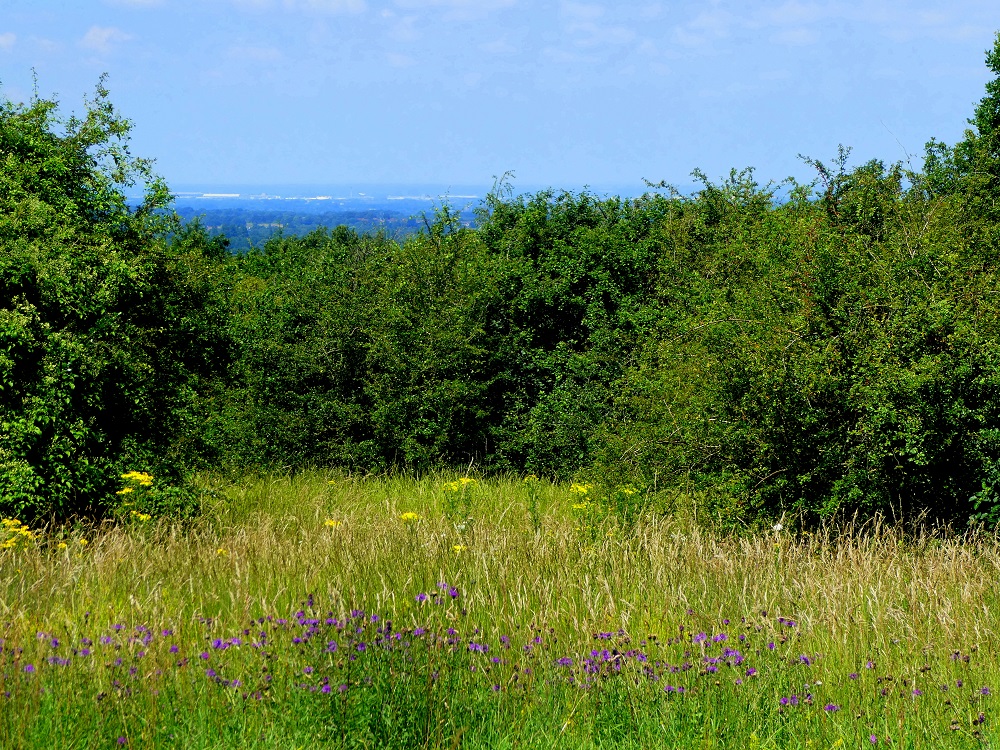
But back to the Common exploration. While the smaller pond had patient fishermen sitting around it, the big 'un is nicely preserved from human invasion on all but its north side, from which you get this vista.

That was a glorious discovery. So, too, was making a virtue out of the necessity of Sunday train chaos by going to Epsom Downs Station (which is not Tattenham Corner Station, as I had thought - initial confusion at the start of the route) and walking from there to the hospital on the hottest day of the year. Fortunately I was sustained by plentiful supplies of water and eventual shade - though not on the Downs, where the views down over London were captivating, but the long grass verges on the edges of the gold course even more so.

Here I saw plenty of Veined White butterflies, but not at rest, and this Brimstone,

as well as a fair few Pyramid orchids.

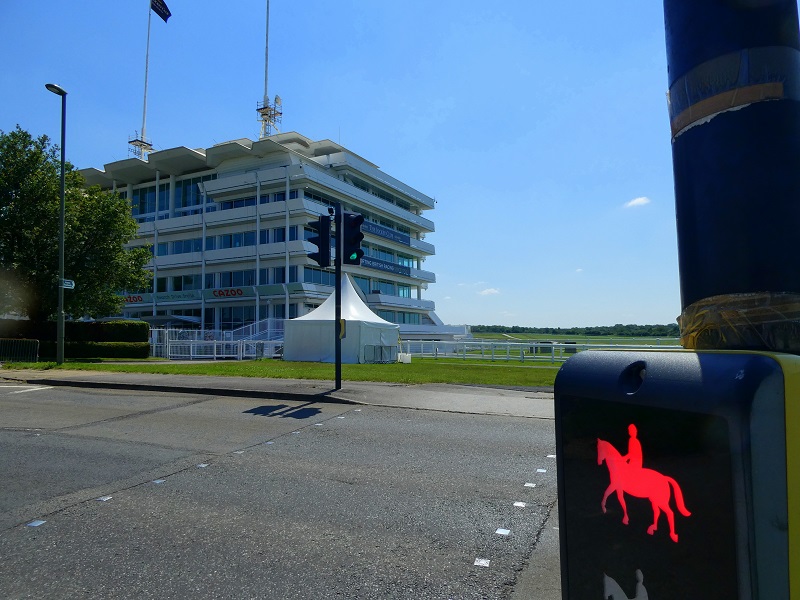
Crossing by the Grandstand

I took the shady route down Chalk Lane, with horse paddocks on either side

and saw for the first time The Durdans, grand old house with gates from elsewhere, where my schoolfriend's mother, who worked there, claimed to have seen a headless horse.

Funnily enough, this route took me out by Epsom Hospital, a grateful stop because I needed more liquids and a sandwich for lunch. Then I crossed Epsom Common via the Wells Estate, and found a new route to NEECH. 


The patient by now, enlivened by plenty of physio and an abatement of her COPD, was in good shape - not bad for 90 - and managed to stay cool throughout the heatwave.

They're very careful at NEECH to keep Covid at bay, so only one designated visitor can book in for an hour each day, though others can arrange a visit outside if they can manage the exclusive table-and-chairs slot. We sat outside again last Tuesday and enjoyed the view - a meadow with plenty of butterflies, sadly shorn on Thursday, plus the pine trees to the left.

That stormy-looking sky did not develop. Of course on a crucial Monday when storms and floods hit London and the area to the south, I would not have walked. I intended to, but when I reached the bus stop just outside the Horton estate, the sky looked like this

and I thought better - the E10 arrived with the first spots and torrents poured as I sat on the train from Epsom. At West Brompton, the downpour went on so long that I stopped sheltering, left my bike there and walked home with an umbrella for only partial protection.

On Saturday, thinking that would be my last visit since mum was due to be released today - it will now be Wednesday since they're sending her to Leatherhead for a test tomorrow - I planned a big route back, this time to Ashtead Station. Even the lane to the common is full of interest - what I saw here is, I think, a rare Jersey Tiger moth which flies about in the day as well as the night. Its russet interior is as colourful as the zebra stripes on the outside.

Epsom Common yields to Ashtead Common with a private wood in between, permissive paths around it. I meant to take the bridleway passing a Roman villa, but turned off too soon - on the Epsom side of the private wood - though this long path still yielded beauties like this stand of oaks

as well as identification of a butterfly I'd seen previously using its camouflage with folded wings on a dead leaf

as a Speckled Wood

alternating on brambles and bracken with the Gatekeeper or Hedge Brown.

What looks like a bee resting on a nearby leaf,

a hoverfly on the notice board at a junction (look carefully, it's taking the yellow path)

and more moulted mandarins in the shade by a small, over-algae-d pond.

Had an interesting chat with a man out walking his lovely collie; he told me this land, bought up by the City of London in 1870, was used for army training in World War Two, and you might find a black lipstick, remnant of camouflaging. Soon I found my way to the lovely meadow about Ashtead Station

and found a large flock of sparrows - not such a common occurrence these days - dustbathing and flitting just before the level crossing.

Dependency on public transport certainly doesn't leave one free as a bird. There was a bus replacement service to Epsom; station attendant told me to hop on the one outside, and it took me in the opposite direction, towards Dorking. So half an hour wait for the right one at Leatherhead. Still, these are peripheral irritations to visits that have much more pleasure in them than I'd anticipated. I may have sacrificed my usual time in Estonia at the Pärnu Music Festival - been lucky at least to watch the concerts on the festival's TV channel - but I know I did the right thing.