Most recent contributor to the long silence here on the blog has been daily hospital visiting - my 90-year old mother is still in New Epsom and Ewell Cottage Hospital convalescing after a difficult time at its big sister in Epsom proper. The smaller establishment is in beautiful countryside, on what was once the mental-hospital conglomeration located on the Horton Estate by London County Council starting in 1900. At one time the patients made up 10 per cent of Epsom's population. I remember going to St Ebba's and West Park with the Epsom Youth Orchestra. Now it's a combination of quite pleasant housing, nurses' training schools, outpatients' facilities and NEECH.

I think I've made the most of visiting. Even when mum was in Epsom Hospital, I found solidarity among the stallholders of the market that's sprung up around the Clock Tower, made by narrowing the high street road to a single lane and building out the pavement area. The coffee and falafel sellaers have been good people to chat to. One Saturday was especially lively, and I was surprised to come across the Caldegrave Ensemble, wind dectet, at the centre of the action.

When slimmed temporarily down to wind quintet, they played some pieces I haven't heard since I played in the Glyn [Grammar School] Wind Quintet - a wayward bolero with a quirky oboe tune I remember having to practise rather a lot. So this was a nice link with the locale as I remember it from more than 40 years ago (daily school journeys were 164 bus to Epsom, 293 to Glyn or a 20-minute walk).

I also discovered how, on days when I didn't take the E10 bus, I could walk to and fro via Epsom Common. Growing up in Banstead, part of the happier aspect of my childhood was biking around Banstead Downs with my chums; but this natural paradise on the other side of Epsom was something I only ever saw from the car. On foot, the quickest route is via West Hill, where there are a few old houses among the suburban build, and down to Stamford Green, where the Cricketers Pub was one of several drinking establishments in the country we used to frequent as teenagers once we had our driving licences. There are also attractive paths nearer NEECH, one on the other side of the road from a rather good garden centre serving the only good coffee (or anything, for that matter) in the vicinity. Twice I startled this deer.

The bus also displayed useful information about local rarities in the fauna. I saw that if I looked carefully, in the shade, on honeysuckle or brambles, I might descry the now-endangered White Admiral - and on an afternoon devoted to that quest across Epsom Common, I finally caught one resting, albeit with a broken wing.

A gorgeous Purple Emperor also flew above my head at the Stew Pond, but too fast to snap. I did at least catch this dragonfly (which one? If anyone can identify, I'd be grateful) settling

and this duck from the place where I saw the Purple Emperor.

Couldn't work it out at all until entering 'duck with white eye-stripe' on Google produced evidence that male Mandarin ducks, so gloriously plumed in winter and spring, shed all their glory in the summer to look like this. Moulting has produced some surprises - the goldfinches still at the feeder in the back yard at home have lost their black polls and red sidebars

and the blackbird is looking less glossy

though I did see the young 'un being fed a mulberry by dad on the wall this morning.
But back to the Common exploration. While the smaller pond had patient fishermen sitting around it, the big 'un is nicely preserved from human invasion on all but its north side, from which you get this vista.

That was a glorious discovery. So, too, was making a virtue out of the necessity of Sunday train chaos by going to Epsom Downs Station (which is not Tattenham Corner Station, as I had thought - initial confusion at the start of the route) and walking from there to the hospital on the hottest day of the year. Fortunately I was sustained by plentiful supplies of water and eventual shade - though not on the Downs, where the views down over London were captivating, but the long grass verges on the edges of the gold course even more so.
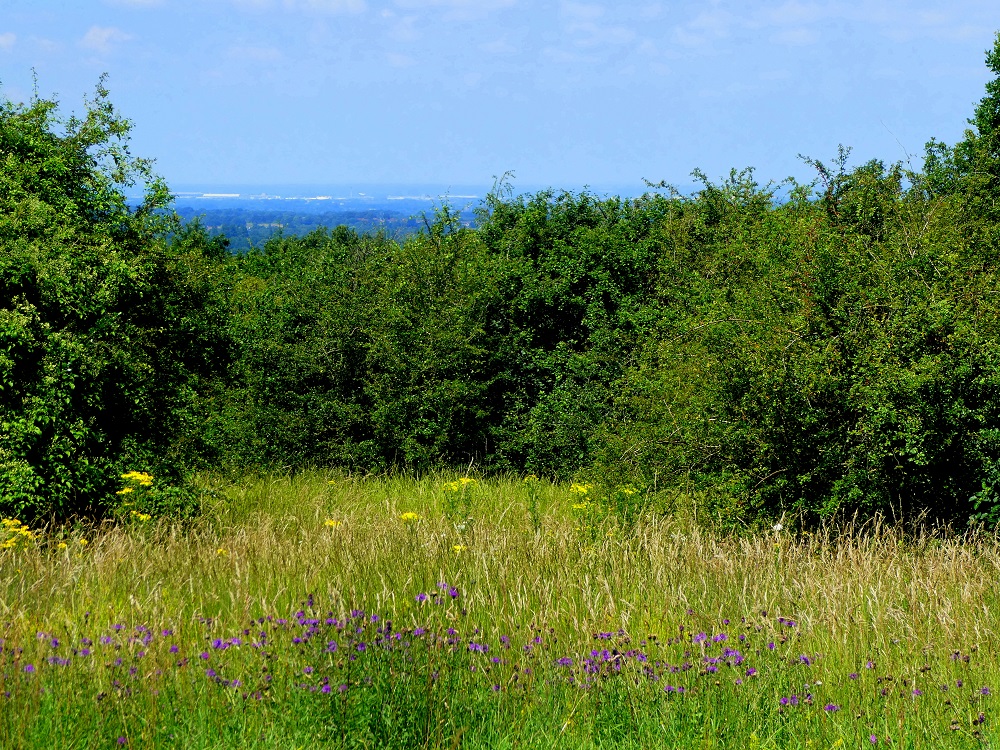
Here I saw plenty of Veined White butterflies, but not at rest, and this Brimstone,

as well as a fair few Pyramid orchids.

Crossing by the Grandstand
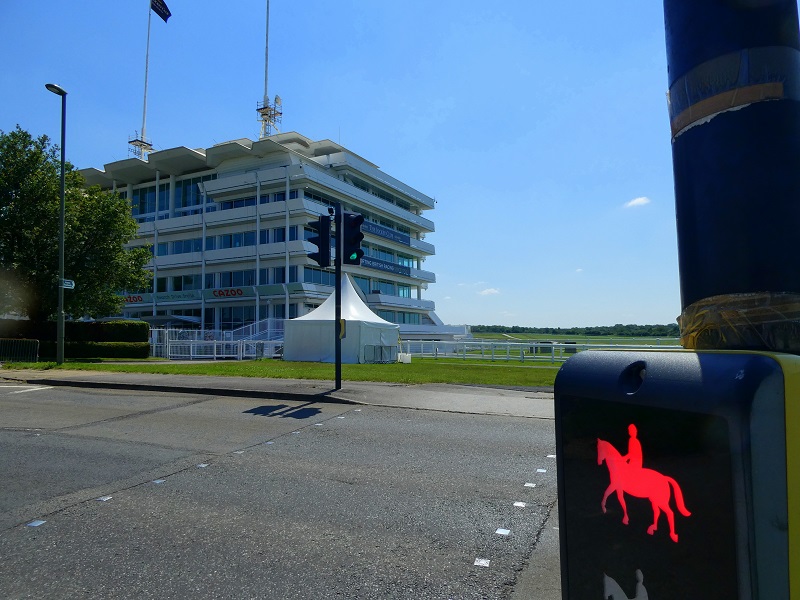
I took the shady route down Chalk Lane, with horse paddocks on either side

and saw for the first time The Durdans, grand old house with gates from elsewhere, where my schoolfriend's mother, who worked there, claimed to have seen a headless horse.

Funnily enough, this route took me out by Epsom Hospital, a grateful stop because I needed more liquids and a sandwich for lunch. Then I crossed Epsom Common via the Wells Estate, and found a new route to NEECH.


The patient by now, enlivened by plenty of physio and an abatement of her COPD, was in good shape - not bad for 90 - and managed to stay cool throughout the heatwave.

They're very careful at NEECH to keep Covid at bay, so only one designated visitor can book in for an hour each day, though others can arrange a visit outside if they can manage the exclusive table-and-chairs slot. We sat outside again last Tuesday and enjoyed the view - a meadow with plenty of butterflies, sadly shorn on Thursday, plus the pine trees to the left.

That stormy-looking sky did not develop. Of course on a crucial Monday when storms and floods hit London and the area to the south, I would not have walked. I intended to, but when I reached the bus stop just outside the Horton estate, the sky looked like this

and I thought better - the E10 arrived with the first spots and torrents poured as I sat on the train from Epsom. At West Brompton, the downpour went on so long that I stopped sheltering, left my bike there and walked home with an umbrella for only partial protection.
On Saturday, thinking that would be my last visit since mum was due to be released today - it will now be Wednesday since they're sending her to Leatherhead for a test tomorrow - I planned a big route back, this time to Ashtead Station. Even the lane to the common is full of interest - what I saw here is, I think, a rare Jersey Tiger moth which flies about in the day as well as the night. Its russet interior is as colourful as the zebra stripes on the outside.

Epsom Common yields to Ashtead Common with a private wood in between, permissive paths around it. I meant to take the bridleway passing a Roman villa, but turned off too soon - on the Epsom side of the private wood - though this long path still yielded beauties like this stand of oaks

as well as identification of a butterfly I'd seen previously using its camouflage with folded wings on a dead leaf

as a Speckled Wood

alternating on brambles and bracken with the Gatekeeper or Hedge Brown.

What looks like a bee resting on a nearby leaf,

a hoverfly on the notice board at a junction (look carefully, it's taking the yellow path)

and more moulted mandarins in the shade by a small, over-algae-d pond.

Had an interesting chat with a man out walking his lovely collie; he told me this land, bought up by the City of London in 1870, was used for army training in World War Two, and you might find a black lipstick, remnant of camouflaging. Soon I found my way to the lovely meadow about Ashtead Station

and found a large flock of sparrows - not such a common occurrence these days - dustbathing and flitting just before the level crossing.

Dependency on public transport certainly doesn't leave one free as a bird. There was a bus replacement service to Epsom; station attendant told me to hop on the one outside, and it took me in the opposite direction, towards Dorking. So half an hour wait for the right one at Leatherhead. Still, these are peripheral irritations to visits that have much more pleasure in them than I'd anticipated. I may have sacrificed my usual time in Estonia at the Pärnu Music Festival - been lucky at least to watch the concerts on the festival's TV channel - but I know I did the right thing.




 Posts
Posts