Showing posts with label Mozart. Show all posts

Wednesday, 17 January 2024

And the Emperor said, 'Good morning!'


Thus ends Hans Christian Andersen's fairy tale The Nightingale. The Chinese ruler has been at death's door, but the exquisite songbird he so easily rejected for a mechanical version has vanquished the grim reaper (paper cut by HCA reproduced in my Penguin edition pictured below). 

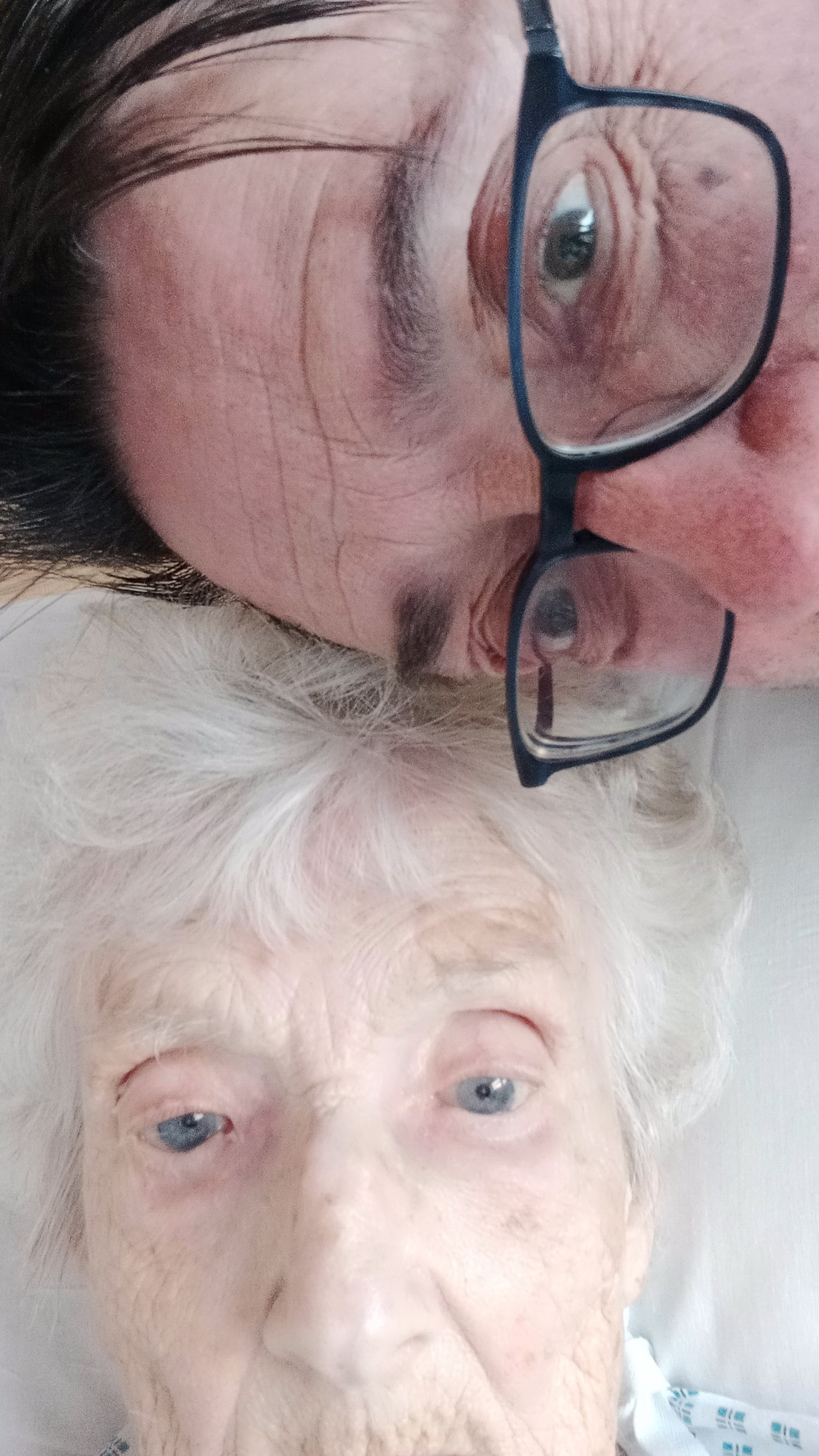
I thought of it when, after two nights of delirium and distress, my nearly-93-year-old mother greeted me on the third visit, back to her old self. She'd been admitted to Epsom Hospital with Covid, the return of her COPD and pneumonia in the right lung. The consultant thought she might decline further. But she rallied, only to get another infection three days later. This time she wasn't beside herself, but still mildly delirious. A second course of antibiotics and more rehydration seem to be doing the trick and, though very tired and barely able to keep her eyes open, she's been lively in all her responses and very much engaged with everything that's going on. I chose the top image because she has yet to be reunited with her dentures, but I decided that the below photo is also fine.


Stravinsky set the Andersen tale in singular fashion, and earlier I'd been reminded of the Bedlam scene in The Rake's Progress, where Anne Trulove calms the troubled spirits of the inmates. The healing power of music struck me twice: on the first visit, straight from landing at Gatwick airport, where I found the finale of Mozart's Clarinet Concerto and the slow movement of Dvořák's Sixth Symphony on my laptop player. She went quiet immediately. And on the second visit, when she seemed worse, I'd downloaded my selection of Mozart slow movements and again, her head off the pillow, me cradling it as best I could, she shut her eyes, occasionally opening them, but otherwise perfectly still, for a full 50 minutes. This was the first track.

Later it was singing along to the ripostes of 'Who Wants To Be A Millionaire?' and the 'hoy's of 'The Deadwood Stage'. We've also been quite interactive with TV; there are quiz shows hosted, to my surprise, by Graham Norton and Stephen Fry, but I also discovered an amazing presenter who's not only very sympathetic but really knows his stuff, wildlife cameraman Hamza Yassin, whom my mother recognised, it transpired, as a winner of 'Strictly Come Dancing'. 


At first it was difficult persuading the staff that my ma isn't in the advanced stages of dementia - over the four months in Greenacres Care Home, she may forget what she's just said, and some details, but I thought she was better when among company. So we showed them photos of how she'd been right up to Boxing Day, when Sara visited with her daughter and grandson Lenny. 

And on the 18th, the day before we left for Italy, thinking all was going just fine, J and I took her to lunch at Prezzo, a short wheelchair ride away from the home. She loved the scarf I'd got her, adorned with flower motifs by Palestinian weavers (see the excellent facilitators, ODE Collective, here).

Today I spoke to the consultant and agreed with most of what he was saying, except for the suggestion that mum is losing interest in her surroundings. Though increasingly more fragile and tired, she was on good form yesterday. She ate four mouthfuls of the coffee marble cake I'd bought (actually for myself) at the Costa Coffee Shop on the second floor, and when I reminded her of how even last year she was still making cakes for the Open Door Cafe of the church, and asked her if she remembered Open Door, said, 'Of COURSE I remember Open Door. Stupid boy' (a reference to Dad's Army). The mock insult was remedied by our farewell, when she called me 'angel child'. She loves the view from her window on the fifth floor, and the curtains. So maybe she rallies when she sees me, but she's far from retreating from the world. 

Even so, both Sara and I had hoped she would be over her suffering the other week, and if this is to be a slow, peaceful fade, so be it.

UPDATE (23/1) - Mum seems to have withdrawn still further. More or less non verbal now, and barely opens her eyes. Not eating or drinking much. I think she wants it to be over, and I want what she wants. Feeling utterly exhausted right now, running on empty.

(26/1) - Another imperial 'good morning!' after I'd had to stay away for four days with nasty virus (not Covid, tested twice, and feeling more or less fine today, though wore a mask; in my absence, Sara visited). Bright eyes and alertness, though very tired. Got two and a half crossword clues right. Slept peacefully duing the last half of my visit - more Mozart on the laptop. The next question is whether Greenacres will be in a position to take her back; reassessment due on Monday.

(27/1) - Dentures are in at long last. Alert to begin with, then dozing. She has a lovely rapport with nurse Joaquin ('Jack') - I don't know who started it but they waggle their eyebrows at each other. He's so funny and kind with her. Was about to persuade her to have some leek and potato soup as I left yesterday. I got her to promise to eat 'the soup, the whole soup and nothing but the soup' and she responded 'so help me God'. 

(Early February) The unanticipated miracle happened - mum returned to her splendid care home, Greenacres, and has been slowly improving to the extent that they get her out of bed for at least one meal with her new friends there. Her voice has got stronger and she's playing things even more for laughs. I feel such relief - and joy after I've visited - and it looks as if I can think of going to Dublin next week.


Saturday, 7 August 2021

Pärnu festival spirit - felt from afar


For the first time in seven years - yes, I even got to go to Estonia last summer, my only foreign travel in 2020 - I had to miss my favourite music festival in the world. Plans were laid, flights (reluctantly, since it's something I'm still trying to avoid) and hotels booked. Then my mother was rushed into hospital and, though much better by the time I was due to leave, still needed daily visits from me: when you're 90, your morale is the thing that most needs sustaining (she's home and in good spirits now). 

I have no doubt I did the right thing; I discovered natural beauties on the way to and from the cottage hospital, and I saw wonders operatic in London as some compensation. Every Pärnu concert, moreover, was filmed and streamed live on the website's TV channel for free (last year there was a very reasonable charge). You can still watch until the end of the month (tbc). The images here are all by photographic artist Kaupo Kikkas, an essential presence at every festival and one of quite a few good friends made in Pärnu (I know which are the real ones by now...) OK, the lineup is seriously blokey, but we've had soloists like Lisa Batiashvili and Viktoria Mullova at past festivals.

I'll confess I still have to see some of the events featuring the excellent Academy Orchestra; the first priority was the three Estonian Festival Orchestra concerts under doyen Paavo Järvi (he sent a very nice recorded message to say I was missed via the wonderful Lucy Maxwell-Stewart, who organised everything as usual). I get the feeling that each of the top soloists was inspired to give of his very best, working with that warmest of super-orchestras and conductors. It was vital to Paavo to get the pianist Lars Vogt along; the pianist has spoken so eloquently and with amazing perspective of his cancer here in an interview in  VAN Magazine, and we hope with all our hearts that he will pull through. Here are conductor and soloist together.

What follows is nothing like a review - it's some time since I watched the first concerts, after all - but a general impression remains that Vogt's playing in Mozart's C minor Concerto, K491, was on a level of sensitivity and response to everything around that I've not experienced before. Of course the wind, so crucial in the Larghetto, are among the best in the world - but this time I listened as much to the piano as I did to them. What a perfect encore, too, consolation and sorrow side by side so lightly etched in Brahms's  A major Intermezzo, Op. 118. 

The EFO repeated much of the same programme the following evening, but with Dvořák's Violin Concerto replacing the Mozart. Unlike that masterpiece, the Dvořák isn't among my concerto favourites, and memories of Truls Mørk in the Cello Concerto at the 2019 festival were still vivid. 


So I was taken aback by the sheer agile, febrile intensity with which Joshua Bell played it - again, visibly inspired by his colleagues, and sweating more than any of them (it was very hot and humid in Parnu that week, I'm told. You wouldn't hear this work played at a high pitch of brilliance anywhere.

I'll confess I was a bit disappointed in the choice of works announced for the visit of Emmanuel Pahud, the world's finest living flautist (that I know of - if anyone else has other information let me know). After all, Mozart's Flute Concerto isn't even as interesting as the one for flute and harp, and it seemed odd to resort to an orchestration of Poulenc's Flute Sonata. Why not Nielsen? 


But Pahud's artistry is compelling in itself, and there was a delicious surprise before the Mozart minuet finale - the perfectly apt interpolation of Arvo Pärt's Estländler (2006/2009). It's a joy to watch the amusement and pleasure of the orchestra's flutes, too, especially the smiles of Maarika Järvi (Paavo's sister, such a lovely person), as Paavo holds up the score for Pahud to follow.  I loved the complicity of the EFO woodwind, too, in Lennox Berkeley's Poulenc arrangement. The encore after the whole audience went wild a second time was Debussy's Syrinx - again, hard to imagine a more perfect arrangement.

There was equal magic from the players of the magnificent EFO - I persist in thinking it's like the Lucerne Festival Orchestra when Abbado was alive - in the chamber gala, always a highlight. I was, of course, cheering on my treasured friends Andres Kaljuste and Sophia Rahman, who were honouring the Tubin works in one of the main programmes - more anon - by performing the composer's transcription for viola of his Saxophone Sonata (1951). 

Not perhaps a work in which you can spot a clear identity - the second movement is utterly different in style from the first - but these two top musicians made magic of it.

The whole programme was well programmed as a classical/romantic sandwich with Estonian filling - on the other side of the interval came the sublime simplicity of Ester Mägi's Duos in National Idiom (1983). What a supremely subtle artist is Sharon Roffman, someone else I've come to treasure through Pärnu acquaintance, duetting with Maarika. 

I'm so proud that we picked a Mägi winner for the Europe Day Concert back in May - everyone loved the compact mood-shifts of The Sea. Any excuse to go back to that great concert, rendered all the more moving in this case by the nearly-100-year old composer's death the following week: I'll post the YouTube film without further comment.


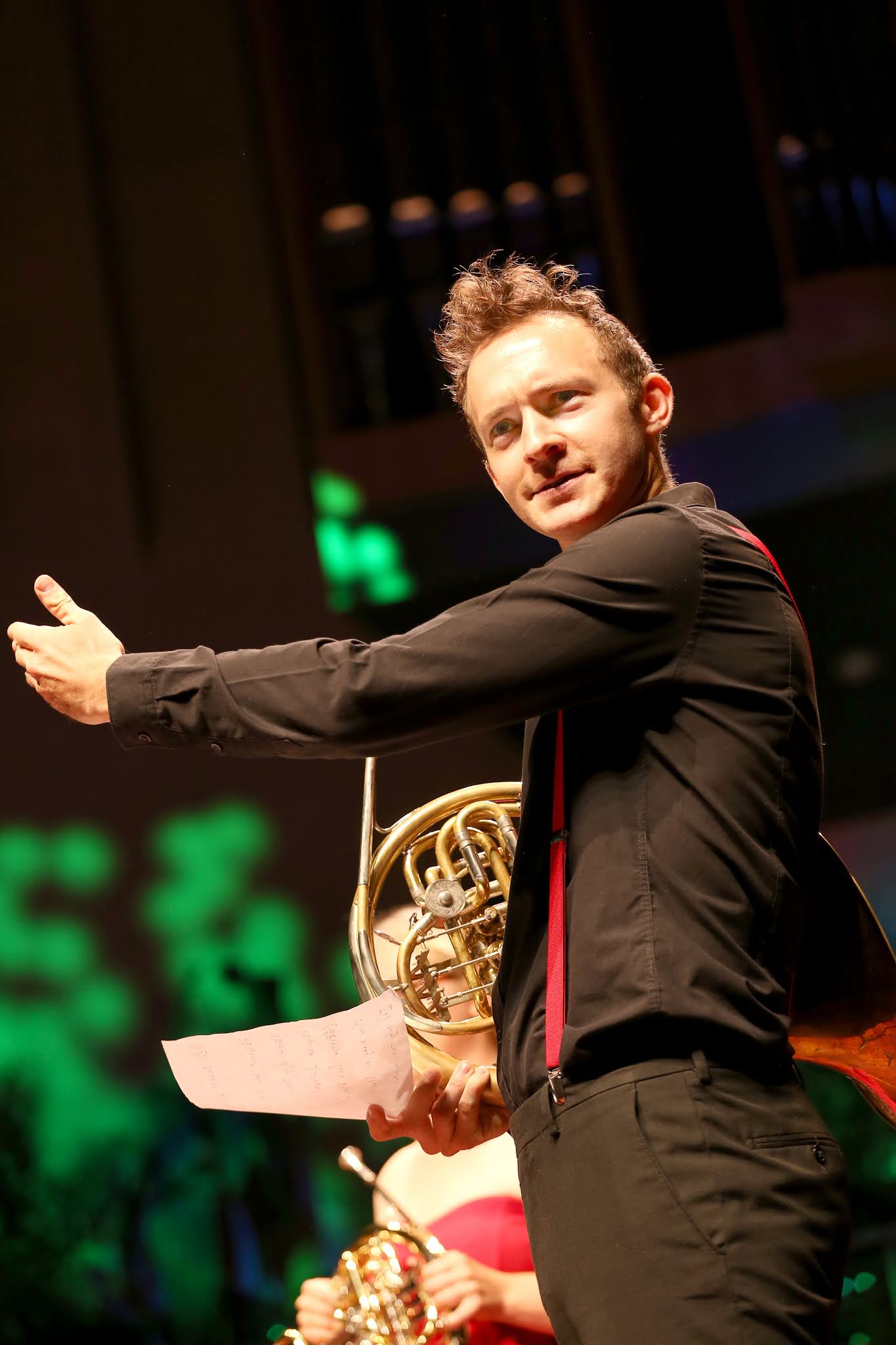
Back at the Pärnu gala, let's just say about the horn quartet transcription of Carmen interludes that the work itself is a terrible mistake - there are other bits of the opera that would actually work in this combination. But it was so delightfully presented by another of the world's best instrumentalists, Alec Frank-Gemmill, and done with such visual panache that I shouldn't be too hard on it.


Here's another of Kaupo's best, of Alec in action. Not for nothing does KK have a reputation as the best photographer of musicians in the business.

As for the grand chamber finale, I kinda thought, Mozart Clarinet Quintet again, really? But never underestimate the creative takes of the orchestra's chief mascot, Matt Hunt. What fantasies he wrought with ornamentations on repeats; what freedom from all five players. I've never heard a performance of a great masterpiece quite as alive as this. Theodor Sink - star of last year's festival in Lepo Sumera's Cello Concerto - seemed perpetually tickled and delighted to be playing alongside the great clarinettist

and look at the fun - you may need to click to enlarge - shared between these two, leader Florian Donderer (playing viola on this occasion), fellow front-desker (and leader of the Estonian National Symphony Orchestra, another fine soloist too) Triin Ruubel and second violinist Emma Yoon.

Kaupo also took some great shots of Florian playing - this is just one.

A final note about the other orchestral works in the main programmes. Again, nothing had excited me in the prospectus. But while Tubin's Music for Strings of 1963 is so typical of much sombre music produced around that time, there are some real firecrackers in the suite from the ballet score Kratt (The Goblin, 1938-43, rev. 1960), and a chance for so many of the players to shine. Here's the unique trumpet of Vladislav Lavrik in the lineup.

About the premiere in the main concerts, Ülo Krigul's The Bow, I have nothing more to say than that when a new work starts with bells and dissonant brass, you know how it's going to go. Infinitely more fresh is Berwarld's Fourth ('Naive') Symphony of 1845. I actually used it as a stick to beat an entirely derivative symphony composed a century later, Ruth Gipps's Second Symphony, a waste of 20 well-executed minutes in the CBSO Prom on Thursday. The Swedish composer must have been a happy and wholesome kind of chap. A lot of his best ideas seem to stem from the fairy music of Mendelssohn, but have their own identity, like the quirky syncopated second theme of the Naive's first movement, delectably counterpointed by bassoon second time around. I'm now on a Berwald binge, courtesy of Järvi senior's two-CD set of the four symphonies with the Gothenburg Symphony Orchestra. Not on YouTube, so I give you  a mono recording by Igor Markevitch and the Berlin Philharmonic.

This is lovely, but the affection and light-spiritedness of the Estonian Festival Orchestra is even finer. Watch these concerts while you still can.

Thursday, 15 April 2021

Zooming Albert, Tito, and Russians from 1948

It seems appropriate to kick off the summer term of my Opera in Depth Zoom course with Britten's Albert Herring*, that Maupassant-adapted classic operatic comedy - one of the few truly great ones of the 20th century - since we're heading towards the merriest of months, and Eric Crozier's libretto is about a virginal May King crowned in the absence of any suitable village maidens (pictured above by Robert Workman: Richard Pinkstone as Albert with Adrian Thompson as the Mayor, Clarissa Meek as Florence Pike and Orla Boylan as Lady Billows in the wonderful Grange Festival production, which I reviewed on The Arts Desk). 

Helping that great mezzo Jean Rigby and her husband director Jamie Hayes with some of the fiddly bits about Zoom sound and vision for a talk they were giving to the Northampton Opera Group, and instantly warming to them both, I thought I might be able to call upon Jean to talk about the Glyndebourne production originally directed by Peter Hall (and still ready for revival, I think). She's delighted to be able to help, and I'm hoping we might reassemble other members of that original cast, including John Graham Hall, Felicity Palmer and Alan Opie. Fingers crossed.


We kick off next Monday afternoon (19 April), 2.30-4.30pm, and the next three or four Mondays (Bank Holidays obviously excepted) will be devoted to Albert. Then we move on to Mozart's La clemenza di Tito for the following five Mondays (pages of Metastasio's libretto, much used by the time Mozart came to set/adapt it, pictured above), due a new production to mark the Royal Opera's emergence from lockdown. Director Richard Jones and conductor Mark Wigglesworth, both regular visitors to my Opera in Depth courses, have promised to come along. 

The last of four terms on Russian music begins next Thursday, 22 April. You don't need to have attended the other three to follow this one. I've made a provisional draft for each class thus:

1: The Zhdanov trials and after  22 April

After the ‘chaos instead of music’ Pravda article attacking Shostakovich’s Lady Macbeth of Mtsensk in 1936, a second massive blow fell on Soviet composers in February 1948, when Stalin’s right-hand man Andrey Zhdanov initiated a conference attacking so-called ‘Formalism in Music’. Shostakovich and Prokofiev were the main victims. The attacks on film came earlier: clips from the main culprit, Lukov's A Great Life (Bolshaya Zhizn) - a mining sequence entirely set to music - and Part Two of Eisenstein's Ivan the Terrible, with Prokofiev's finest film score are followed by the final scene of a party-line monster, Chiaureli's The Fall of Berlin (1949), where Stalinalike Mikhail Gelovani arrives in the destroyed German city to a perfunctory choral epilogue by Shostakovich, and see how Prokofiev adapted with a further simplified, but still characteristic, style. We hope that Steven Isserlis will be our guest to discuss the cello works of that period.

2: The effect of the trials on symphonic music  29 April

We look at Shostakovich’s ‘bottom-drawer’ parody of the event and its 1957 sequel, Rayok or The Musical Peepshow, before hearing excerpts from symphonic music composed in the shadows, with short clips from Myaskovsky's 26th and 27th Symphonies, much more on Prokofiev's Symphony-Concerto and his swansong, the Seventh Symphony, with a backwards glance at his major revision of the 1930 Fourth Symphony in 1947. Andrew Litton returns to the class. 

3: Shostakovich before and after the death of Stalin  6 May

Shostakovich had begun his Tenth Symphony before the death of Stalin on 5 March 1953 (the same day as that of Prokofiev; no surprise to see see how the Italian communist paper l'Unità covered the 'main' event, pictured above) but did not compose the bulk of it until after that watershed, allowing himself an uncharacteristically jubilant if wild finale. Andrew Litton returns to give a masterclass on a symphony he has conducted 66 times. With a brief look at how the 24 Preludes and Fugues were received by a hostile committee in 1951.

4: Chamber and instrumental: Shotakovich and the younger generation in the 1950s 13 May

Shostakovich's position as the supreme chronicler of Russian life and soul was now unchallenged, but new names start to emerge: the considerable figure of Mieczyslaw Weinberg, aka Moisey Vainberg, born in Poland in 1919 but Moscow based from 1943, at Shostakovich’s urging; and Galina Ustvolskaya, Shostakovich’s pupil from 1939 to 1941 and then from 1947 to 1948. Her output is small but original – ‘there is no link whatsoever between my music and that of any other composer, living or dead’, she declared, with a certain hyperbole – and Shostakovich quotes her 1949 Trio for clarinet, violin and piano in his Fifth String Quartet, premiered in 1953.


5: Quotations: Shostakovich's Eleventh Symphony and Eighth String Quartet  27 May

Why did Shostakovich revert to revolutionary songs as the material for his Eleventh Symphony, 'The Year 1905'? We look at some of them with the help of the singing of the National Youth Orchestra players. And what was the real significance of the deeply personal Eighth Quartet? With an interlude in the shape of light music by Kabalevsky and Shostakovich in his operetta Moscow Cheryomushki.

6: Americans in the USSR: Van Cliburn, Bernstein, Stravinsky and Balanchine 3 June

The third great 20th century Russian composer came in triumph to Moscow, celebrating his 80th birthday (pictured above with Rostropovich). We take the opportunity to look at the very different paths he had taken in America, and what came next.

7:  End of the Thaw and musical life after Khrushchev: 1962-8  10 June

Khrushchev's sudden rages against jazz and abstract art signalled a closing-down of hard-won freedoms. Shostakovich's Thirteenth Symphony, setting a range of poems by the young iconoclast Yevgeny Yevtushenko, was a surprise casualty. Meanwhile, dodecaphony was having its impact on a younger generation of composers, but not for long: we see how Alfred Schnittke and the Estonian Arvo
Pärt. With a special visit from pianist Sophia Rahman.

8: The inspirers: great Russian performers of the later Soviet years, Shostakovich and Britten  17 June

Time to consider those towering artists who offered such lifelines to composers in trouble, with special focus once more on Rostropovich, and this time investigating the special connections forged by his wife, soprano Galina Vishnevskaya (pictured above at Amsterdam's Schiphol Airport in 1963). Britten quickly became friends with the pair, and later with Shostakovich: we examine further links between the British and Russian composers.

9: Shostakovich: Endgames   24 June

In his later years, an ailing Shostakovich was much preoccupied by death, and approached each work as if it could be his last. The Fourteenth Symphony is his answer to Musorgsky’s Songs and Dances of Death, which he orchestrated: a cycle setting poems by Lorca, Apollinaire, Küchelbecker and Rilke for soprano, bass, strings and percussion. The Fifteenth Symphony of 1971 is an autobiographical orchestral summing up, but by no means his last work. Each of the last three string quartets offers a different angle on death: terrified in the Thirteenth, ultimately radiant in the Fourteenth and skeletally enigmatic in the Fifteenth. Parallel are the last song cycles, with explicit reflections in the texts especially of the Michelangelo Suite, and the swansong of the Viola Sonata

10: The end of history – the mid-1970s onwards  1 July

Two towering figures in Russian music emerged after Shostakovich – Alfred Schnittke, who like the master constantly surprised with his eclecticism up to his death in 1998, and Sofia Gubaidulina (born in 1931), who has continued to compose music of a visionary intensity.

If you're interested in signing up - each two-hour class is a tenner, making it £100 for each term - leave me a message here with your e-mail. I won't publish it, but I promise to get back in touch.

*UPDATE - since Mark Wigglesworth offered 24 May for his date to talk about the Royal Opera La clemenza di Tito, I thought we'd actually start with the Mozart instead. 

Wednesday, 6 May 2020

Zooming the symphony, from Haydn to Adams


A colleague once said he used his blog as a kind of shop window for his work. Although it's absolutely not my aim here - there are no barriers, I write about what I want to and see it more as a kind of public diary - this is one of those shop-window posts. Certainly not born out of need to try and hook more punters to a course which already has so many signed up - the response from my regular list of students was very surprising, since it's usually easier to 'sell' opera than orchestral music - but out of a genuine sense of excitement about where the 11 classes might take us.

Mastering Zoom is easy - even my senior students, up to the age of 95, can manage it - but there was quite a bit of stress before I settled in the second of my Opera in Depth classes the Monday before last. First, not being able to find the camera on my computer, which took five hours of collaborative searching here at home - even my techno-wizz spouse was foxed - before it appeared after a re-start. Then the awful quality of the sound clips, which could have been solved if my two tech-savviest students had joined the test class. They showed me what to do et voilà - state-of-the-art sound for all, best using headphones.


So two out of the three (out of five) OiD classes on Strauss's Elektra so far have gone like a dream - beyond my wildest expectations in one sense, since Susan Bullock - a top Elektra all round the world, and now singing the other most challenging role, Klytemnestra - was there for most of the second class and the whole of the third, bringing extraordinary insights to every scene (for the above photo, I return to Frontline Club days, when she and Anne Evans - on the left - came to talk Isolde). The students thought our double act went very well. She'll be back, and for Madama Butterfly in the second batch of five classes. I've also just heard that Ermonela Jaho, the heartbreaker of the Royal Opera production who should have been reprising the role this summer (pictured below by Bill Cooper), will also be joining us.


Having established the special guests there, I thought I could also call upon conductors I know and respect. So delighted to say that Mark Wigglesworth, who's just conducted a Beethoven cycle in Adelaide, chose to make his appearance in the 'Eroica' class. Again I return to Frontline days and a visit which was photographed by professional (and, briefly, student) Frances Marshall.


Three other stars are expected, but not confirmed yet, so I won't pre-empt. STOP PRESS: Ian Page, who's recording a Sturm und Drang series with his Mozartists orchestra, will be with us tomorrow. ADDITIONAL STOP PRESS: so is Jonathan Bloxham, inspirational founder of the Northern Chords Festival and its superb young professional orchestra who conducted our last three Europe Day Concerts (read all about the 2019 one here).

Below are the plans for all 11 classes, just so that I have them in something I can link to rather than just on an attachment. Message me if you'd like to join for all or some: it's a bargain (I halved the usual fees because I don't have room hire expenses and Zoom is, after all, not live with great equipment to hand, so it's £10 a class, ie £5 an hour. We meet on Thursdays as from tomorrow, 3.30-5.50pm. and if anyone misses a class or has connection/sound issues their end, I can send on a recording of the whole thing. Send me a message with your email and I won't publish it, but I'll be sure to get back to you.

This list has now been updated in the light of how we progressed, and who came to visit.

1: Sonata form and instrumental novelty   7 May
Selected movements/snippets from Haydn symphonies - 22,  31, 45, 70, 83 and 101; Mozart 41, 'Jupiter' (1788) Special guests: Jonathan Bloxham and Ian Page.

2: A new and noble scale  14 May
Beethoven's Third Symphony, 'Eroica' (1803-4). Special guests: Mark Wigglesworth and Jonathan Bloxham.


3: Follow that! Scaling up and down after Beethoven  21 May
Berlioz's Symphonie fantastique (1829-30) and Schumann's Second (1845-6). Special guest: Nicholas Collon.

4: Songs for Clara  28 May UPDATED
Schumann's Second (continued) and Brahms's First Symphony (1875-6). Special guest: Catherine Larsen-Maguire.

5: New/old approaches to the finale  4 June UPDATED
Brahms's Fourth (1885) andTchaikovsky's Sixth Symphony, 'Pathétique' (1893). Special guest: Vladimir Jurowski.

6: The world in a symphony   11 June
Mahler's Third Symphony (1895-6). Special guest: Paavo Järvi.

7: Imagining cataclysms   18 June
Mahler's Ninth Symphony (1909-10) and Elgar's Second (1911). Special guest: Vasily Petrenko.


8: Mosaic tiles from heaven   25 June
Sibelius's Fifth Symphony in its original (1914-15) and final (1919) versions. Special guests: Kristiina Poska and Andres Kaljuste.

9: The finale question: 1920s, 1940s  2 July
Nielsen's Fifth Symphony (1921-2); Martinů's Third Symphony (1944-5), Vaughan Williams's Sixth (1944-7) and Prokofiev's Sixth (1947). Special guest: Sir Mark Elder.

10: Endgame   9 July
Shostakovich's Fifteenth Symphony (1971). Special guests: Elizabeth Wilson and Peter Manning.

11 Symphonies in all but name   16 July
John Adams's Harmonielehre (1985) and Naive and Sentimental Music (1999). Special guest: Catherine Larsen-Maguire.

Tuesday, 29 January 2019

Johnson and Carduccis play Johnson


As in our national treasure clarinettist Emma Johnson (pictured right) and the Carducci Quartet (above, Matthew Denton, Eoin Schmidt-Martin, Michelle Fleming and Emma Denton) giving the world premiere last Thursday of Angel's Arc by my very good friend Stephen (no relation to Emma). This was his second big event at the Cadogan Hall; back in 2016 his orchestral homage to Bulgakov's cat-demon, Behemoth Dances, was performed here by the Moscow State Symphony Orchestra and Pavel Kogan following its Russian first performance. I couldn't make it, but I've since heard a recording.


Apart from its strange and reflective inner core, Behemoth Dances couldn't be more different from the quintet for clarinet and strings. Obviously the forces make a difference, but this is somehow more personal, Stephen reflecting back on his troubled teens from the perspective of a more recent grief . Placed after Brahms's Clarinet Quintet and an interval, and before Mozart's great example, it had a different dynamic, the clarinet more apart and clearly leading in a very vocal way (how many other composers today make the instrument sing like the human voice? I'd love to hear a soprano or tenor-and-string-quartet work from SJ) To me the strings were more bent on effects to create atmosphere, though there's a lively central section with a riff passed around the players - Behemoth inside out - which Stephen calls 'a nocturnal scherzo, whose sweet-sour alternations recall the moods (and some of the colours) of Mahler's haunted symphonic scherzos'; what came to my mind was more the extraordinary boogie-woogie-plus-tappings core of Shostakovich's Thirteenth Quartet.

But I don't want to do the usual critical thing of citing influences, other than those Stephen intended; I certainly caught a paraphrase of several bars from the Andante con malinconia of Walton's First Symphony, which he did mention in the note (and we both know a bit about malinconia). I was so proud of my perceptive artist companion, Pia Östlund, who 'got' and encapsulated the bigger picture much better than I did, and with little knowledge of the background; she described it as personal and introspective, but at the same time so spacious. We both agreed that the ending was pure metaphysical poetry. Stephen hoped it would convey gratitude as well as grief, and it does. I'm sure he couldn't have wished for a better performance, and the players were all so subtly fused in the Brahms and Mozart (loved the little transcription of Mozart's 'Ave verum corpus' as the encore, too).


Without being told I wouldn't have got the hidden reference which connects to Behemoth Dances through cats: in this case the most undemonic and human cat I've ever met, the late Agatha (I always called her A-GAAA-ta as in the Freischütz heroine), one of the few who could turn my dog-loving head. Expanding on his original programme note in a blog guestpost for Jessica Duchen, Stephen noted how Agatha's death triggered off recent griefs for his splendid father-in-law Canon Harold Jones and his aunt, Elizabeth Johnson. 'Playing around on the piano it struck me that I could make a kind of Schumann/Shostakovich-style cipher out of the letters of Agatha's name: with Te (sol fa) representing B, plus H from German notation, it gave A-G-A-B-B-A - a chant-like motif very like the haunting plainsong phrase "Lux aeterna" I'd used in Behemoth Dances.' Agatha, you will never be forgotten (cue repeat pic above).

Quality time with Agatha staying at the Johnson-Jones residence in Sutton St Nicholas was interspersed with hearty walks. And this connects very much with the new work, because Angelzarke on the West Pennine Moors was a favourite walking and cycling haunt of the young Johnson. Now he walks with greater peace of mind, for the most part, with Kate at his side. Another personal shot, then, from a May 2011 (!) ramble we took with the JJs up and around and down Skirrid Fawr.


I have to evoke those bluebells seen from the lower slopes again, because they offer promise of the spring which seems so far away still.


Even so, the snowdrops were out in force around some of the Brompton Cemetery graves as I cycled to yet another appointment at Chelsea and Westminster Hospital yesterday - as far as I'm prepared to go on a bike at the moment -


and someone had thoughtfully placed a bunch of daffs through the arm of a stone angel.


Praying I'll have had my op - still not scheduled - and be free of the stent when spring does arrive, so I can walk much further than I do now.

Tuesday, 18 July 2017

After Pelléas, Ariadne and Tito


'Ah! I breathe at last!...I thought for a moment that I was going to be ill in those enormous vaults.' Following Pelléas's cue as he emerges onto a sunlit terrace after a terrifying time in the depths of the gloomy old castle, I think most of us in my Opera in Depth course at the Frontline Club were glad to get out into the sunny streets of Paddington after the last of four and a half Monday afternoon immersed in the world of Debussy's Pelléas et Mélisande. Some of us will be staying in the light for Strauss's Ariadne auf Naxos next Monday. Pelléas was hard emotional work, though. It's probably the most exquisitely refined and orchestrally ravishing operatic score ever written, but as a drama more cruel and harsh than it is soft and beautiful.


We've been aware of its multiple meanings, but above all how it functions both as the most straightforward triangle - as Richard Jones put it to me when I first met him as he was working on the ENO production, 'two men fall in love with the same woman, with disastrous results' - and as so much more, partly intimated by Arthur Symons: 'we have two innocent lovers, to whom love is guilt; we have blind vengeance, aged and helpless wisdom; we have the conflict of passions fighting in the dark, destroying what they most desire in the world'.


Ascribe that first to Maeterlinck's nightmarish play, following his obsession with the destruction of the young by the old. Of course Debussy completely transfigures it with his music of nature, reaching its most dreamlike, minimalist, barely-audible apogee in the scene at the grotto by the sea. But he knows how to unleash the full harshness  - at the end of Act Three and in Act Four, in the scenes of the insanely jealous Golaud's abusive cruelty to his son and wife, the musical violence is extreme. This made an interesting comparison with the pathology of the protagonist in Verdi's Otello, on which we'd spent the first five and a half weeks of the summer term - the difference being that Golaud has real cause for his jealousy, whereas Otello does not.


As well as snippeting sound recordings by Désormière - the classic and text-unsurpassable 1941 recording with Irène Joachim and Jacques Jansen - and by Karajan, featuring an superb José Van Dam and Frederica von Stade, we stuck for visuals with the 1999 Glyndebourne production by Graham Vick on DVD. I'm kicking myself that I never saw it at the time; apart from possibly being the most visually arresting production ever seen at the Sussex house, with its flowers under the floor, spiral staircase and peeling gold walls, the focus on nuance from John Tomlinson, Christiane Oelze and Richard Croft is ideal for video close-up. We came away devastated from the tower scene (Mélisande actually hangs backwards from a huge deco light, as you can see in the DVD cover up top) and, yesterday, from the disturbing death of Act 5, as quiet and strange as the lovers' unaccompanied 'je t'aime'/'je t'aime aussi'.


Much more to say on this, but the advertising point here is that we move on and for the next two Mondays, I've added two extra one-off classes on Strauss's Ariadne auf Naxos (24 July) and Mozart's La clemenza di Tito (31 July), tying in with the Glyndebourne productions (scene from the Ariadne opera in the 2017 revival, image by Robert Workman). Same time, 2.30pm-4.30pm, location a private house generously loaned by a friend just down the road from our usual venue. the superb Frontline Club. If you're interested in coming along - or indeed if you're interested in next season's course, which will start with La bohème, including (I hope) another visit from Richard Jones, he director of the new production due at the Royal Opera - leave a message here with your email. I won't publish it but I promise to reply.

Saturday, 31 December 2016

Freud Museum memories on Radio 3


Coming up on New Year's Day at 18.45, Breaking Free: Freud versus Music, Stephen Johnson's examination of the great man's singular relationship to music. The programme is available here, I assume for more than the usual 28 days as that proviso isn't given. Delightful producer Elizabeth Arno, pictured with Stephen above by me in the famous Maresfield Gardens study (yes, in case you didn't know, that's yer actual couch behind - Berggasse 19 has a copy), asked the folk at the Freud Museum who might represent their side of the argument, and Ivan Ward, who arrived as part of the new batch of 'Museum Educators' towards the end of my group's stint, recommended me.

It was a trip down memory lane in more ways than one. I first met Stephen, now my best pal in the music fraternity, during my year at the Freud, which means both the work and the friendship date back 30 years (ouch). Though the blurb says it was my first job, that's not right; I'd spent a year as Assistant Editor on the beleaguered, shoestring-run Music and Musicians and had just gone freelance, with a book on Richard Strauss to finish. The three days a week at the Freud, sponsored by the Manpower Services Commission - I found the job at Golders Green Job Centre - was just right (pictured below: bin in Maresfield Gardens covered with Freud Anniversary stickers).


Not only that, but it will always be my most meaningful time in some kind of 'office'.I even got to put on a concert of Freud-related works, a sandwich of analogous works - Mahler's Lieder eines Fahrenden Gesellen in the Schoenberg arrangement, with J as soloist, and Schoenberg's First Chamber Symphony - flanked by the only music Freud seemed to care for, Mozart's Le nozze di Figaro and Don Giovanni, in excerpts arranged for wind. My friend Andrew Constantine brought his Bardi Ensemble from Leicester and I reckon it was a pretty good concert in Belsize Park Town Hall.

I'd completely forgotten that I'd even given a talk on Freud and Music in the museum, and only when Ivan printed out select quotations was my memory jogged this time to realise that Freud actually references Walter's Morgentraumdeutungweise via Sachs.  Now that there's a catalogue of the 3000 plus books in the library we were also able to find two short psychoanalytic studies of Wagner operas, both of them gifts so hard to tell if Freud read them or not.


More of the issues you can hear in the complete programme, where I'm proud to stand alongside some fine figures in the psychoanalytic world as the more gossipy lifestyle commenter. We'll see what's there, but the main point is that we spent a very jolly couple of hours in the Museum and as always I sensed that extraordinary centredness and serenity that comes from standing in the downstairs rooms, left as they were at Freud's death by keeper of the flame his daughter Anna.


Stephen and Elizabeth needed to get down to editing business afterwards, so I took myself to Louis up in Hampstead, the Austro-Hungarian cafe, which never changes, for a coffee and cake and then wandered down ever-idyllic Flask Walk in peak Autumntime (as pictured above, looking up towards the local school) to Burgh House for a bowl of appropriately autumnal pumpkin soup


via an affectionate cat, appropriate since Stephen and his wife Kate were recently bereaved of the most characterful feline in the world, Agatha (I always called her A-GAA-the a la Freischütz) and we'd been talking about their new pair. Freud's favourite animals were chows, and he recalled that while stroking one of them, Jo-Fi, he found himself humming, 'unmusical as I am,' 'Dalla sua pace' from Don Giovanni - 'on her peace of mind mine also depends'. The words of the melody unconsciously summoned, he would argue in The Psychopathology of Everyday Life, usually had a significance.


Anyway, it's nice, after a rather thin year for me on Radio 3, to be featured in something on New Year's Day. May 2017 be a good one for all, as 2016 has been for me on the personal and work levels albeit a horror on the world front - Brexit, Trump and Aleppo offset in tiny ways by victories for Sadiq Khan as London Mayor and LibDem Sarah Olney overturning the wretched Zac Goldsmith's 23,000 majority in Richmond Park. The fight against Fascism is going to be a hard one, but we've got to get tougher.